What are the cultivation methods and medicinal value of Veronica?
You should know that Veronica is quite common and can be seen in many places, it's just that many people don't know that this is Veronica. Let's take a look at what the cultivation methods of Veronica are like? What medicinal values does Veronica have?
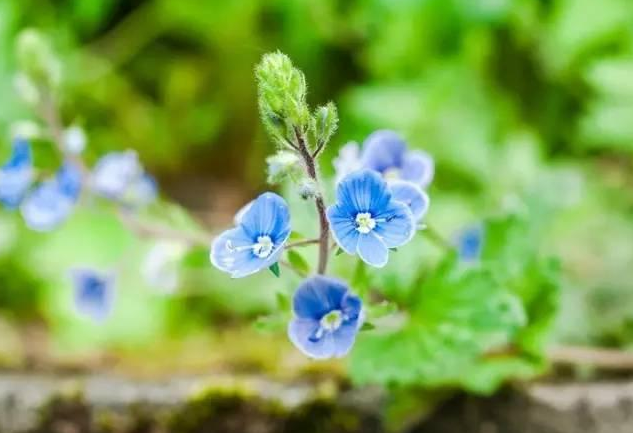
Cultivation methods of Veronica:
1. Seedling raising
Radicle germination stage: the temperature is 18°C-24°C, and germination can occur in 7-14 days. Keep a relatively low EC value in the substrate, with a pH of 5.8-7.5. Seed germination requires light. After sowing, cover with a thin layer of vermiculite and keep the substrate light and slightly moist, but not overly wet. Avoid direct sunlight and provide appropriate shading.
Cotyledon emergence and growth stage: starting from this stage, soil moisture needs to be appropriately reduced, but it still must not be too dry, and the temperature should also be lowered to 16°C-18°C.
True leaf growth and development stage, and hardening-off stage: pay attention to timely transplanting into pots.
2. Transplanting
3-4 weeks after germination, transplanting can be done using pots with a diameter of 8-15 cm, or 1-2 seedlings can be transplanted into 3-5 liter containers. After transplanting, continue to keep the plug tray, because some seeds may continue to germinate over the following period. When producing in pots, make sure the pot size is suitable.
3. Soil medium
The cultivation substrate needs good drainage. The clay content in the substrate is 15%-30%, and about 20% bark, wood fiber, and sand can be added.
Cultivation requires fertile, well-drained sandy loam soil, with a fertilization standard of spraying 60-80 grams of slow-release fertilizer per square meter.
4. Light
It is a long-day plant, so maintain a high light level. Long-day and strong-light conditions can promote plant flowering and flower growth. Supplemental lighting is needed in winter and early spring. Insufficient light will cause the plant stems to become leggy.
5. Temperature
Day temperature 12°C-18°C, night temperature 10°C-13°C. Outdoor cultivation in winter requires covering. In spring, plants grown at 15°C-18°C need 6-8 weeks or 8-10 weeks.
At cool temperatures of 8°C-13°C, the cultivation time will be extended. Flowering of the plant requires vernalization at 5°C for 10 weeks.
6. Fertilizer
When planting, provide the plants with good nutrients. If necessary, slow-release fertilizer can be applied in some positions, or compost soil can be used directly, which helps improve soil quality.
Medicinal value of Veronica:
Cools the blood and stops bleeding, regulates qi and relieves pain. In medicinal use, Veronica is effective for hematemesis, hernia, orchitis, and leukorrhea, though of course this requires extraction.
That's all for the introduction to Veronica's cultivation methods and medicinal value. Hurry and plant one at home!
Persian speedwell Veronica persica Persian speedwell illustrated guide: how to grow Persian speedwell / how to propagate Persian speedwell
Persian speedwell profilePersian speedwell Veronica persica
Cultivation methods and precautions of Persian speedwell Introduction to Persian speedwell
Annual to biennial herbaceous plant in the Scrophulariaceae family, with soft hairs. The stem branches from the base, the lower part lies prostrate on the ground, and the upper part is ascending. Leaves are opposite at the stem base and alternate above. Flowers are solitary in the leaf axils, the corolla is light blue with radial dark blue stripes. It grows everywhere, and is more common in the south. It grows in fields and roadsides, and is a common weed in early spring in East China; it is also a common invasive plant. The whole plant can be used medicinally and can treat rheumatism, kidney-deficiency waist pain, external malaria, and other conditions.
Annual or overwintering broadleaf weed. Veronica persica is a regionally malignant weed in the Yangtze River basin and North China. It has strong reproductive capacity and is relatively difficult to control, thus causing great harm. It mainly damages wheat, barley, spinach, beet, and other crops.
Morphological characteristics of Persian speedwell
The whole plant is hairy. The stem branches from the base, the lower part is prostrate, 15-45 cm tall. The basal leaves are opposite, petiolate or nearly sessile, ovate-oblong, with coarse obtuse teeth on the margin. The inflorescence is terminal, and the bracts are the same shape as the stem leaves, alternate. Flowers are solitary in the bracts' axils, and the pedicel is clearly longer than the bract; the calyx is 4-lobed, and the corolla is light blue with dark blue veins. The capsule is kidney-shaped, wider than long, with the apical notch opening at an angle greater than 90°, and the persistent style clearly extends beyond the notch. The seed surface has granular protrusions. Overwintering or annual herb, flowering from March to May.
Spreading and much-branched herb, the stem densely covered with two rows of multicellular soft hairs. Leaves 2-4 pairs (those bearing flowers in the axils are called bracts), with short petioles, ovate or rounded, 6-20 mm long, 5-18 mm wide, base shallowly cordate, truncate or rounded, margin obtusely toothed, sparsely soft-hairy on both surfaces. Raceme very long; bracts alternate, same shape as the leaves and nearly equal in size; pedicels longer than the bracts, sometimes more than twice as long; calyx at flowering only 3-5 mm long, enlarging to 8 mm in fruit, lobes ovate-lanceolate, ciliate, with three veins; corolla blue, purple, or blue-purple, 4-6 mm long, lobes ovate to rounded, throat sparsely hairy; stamens shorter than the corolla. Capsule kidney-shaped, about 5 mm long, about 7 mm wide, glandular-hairy, nearly hairless when mature, with obvious reticulate veins, notch angle exceeding 90 degrees, lobes obtuse, persistent style about 2.5 mm long, exceeding the notch. Seeds with deep transverse striations on the back, about 1.6 mm long. Flowering from March to May. 2n=28.
Seedling
Cotyledons emerge above ground, broad ovate, with long petioles, hairless; both hypocotyl and epicotyl are developed, densely covered with obliquely pendulous curved hairs; primary leaves 2, opposite, ovate-triangular, apex obtuse-acuminate, margin with 2-3 coarse teeth, and ciliate, veins obvious, covered with short soft hairs.
Mature plant
Spreading and much-branched herb, the whole plant covered with soft hairs. Branching from the base, the lower branches prostrate on the ground, the rest ascending, plant height 10-15 cm; basal stem leaves 2-4 pairs, opposite, petiolate. Upper leaves (also called bracts) sessile, alternate. Leaves ovate-rounded, margin obtusely serrate. Flowers solitary in the bracts' axils, bracts leaf-like, pedicels longer than the bracts, sometimes more than twice as long; calyx deeply 4-parted, lobes narrowly ovate, ciliate, with three veins, persistent; corolla light blue, blue, or blue-purple, with radial blue stripes; pedicels 1.5-2.5 cm long, longer than the bracts. Stamens 2, inserted on the corolla, shorter than the corolla. Capsule kidney-shaped, about 5 mm long, about 7 mm wide, reticulate, seeds boat-shaped or oblong, ventral side concave, dorsal side with deep transverse striations, about 1.6 mm long.
Similar species
Veronica maxima and Veronica arvensis are similar to Veronica persica, but Veronica maxima seedlings have the epicotyl covered with obliquely pendulous curved hairs, the pedicels are not longer than the bracts, and the flowers are pale purplish-red. Veronica arvensis has an upright stem and blue flowers, but the pedicels are very short.
It closely resembles Veronica didyma Tenore, and the difference is that this species has pedicels clearly longer than the bracts (also called bract leaves); the capsule surface clearly has reticulate veins, the notch is greater than 90 degrees, the lobe tips are obtuse rather than rounded, and the chromosome number is also different.
Ecological habits of Persian speedwell
It grows on roadsides, beside houses, and in summer-harvested crop fields on dry land, especially in wheat fields, causing serious harm to crops. At the same time, it becomes a host for cucumber mosaic virus, plum pox virus, aphids, and various other microorganisms and pests. The pathogenic fungus (Aphanomyces cladogamus) distributed in the roots of crops such as spinach, beet, and barley also parasitizes this plant.
Distribution area of Persian speedwell
Native to Eurasia. Distributed in East China, Central China, Guizhou, Yunnan, eastern Tibet, and ** (Yining). It is a naturalized roadside and wasteland weed, native to western Asia and Europe.
Related species in the variety classification of Persian speedwell: Veronica biloba L. Mant.
Plant height 5-50 cm. Stem upright, usually branching in the middle and lower parts, sparsely covered with white soft hairs. Leaves all opposite, with short petioles, oblong to ovate-lanceolate, 5-30 mm long, 4-13 mm wide, base broadly cuneate to rounded-obtuse, margin sparsely and shallowly serrate. Inflorescence 2-40 cm long, all parts sparsely covered with white glandular hairs; bracts smaller than leaves, lanceolate to ovate-lanceolate; pedicels equal in length to bracts, spreading or somewhat downward-curved after flowering; calyx laterally shallowly lobed, divided to 3/4, lobes ovate or ovate-lanceolate, acute, up to 4-8 mm long in fruit, clearly 3-veined; corolla white, blue, or purple, 3-4 mm in diameter, posterior lobe rounded, the other 3 ovate-rounded; filaments shorter than the corolla. Capsule 3-4.5 mm long, 4-5 mm wide, glandular-hairy, almost divided to the base into two mericarps, notch spreading at 30-45 degrees, lobe tips rounded-obtuse, persistent style much lower than the notch. Seeds 1.2-1.5 mm long, with inconspicuous transverse wrinkles. Flowering from April to August. 2n=28
Distributed in Northwest China, western Sichuan, and Tibet. Widely distributed in central and western Asia. Grows in wasteland, grasslands, and hillsides. Altitude 800-**** m.
A species close to this one is V. argute-serrata Rgl. et Schmalh. Its distinguishing points are that the upper stem leaves are alternate; pedicels arch upward after flowering; the corolla is larger, 3-4 mm long; the capsule is divided to 2/3, lobes ovate; the style is slightly longer, half the length of the capsule notch; seeds smooth or slightly covered with soft hairs. According to records, it is distributed from the Caucasus to Central Asia (including ** in China), the Pamirs, and the Himalayas. We have one specimen (** Fukang, Guan Kejian 4332), the upper stem leaves are alternate; the capsule is divided to 1/2 to 2/3, the notch spreads at 60 degrees; the style is also relatively long, but the corolla is 2.5 mm long; pedicels curve downward after flowering; seeds have inconspicuous transverse wrinkles. Whether V. argute-serrata is indeed a species, and our specimen is it, or whether this specimen well illustrates that Hook. f. (Fl. Brit. Ind. 4: 295. 1884) was right in treating V. argute-serrata as a form within V. biloba. How exactly it should be handled awaits more specimens for clarification.
Veronica campylopoda Boiss.
Plant height 5-15 cm. Stem upright, slender, unbranched or branching in the middle and lower parts, covered with curved hairs. Leaves opposite, sometimes alternate, the lower ones with short petioles, blades oblong or oblong-lanceolate, 4-12 mm long, 2-5 mm wide, entire or the lower leaves with inconspicuous serrations, more or less hairy. Flowers sparse, 8-12 gathered into a raceme up to 10 cm long, the inflorescence axis and pedicels covered with white curved hairs mixed with glandular hairs; bracts oblong-elliptic, smaller than the leaves, entire or rarely toothed; pedicels filiform, usually exceeding the bracts, sometimes reaching twice the length of the bracts, straight in fruit, slightly curved or recurved downward; calyx lobes lanceolate, short-acuminate, nearly 3 mm long, 3-veined, sparsely glandular-hairy, the lateral two not divided to the base; corolla 2-3 mm long, blue or light blue. Capsule nearly equal to or slightly shorter than the calyx, less than 4 mm wide, almost divided to the base, the two lobes obovate, spreading at a 30-45 degree angle, glandular-hairy, style reaching the middle of the notch. Seeds long-ovate, nearly 1 mm long, with 4-6 obvious transverse striations. 2n=42
Produced in ** and western Tibet. Also found from Iran to India and in Central Asia and Western Siberia of the Soviet Union. Grows in wasteland and dry hillsides.
Veronica cardiocarpa (Kar. et Kir.) Walpers
Plant height 5-15 cm. Stem upright, slender, unbranched or branching in the middle and lower parts, covered with curved hairs. Leaves opposite, sometimes alternate, the lower ones with short petioles, blades oblong or oblong-lanceolate, 4-12 mm long, 2-5 mm wide, entire or the lower leaves with inconspicuous serrations, more or less hairy. Flowers sparse, 8-12 gathered into a raceme up to 10 cm long, the inflorescence axis and pedicels covered with white curved hairs mixed with glandular hairs; bracts oblong-elliptic, smaller than the leaves, entire or rarely toothed; pedicels filiform, usually exceeding the bracts, sometimes reaching twice the length of the bracts, straight in fruit, slightly curved or recurved downward; calyx lobes lanceolate, short-acuminate, nearly 3 mm long, 3-veined, sparsely glandular-hairy, the lateral two not divided to the base; corolla 2-3 mm long, blue or light blue. Capsule nearly equal to or slightly shorter than the calyx, less than 4 mm wide, almost divided to the base, the two lobes obovate, spreading at a 30-45 degree angle, glandular-hairy, style reaching the middle of the notch. Seeds long-ovate, nearly 1 mm long, with 4-6 obvious transverse striations. 2n=42
Produced in ** and western Tibet. Also found from Iran to India and in Central Asia and Western Siberia of the Soviet Union. Grows in wasteland and dry hillsides.
Veronica didyma Tenore
Spreading and much-branched herb, more or less covered with long soft hairs, 10-25 cm tall. Leaves only 2-4 pairs (those with flowers in the axils are bracts, see below), with short petioles 3-6 mm long, blades cordate to ovate, 5-10 mm long, 6-7 mm wide, each side with 2-4 deep obtuse teeth, both surfaces covered with white long soft hairs. Raceme very long; bracts leaf-like, the lower ones opposite or all alternate; pedicels slightly shorter than the bracts; calyx lobes ovate, apex acute, slightly enlarged in fruit, three-veined, sparsely covered with short stiff hairs; corolla light purple, blue, pink, or white, 4-5 mm in diameter, lobes rounded to ovate; stamens shorter than the corolla. Capsule nearly kidney-shaped, densely glandular-hairy, slightly shorter than the calyx, 4-5 mm wide, notch about a 90 degree angle, lobe tips rounded, veins inconspicuous, persistent style equal to or slightly exceeding the notch. Seeds with transverse striations on the back, about 1.5 mm long. Flowering from March to October. 2n=14
Common in East China, Central China, Southwest China, Northwest China, and Beijing. Widely distributed in northern Eurasia. Grows in wasteland.
Stems and leaves taste sweet and can be eaten.
Veronica ferganica M. Pop.
Small upright herb, 1-7 cm tall, often reddish. Stem unbranched or branching in the middle, covered with white soft hairs. Leaves opposite, with petioles about 2 mm long, the upper ones nearly sessile, blades ovate or ovate-oblong, 3-10 mm long, 2-5 mm wide, entire or the lower leaves with sparse and shallowly incised serrations, upper surface hairless, lower surface sparsely soft-hairy. Inflorescence about 2 cm long, axis and pedicels soft-hairy and glandular-hairy; bracts lanceolate or linear, smaller than the leaves; pedicels longer than the bracts, curved upward after flowering; calyx slightly enlarged after flowering, 3-4.5 mm long, back covered with multicellular soft hairs, margin covered with red glandular hairs, lobes ovate, 3 veins faintly visible; corolla white or light blue, shorter than the calyx, lobes ovate. Capsule obcordate, slightly shorter than the calyx, 4 mm wide, divided to the middle, the notch spreading at 70-90 degrees, lobes ovate, margin with red glandular hairs, persistent style about 0.5 mm long. Seeds ovate-boat-shaped, smooth, about 1 mm long.
Produced in northern **. Also found in Iran and in Central Asia and Western Siberia of the Soviet Union. Grows in sandy areas and dry hillsides, up to an altitude of 3800 m.
This species is distinguished from related species by its seeds lacking wrinkles, the calyx more or less densely covered with soft hairs and red glandular hairs, the 3 veins only faintly visible, the plant often reddish, and the short inflorescence. It was first recorded in China in "Iconographia Cormophytorum Sinicorum", using the scientific name V. rubrifolia Boiss.
Veronica tenuissima Boris
Plant height 5-10 cm. Stem upright, hairless or slightly soft-hairy. Leaves only 4, arranged in a whorl below the inflorescence, oblong or oblong-lanceolate, 3-10 mm long, base gradually narrowing into a short petiole, entire, hairless. Flowers numerous, distant, gathered into a raceme, the inflorescence axis more or less flexuous; bracts much smaller than the leaves, oblanceolate or almost linear, entire; pedicels long and slender, 3.5-12 mm long, 1-4 times longer than the bracts, curved downward after flowering; calyx 2-2.5 mm long, equally divided to the base, lobes lanceolate, hairless, midvein obvious; corolla blue, nearly 1 mm long. Capsule nearly 2 mm long, 2.5 mm wide, kidney-shaped, divided to 2/3, the two lobes spreading at a 90 degree angle, hairless. Style 0.5-0.7 mm long. Seeds about 0.7 mm long, oblong, with slightly wavy protrusions on the back. Flowering from April to June.
Produced in ** (northern part). Also found in Iran and Central Asia of the Soviet Union. Grows on clay plains, in mountain gullies, and on hillsides.
Landscape uses of Persian speedwell
There are two germination peaks each year, respectively at the end of November and in March-April. Persian speedwell has very strong vegetative propagation ability; stems touching soil easily produce adventitious roots and form new plants. Precisely because Persian speedwell has very strong vegetative propagation ability, it can be planted on bare ground surfaces to quickly cover the ground.
Dietary or medicinal value of Persian speedwell
The medical information and health dietary information on Huahua Network are for reference only and cannot be used as a basis for diagnosis or medical treatment. Any health issues should be consulted with professional medical staff, and any disease treatment should follow medical advice.
Ultimate flower-protecting task: love yourself, and start from reality, strictly follow medical advice. For illness, do not be careless, do not delay, do not give up hope, face it bravely, use love to warm the silent world, and use your heart to care for the flower field within.
The medical content on Huahua Network is for reference only and cannot be regarded as professional advice. Any health issues should be consulted with professional medical staff.
Medicinal information (1)
Chinese medicinal name: Shenzicao "Guizhou Folk Medicines"
Aliases: Denglongcao "Guizhou Folk Medicines", Denglong Veronica "National Compilation of Chinese Herbal Medicines".
Medicinal source: the whole plant of the Scrophulariaceae plant Veronica persica Poir.
Nature, flavor, and effects: pungent; bitter; salty; neutral. Dispels wind and removes dampness; strengthens the waist; treats malaria.
Chinese medicinal aliases: Denglongcao, Denglong Veronica.
Medicinal source: the Scrophulariaceae plant Veronica persica is used as medicine as the whole plant.
Medicinal nature and flavor: bitter, pungent, salty, neutral.
Functions and indications: clears heat toxin. Mainly treats kidney deficiency, rheumatism, and malaria. "National Compilation of Chinese Herbal Medicines".
Propagation method of Persian speedwell
Seed propagation.
Cultivation techniques of Persian speedwell
Because this species is in the lower layer of crops, moderate dense planting of crops can control this weed to a certain extent; changing dryland rotation to paddy-upland rotation can effectively control the occurrence of this weed; herbicides such as chlorotoluron, chlorsulfuron, metsulfuron-methyl, thiobencarb, and nitrofen can effectively kill this species; certain fungi of the genus Colletotrichium can cause anthracnose in this species.
Disease control of Persian speedwell
It was first recorded in "Jiangsu Plant Directory" (1919-1921). Collected in Wuchang, Hubei in 1933. It grows on roadsides, beside houses, and in summer-harvested crop fields on dry land, especially in wheat fields, causing serious harm to crops. At the same time, it becomes a host for cucumber mosaic virus, plum pox virus, aphids, and various other microorganisms and pests. The pathogenic fungus (Aphanomyces cladogamus) distributed in the roots of crops such as spinach, beet, and barley also parasitizes this plant.
Veronica persica mainly harms summer-harvested crops such as wheat and rapeseed, and also seriously harms the seedling growth of autumn crops such as corn, soybean, and cotton. It grows on roadsides, beside houses, and in summer-harvested crop fields on dry land, especially in wheat fields, causing serious harm to crops. At the same time, it becomes a host for cucumber mosaic virus, plum pox virus, aphids, and various other microorganisms and pests. The pathogenic fungus distributed in the roots of crops such as spinach, beet, and barley also parasitizes this plant.
Common control methods
Because this species is in the lower layer of crops, moderate dense planting of crops can control this weed to a certain extent; changing dryland rotation to paddy-upland rotation can effectively control the occurrence of this weed; herbicides such as chlorotoluron, chlorsulfuron, metsulfuron-methyl, thiobencarb, and nitrofen can effectively kill this species; certain fungi of the genus Colletotrichum can cause anthracnose in this species.
Agricultural control
Establish a reasonable planting rotation system to form an ecological environment unfavorable for weed growth and seed preservation, shorten the lifespan of weed seeds in the soil seed bank, reduce the weed base in the second year, achieve scientific and long-term weed management, and control the occurrence of drought-loving weeds such as Persian speedwell.
Control methods in wheat fields
(1) In rice-wheat rotation fields, 7-14 days after wheat sowing, use 5 grams of 20% Maicaoning per mu, dilute with 0.5 kg of water and then add 40 kg of water for spraying.
(2) From the end of November to the first ten days of December, after wheat tillering and at the 2-3 leaf stage of weeds, use 1.2 grams of 775% Juxing dry suspension per mu and add water for spraying.
(3) After wheat emergence and at the 3-6 leaf stage of weeds, use 10 milliliters of 5.8% Maixi suspension per mu, add 30-40 kg of water, and spray.
(4) From the 3-leaf stage of wheat to before jointing, use 5 grams of Benteng per mu, add 40 kg of water, and spray.
(5) From the greening and tillering stage to the jointing stage of wheat seedlings, use 30 milliliters of 20% Shitalong and 125 milliliters of MCPA per mu, add 40 kg of water, and spray.
Control methods in rapeseed fields
(1) At the weed seedling stage and the overwintering stage of rapeseed, use 250 milliliters of 10% Gaoteke per mu, add 40 kg of water, and spray.
(2) Before sowing and after transplanting rapeseed, use 250 grams of 70% Caozhangmie per mu, add 30 kg of water, and spray.
(3) At the 2-3 leaf stage of weeds, the 6-8 leaf stage of directly sown rapeseed, or after transplanting rapeseed and its greening, use 50-55 grams of Haoshiduo per mu, add 30-40 kg of water, and spray. Do not use it in mustard-type or Chinese cabbage-type rapeseed fields.
(4) At the 6-8 leaf stage of directly sown rapeseed or the greening stage of transplanted rapeseed, and at the 2-3 leaf stage of weeds, use 26-30 milliliters of 50% Gaoteke suspension per mu, add 40 kg of water, and spray.
Flower language of Persian speedwell
Health.
Persian speedwell pictures
Cultivation methods and precautions of Veronicastrum sibiricum
Chinese scientific name: Veronicastrum sibiricumLatin scientific name: Veronicastrum sibiricum (L.) PennellKingdom: PlantaePhylum: AngiospermsClass: MagnoliopsidaSubclass: AsteridaeOrder: ScrophularialesFamily: ScrophulariaceaeSubfamily: RhinanthoideaeTribe: VeroniceaeGenus: VeronicastrumSpecies: Veronicastrum sibiricumVeronicastrum sibiricum (scientific name: Veronicastrum sibiricum (L.) Pennell) also known as: Jiugaicao, Langweibahua, Jiujiecao, Shanbiancao, Caoyumei, Jiuluncao, Zhanlongjian, Gangan Shengma, Caolongdan, Shanhonghua, Erlangjian. Scrophulariaceae, Veronicastrum, perennial herbaceous plant. Seeds elliptical. Flowering from July to September; roots and whole plant can be used medicinally.1. Morphological characteristics
Height 80-150 cm. Rhizome horizontal, up to 13 cm long, internodes short, with many fibrous roots. Stem upright, cylindrical, unbranched, hairless or slightly soft-hairy. Leaves 4-6 in a whorl; sessile; blades oblong to broadly linear, 8-15 cm long, 1.5-4.5 cm wide, apex acuminate, margin with triangular serrations, both surfaces hairless or sparsely soft-hairy.Flowers terminal on the stem, long-tailed, all parts hairless; pedicels short; calyx deeply 5-parted, the lobes unequal in length, the longest anterior lobe about half as long as the corolla, subulate; flowers red-purple, purple or pale purple, 5-7 mm long, 4-lobed, the lobes unequal in width, the inner surface of the corolla tube hairy; stamens 2. Capsule ovoid, about 3 mm long, 4-valved, grooved on both sides.
2. Distribution and habitat
Distributed in Northeast China, North China, northern Shaanxi, eastern Gansu and the Shandong Peninsula. Also found in Korea, Japan and the Asian part of the Soviet Union. It grows along roadsides, on hillside grasslands and in hillside scrub, at elevations up to 2500 m.3. Medicinal value
This species was one of the medicinal Weilingxian varieties used from the Song Dynasty to the Qing Dynasty. In its discussion of Weilingxian, the Bencao Tujing says: "Now it is found in the prefectures and armies of Shaanxi and in Hedong and Hebei. In the eastern capital (Bian) and the prefectures of Jianghu it may also occur. It sprouts earlier than all other grasses, its stem and stalk are like a hairpin shaft, four-angled, its leaves resemble willow leaves and are arranged in layers, each layer with six or seven leaves like a cartwheel, and some have six to seven layers; in the seventh month it produces flowers, pale purple or greenish white, forming spikes like those of Putaisi, and some resemble chrysanthemum heads; the fruit is green, and the root is dense with many fibers like grain, and also decays each year." Based on this account, refer to the illustrations of Weilingxian from Bingzhou (present-day Taiyuan, Shanxi), Jinzhou (present-day Linfen, Shanxi) and Ninghua Jun (in the area of present-day Ningwu County, Shanxi).Chemical constituents
This species contains isoferulic acid, 3,4-dimethoxy cinnamic acid, 3-O-acetyloleanolic acid, D-mannitol, daucosterol and β-sitosterol. The root contains minecoside, catalpol, 6-O-veratryl catalpol ester, aucubin, 6-deoxy-8-isoferuloyl harpagide, β-sitosteryl 3-O-D-glucoside, campesteryl 3-O-D-glucoside, β-sitosterol, campesterol, stigmasterol and mannitol. The seeds contain palmitic acid, stearic acid, oleic acid, linoleic acid, etc.