Does the Rubber Plant Bloom? A Detailed Guide to Rubber Plant Propagation Methods
When it comes to the rubber plant, it looks quite similar to the southern magnolia, and many people even mistake one for the other. Let's take a look: does the rubber plant bloom? How do you propagate a rubber plant?
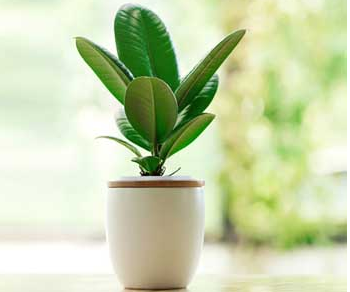
Does the rubber plant bloom:
The rubber plant does bloom, but blooming requires certain conditions. If grown in its place of origin, the chance of blooming is very high. The flowers are small and lovely, with five petals; the outer petals are white, the inner petals are yellow, and the center of the flower is orange-yellow, quite beautiful. Ever since it has been grown in pots, the rubber plant has rarely bloomed, because the temperature and humidity cannot reach the conditions needed for blooming.
Both the flowers and leaves of the rubber plant are toxic and pose a certain harm to the human body, but there is no need to worry too much when buying one, because as long as you do not eat it, you will not be poisoned, and it can be placed in any spot in the home. To prevent children from being poisoned, warn them not to pick the leaves and flowers of the potted plant.
How to propagate the rubber plant:
Cuttings are one of the propagation methods for the rubber plant. They are easy to do and have a high survival rate, and can be combined with pruning. First, prune the rubber plant in late spring, then select a semi-lignified branch from the middle as the cutting, and finally insert it into plain sandy soil. Before inserting, remember to cut off the excess leaves from the branch, leaving only 2 leaves. In addition, to prevent the milky sap from being lost, seal the wound with clay after cutting the branch. After inserting, keep the soil highly moist and provide shade. Once new buds sprout on the branch, increase the light.
Air layering is also one of the propagation methods for the rubber plant. It is relatively simple to do, but the success rate is not as high as with cuttings. First, choose a well-developed, pest-free branch, peel off the outer bark, and apply naphthalene acetic acid solution. Then wrap the bottom of the branch with plastic film, tie it tightly, and place it on a sponge to care for it. Layer in June, and roots form in July-August.
The rubber plant does bloom, but the flowers of the rubber plant are toxic, so it is better not to touch them. The propagation methods for the rubber plant have been covered here as well. Why not hurry up and grow a few more in your own home?
Does the Rubber Plant Bloom? Rubber Plant Blooming Pictures to Enjoy
The rubber plant actually has very good ornamental value, because it is also an evergreen plant throughout the four seasons. The rubber plant is a large tree of the genus Ficus, with a relatively obvious trunk, few branches, and aerial roots. The rubber plant has high ornamental value and is a famous potted foliage plant. So, does the rubber plant bloom? Let us enjoy rubber plant blooming pictures together while learning whether the rubber plant blooms.
[Rubber Plant Pictures to Enjoy 1]
The rubber plant is very suitable for placement indoors for beautifying and decorating. Small and medium-sized plants are often used to beautify living rooms, studies and so on, while medium and large rubber plants are appropriately placed on both sides of the entrance halls of large buildings and in the center of lobbies. This makes them look majestic and magnificent, and can also reflect a tropical scenery.
[Rubber Plant Pictures to Enjoy 2]
The rubber plant likes a high-temperature, humid environment with plenty of sunlight, and the temperature most suitable for its growth is 20-25 degrees. It dislikes direct sunlight. It can also tolerate shade well but is not cold-tolerant. The safe overwintering temperature is around 5 degrees. It tolerates dry air and dislikes sticky soil. It is not tolerant of barren and dry soil, and likes loose, fertile, well-drained, slightly acidic soil.
[Rubber Plant Pictures to Enjoy 3]
The cultivated varieties and cultivars we often see include: the golden-edged rubber plant, whose leaf margins are golden yellow; the variegated rubber plant, whose leaves are slightly round at the margins and have many irregular yellow-white patches on the leaves, and whose growth vigor is relatively weak and propagation is relatively slow. The white-spotted rubber plant has relatively narrow leaves with many white patches. The golden-star broadleaf rubber plant has leaves much larger and rounder than ordinary rubber plants; when young and tender, the leaves are brown-red-green, and after the leaves mature, the red-brown fades slightly, with sparse pinhead-sized spots scattered near the edges, which can be identified with a little attention. It is an excellent variety of rubber plant.
[Rubber Plant Pictures to Enjoy 4]
The rubber plant has a unique function of purifying dust, and can also purify formaldehyde from volatile substances. The rubber plant can also absorb carbon monoxide and carbon dioxide in the air, purifying the air. The rubber plant likes places with plenty of sunlight, so that it can ensure vigorous photosynthesis and transpiration. For offices with a lot of dust, it is most suitable for us to place it by the window. The rubber plant is not cold-tolerant, so in winter we should not place it in a place with lower temperatures.
[Does the Rubber Plant Bloom]
The rubber plant does bloom, and its flowers are very small, with no petals. Many small flowers are hidden inside a small jar-like receptacle. Its flowering period can last for several months. They are syconia, without the usual flowers; the very small flowers are hidden on the inner wall of the invisible receptacle. There is a small opening at the top of the receptacle connecting it to the outside, and small insects can go in and out of the opening to pollinate the small flowers inside.
The introduced potted rubber plants usually cannot reach the scale of blooming when cultivated, so we rarely see them blooming and fruiting in ordinary circumstances.
Does the Rubber Plant Bloom? Rubber Plant Pictures to Enjoy
The rubber plant is an evergreen woody foliage plant. Its variegated cultivars have yellow-white patches on green leaves, making them even more beautiful and pleasing to the eye, but its leaves are toxic. On the leaves, the young leaves are rolled inward, thick and leathery, glossy, elliptical to oblong-obovate; the leaf surface is dark green or red-green, and the underside is light green. So, does the rubber plant bloom? Why do the rubber plants we grow rarely bloom?
[Rubber Plant Pictures to Enjoy 1]
The rubber plant is very suitable for placement indoors for beautifying and decorating. Small and medium-sized plants are often used to beautify living rooms, studies and so on, while medium and large rubber plants are appropriately placed on both sides of the entrance halls of large buildings and in the center of lobbies. This makes them look majestic and magnificent, and can also reflect a tropical scenery.
[Rubber Plant Pictures to Enjoy 2]
The rubber plant likes a high-temperature, humid environment with plenty of sunlight, and the temperature most suitable for its growth is 20-25 degrees. It dislikes direct sunlight. It can also tolerate shade well but is not cold-tolerant. The safe overwintering temperature is around 5 degrees. It tolerates dry air and dislikes sticky soil. It is not tolerant of barren and dry soil, and likes loose, fertile, well-drained, slightly acidic soil.
[Rubber Plant Pictures to Enjoy 3]
The cultivated varieties and cultivars we often see include: the golden-edged rubber plant, whose leaf margins are golden yellow; the variegated rubber plant, whose leaves are slightly round at the margins and have many irregular yellow-white patches on the leaves, and whose growth vigor is relatively weak and propagation is relatively slow. The white-spotted rubber plant has relatively narrow leaves with many white patches. The golden-star broadleaf rubber plant has leaves much larger and rounder than ordinary rubber plants; when young and tender, the leaves are brown-red-green, and after the leaves mature, the red-brown fades slightly, with sparse pinhead-sized spots scattered near the edges, which can be identified with a little attention. It is an excellent variety of rubber plant.
[Rubber Plant Pictures to Enjoy 4]
The rubber plant has a unique function of purifying dust, and can also purify formaldehyde from volatile substances. The rubber plant can also absorb carbon monoxide and carbon dioxide in the air, purifying the air. The rubber plant likes places with plenty of sunlight, so that it can ensure vigorous photosynthesis and transpiration. For offices with a lot of dust, it is most suitable for us to place it by the window. The rubber plant is not cold-tolerant, so in winter we should not place it in a place with lower temperatures.
[Does the Rubber Plant Bloom]
The rubber plant does bloom, and its flowers are very small, with no petals. Many small flowers are hidden inside a small jar-like receptacle. Its flowering period can last for several months. They are syconia, without the usual flowers; the very small flowers are hidden on the inner wall of the invisible receptacle. There is a small opening at the top of the receptacle connecting it to the outside, and small insects can go in and out of the opening to pollinate the small flowers inside. The introduced potted rubber plants usually cannot reach the scale of blooming when cultivated, so we rarely see them blooming and fruiting in ordinary circumstances.
After the above introduction to the rubber plant and the enjoyment of rubber plant pictures, I believe everyone already knows that the rubber plant does bloom, but the rubber plants we grow can hardly reach the scale of blooming, which is why the rubber plants we see are all non-blooming. For more information about the rubber plant, please keep following.