Can Monstera deliciosa be grown in water after being cut? Pest and disease control methods
When it comes to Monstera deliciosa, it can be grown in water, which everyone knows; it is cultivated the same way as lucky bamboo. Let's take a look: can Monstera deliciosa be grown in water after being cut? How do you control pests and diseases on Monstera deliciosa:
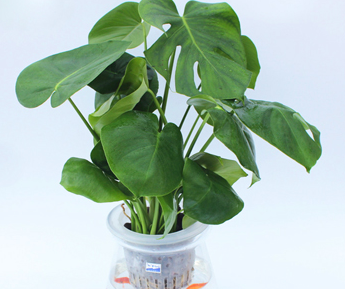
Can Monstera deliciosa be grown in water after being cut:
Monstera deliciosa itself is propagated by cuttings, so a broken stem is perfectly suitable for water culture. However, since the broken stem may have suffered other damage and has no root system, it must grow new roots before it can better absorb water and nutrients. Therefore, during water culture it is very prone to bacterial infection and rot, so before water culture it is a good idea to first use a diluted potassium permanganate solution to disinfect it slightly. During water culture, shade facilities should also be set up to ensure a certain amount of light but absolutely avoid direct sunlight, and frequently misting the leaves is also necessary. Only when it grows roots has it truly survived; at this point normal watering, fertilizing and other care measures can be resumed.
How to control pests and diseases on Monstera deliciosa:
1. Gray leaf spot
Symptoms: The disease starts from the leaf margins; at first there are small grayish-brown spots on the leaf surface, then the spots gradually enlarge and become round or irregular dark brown lesions. The lesions can join together into patches and eventually cause the leaves to die.
Control methods: First, improve the indoor environmental conditions and strengthen cultivation management. Pay attention to controlling the indoor temperature; if the temperature is too high, water to cool it down, and if the temperature is too low, add a cold-protection cover. Also pay attention to reasonable fertilizing and watering, and control pests in time. Once lesions are found on the leaves, remove them promptly and destroy the diseased leaves. Second, carry out chemical control. Spray Bordeaux mixture in the early stage of the disease, and spray Tuzet in the later stage. Finally, do a good job of household cleaning. A clean and tidy home environment makes it hard for pests and diseases to breed.
2. Rust disease
Symptoms: In the early stage of the disease, yellow spots appear on the leaves, the size of a needle tip, and then they join together and become large patches. In severe cases, the leaves are covered with spots, turn yellow and fall off.
Control methods: First, avoid spray-style watering to reduce the spread of the pathogen; second, the bottom of the flowerpot used for planting Monstera deliciosa should not be sealed, and there should be some distance between flowerpots; third, ventilate and drain moisture to reduce the density between plants; finally, carry out chemical control, spraying triadimefon wettable powder or chlorothalonil and thiophanate wettable powder in the early stage of the disease.
Monstera deliciosa can be grown in water even after being cut, and it can also survive; when growing Monstera deliciosa, you also need to pay attention to pests and diseases.
Methods for obtaining and converting water-culture plants
1. Ways to obtain water-culture plants: generally they can be obtained through two routes, direct and indirect.1. Direct acquisition. Direct acquisition refers to a method of directly converting soil-cultured plants into water-culture material. According to the different forms of the plants, corresponding methods can be adopted to obtain water-culture material.
(1) Single-plant type plants: Dig out the entire soil-cultured plant matching the size of the container and use it as water-culture material.
(2) Clump-forming plants: Dig the whole plant out of the soil or pot, shake off the soil, expose the connection between the offsets and the mother plant, and cut it off at the connection with a sharp blade; select robust offsets with roots and no pest or disease damage as water-culture material. Since the offsets have cuts, first apply plant ash, charcoal powder or fine bran ash, etc., to the cuts, and wait until the cuts are dry before converting. Plants of this type include peace lily, Chinese evergreen, snake plant, arrowhead plant, umbrella plant, and bamboo palm.
(3) Plants with rooted sucker seedlings: Dig out the root suckers that sprout from the base of the soil-cultured mother plant, cut from them with a sharp blade a properly sized, robustly growing, pest- and disease-free root sucker with roots, treat the cut, and use it as water-culture material. Such as clivia, aloe, bromeliad, agave, snake plant, etc.
(4) Plants with runners: Runners are slender aboveground stems, and one or more small plantlets often grow on the runners. Cut off the plantlets, protect the root system well, and use them as water-culture material. Such as variegated spider plant, etc.
(5) Plants that grow offsets: Peel off robustly growing offsets from the soil-cultured mother bulb and use them as water-culture material. Such as cactus, etc. 2. Indirect acquisition. Indirect acquisition refers to using seedlings obtained through seed propagation and tissue culture as water-culture material.
2. Water-culture methods
1. Root-washing method. Depending on whether the water-culture plant raw material has a root system, different conversion methods can be used; the root-washing method is suitable for water-culture plant raw materials that have a root system. Root washing is best done in late spring and early autumn, because the temperature in this season is generally around 20°C, which is the suitable temperature for plant growth and favors the sprouting of water-culture roots; at the same time, the oxygen content in the water in late spring and early autumn is relatively high, which guarantees root respiration. Therefore, late spring and early autumn are the best time to convert plants from soil culture to water culture.
The specific method of root washing is as follows
1) Remove the soil and wash the roots. After digging out the soil-cultured plant raw material with a root system, remove the heavy soil on the roots, then wash them clean with clear water. Note that no soil may remain. For plants with sparse roots, it is not advisable to thin them out, otherwise it will affect their adaptability when converted to water culture.
2) Place in a shaded spot and keep the air moist. Place the plant being maintained in clear water in a shaded spot and do not expose it to direct sunlight; when the air is dry, you can spray the leaves and the surrounding area to keep the air moist.
3) Change the water frequently. During the process of conversion and adaptation, the clear water in the container should be changed frequently. Changing the clear water not only ensures clean water quality and reduces the harm of pathogens to root wounds, but is also an effective measure to increase the oxygen content in the water. The frequency of water changes depends on the plant species.
(1) Water-cutting method. The water-cutting method is suitable for water-culture plant raw materials without a root system. It refers to cutting a section of stem or branch from the mother plant, inserting the stem into water to root, and thereby forming a new water-culture plant. The water-cutting method is divided into two categories according to differences in the structure of the raw material.
1. Water-cutting method for general plants (non-succulent plants). It is best done in late spring and early autumn, because the temperature at this time is suitable for root development, and the oxygen content in the water can also meet the respiratory metabolism of the roots.
When doing water cuttings, pay attention to the following points:
1. Plant selection: Cut stems and branches from plants that can root quickly in water as water-culture raw material, such as Monstera deliciosa, ivy, variegated ivy, dusty miller, philodendrons, spiderworts, etc.
2. Branch selection: It is best to choose thick, robust branches free of pest and disease damage. Thick branches contain more nutrients, which favors the formation of callus tissue and rooting. The cut branches should come from the top and middle sections of the main trunk and main branches, or from branches close to the main trunk and main branches, because these parts have a strong ability to sprout roots.
3. Length of cut branches: Generally determined by the plant species and decorative requirements. For plants with a relatively slender and elongated form, the cuttings can be longer for decorative purposes; otherwise, they can be shorter. For favorable combined arrangement, branches can be cut into varying lengths to give rich layering and a full plant shape. 4. Cutting position: It is best at 0.2-0.5 cm below a node