Can Monstera deliciosa grown hydroponically be kept with fish, and can it also be grown in soil?
When it comes to Monstera deliciosa, it is fairly easy to care for and can also be grown hydroponically. Let's take a look at whether Monstera deliciosa grown hydroponically can be kept with fish, and whether Monstera deliciosa grown hydroponically can be moved to soil:
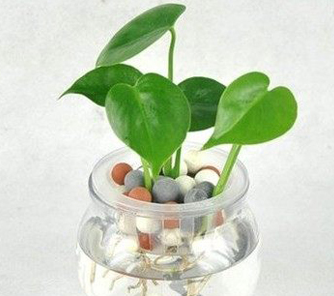
Can Monstera deliciosa grown hydroponically be kept with fish:
Generally speaking, Monstera deliciosa grown hydroponically can also be kept with fish. Only by following the principle of “focusing mainly on the plants, keeping fish as a secondary concern, and choosing small fish” can the plants and fish coexist harmoniously.
Keeping fish is itself a challenge, and keeping them in hydroponic Monstera deliciosa is even more of a challenge. When keeping fish, do not feed them, because fish food is usually organic matter that will cause water quality to deteriorate and bring bacterial harm to the plant roots. On the other hand, the nutrient solution for hydroponic plants must not be added in excess, otherwise it will cause the fish to die. In addition, the interval between water changes should not be too long, as this not only replenishes oxygen for the fish and the Monstera deliciosa, but also reduces the pH difference in the water before and after each water change.
Can Monstera deliciosa grown hydroponically be moved to soil:
1. Clean the roots.
Rinse the roots of the Monstera deliciosa with clean water, cut off the rotten roots, and soak them in a diluted potassium permanganate solution for disinfection.
2. Prepare a flower pot.
You can use a ceramic pot, a purple clay pot, a plastic pot, or a porcelain pot, though porcelain pots have slightly poorer air permeability. The size of the flower pot is generally determined by the size of the plant.
3. Prepare the potting soil.
The growing soil must be loose, breathable, well-draining, and have a certain ability to retain water and fertilizer. Soil made from peat soil mixed with a small amount of perlite is very suitable. If you are not confident about getting it right, you can also buy it from a flower market.
4. Repot the plant.
Hold the plant upright with one hand, and use the other hand to hold a small trowel to fill the pot with soil. When it is half full, gently lift the plant upward with one hand so that the roots can spread out naturally. Fill until the pot is about eighty percent full.
5. Later care.
Place the Monstera deliciosa in a spot with partial shade or scattered light. First use a spray bottle to mist the plant, then pour clean water into the potting soil. Do not fertilize before it has taken root. With proper care, it will grow new roots after one month.
Monstera deliciosa grown hydroponically can be kept with fish, and after being grown hydroponically it can also be moved to soil. Winter is a relatively suitable time to switch hydroponic Monstera deliciosa to soil cultivation.
Can Monstera deliciosa grown hydroponically be kept with fish? Can Monstera deliciosa grown hydroponically be moved to soil?
Monstera deliciosa grown hydroponically is very eco-friendly and fresh, with high ornamental value. Placing it in indoor living rooms, bedrooms, and studies gives a rather tropical feel. Many plant enthusiasts are curious about whether Monstera deliciosa grown hydroponically can be kept with fish and whether Monstera deliciosa grown hydroponically can be moved to soil. Let's take a closer look below!
Can Monstera deliciosa grown hydroponically be kept with fish:
Generally speaking, Monstera deliciosa grown hydroponically can also be kept with fish. Only by following the principle of “focusing mainly on the plants, keeping fish as a secondary concern, and choosing small fish” can the plants and fish coexist harmoniously.
Keeping fish is itself a challenge, and keeping them in hydroponic Monstera deliciosa is even more of a challenge. When keeping fish, do not feed them, because fish food is usually organic matter that will cause water quality to deteriorate and bring bacterial harm to the plant roots. On the other hand, the nutrient solution for hydroponic plants must not be added in excess, otherwise it will cause the fish to die. In addition, the interval between water changes should not be too long, as this not only replenishes oxygen for the fish and the Monstera deliciosa, but also reduces the pH difference in the water before and after each water change.
Can Monstera deliciosa grown hydroponically be moved to soil:
Yes.
1. Clean the roots.
Rinse the roots of the Monstera deliciosa with clean water, cut off the rotten roots, and soak them in a diluted potassium permanganate solution for disinfection.
2. Prepare a flower pot.
You can use a ceramic pot, a purple clay pot, a plastic pot, or a porcelain pot, though porcelain pots have slightly poorer air permeability. The size of the flower pot is generally determined by the size of the plant.
3. Prepare the potting soil.
The growing soil must be loose, breathable, well-draining, and have a certain ability to retain water and fertilizer. Soil made from peat soil mixed with a small amount of perlite is very suitable. If you are not confident about getting it right, you can also buy it from a flower market.
4. Repot the plant.
Hold the plant upright with one hand, and use the other hand to hold a small trowel to fill the pot with soil. When it is half full, gently lift the plant upward with one hand so that the roots can spread out naturally. Fill until the pot is about eighty percent full.
5. Later care.
Place the Monstera deliciosa in a spot with partial shade or scattered light. First use a spray bottle to mist the plant, then pour clean water into the potting soil. Do not fertilize before it has taken root. With proper care, it will grow new roots after one month.
Can Monstera deliciosa be grown hydroponically after being cut off:
Monstera deliciosa itself is propagated by cuttings, so a broken stem is completely suitable for hydroponic cultivation. However, since the broken stem may have suffered other damage and does not have roots, it must grow new roots before it can better absorb water and nutrients. Therefore, during hydroponic cultivation it is very susceptible to bacterial infection and rot, so before hydroponic cultivation you might as well first use a diluted potassium permanganate solution to disinfect it slightly. During hydroponic cultivation, shade facilities should also be set up to ensure a certain amount of light while strictly avoiding direct sunlight. Frequently misting the leaf surface is also necessary. Only when it has grown roots can it be considered truly established, and at that point normal watering, fertilizing, and other care measures can be resumed.
What hydroponic plants are there, and how do you grow hydroponic plants
Hydroponic plants are a common method of growing plants in modern homes. Unlike traditionally growing plants in soil, the plants are grown in water with the addition of the nutrient solution the plants need. Hydroponic plants have better ornamental value, and now a few goldfish are even kept in hydroponic plants on the market, giving an even better decorative effect. So what hydroponic plants are there? Let me introduce them to you one by one below.
[What hydroponic plants are there]
Plants that can generally be grown hydroponically include Monstera deliciosa, Aglaia odorata, Clivia miniata, camellia, Chinese rose, jasmine, rhododendron, lucky bamboo, violet, Phalaenopsis, fuchsia, five-needle pine, rubber fig, Brazilian iron, begonia types, ferns, palm family plants, and so on, as well as various foliage plants, such as clustered Alocasia, Spathiphyllum, Anthurium, Guangdong spider plant, and variegated lucky bamboo;
Sedum types such as Aeonium and Kleinia, as well as other types such as Clivia miniata, Paphiopedilum, crab claw orchid, lucky bamboo, Guzmania, silver ragwort, Dracaena fragrans, English ivy, coleus, and more than a hundred kinds. Basically, any plant that can be grown in soil can also be grown hydroponically; only a very small portion of plants that like dry environments are unsuitable for hydroponics.
In addition, plants need sunlight, so when cultivating indoor hydroponic plants, be careful to choose the growing environment for the hydroponic plants according to the different types of plants.
[How to grow hydroponic plants]
1. Pay attention to the stages
From the perspective of the plant growth cycle, hydroponic flower technology has two technical stages that need attention: one is the seedling cultivation stage, that is, carrying out the water propagation process; the other is the care stage of the finished plant, that is, carrying out the personal hydroponic process after successful hydroponic cultivation. Through the care work in these two stages, following the correct hydroponic rules, and paying attention to the issues that need attention during the cultivation process, we can see beautiful, elegant, clean, and healthy hydroponic flowers.
2. Soilless acclimatization
(1) Planting large seedlings: Gently tap around the flower pot with your hand, and once the soil loosens, take the whole plant out of the pot. Gently remove the soil by hand, or rinse it off directly with water; then trim the planting basket. If the top of the plant is too large while the holes in the planting basket are too small, the holes in the planting basket need to be enlarged to make planting easier. After that, add the prepared nutrient solution to the container, insert the roots of the large seedling through the planting basket, and then fix it in place with sponge or stones, being careful to avoid damaging the roots.
(2) Planting small seedlings: Planting small seedlings is much simpler than planting large seedlings. Generally, the small seedlings taken are no more than 8 cm. Take the small seedling directly out of the pot, rinse the roots slightly in water, and be careful not to accidentally damage the roots; then begin planting the small seedling by inserting its roots directly through the holes of the planting basket and fixing it in place with stones.
(3) Mixing the nutrient solution: As for mixing the nutrient solution for hydroponic flowers, you can buy the ingredients from a chemical reagent store according to the formula provided in relevant materials and mix it; you can also use fertilizers such as urea for mixing research according to the local fertilizer sources, and after gaining experience, use it on hydroponic flowers. The general concentration principle for mixing other fertilizers should be controlled at 0.1%-0.2%.
(4) Key points for transplanting flowers: For hydroponic flowers, the water level must be well controlled, and it is better to keep it low rather than high. It is enough to keep the plant's roots in the water, or even a little less. This state should be maintained for an adaptation period of one month, after which the water volume can be gradually increased. During the hydroponic process, when water droplets appear on the tips of the flower leaves, the hydroponic water level needs to be appropriately lowered, and when hydroponic cultivation has just begun, be careful to avoid direct sunlight.
3. Soilless trough cultivation
(1) Establishment and method of the water propagation seedling bed: The water propagation seedling bed must not leak water. It is usually made of concrete or built with bricks along the edges and covered with a film, about 1.2-1.5 m wide, with the length depending on the scale. It is best to build a stepped seedling bed, which is good for water flow and maintains the oxygen content in the water. Lay an electric heating wire for water supply and heating at the bottom of the bed to keep the water temperature stable at 21-25°C. Water propagation can be carried out all year round, with the water temperature controlled at around 25°C, not too high or too low. During water propagation, plant seedlings should be inserted shallowly, with water or nutrient solution 5-8 cm in the bed. However, to keep the seedlings stable, you can put clean sand at the bottom, or drill holes in a styrene foam plastic board, or set up a grid on the water surface. Insert the plant seedlings into the board and place them in the water. During the rooting process, use a water pump to circulate the water at regular times every day to keep the oxygen in the water sufficient.
(2) Preparation of commonly used nutrient solutions for water propagation seedlings: Water propagation uses water as the medium, and the water contains none of the nutrient elements needed for plant growth. Therefore, a certain nutrient solution must be prepared to provide the nutrients needed for plant rooting and for the growth of seedlings before transplanting. The choice of nutrient solution formula is the key to successful water propagation, and different plants require different nutrient solution formulas, so when carrying out hydroponics we must prepare the nutrient solution according to what the plant needs.
[Recommended common hydroponic plants]
Hydroponic plant one (Clear-water hibiscus):
The lotus has always been called the clear-water hibiscus, and the lotus has always been a representative hydroponic plant. The lotus is loved by people for many reasons. For example, its meaning is very auspicious, as "lotus" is homophonous with "harmony." It blesses a family with complete happiness and ten thousand years of fortune. The lotus also symbolizes love, because in Wang Bo's "Song of Picking Lotus" from the early Tang Dynasty, "pulling flowers just as twin blooms, breaking lotus root in love with unbroken threads," using twin lotuses and unbroken lotus root threads to express the steadfast and unchanging love between men and women.
Hydroponic plant two (The peacock in the water, water hyacinth):
The center of the water hyacinth's petals has an obvious bright yellow spot, shaped like a phoenix eye, and also like the flower spot at the tip of a peacock's tail feather, very dazzling and beautiful. It is like a peacock in the water, with an elegant and noble posture. Water hyacinth likes to grow on sunny, calm water surfaces, or on moist and fertile slopes, so it is a very easy hydroponic plant to grow. Therefore, water hyacinth has the advantages of both high ornamental value and easy cultivation.
Hydroponic plant three (Elegant water lily):
The water lily, also known as the noon lotus and water cress flower, is a perennial aquatic plant. The water lily is a precious flower among aquatic flowers. Its appearance is similar to the lotus, except that the lotus's leaves and flowers rise above the water surface, while the water lily's leaves and flowers float on the water surface. Because it opens during the day and closes at night, the water lily is praised as the "sleeping beauty among flowers." The water lily has a wide range of uses and can be used for food, making tea, cut flowers, medicine, and other purposes. Its ornamental value is also very high. With so many advantages, are you tempted by this hydroponic plant?
If you want to learn more related information, you can continue to follow No.1 Home Network.