What to Do When Hydroponic Monstera Leaves Turn Yellow or Roots Rot
Speaking of the Monstera deliciosa, it is actually quite easy to care for, and it can also be grown hydroponically, which makes things much simpler. Let's take a look at what to do when hydroponic Monstera leaves turn yellow and what to do when its roots rot:
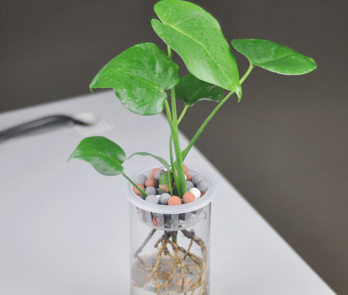
What to do when hydroponic Monstera leaves turn yellow:
1. Place it in a spot with plenty of light. When leaves turn yellow, you especially need to increase the light, but avoid direct sunlight, otherwise the leaves will turn even more yellow after being sunburned.
2. Make sure there is good ventilation. Check the ventilation conditions. If the room is too stuffy, the leaves can easily become stuffy and turn yellow, so opening the windows regularly for ventilation is very necessary.
3. Apply nutrient solution to the plant. If no nutrient solution is applied for a long time, the plant will lack nutrients, causing the leaves to become "malnourished" and turn yellow, so add a few drops of nutrient solution when adding water.
4. Water appropriately on a regular basis. Too much or too little watering will both have a certain adverse effect on the growth of the Monstera deliciosa, causing the leaves to turn yellow. When adding water to a hydroponic Monstera, you should pour out part of the water and add part of it to maintain the balance of nutrient conditions in the water. If you pour out all the water and then add new water every time, the leaves will very easily turn yellow.
5. Keep the indoor temperature suitable. The best temperature for growing Monstera deliciosa is around 20 degrees. Winter temperatures are relatively low, and placing it outdoors can easily cause cold damage, leading to yellowing leaves. Therefore, in winter the plant should not be placed outdoors, and it is best to turn on the heating indoors as well.
What to do when hydroponic Monstera roots rot:
1. Trim the roots.
Cut off the parts of the Monstera deliciosa roots that have already rotted, to prevent the infection from spreading further.
2. Disinfect the roots.
Soak the roots of the Monstera deliciosa in a 0.1% potassium permanganate solution for half an hour to kill bacteria.
3. Let them dry slightly.
Place the Monstera deliciosa in a cool, dry place to dry slightly, giving the wounds some time to recover.
4. Clean the container.
Replace all the water in the container with new water, and at the same time clean off moss and other dirt on the walls of the container.
5. Care for it again.
Add water again, place the Monstera deliciosa in, and be sure to change the water every day. After it grows new roots, reduce the frequency of water changes, and apply nutrient solution appropriately.
That is all for the methods of dealing with yellowing leaves on hydroponic Monstera. Hydroponic Monstera can also run into the problem of root rot, so this still needs attention.
Monstera deliciosa pictures Monstera deliciosa pictures, how to grow Monstera deliciosa
The Monstera deliciosa is a radiation-resistant plant. With its elegant, upright and noble appearance, it attracts the attention of many consumers, and more and more people are introducing and cultivating it, including it among potted indoor ornamental plants. This article will combine Monstera deliciosa pictures to tell everyone about how to grow Monstera deliciosa.
【Editor's top picks]Indoor plants Plectranthus amboinicus, Dalbergia odorifera, hydroponic plants, small potted plants, flowers and plants, feng shui radiation-resistant plants,
[Monstera deliciosa] Monstera deliciosa pictures, how to grow Monstera deliciosa——————————————————————————————————————————————
[Plant profile]
——————————————————————————————————————————————
Chinese name:Monstera deliciosa
Scientific name:Monstera deliciosa
Alternative names:Penglai banana, wire orchid, perforated Philodendron, Monstera banana, wire lotus, dragon-eye palm, wire orchid, Monstera taro
Family:Araceae
Genus:Monstera
Place of origin and distribution:Native to the tropical rainforests of Mexico, it is very widely introduced and cultivated in China.
Morphological characteristics:The stem is thick and strong, with many nodes resembling bamboo. The stem bears long, drooping brown aerial roots that can cling to other objects and grow upward. The leaves are thick and leathery, alternate, dark green or green; the leaves are thick and leathery, alternate, dark green or green; young leaves are heart-shaped without perforations, and when mature the leaves become oblong with irregular pinnate deep lobes, with holes from the leaf margin to near the veins; 30-50 cm long, dark green, with leaf scars; at the leaf scars there are bracts, leathery, yellow-white. The flower is shaped like a spathe, pale yellow. The fruit is edible.
How to grow Monstera deliciosa? - "Five likes and five dislikes" for growing Monstera deliciosa
——————————————————————————————————————————————
◆ First, it likes warmth and dislikes severe cold. Monstera deliciosa is native to the tropical rainforests of Mexico and likes a warm environment, disliking freezing cold weather. It will not suffer cold damage when the temperature is above 5°C, and grows well above 12°C.
◆ Second, it likes shade and dislikes strong light. Monstera deliciosa has a strong tolerance for shade, and in a semi-shady environment it grows especially well, showing vigorous growth, well-developed aerial roots, thick and large leaves, and bright, deep green leaf color.
◆ Third, it likes moisture and dislikes waterlogging. Monstera deliciosa likes to grow in a moist ecological environment. In the south, where there is a lot of rain, if waterlogging lasts too long, root rot, stem rot and leaf rot will occur.
◆ Fourth, it likes fertile soil and dislikes poor soil. Monstera deliciosa likes fertile soil, especially fertile sandy loam. Although it can grow in poor red-yellow soil, its growth becomes weaker, its form becomes deformed, its leaves become smaller, and its leaf color becomes lighter, affecting the ornamental effect.
◆ Fifth, it likes soil fertilizer and dislikes chemical fertilizer. Monstera deliciosa is often given organic fertilizer, such as cake fertilizer, artificial organic fertilizer, livestock and poultry manure residue, farmyard manure, etc. Its growth is then strong, its leaves are as large as plates, its leaf texture is thick and solid, and its leaf color is deep green and shiny, especially making the tortoiseshell pattern clearer and more distinct.
According to the "five likes and five dislikes" characteristics of Monstera deliciosa, in summer and autumn carry out shady and moist management, avoid direct sunlight, water twice a day, frequently spray the leaf surface, and maintain air humidity; in winter keep the room temperature above 5°C, and for outdoor cultivation set up a frame covered with film for insulation so it can overwinter safely. With proper care, a Monstera deliciosa over 4 years old will also bloom, with a single petal wrapping the berry, the flower being a brilliant jade color, and the berry pale yellow, oblong; its spadix inflorescence can be used to make dishes, and the berry can also be eaten after it ripens.
How to grow Monstera deliciosa
——————————————————————————————————————————————
① Sowing
Monstera deliciosa blooms in summer. To increase the seed setting rate, manual pollination is needed. Pollinating twice, at 9-10 a.m. and 3-4 p.m., is best, with a high pollination success rate. From pollination to seed maturity takes 15 months. During the seed development stage, pay attention to ventilation and fertilizer and water management to promote full and plump seeds.
Before sowing, first soak the seeds in 40°C warm water for 10 hours, and the sowing soil should be sterilized at high temperature. Monstera deliciosa seeds are relatively large, so spot sowing can be used. After sowing, keep the room temperature at 20-25°C, cover the box opening with plastic film, and maintain humidity above 80%. After sowing, they generally germinate in 20-25 days. If the room temperature is too low during the sowing process, it will not only affect emergence, but the seeds may even become water-soaked and rot.
② Cuttage
Stem node cuttings can be used in both spring and autumn, with the best results in April-May in spring and September-October in autumn. This is because the temperature during these periods is suitable for the stem node cuts to heal and take root, and they survive quickly.
Select current-year side branches with substantial stem tissue and robust growth as cuttings. The cuttings should be 20-25 cm long, and the leaves at the base should be cut off. Keep the small leaves at the upper end, cut off the long aerial roots, and keep the short aerial roots to absorb water and help rooting. Use a mixed substrate of coarse sand and peat or leaf mold for the cutting bed. After cutting, maintain 25-27°C and relatively high air humidity. Rooting only begins about 1 month after cutting. After the cuttings take root, the axillary buds on the stem nodes also begin to sprout and unfold leaves. To speed up the growth of the seedlings, keep the room temperature above 10°C and strengthen fertilizer and water management. In the second year after cutting, the seedlings take shape and can be sold as goods.
Division: carried out in summer and autumn. Cut off an entire section of a side branch of a large Monstera deliciosa, with some aerial roots, and plant it directly in a wooden barrel or pot. Not only is the survival rate high, but the shaping effect is also fast.
③ Cultivation
Monstera deliciosa is very easy to cultivate. It usually uses an equal mix of leaf mold, garden soil and river sand as the substrate. When planting, add a small amount of bone meal and dried cow dung as base fertilizer. Monstera deliciosa likes moisture and needs sufficient water, keeping the pot soil moist. Of course, in dry weather you must also spray water on the leaf surface to keep the air humid. During the growing season, pay attention to shading and avoid direct strong light, especially in midsummer it must not be placed in direct sunlight, otherwise the leaves will easily scorch and burn, affecting the ornamental value.
"Conclusion:Today, large potted Monstera deliciosa has become the main backbone material for hotel lobbies, and small and medium potted Monstera deliciosa will also be one of the more ornamental plants in modern home decoration. It is very commonly introduced and cultivated in China.
Of course, potted Monstera deliciosa is beloved not only because it is a famous indoor foliage plant, but also because Monstera deliciosa has the peculiar ability to absorb carbon dioxide at night.
【More plant encyclopedia】
How to grow Peperomia argyreia How to grow Cycas revoluta The role of cactus The characteristics of peony How to grow wintersweet How to grow Aglaia odorata
How to grow Epipremnum aureum and precautions Does the cactus resist radiation How to grow Guzmania Does Cyclamen leaf turn yellow The price of blue enchantress
Lucky bamboo Cycas revoluta pictures How to grow Cycas revoluta Is Ficus elastica toxic Sunflower flower language Peace tree Cyclamen Sansevieria trifasciata
Spider plant leaf tips turn yellow How to grow lily Nine sons Cymbidium Anthurium Is flamingo flower toxic How to grow Pachira aquatica Podocarpus bonsai pictures
What is the flower language of Monstera deliciosa? How to care for Monstera deliciosa in winter?
Monstera deliciosa has a graceful plant shape, peculiarly shaped leaves, and a rich green, glossy leaf color, with a good overall ornamental effect. It also has the characteristic of absorbing harmful gases such as formaldehyde and benzene, achieving the effect of purifying indoor air, and is an ideal indoor plant.
Alternative names of Monstera deliciosa:
Penglai banana, wire orchid, perforated Philodendron, Monstera banana, wire lotus, dragon-eye palm.
Habits of Monstera deliciosa:
Monstera deliciosa originally grew epiphytically on tall trees in tropical rainforests. It likes a warm and humid environment, and dislikes strong sunlight and dryness.
Monstera deliciosa is shade-tolerant and easily grows in fertile, loose, slightly acidic loam with high water absorption and good water retention, with leaf mold or peat soil being best.
The suitable growth temperature is 20-25°C. Below 5°C it is prone to cold damage, and when the temperature rises above 32°C, growth stops.
Flower language of Monstera deliciosa
The flower language and symbolic meaning of Monstera deliciosa: health and longevity.
This is because the leaves of Monstera deliciosa are very similar in shape to a turtle shell, and it has a relatively long lifespan. At the same time, it has the peculiar ability to absorb carbon dioxide, which is beneficial to human health.
Winter care methods
1. Control the indoor temperature
Monstera deliciosa can grow well at normal room temperature. But Monstera deliciosa is not cold-tolerant, and will suffer freezing when the winter temperature is below 5°C. The winter temperature in ordinary households can basically meet its growth needs.
2. Gradually reduce watering
In autumn and winter, the amount of watering can be gradually reduced. In late October, when the temperature drops to around 10°C, move the Monstera deliciosa indoors for care and gradually reduce watering.
In addition, air that is too dry in winter will make Monstera deliciosa uncomfortable. During care, frequently spray around the Monstera deliciosa to increase humidity, otherwise after a winter of dry living, the Monstera leaves will slowly wither and die.
3. Avoid strong sunlight
Pay attention to winter sunlight too! Monstera deliciosa fears strong sunlight. Do not think that winter sunlight is very weak; winter ultraviolet rays are still very strong. Because Monstera deliciosa is extremely shade-tolerant, placing it indoors for care in winter is completely fine. Just occasionally move it to the balcony to get some sunlight. Especially for young seedlings that have just successfully rooted from cuttings, they must not be placed directly in the sunlight, to avoid burning the tender leaves. Adult leaves also need shade, otherwise the leaves will lack luster and affect the ornamental effect.
4. Apply light fertilizer frequently
Monstera deliciosa is a foliage plant that is relatively tolerant of fertilizer, and in winter it also needs light fertilizer applied frequently. To make it produce more new leaves and keep the leaf color emerald green with a natural luster, apply fertilizer once every half month. When fertilizing, be careful not to let the fertilizer solution stain the leaf surface. At the same time, the roots of Monstera deliciosa are relatively tender, and it should not be given raw fertilizer or concentrated fertilizer, to avoid burning the roots.
5. Tie and shape
Monstera deliciosa is a large foliage plant with thick stems and large leaves. Especially when dividing adult plants, a frame should be set up and tied to prevent lodging and deformation. In winter, Monstera deliciosa grows relatively slowly, and it needs help with tying and shaping.
After the Monstera deliciosa takes shape, remove the support frame. At the same time, after shaping, when the stem node leaves grow too densely and the branches and vines grow too long, pay attention to pruning the whole plant, striving for a natural and beautiful appearance.
Monstera deliciosa gets its name because its leaf shape is peculiar, with holes and cracks, very much like a turtle shell. Monstera deliciosa is widely cultivated indoors for decoration and viewing. Do you know whether Monstera deliciosa can be grown hydroponically? How to grow hydroponic Monstera deliciosa? Below I will introduce the cultivation method of hydroponic Monstera deliciosa.
Hydroponic Monstera deliciosa method
1. Choose a container
Hydroponic Monstera deliciosa is easy
For the hydroponic Monstera deliciosa container, try to choose a professional hydroponic container. For hydroponic beginners, it is convenient for care and more conducive to plant growth. Usually an oval glass hydroponic vessel is chosen.
2. Handle the plant
Handle the plant
Remove the soil-cultured Monstera deliciosa from its pot, wash the soil off the roots, and appropriately trim the old roots. Do not damage the roots during the process.
Put a certain amount of water in the glass container, not too full, so that two-thirds of the root of the Monstera deliciosa plant is immersed in water and the rest is exposed to the air. If the root condition is checked from time to time and everything is normal, that means the hydroponic cultivation has succeeded. Change the water once a week. When the roots have grown a sufficient amount of water roots, you can appropriately add nutrient solution and just carry out normal care.
Monstera deliciosa likes moisture. Even in hydroponics, in dry weather you still need to spray water on the leaf surface to keep the air humid, so as to benefit the growth of branches and leaves and keep the leaves bright.
Place the hydroponic Monstera deliciosa in a place with plenty of scattered light for care. If it is too shady for a long time, artificial supplemental light can be used. In winter, place the Monstera deliciosa in a sunny and warm place, avoiding direct cold wind.
Because the leaves of Monstera deliciosa are relatively large, a heavy vessel should be used for hydroponics to prevent it from tipping over. The placement should be as stable as possible. If it is simple hydroponics, try not to place it in a high place for care.
The leaves of Monstera deliciosa can sometimes develop brown spot disease, and it must be sprayed with thiophanate or carbendazim in time for prevention and control, to avoid the disease spreading.
Common problems:
Monstera deliciosa is an evergreen vine plant, often used in indoor home potted plant arrangements. Growing Monstera deliciosa is not troublesome, but occasionally improper care can also cause the leaves of Monstera deliciosa to turn yellow. Below, let's take a look with editor Banxia at how to deal with yellowing leaves on Monstera deliciosa!
1. Unsuitable soil
Cause
Monstera deliciosa has well-developed fleshy roots and has relatively high requirements for soil air permeability. Sticky or slightly sticky soil is unfavorable to its growth. If the soil is not changed for a long time or the soil itself has poor air permeability, the soil will become compacted, affecting the respiration of the Monstera deliciosa roots, causing poor growth and yellowing leaves.
Solution
For household potted Monstera deliciosa, the cultivation soil can be a mixed soil made by mixing 2 parts cooked loess, 1 part honeycomb coal ash, and 1 part chicken manure. This can both ensure the air permeability of the potting soil for Monstera deliciosa and meet the fertilizer requirements needed for growth.
2. Too much or too little watering
Cause
Too much water will cause root rot in Monstera deliciosa, and too little water will cause the plant to lack water and grow poorly. Both of these conditions will cause yellow leaves in Monstera deliciosa.
Solution
Water regularly according to the surrounding environment. Each watering should soak through, keeping the pot soil surface slightly dry. You can often sprinkle water on the leaves of Monstera and around the environment to increase air humidity.
3. Light too strong or too dark
Cause
Monstera deliciosa is shade-tolerant, but placing Monstera deliciosa in a shaded environment for a long time will affect photosynthesis and cause the leaves to turn yellow; at the same time, Monstera deliciosa cannot be placed in strong light either, as strong light will cause the leaves of Monstera deliciosa to burn and turn yellow.
Solution
In summer, Monstera deliciosa should be shaded. It is best to place Monstera deliciosa in a place with scattered light for care. In winter, when the temperature is low, move Monstera deliciosa to a sunny place indoors. If the light at the care location is too weak, supplemental light can be given at noon on a regular basis.
4. Temperature too low
Cause
The optimal growth temperature for the Swiss cheese plant (Monstera deliciosa) is 20-25°C. In winter, the nighttime temperature must not drop below 10°C. Mature plants can tolerate short periods at 5°C, but below 5°C they are prone to cold damage, which causes yellowing leaves.
Solution
Before winter sets in, reduce watering appropriately to strengthen the plant's cold resistance.
In winter, provide appropriate warmth to the root zone of the Swiss cheese plant to enhance its cold resistance, but do not place it directly on a radiator or next to an air conditioner.
5. Insufficient fertilization
Cause
Iron is an essential raw material for plants to synthesize chlorophyll. If the plant has not been fertilized for a long time, or if the soil or fertilizer lacks sufficient iron, chlorophyll synthesis in the Swiss cheese plant will be affected, causing the leaves to lose their green color and turn yellow.
Solution
For yellowing leaves caused by iron deficiency, apply alum fertilizer water or spray with a 0.1-0.3% ferrous sulfate solution.
6. Poor ventilation
Cause
The Swiss cheese plant likes a humid environment, but if ventilation is poor and the environment is stuffy and hot, the plant will grow in stale air for a long time and have difficulty breathing, causing its leaves to turn dull yellow.
Solution
Place the plant on a balcony or windowsill for care, and open the windows often for ventilation. Alternatively, keep the Swiss cheese plant indoors for display during the day and move it outdoors at night to breathe fresh air. (Except in winter)