Is the Bromeliad Poisonous? A Detailed Guide to Growing It
Is the bromeliad poisonous? The bromeliad has another name, "Good Fortune." Many people buy bromeliads and bring them home without knowing how to grow them, so next let's look at how to grow bromeliads.
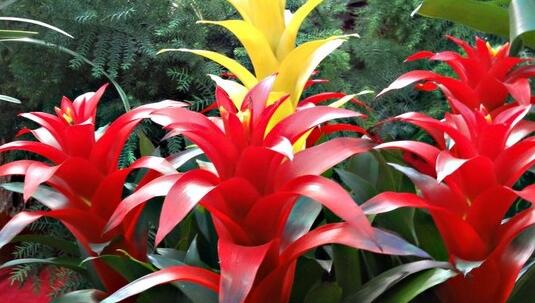
Bromeliad growing methods:
(1) Water
Water is the source of life and the key to development. The water bromeliads like best should ideally have a pH of 5.5-6.5, which is most conducive to nutrient absorption and can also reduce the pressure the roots bear from the outside environment. So the ideal choice is to water with rainwater; if that is not available, watering with lake water or surface water is also good. If conditions allow, you can buy a spray bottle, which not only helps keep the bottom of the pot from accumulating water but can also lower the indoor temperature.
(2) Light
The bromeliad is a shade-loving indoor plant and is not suited to direct sunlight, but it still needs sunlight. According to traditional growing experience, 3 hours a day is best. Spring and autumn go without saying, but note that in summer there must be no direct sunlight, and in winter the temperature must be above 10° and below 20°, which helps the plant rest and will not affect the next year's growth.
(3) Fertilizing
The bromeliad was originally a parasitic plant, and its root system is not very developed. It has no main root, only weak fibrous roots, so do not add too much fertilizer to the pot; this is also the main reason many people report yellowing leaves and root rot during cultivation. Here the editor suggests planting in a small, shallow pot so that some of the roots are exposed to the air, and for the soil, just use leaf mold plus a little garden soil, or mix peat and perlite in a half-and-half ratio. #p#Subtitle#e#
Bromeliad varieties:
(1) Water Tower Plant
The leaves of the water tower plant are narrow and long like swords, green and glossy. From winter to early spring, a bright red columnar inflorescence, about 30 cm tall, emerges from the tender green leaf tube; at the top are 6—12 small flowers with 3 petals, pale yellow-green with blue edges, curling outward after opening. When in full bloom, strings of blue-green flowers, set off by red bracts, look especially brilliant and eye-catching, and the ornamental period can last as long as two months.
(2) Dwarf Bromeliad
The dwarf bromeliad, also known as the small bromeliad, is most suitable for potted ornamental display. Its leaves are firm and slender with wavy edges, and the colors include creamy yellow, red or purplish red; the leaf surface has long vertical stripes radiating like a crab shape, and the flowers are white or light green, growing among the leaf clusters to form a disc.
(3) Dragonfly Bromeliad
The dragonfly bromeliad is also known as beautiful-leaf guangdenghe and spotted pink pineapple. The plant consists of 10——20 leaves forming a rosette-shaped leaf cluster, with a cup shape at the base. The leaf tips are bluntly rounded and turned outward, bright green, with the surface coated in a silvery white layer, and the leaf surface has irregular brownish and dark green horizontal stripes and patches. Between summer and autumn, after the peach-pink columnar flower, about 15 cm tall. The dense small flowers first open blue, then turn rose red, like a dragonfly spreading its wings in flight, and the ornamental period can last several months.
(4) Golden-edged Bromeliad
The leaves of the golden-edged bromeliad are sword-shaped, curling outward, crisp and glossy. The front of the leaf is dark green with yellow-green edges, and some leaves also gradually show varying yellow-green stripes in the middle. The back of the leaf is light green, with the same yellow-green hidden stripes as the leaf surface. In spring and summer, the cylindrical flower bud emerging from the leaf tube is about 2.5 cm thick, and 25--30 sepals wrap it from bottom to top like bamboo shoot shells into a column ranging from deep red to pink, much like a red bamboo shoot set into the leaf tube. Over two or three weeks, the columnar bud splits open and sends up a straight flower stem, on which more than a dozen small flowers open, each showing three colors from bottom to top: yellow, red and purple, and it is very ornamental.
(5) Painted Bract Bromeliad
The painted bract bromeliad, also called the torch, is a hybrid. The leaf edges are smooth and have no serrations. From the center it sends up an upright flower stem, 35——40 cm long, with a spike inflorescence at the top, and the flower spike has 2——4 branches. The bracts are deep red, thick and glossy, and the whole inflorescence looks like a blazing torch; the flowering period can reach three months, and it is also a favorite among ornamental bromeliads.
Is the bromeliad poisonous:
Bromeliads, datura and other flowers and plants are southern subtropical plants, and the extracts from their leaves and stems are the prototype of anesthetics. The oxygen produced by their photosynthesis contains a small amount of alkaloids (strong cardiac alkaloids). After a slightly longer time, symptoms such as dizziness and nausea may occur. Long-term cultivation may cause symptoms such as hallucinations and numbness of the hands and feet.
Therefore, such ornamental plants are absolutely unsuitable for indoor cultivation. The bromeliad is indeed highly ornamental, but it does have a certain toxicity, so it is suitable for planting in an environment with good ventilation.
Is the Bromeliad Poisonous? Bromeliad Growing Methods
The bromeliad, of the genus Billbergia, originated in the jungles from Mexico to southern Brazil and northern Argentina, with about 50 species, mostly terrestrial. The leaves are sickle-shaped, with the upper half sloping downward, arranged in groups of 5 to 8 into a tube-shaped rosette leaf cluster. So, do you know whether the bromeliad is poisonous? What are the bromeliad growing methods?
I. Bromeliad growing methods
How do you grow a bromeliad?
1. Light
The bromeliad likes semi-shade by habit, and direct sun exposure should be prevented; place it in a semi-shaded spot or a bright window or indoors. The bromeliad's native state is as a parasitic plant under trees in tropical rainforests, so its demand for sunlight is not especially great. When it is exposed to sunlight for too long, some of its leaves will turn yellow, and then the flower tips will dry out a bit, and so on. If grown outdoors, in spring, summer and autumn it should be properly shaded, especially in summer when 70% shading is needed. Direct sunlight will make leaf temperature higher than air temperature; too high a leaf temperature will cause scorching and burnt leaves, fade the bracts, and slow leaf growth.
2. Temperature
The most suitable growing temperature for bromeliads is 20℃ to 30℃; the maximum temperature should not exceed 35℃, and the minimum temperature is 14℃. Below 10℃ there is a constant risk of cold damage. In winter, it is best not to place it under a radiator, because then it dries out especially badly and will be scorched by it; a person could not stand next to a radiator all the time either, as it is easy to get overheated.
3. Moisture
For bromeliads, water the potting soil when the surface is slightly dry, that is, when the top 1 to 2 cm of soil is dry, then water a second time. It must not be too wet; too wet easily rots the roots. Bromeliad plants all have a leaf tube at the base of the leaves, and the leaf tube has a water channel; make sure there is often water in the channel and that it does not run out. The water in the leaf tube should be replaced after a period, say about ten days, to prevent it from becoming foul, and normally you can also spray a little mist-like water on the surface, leaves and flowers.
The most suitable relative air humidity is 70% to 80%, and it should not be lower than 50%, because maintaining relatively high air humidity in the growing environment is the key to successful anthurium cultivation. Therefore, leaf spraying should be done more throughout the year.
4. Soil
For potted anthurium, a substrate with good drainage should be chosen; for large-scale production, a mixed substrate of peat, perlite and sand is used, in the ratio: 1 cubic meter of peat: 4 to 5 kg of perlite: 0.15 cubic meters of sand. Its pH value should remain between 5.5 and 6.5 . If a small amount of decomposed chicken manure, cake fertilizer powder or bone meal and other base fertilizer can be placed at the bottom of the pot, the growth will be even better;
5. Fertilizing
During the growing season from April to September each year, apply liquid fertilizer once every two weeks. Fermented organic fertilizer can be used, or a 0.1% urea plus 0.2% potassium dihydrogen phosphate solution can be sprayed on both sides of the leaves, and some extremely dilute liquid fertilizer can also be poured into the leaf tube to be absorbed by the scale hairs at its base. The ratio of nitrogen, phosphorus and potassium is 10 to 15 to 20.
6. Propagation
Usually propagated by division, but at present tissue culture is mostly used for mass propagation, and seed propagation is used in breeding. For division, in spring the tiller buds at the rhizome of the adult mother plant can be separated and planted separately; for tissue culture, young leaves are mostly used as explants, and after callus induction and differentiation into clustered buds, rooting is then induced to form seedlings. From inoculation to seedling transplanting takes about 4 months, and after planting it takes 2-3 years to flower.
II. Is the bromeliad poisonous
Bromeliads, datura and other flowers and plants are southern subtropical plants, and the extracts from their leaves and stems are the prototype of anesthetics. The oxygen produced by their photosynthesis contains a small amount of alkaloids (strong cardiac alkaloids). After a slightly longer time, symptoms such as dizziness and nausea may occur. Long-term cultivation may cause symptoms such as hallucinations and numbness of the hands and feet.
Therefore, such ornamental plants are absolutely unsuitable for indoor cultivation.
The bromeliad is indeed highly ornamental, but it does have a certain toxicity, so it is suitable for planting in an environment with good ventilation. Potted bromeliads are very beautiful, and I hope everyone can learn the bromeliad growing methods and how to grow bromeliads, and can also be clear about knowledge such as whether bromeliads are poisonous.
The above is what the editor introduced about whether the bromeliad is poisonous, and I hope it can help you. For more information related to whether the bromeliad is poisonous, please continue to follow Tubatu Learn Decoration.
Bromeliad growing methods, bromeliad pictures, is the bromeliad poisonous, bromeliad prices
Bromeliad
Bromeliad plants are highly ornamental flowering and foliage plants, especially suitable for cultivation indoors, and as home gardening ornamentals they are very tasteful. The bromeliad originated in the jungles from Mexico to southern Brazil and northern Argentina, with about 50 species, and is today's most popular indoor foliage plant. With its peculiar flowers and beautiful patterns, it makes people gasp in wonder.Bromeliad growing methods
Bromeliad growing methods
1. Light:
Different genera of bromeliad plants tolerate different levels of light. Some can withstand full tropical sunlight, while others may scorch quickly. In general, however, bromeliad plants like a location with plenty of light, such as a bright windowsill, rather than direct sunlight. A south, west or east window is often perfect. Yellow plants may be receiving too much light, while plants that are dark green, or stretched out, may be receiving too little light.
How to water a bromeliad
1. When it is flowering, do not pour water onto the flowers. In winter, when there are no flowers, the water in the leaf tube should be poured out, and the soil should be kept appropriately moist, which helps it get through winter; overwatering instead causes root rot. Normally during the growing season, in addition to keeping the growing substrate moist, also put half a tube of water in the leaf tube, but replace the water every two or three days to avoid it becoming foul in the tube and affecting plant growth.
Bromeliad picture collection
I. About the bromeliad:
The bromeliad is also called the pineapple flower. It is a crop native to the jungles of Mexico and Brazil, and is a by-product of the pineapple. Its shape is very peculiar, more like the throne of Guanyin Bodhisattva, and it has great ornamental value. It is a very popular potted plant on the market. The leaves of the bromeliad are like sickles, hanging downward, and each leaf grows in a tube shape in a rosette form, with peculiarly shaped flowers. The flower language of the bromeliad symbolizes good fortune, good luck and perfection, and it also carries the auspicious meaning of "Good Fortune."
Is the bromeliad poisonous
1. Bromeliads, datura and other flowers and plants are southern subtropical plants, and the extracts from their leaves and stems are the prototype of anesthetics. The oxygen produced by their photosynthesis contains a small amount of alkaloids (strong cardiac alkaloids). After a slightly longer time, symptoms such as dizziness and nausea may occur. Long-term cultivation may cause symptoms such as hallucinations and numbness of the hands and feet. Therefore, such ornamental plants are absolutely unsuitable for indoor cultivation.
Bromeliad leaves turning yellow
If the leaves at the base turn yellow, it is fine, it is a normal phenomenon, and you can just cut them off. If the upper leaves turn yellow, then it is a care problem. I will introduce some simple key points for caring for bromeliads, and you can use them to find the cause and the solution.
Bromeliads do not need special care, and in autumn and winter you can even replenish water once every 7-10 days. When adding water, let the water collect in the central leaf tube, and observe how the water is absorbed. If the accumulated water exceeds one week, it should be poured out and replaced with fresh water to avoid breeding bacteria. In daily care, bromeliad plants should be placed in a semi-shaded, ventilated spot and grown with scattered light. Strong light easily scorches the leaves and causes mottled patches; but be careful not to leave it in too shady a place for a long time, as the beautiful color of the leaves often becomes lighter and paler because of this, causing regret in ornamental terms.
Bromeliad prices
1. A bromeliad with a plant height of 25 cm is generally 40, 50 cm is around 90, and one over one meter tall is very good, generally 200 or more expensive. The taller the flower, the more expensive; also, if bought around a big occasion like the New Year, it is more expensive than usual.
2. Not expensive, prices range from a few yuan to a few dozen yuan.
3. This depends on the variety. Ordinary ones are around a dozen yuan.
Related encyclopedia
Pocket scale non-woven bag lamp grass bamboo shoot crab claw redmi note3 ykk zipper ybs zipper large mountain cherry climbing wall plum wild senna winter plum green pine wristwatch Omega Longines famous watch children's building blocks flint dujiang orchid curling iron soursop