How to grow Schlumbergera, making its flowers delicate, graceful and brightly beautiful
Schlumbergera, also known as crab claw cactus, is an evergreen perennial flowering plant. It usually blooms during the winter holidays, with delicate, graceful and brightly beautiful flowers, and is especially loved and sought after by Chinese people. Let's take a look at how to grow Schlumbergera below.
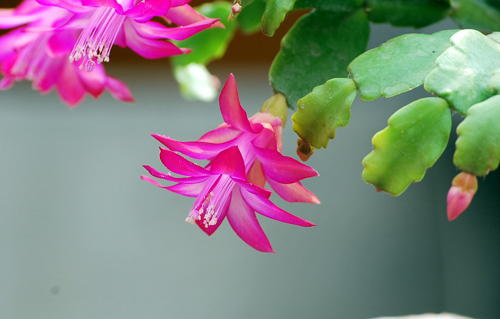
How to grow Schlumbergera:
1. Soil
The soil should be a relatively fertile mix of leaf mold, peat and coarse sand, with the pH kept between 5.5 and 6.5.
2. Watering
Schlumbergera should not be watered too much. Otherwise it may cause root rot. In the cooler seasons, water once every 3 to 4 days, but reduce watering after September; during hot periods, water once every 1 to 2 days. When it is hot and dry, spraying the leaves with water to increase humidity is also good; during the winter, watering once a week is enough. This should be adjusted flexibly according to the weather; generally, water when the surface soil of the pot is dry.
3. Fertilizing
Fertilizing Schlumbergera can promote its rapid growth. Generally fertilize in spring with a compound fertilizer with an N:P:K ratio of 2:1:2 at 800 to 1000 times dilution, once a week. Stop fertilizing during high temperatures, and resume fertilizing in autumn, but at this time it is best to increase the proportion of P and K fertilizers and reduce the proportion of N fertilizer, which can promote flower bud development. Fertilizing must be stopped during the flowering period and the dormant period.
4. Light
The growing environment for Schlumbergera requires semi-shade and moisture. Avoid scorching sun and rain in summer, and require warmth and sufficient light in winter. In summer high temperatures, pay attention to humidifying, ventilating and cooling, and use a shade net if necessary. Gradually remove the shade net in late autumn. In winter, strengthen heat preservation and cold protection; if the temperature is low, use heating to raise the temperature.
5. Shaping
Shaping is generally carried out in spring and autumn. After the flowers fade, promptly cut back to 3 to 4 stem segments below the spent flowers, and also remove diseased, old, dense and inward-growing stem segments, which helps ventilation and care; if 4 to 5 new shoots grow from the top of one segment, remove 2 to 3 and keep 2. Autumn shaping generally removes immature stem segments that cannot set buds, so as to ensure concentrated nutrient supply to the flower buds.
6. Pests and diseases
Diseases of Schlumbergera are generally caused by improper water and fertilizer management. Strengthening water and fertilizer management, controlling light and temperature, and timely prevention are the main methods. Pests are mainly caused by overcrowding, poor growth and poor ventilation. The main methods are shaping and pruning, and timely removal of pest-infested and diseased branches. Pay attention to timely observation, with prevention as the priority.
Water Lily - How to grow water lilies | Water lily pictures | How to care for water lilies
Water Lily
Water lily (Latin scientific name: Nymphaea alba), also known as noon lotus, watercress flower, Rui lotus, water ocean flower, small lotus, etc., is a perennial aquatic plant belonging to the genus Nymphaea in the family Nymphaeaceae. The water lily is a precious flower among aquatic flowers. Its appearance is similar to the lotus, but the difference is that the leaves and flowers of the lotus stand out of the water, while the leaves and flowers of the water lily float on the water surface. Because it opens by day and closes by night, the water lily is known as the "sleeping beauty among flowers." The water lily has a wide range of uses and can be used for food, tea making, cut flowers, medicine and other purposes.Water lily picture collection
Water lily, (Latin scientific name: Nymphaea tetragona Georgi), also known as noon lotus and watercress flower, is a plant of the family Nymphaeaceae in the order Ranunculales. Perennial aquatic herb; rhizome thick and fleshy. Leaves dimorphic: floating leaves round or ovate, with a curved notch at the base, heart-shaped or arrow-shaped, often without emergent leaves; submerged leaves membranous, fragile. Flowers large and beautiful, floating on or rising above the water surface; sepals nearly free;
How to grow water lilies
1. Division propagation This is the main propagation method for water lilies. In spring each year from March to April, when the buds are just beginning to sprout, dig up the rhizome and cut it into several pieces with a sharp knife. Make sure each rhizome piece has more than two plump buds, and plant it into the river mud in a pond or tank.
2. Seed propagation Store plump black oval seeds sealed in clean water until they are taken out before sowing the following spring. Germinate them in water at 5°C to 30°C, changing the water every day; they will sprout after two weeks. When the seedlings grow to 3 to 4 cm, they can be planted in a pond, ensuring sufficient water depth.
How to grow water lilies
1. Soil: Water lilies are not strict about soil quality and can grow normally at pH 6 to 8, but they prefer loamy soil rich in organic matter. In the growing season, the pond water depth should preferably not exceed 80 cm.
2. Water: When planting water lilies in summer, fill with water to a depth of about 25 cm and keep this depth regularly. In hot seasons, pay attention to keeping the basin water clean; when the basin water becomes turbid, promptly remove the dirt and replace it with fresh water.
How to plant mini water lilies
1. Rhizome propagation method
Mini water lilies are mainly propagated by rhizome. At first, plant the mini water lily in a flower pot, then place it in water. After about a year, the rhizome of the mini water lily will grow very densely, and then the mini water lily can be divided and planted. First remove the soil from the rhizome part, cut the root hairs short, and cut off the horizontally growing rhizome with stems and leaves at about 10 cm. Then put base sand and fertilizer, etc. into the bottom of the pot, place the stem segments in, cover with a layer of soil and firm it, water timely, and then wait for it to grow.
Water Lily Flower Language
What is the flower language of the water lily? In ancient Greece and ancient Rome, the water lily, like the Chinese lotus, was regarded as the embodiment of holiness and beauty, and was often used as an offering to goddesses. In the New Testament, there is also the saying of "a holy thing, emerging from mud unstained." The water lily is the birth flower of August 5 each year, and its flower language is: purity, innocence, glamour. In the minds of Germans, the flower language of the water lily is glamorous. Anyone born blessed by this flower is naturally endowed with a charm that the opposite sex finds hard to resist, but finds it difficult to get along peacefully with friends of the same sex.
How to plant water lily seeds
1. Sowing time: Lotus seeds have no dormancy period. As long as the water temperature can be kept above 16°C, they can be sown in all four seasons. Under suitable temperature and light conditions, lotus seeds take 50-60 days from sowing to flowering in spring and 60-80 days in autumn.
Pest and disease control for water lilies
Water lily pests and diseases: 1. Aphids. During the growth and development period of water lilies, if there is insufficient light and poor ventilation, they will not only grow weakly but also be prone to aphid damage. Solution: when pests are found, spray with a 1200-times aqueous solution of dichlorvos, or kill them with tobacco leaf water (50 g tobacco leaves plus 5 kg water, boiled and ready).
Uses of water lilies
Uses of water lilies: 1. Ornamental
The water lily is a perennial emergent herb and an ornamental plant with both beautiful flowers and leaves. It has rich flower colors and a long flowering period, and is deeply loved by people. Planted in clusters along the banks of lakes and ponds, or dotted in courtyard waterscapes and at a corner of waterside rockeries, it has good ornamental value.
Differences between water lilies and lotus
Both belong to the family Nymphaeaceae. The specific differences are as follows:
Water lily, also known as noon lotus. It belongs to the family Nymphaeaceae and is a perennial aquatic flower. The rhizome is short, thick and upright. The leaves float on the water surface, heart-shaped or broadly elliptical, with a deep notch at the base, bright green above and purplish red below. The flowers are solitary and float on the water surface, with many petals in colors such as white, pink, red and yellow. They open every morning and close in the afternoon, hence the name noon lotus, with a flowering period from June to September. The berry is enclosed by persistent sepals. It is native to East Asia and is cultivated in various parts of China. It grows in ponds and swamps and likes sunlight and clay rich in humus. The flowers and leaves of the water lily are both beautiful. Besides being ornamental, its rhizome can be eaten or used medicinally.
Related encyclopedia
Pocket scale non-woven bag lamp rush bamboo shoot crab claw Redmi Note 3 YKK zipper YBS zipper Prunus sargentii climbing rose Senna nomame winter plum green pine wristwatch Omega Longines famous watch children's building blocks flint rosebay orchids curling iron soursop
How to grow Schlumbergera and precautions for cultivation and management
Schlumbergera leaves are evergreen, and the flowers come in many colors including red, white, orange and yellow. It has a beautiful shape and is especially suitable for home growing. Let's talk about the precautions for keeping Schlumbergera at home.
1. To grow flowers, first cultivate the soil.
For growing any green plant at home, the choice of soil is very important, and Schlumbergera is no exception. For beginners, cultivating good flower soil means the growing of flowers and plants is half successful. Schlumbergera likes well-draining mixed soil. Mix leaf mold, peat and coarse sand together, and keep the soil acidity under acidic conditions, with a pH of about 6.
2. Temperature and sunlight requirements.
Schlumbergera likes a semi-shady, moist environment. Its growing temperature is between 18 and 23°C, while the flowering temperature is 10 to 15°C; above 25°C it will not bloom, or bloom less. Schlumbergera can be grown in indoor light. In summer, it must not be exposed to scorching sun, and rain should be avoided. In winter, grow it indoors, and the temperature should not be lower than 10°C. The flowering period of Schlumbergera is around October each year. About two months before the flowering period, ensure at least 8 hours of sunlight per day, and flower buds can bloom in late September and early October.
3. Watering.
How to water green plants is an often-discussed question. Plants may prefer moisture or dryness, with different temperaments, and water should be given according to their characteristics. Schlumbergera can grow in dry environments, and if water accumulates too much in the pot, it is prone to root rot and death. Therefore, when watering Schlumbergera, water thoroughly at one time, but avoid water accumulation. You can wait until the soil in the pot is dry before watering, and do not be too diligent.
Generally, in winter, water about once every four or five days. In summer, water evaporates relatively quickly, so watering once every two days is enough. If the weather is relatively hot, you can spray misted water on the leaves, which preserves moisture and also has a cooling effect.
What needs to be reminded is that after Schlumbergera enters the flowering period, the soil cannot be too dry, otherwise the flower buds will fall off, but watering too much will also cause flower buds to drop. After the flowering period of Schlumbergera ends, the plant enters a brief dormancy, and at this time the soil in the pot can be kept a bit drier.
4. Propagation
The propagation method of Schlumbergera is very simple. Cut off strong stem segments, place them in a cool place for two days, and insert them into sandy soil to survive. Isn't it very simple?
5. Flowering period management.
It was already mentioned above that during the flowering period of Schlumbergera, too little or too much watering can easily cause flower buds to drop, so how much water is appropriate? Observe that the soil in the pot is in a moist state and does not crumble when pinched by hand. You can spray misted water at room temperature every day at noon. In addition, note that fertilizing should be stopped during the flowering period to prevent flower fertilizer from burning the flowers.
6. Fertilizing.
Fertilizing is generally carried out around September before flowering and in April after the flowering period ends. In spring, apply nitrogen fertilizer, mainly to nourish branches and leaves. In summer, stop fertilizing to avoid rot. In autumn, mainly apply phosphorus fertilizer. Note that strongly irritating chemical fertilizers must not be used.
7. Other precautions.
1. Find a suitable place for Schlumbergera at home, one that ensures sufficient sunlight and also suitable temperature. Once the position is determined, do not move it frequently, especially during the flowering period; casually moving the position can easily cause bud drop.
2. Schlumbergera must not live under strong sunlight. In summer, shade it moderately, otherwise it will harm the plant.
The above are the precautions for growing Schlumbergera. Overall, it is a relatively easy-to-survive home green plant. With careful care, it can generally bloom. Have you learned it?