What are the planting methods and precautions for coral bells (Heuchera)?
Very few people grow coral bells (Heuchera) in China, so many people do not know how to plant them, and there is not much experience to draw on. Below we will explain the planting methods for coral bells.
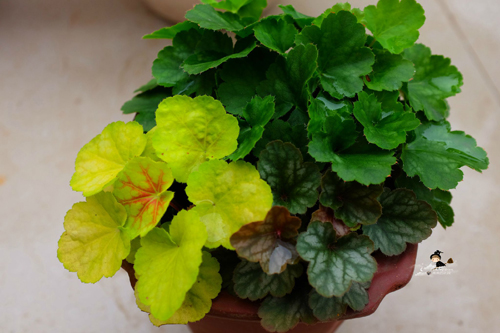
Planting methods for coral bells:
1. The best time to bring in seedlings is spring, autumn, and winter. Try to avoid buying seedlings in summer;
2. When buying seedlings, try to buy red-pot seedlings or pot seedlings. If you buy plug seedlings in order to collect more varieties, be sure to check clearly whether the plug seedling medium is peat or flower foam cuttings (very few shops have peat seedlings; peat seedlings are much smaller than flower foam seedlings but are easy to keep alive.)
3. Do not combine small seedlings in one pot; one plant per pot is enough, and it is best to use an airy succulent or bulb pot for planting.
4. The soil can be coconut coir or peat, plus perlite and a small amount of granules (do not use too many granules, keep it under 1/3), and pot-bottom stones can be used as a drainage layer. Note: the planting depth must not be too deep; the growth point must be exposed.
5. Watering is a skill. In the hottest summer, water twice a week (remember to provide appropriate shade); in spring and autumn, water once a week; in winter, water once every half month; when the weather is coldest, do not water. It is best to lift the pot and estimate the weight, and water only when it is noticeably lighter. In the hottest weather, water in the afternoon, as it is cool at night and good for water uptake; in the coldest weather, avoid watering. If you must water, add a small amount of water on a sunny morning, to avoid frost damage at night caused by water damage.
Note! Never water toward the crown, and do not use a small spray bottle to mist water (people who like to court disaster all like to use spray bottles to mist water; spray bottles are for applying pesticides!). If there is water on the leaves, wipe it dry promptly (if it is exposed to the sun, the refraction of the water droplets will ruin the leaf).
One more point: ventilation is very important~ ventilation is very important~ ventilation is very important! Important things should be said three times!#p#Subtitle#e#
Precautions for growing coral bells:
1. Grow in a sunny spot in winter; it is cold-hardy and can grow at temperatures above -15°C.
2. In summer, grow in partial shade; avoid direct strong light.
3. Soil and fertilizer: plant in well-drained soil and add slow-release fertilizer. During the growing period, fertilize appropriately.
4. Watering: follow the principle of “water when dry, stop when wet.” Water after the soil surface dries. Because it does not like being too moist, watering can be appropriately controlled in summer.
5. Plant coral bells in a sloped location. This is because they like a well-drained substrate. Although they can tolerate short periods of high fertilizer content or high pH, coral bells grow more vigorously in a well-drained, low-fertilizer soilless substrate.
6. Coral bells can also be propagated by leaf cuttings, and it is very simple; not only is the propagation speed fast, but multiple plants can be propagated at one time.
What are the growing methods for coral bells? What are the precautions for growing coral bells?
Coral bells planting
[Coral bells planting] What are the growing methods for coral bells? What are the precautions for growing coral bells?
[Expert interpretation]
Coral bells (Heuchera) is a perennial cold-hardy herbaceous plant, suitable for growing in northern China. Below, the editor introduces the growing methods for coral bells and the precautions for growing coral bells.
● Growing methods for coral bells:
Best propagation time: can be propagated all year round as long as the high temperatures at noon in summer are avoided; best growing soil: fertile, well-drained soil that prefers neutral to slightly acidic and is rich in humus; growing humidity requirement: does not like moisture and prefers a semi-dry, semi-moist environment; best growing temperature: grows well above minus 15 degrees, but stops growing above 30 degrees; best growing light: coral bells is cold-hardy, likes sun and tolerates shade.
● Precautions for growing coral bells:
Fertilizer application: plant in well-drained soil and add slow-release fertilizer. During the growing period, fertilize appropriately.
Key watering points: follow the principle of “water when dry, stop when wet.” Water after the soil surface dries. Because it does not like being too moist, watering can be appropriately controlled in summer.
Light and temperature: in summer, grow in partial shade; avoid direct strong light. In winter, grow in a sunny spot; it is cold-hardy and can grow at temperatures above -15°C.
Key propagation points: coral bells is mainly grown by sowing and division propagation, and leaf cuttings can also be used; the planting site should face the sun.
Key division points: once the mother plant has grown enough to fill the pot, it can be divided. When dividing, pay attention to sterilization and disinfection. It is not strict about soil requirements for planting; if conditions permit, use slightly acidic soil that retains water and is airy. Mix some peat soil with perlite at about four to one, apply fertilizer regularly, and do not let water accumulate.
Pest and disease control: because it is a newly introduced variety, it rarely gets sick or gets bugs. Just pay more attention normally, and spraying ordinary insecticides or carbendazim is enough.
[Editor's summary]
What are the growing methods for coral bells? What are the precautions for growing coral bells? The above is an article compiled for you by the editor of First Agricultural Economics Network.
Introduction to the planting methods and precautions for coral bells. How do you grow coral bells?
Coral bells, also known as coral bells (Heuchera), belongs to the genus Heuchera in the saxifrage family. It is a perennial cold-hardy herbaceous flower with a shallow root system. The leaves are basal, broadly heart-shaped, 20-25 cm long, deep purple, and evergreen in warm regions. The flowers are small, bell-shaped, 0.6-1.2 cm in diameter, red, and bilaterally symmetrical. Because coral bells is native to the United States, relatively few people grow it in China. This article focuses on introducing the care methods for coral bells.Coral bells is cold-hardy, likes sun and tolerates shade, and grows well in fertile, well-drained soil rich in humus. It likes neutral to slightly acidic, loose and fertile loam, and is suitable for growing in moist but well-drained, partially shaded soil. It avoids direct strong light. Seedlings grow slowly, and after becoming established plants they grow vigorously. It is a rare colored-leaf shade groundcover plant and tolerates low temperatures of -34°C.
Coral bells is very easy to grow. Whether the light conditions are full sun or partial shade, whether the growing soil is slightly moist or slightly dry, and whether the humidity is high or low, they can all grow well. Even so, you should still note during cultivation that they prefer a partially shaded, cooler environment and should avoid direct strong afternoon sunlight.
Precautions for growing coral bells:
1. Grow in a sunny spot in winter; it is cold-hardy and can grow at temperatures above -15°C.
2. In summer, grow in partial shade; avoid direct strong light.
3. Soil and fertilizer: plant in well-drained soil and add slow-release fertilizer. During the growing period, fertilize appropriately.
4. Watering: follow the principle of "water when dry, stop when wet." Water after the soil surface dries. Because it does not like being too moist, watering can be appropriately controlled in summer.
5. Plant coral bells in a sloped location. This is because they like a well-drained substrate. Although they can tolerate short periods of high fertilizer content or high pH, coral bells grow more vigorously in a well-drained, low-fertilizer soilless substrate.
6. Coral bells can also be propagated by leaf cuttings, and it is very simple; not only is the propagation speed fast, but multiple plants can be propagated at one time.
Summary: The above is an introduction to the care methods for coral bells. We hope it is helpful to flower lovers who like growing coral bells.