How to grow Nepenthes? Seven tips to make it easier to keep alive
Once, a newspaper's report on Nepenthes sparked a buying craze for Nepenthes in China. Its insect-catching nature and peculiar appearance are deeply loved by the general public. But from the tropics to the subtropics, how do you grow Nepenthes?
1. Nepenthes cultivation——Temperature
Nepenthes likes a high-temperature environment and grows vigorously at 20——30°C. In the colder winter, Nepenthes almost stops growing. To prevent Nepenthes from freezing to death, you also need to add warmth for it. Make sure the indoor temperature is not lower than 10°C.
2. Nepenthes cultivation——Humidity
The level of air humidity is the key to whether Nepenthes can normally produce pitchers. To raise air humidity, you can cover the whole Nepenthes with a transparent plastic bag, and you can easily get a high-humidity environment. In addition, placing Nepenthes in an aquarium, or in a corner to reduce ventilation, will raise the humidity.
3. Nepenthes cultivation——Light
Nepenthes likes sunlight, but is afraid of direct strong light. So in summer, be careful about sun protection; the usual method is to put up a shade net. Too little sunlight is also not good; it will cause Nepenthes to grow slowly, with weak and thin plants, smaller pitchers, or no pitchers at all.
4. Nepenthes cultivation——Water
Nepenthes needs a large amount of water. When the temperature exceeds 30°C, water 2-3 times a day. If conditions permit, it is best to spray water mist on the branches and leaves of Nepenthes. When the temperature is lower, you can water a little less, but the soil should still always remain moist. #p#Subtitle#e#
5. Nepenthes cultivation——Fertilizing
Generally, organic fertilizer is applied to Nepenthes, and it should be watered promptly after fertilizing. If there is no organic fertilizer, or if you dislike organic fertilizer, you can apply a little chemical fertilizer, and the amount of chemical fertilizer should be kept relatively low. Applying too much fertilizer at one time will cause the plant to wither, as if it were lacking water. Besides these fertilizers, leaf fertilizer can also be applied, and its effect is relatively quick.
6. Nepenthes cultivation——Substrate
Nepenthes likes a substrate that is sufficiently loose and well-drained, yet can fully retain water and provide the plant with sufficient moisture. A mixed substrate based on coconut husk, mixed with wood chips and perlite, or pure sphagnum moss, is very suitable for Nepenthes. Sphagnum moss is not only a suitable substrate for Nepenthes growth, but also a sign of whether the growing environment is suitable for Nepenthes.
7. Nepenthes cultivation——Pest and disease control
Nepenthes is prone to leaf spot disease, root rot, sunscald, and so on. Leaf spot disease and root rot are the more serious.
How to grow Nepenthes in water and how to water it
Nepenthes, this is a magical plant that can actually eat small insects, an attribute many plants do not have. Let's see how to grow Nepenthes in water and how to water Nepenthes:
How to grow Nepenthes in water:
Materials for hydroponic preparation:
A vase, which must be beautiful; the greatest purpose of hydroponics is to decorate the room. Try to choose a fairly pretty transparent glass bottle.
Sharp scissors; if the scissors are not sharp, the operation will be very laborious.
Nepenthes with relatively good growth
Culture solution, rooting agent, clean water, wire mesh, colored stones
Hydroponic steps:
First, prepare the culture substrate. Pour 3/2 of water into the bottle, add a few drops of culture solution, and set it aside for later use.
Cut branches from a mature plant, keeping the buds on the branches, so new branches are easy to grow. Do not keep too many leaves; 1-2 leaves are enough.
Apply rooting agent to the cut end of the branch, then put the branch into the water. Be careful not to let the leaves soak in the water, so as to avoid contaminating the water quality.
Put a small amount of colored stones in the bottle to enhance the effect.
Fix the branch with wire mesh to keep it upright.
After the above five steps, the hydroponics is complete, and what remains is care. In the early stage, change the water once every 3 days. After rooting, change the water about once a week. Each time you change the water, add nutrient solution.
How to water Nepenthes:
1. When to water
Nepenthes has strict water requirements, and the watering time must be strictly controlled; it cannot be too frequent, nor can it go without watering. Just try to keep the soil moist. As for the watering time, water twice a day, once in the morning and once in the evening. Remember not to water at noon.
3. Nepenthes water quality requirements
Nepenthes has relatively low water quality requirements; as long as it is not very dirty and does not contain bacteria, ordinary water is fine. But if you often use the soak-and-absorb method to water, salt will accumulate, and many yellow-white water stains will appear on the surface of the soil. Replace the surface soil in time.
4. How to water
There are many ways to water, such as pouring, pot-surface watering, spraying, and soak-and-absorb watering. Nepenthes is suitable for growing in moist but relatively loose soil, so watering generally uses pot-surface watering and soak-and-absorb watering.
Pot-surface watering: Water directly into the soil, and try to avoid watering the flowers and leaves.
Soak-and-absorb watering: To avoid the loss of nutrients in the soil, soak the pot in water and let the soil become moist.
That is all for the introduction to the hydroponic method for Nepenthes. Do not water into the pitcher just because the pitcher looks cute, or you will kill it. Pay attention.
How to grow Nepenthes How to grow Nepenthes? A collection of Nepenthes pictures
Nepenthes can prey on insects, and this is inseparable from its unique appearance and form. Each of its leaves grows a pitcher, specially used to hunt insects. The pitcher secretes nectar with a numbing effect to attract insects. After being numbed, the insects fall into the pitcher and are digested by the digestive fluid. This is the predation process of Nepenthes.
[Recommended reading] Cuban oregano, Peperomia obtusifolia, Spring Festival flowers, hydroponic lucky bamboo, African jasmine, rose, succulent plants, tropical plants, Rosa rubus
How to grow Nepenthes? A collection of Nepenthes pictures
——————————————————————————————————————————————
[Plant profile]
——————————————————————————————————————————————
Chinese name:Nepenthes
Scientific name:Nepenthes sp.
Aliases:Water-pitcher plant, monkey water bottle, monkey cup, piglet cage, Leigong pot
Family:Nepenthaceae
Genus:Nepenthes
Origin and distribution:Native to tropical regions such as Indonesia, Malaysia, and the Philippines in Southeast Asia, as well as China and Australia
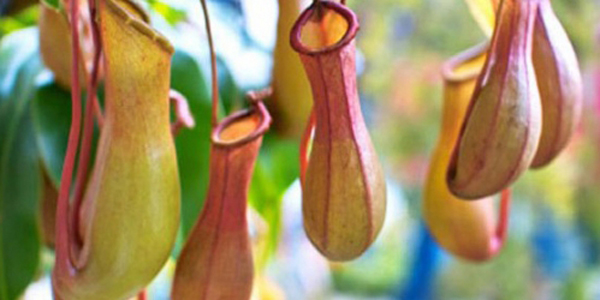
Morphological characteristics:A perennial vine, with woody or semi-woody stems, growing attached to trees or on land, climbing or growing along the ground. The leaves are generally oblong, with tendrils at the ends. The end of the tendril forms a bottle-shaped or funnel-shaped pitcher, and has a lid. Nepenthes only blooms after growing for many years. The flowers are usually racemes, dioecious. The flowers are small; during the day the scent is light and slightly fragrant; at night the scent is strong and turns foul.
How to grow Nepenthes?
——————————————————————————————————————————————
Nepenthes has no dormancy period. Its basic growth requirements are: light, humidity, water, temperature, nutrients, and growing substrate.
◆Nepenthes growth habits: There are many plant species in the genus Nepenthes, about 120 species worldwide. They are divided into highland species and lowland species. Highland species like cool, moist conditions and do not mind high daytime temperatures, but at night must be kept at around 15°C; lowland species like warmth and humidity.
◆Nepenthes light and temperature management: Light is one of the most important factors for growing huge, brightly colored pitchers. Full sun will darken the plant's color and hinder growth. Bright diffused light is more suitable for Nepenthes. Providing sufficient air humidity, medium soil moisture, and sufficient light can make the leaves show a red like red wine. The suitable growth temperature for Nepenthes is 25-30°C, 21-30°C from March to September, and 18-24°C from September to the following March. The winter temperature should not be lower than 16°C.
◆Nepenthes water management: Nepenthes does not have high requirements for the moisture content of the growing medium, and usually does not like growing media that is overly wet and not breathable. When growing Nepenthes, the soil needs to be kept moist at all times. The substrate should preferably be loose and not squeeze out water. Providing high-quality soft water for Nepenthes in a timely manner is more beneficial to its growth.
◆Nepenthes humidity management: The level of air humidity is the key to whether Nepenthes can normally produce pitchers. To raise air humidity, you can cover the whole Nepenthes with a transparent plastic bag, and you can easily get a high-humidity environment. In addition, placing Nepenthes in an aquarium, or in a corner to reduce ventilation, will raise the humidity. Once new pitchers have grown, you can try gradually lowering the air humidity to let Nepenthes adapt to a relatively dry environment.
◆Nepenthes substrate management: Nepenthes likes a substrate that is sufficiently loose and well-drained, yet can fully retain water and provide the plant with sufficient moisture. A mixed substrate based on coconut husk, mixed with wood chips and perlite, or pure sphagnum moss, is very suitable for Nepenthes. Sphagnum moss is not only a suitable substrate for Nepenthes growth, but also a sign of whether the growing environment is suitable for Nepenthes.
◆Nepenthes fertilizing management: If Nepenthes catches insects, there is no need to fertilize it further. However, when grown indoors, there are usually not enough insects for Nepenthes to catch, so a quick-dissolving foliar fertilizer can be used. Never apply non-slow-release fertilizer directly into the soil. Regarding nutrients, it should be noted that Nepenthes is a carnivorous plant, and they already have the ability to obtain nutrients by catching insects or small animals. There is no harm in feeding them manually, but it is not recommended to feed too many or too large insects, such as cockroaches. This is because large insects take several weeks to be completely digested, and during this period the rotting odor they give off is unbearable.
◆Nepenthes pests and diseases: Nepenthes is prone to leaf spot disease, root rot, sunscald, and so on. Leaf spot disease and root rot are the more serious.
[More plant encyclopedia]
Agave, Canna, Lycoris radiata, Forget-me-not, Dandelion, Dendrobium officinale, Taxus chinensis, Kapok, Osmanthus, Begonia, Hydroponic plants
Home feng shui plants, bedroom feng shui plants, Plum blossom, Aloe, Jasmine, Anti-radiation plants, Copper coin grass, Potted landscape making, Drug plants
Mistletoe, Indoor flowers, Money tree, Lucky bamboo, Potted plant making, Anthurium, Mint, Lithops, Geranium, Garden, Schlumbergera, Peace lily