How to grow Bridal Veil Spider Plant: Avoid direct sunlight, not shade-tolerant
Bridal Veil Spider Plant originates from Korea. Its small leaves are tender green and glossy, with purplish-red undersides; its stems are jointed, slender and soft; its small white flowers are upright and borne gracefully. Because of this it is often used as a wedding flower, so below we will explain how to grow Bridal Veil Spider Plant.
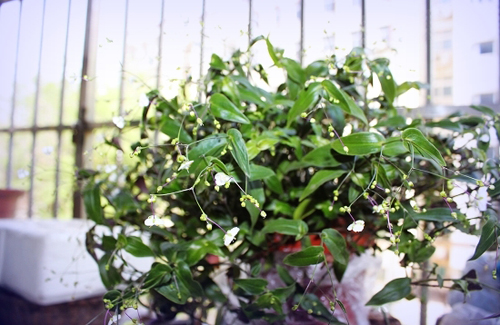
Bridal Veil Spider Plant growing habits:
Prefers high temperature and high humidity, diffused light environment; avoid direct sunlight; not shade-tolerant; likes water and fertilizer; tolerant of pruning; afraid of cold; afraid of drought.
Bridal Veil Spider Plant morphological characteristics:
Needle-shaped, narrow and long, flexible like an orchid, 20—45 cm long and 1-2 cm wide, with a long, gradually pointed tip; the base clasps the stem, growing on short stems. The greatest feature of the spider plant is that mature plants will from time to time produce runners, 30—60 cm long, each with a small plantlet at the tip. The flower scape is slender, longer than the leaves, arching and drooping; the raceme is simple or branched, and sometimes 2—8 cm strap-like leaf clusters also grow in clusters at the upper nodes of the inflorescence; the flowers are white, several per cluster, sparsely scattered along the inflorescence axis. The flowering period is between spring and summer, and it can also bloom indoors in winter.#p#Subtitle#e#
How to grow Bridal Veil Spider Plant:
The growing methods for Bridal Veil Spider Plant include cuttings and division, which can be done at any time from spring to autumn.
Bridal Veil Spider Plant has strong adaptability and a high survival rate, and is generally propagated by two methods: cuttings or division. For cuttings, simply take a 5-10 cm stolon with new buds and insert it into the soil; roots will form in about one week, and after about 20 days it can be transplanted into a pot, watered thoroughly, and placed in a shady spot for care. For division, lift the Bridal Veil Spider Plant out of the pot, remove the old soil and rotten roots, cut apart the old roots so that each divided plant retains three stems, then transplant and grow them separately. You can also cut off the clustered stems and leaves on the stolons of the Bridal Veil Spider Plant (in fact a young new plantlet, with leaves above and aerial roots below), and plant it directly into a flower pot to grow.
Seed propagation of spider plant can be carried out in March each year. Because the seeds are not large, after sowing the covering soil should not be thick, generally 0.5 cm is enough. At a temperature of 15°C, the seeds can sprout in about 2 weeks, and after the seedlings take shape they can be transplanted for growing.
How to grow Bridal Veil Spider Plant: growing methods for Bridal Veil Spider Plant
Bridal Veil Spider Plant is a relatively festive flower, mostly displayed and used at wedding venues; hung up it is very romantic, and can be paired with some lilies and roses for embellishment. Many friends also choose to grow it in pots. Below we will share with you how to grow Bridal Veil Spider Plant as well as related knowledge and growing methods.
Introduction to Bridal Veil Spider Plant
Bridal Veil Spider Plant originates from Korea and is a flower of the Commelinaceae family, genus Commelina. Its other alias is “Romantic Grass”; the flowers it produces are white, delicate and small. Doesn't Bridal Veil Spider Plant stir up many pure memories and romantic fantasies for you? The flowering period of Bridal Veil Spider Plant can last until autumn, with lush green dotted with pure white forget-me-nots, giving it a special charm.
1. Growing habits
Prefers high temperature and high humidity, diffused light environment; avoid direct sunlight; not shade-tolerant; likes water and fertilizer; tolerant of pruning; afraid of cold; afraid of drought.
2. Morphological characteristics
Needle-shaped, narrow and long, flexible like an orchid, 20—45 cm long and 1-2 cm wide, with a long, gradually pointed tip; the base clasps the stem, growing on short stems. The greatest feature of the spider plant is that mature plants will from time to time produce runners, 30—60 cm long, each with a small plantlet at the tip. The flower scape is slender, longer than the leaves, arching and drooping; the raceme is simple or branched, and sometimes 2—8 cm strap-like leaf clusters also grow in clusters at the upper nodes of the inflorescence; the flowers are white, several per cluster, sparsely scattered along the inflorescence axis. The flowering period is between spring and summer, and it can also bloom indoors in winter.
How to grow Bridal Veil Spider Plant——growing methods
The growing methods for Bridal Veil Spider Plant include cuttings and division, which can be done at any time from spring to autumn.
Bridal Veil Spider Plant has strong adaptability and a high survival rate, and is generally propagated by two methods: cuttings or division. For cuttings, simply take a 5-10 cm stolon with new buds and insert it into the soil; roots will form in about one week, and after about 20 days it can be transplanted into a pot, watered thoroughly, and placed in a shady spot for care. For division, lift the Bridal Veil Spider Plant out of the pot, remove the old soil and rotten roots, cut apart the old roots so that each divided plant retains three stems, then transplant and grow them separately. You can also cut off the clustered stems and leaves on the stolons of the Bridal Veil Spider Plant (in fact a young new plantlet, with leaves above and aerial roots below), and plant it directly into a flower pot to grow.
Seed propagation of spider plant can be carried out in March each year. Because the seeds are not large, after sowing the covering soil should not be thick, generally 0.5 cm is enough. At a temperature of 15°C, the seeds can sprout in about 2 weeks, and after the seedlings take shape they can be transplanted for growing.
Growing methods for Bridal Veil Spider Plant: how to grow Bridal Veil Spider Plant
Flower Bonsai Network introduction: today Flower Bonsai Network shares with you an article about the growing methods for Bridal Veil Spider Plant and how to grow Bridal Veil Spider Plant. Let's take a look.
Bridal Veil Spider Plant is a plant that has not been fully recognized by people. Its origins seem unclear, with no scientific name and no family or genus, but its beautiful flower shape has attracted many flower lovers to grow it. So an important question is: what are the growing methods for Bridal Veil Spider Plant?
Growing habits of Bridal Veil Spider Plant
Based on the growing region and habits of Bridal Veil Spider Plant, it can be judged that it relatively prefers conditions of high temperature and high humidity, avoiding direct sunlight, that is, a diffused light environment, and especially avoids strong light exposure. In addition, Bridal Veil Spider Plant is also not shade-tolerant, likes water, likes fertilizer, fears cold, fears drought, and is tolerant of pruning. Be sure to remember these. In addition, regarding the flowering period of Bridal Veil Spider Plant, if you grow Bridal Veil Spider Plant it generally needs to be grown for seven or eight months before it blooms, and Bridal Veil Spider Plant generally blooms from December to March of the following year.
Growing methods for Bridal Veil Spider Plant
Bridal Veil Spider Plant has fairly strong adaptability, so when caring for Bridal Veil Spider Plant you only need to control the amount of watering and make sure water never accumulates in the pot. In addition, take care in summer to avoid direct sunlight to prevent scorching, and in winter increase light to avoid cold damage. If flower lovers want to increase the flowering rate of Bridal Veil Spider Plant, they need to pay special attention to water control and must ensure suitable light. If light is insufficient it will affect the plant's growth and reduce the flowering rate.
Bridal Veil Spider Plant is said to be a plant from Korea. Because it produces small white flowers, like a bride wearing a white wedding dress, it is called Bridal Veil Spider Plant. Of course, some flower lovers also say it is just like a weed; in fact, judging by its appearance, it is simply a grass of the Commelinaceae family.
Bridal Veil Spider Plant is suitable for care in a high temperature, high humidity, diffused light environment (a place on the balcony not reached by direct sunlight is fine); avoid direct sunlight; not shade-tolerant (it easily becomes leggy and does not bloom); likes water and fertilizer; tolerant of pruning; afraid of cold; afraid of drought. As for the flowering period of Bridal Veil Spider Plant, generally speaking the Bridal Veil Spider Plant we grow needs to be grown for 7-8 months before it blooms; under normal circumstances, the flowering period of Bridal Veil Spider Plant is from December to March of the following year.
In fact, Bridal Veil Spider Plant is very easy to grow. Just be careful not to let water accumulate in the pot, not to expose it to strong sun, and not to let it freeze, and that's OK. After all, it is just a "grass." The difficulty lies in flowering. If flower lovers want it to bloom, it is best to control water appropriately and give suitable light. When light is lacking, Bridal Veil Spider Plant grows well, but the chance of flowering is small or there are few flowers.
Precautions for growing Bridal Veil Spider Plant
When growing Bridal Veil Spider Plant, special attention should be paid to fertilization. Bridal Veil Spider Plant relatively likes fertilizer, but fertilization still needs to be controlled; do not over-fertilize; apply thin fertilizer frequently. In addition, be sure to apply fertilizer according to the fertilizer instructions, and distinguish whether the fertilizer should be buried in the soil or sprayed on the leaves. In this way, as long as you apply thin fertilizer frequently and apply fertilizer with the corresponding effect, normal care is all that is needed.
Fertilization methods for spider plant
Spider plant has fleshy roots, and its root system is very developed; the pot is basically full of roots, so when fertilizing spider plant we should note a few points:
1. Do not apply too much fertilizer; just give a little bit of fertilizer. You can apply thin fertilizer frequently, once a week, with a smaller amount each time.
2. Fertilize according to the fertilizer instructions, either buried in the pot soil or dissolved in water to water the spider plant.
Actually, when fertilizing spider plant, we only need to note one thing: apply thin fertilizer frequently, and apply fertilizer with the corresponding effect. There is nothing else for flower lovers to worry about; just fertilize with confidence according to the fertilizer instructions.
How to propagate Bridal Veil Spider Plant
Bridal Veil Spider Plant is a clump-forming plant originating from Korea. It is named Bridal Veil Spider Plant because its small white flowers resemble a bride wearing a wedding dress, and it has great beauty and ornamental value. So friends who want to grow Bridal Veil Spider Plant will inevitably ask about its propagation methods. As far as its habits are concerned, Bridal Veil Spider Plant has strong adaptability and a high survival rate, and is generally propagated by three methods: cuttings, division, and sowing.
Cuttings propagation of Bridal Veil Spider Plant
The specific steps for cuttings propagation of Bridal Veil Spider Plant include: first take a stolon with new buds and insert it into the soil 5 to 10 cm; then it generally takes about one week for it to root normally, and during this period normal care and management are all that is needed. By the time more than 20 days have passed, it can be transplanted into a pot, after which water it thoroughly and place it in a shady spot to grow.
Division propagation of Bridal Veil Spider Plant
The specific steps for division propagation of Bridal Veil Spider Plant include: first lift the whole plant out of the pot, remove the old soil and dead roots on top, cut apart the roots, and at this time ensure that each divided branch retains three stems; afterward transplant them separately into pots for cultivation. The second division method is to cut off the clustered stems and leaves on the stolons of Bridal Veil Spider Plant, that is, young plantlets with leaves and aerial roots, and then plant them directly in a flower pot to grow.
Sowing propagation of Bridal Veil Spider Plant
Seed propagation of Bridal Veil Spider Plant is best carried out in March each year. When sowing Bridal Veil Spider Plant, be sure not to cover with too thick a layer of soil; generally 0.5 cm is enough. After sowing is completed, care and manage it at a room temperature of 15°C. In this way it generally sprouts within two weeks, and then once the plant takes shape it can be transplanted for cultivation.
The role of spider plant
Spider plant not only has a form like an orchid and stays fresh green all year round, but also has a powerful ability to absorb pollutants. "Grow spider plant at home, and filthy ghosts tremble with fear" - this is how people in southern Fujian, Taiwan, China and other places praise spider plant. Spider plant is the best plant for purifying indoor air, and this has already been affirmed by scientists.
American environmental issues expert Bill Wolverton once conducted an experiment. He placed a spider plant in a specially made plexiglass container, gave it good light, and then filled it with air from a polluted room. After some time he measured the composition of the air that had been absorbed by the spider plant, and found that almost none of the harmful gases in the container remained; its efficiency almost exceeded that of an air filter.
Experiments prove that spider plant can absorb and purify all harmful gases in an experimental container within 24 hours. As long as one pot of spider plant is placed in a bedroom, within one day it can absorb harmful gases such as carbon monoxide and nitrogen oxides released by indoor electrical appliances, stoves, plastic products, coatings, etc. and transport them to the roots, where microorganisms in the soil decompose them into harmless substances that are then absorbed as nutrients.
In its own metabolism, spider plant can also convert carcinogenic formaldehyde in the air into substances such as sugars and amino acids. It can also decompose benzene emitted by copiers and printers, and can even "devour" nicotine and so on. Therefore, in a room of about 10 sq m, as long as there is one pot of spider plant, it is equivalent to installing an air purifier, enough to offset the negative effects brought by harmful gases.
Scientists also placed several pots of spider plant in a closed environment like a space shuttle sealed cabin, and after 12 hours measured that harmful gases such as carbon monoxide, nitrous oxide and formaldehyde in the cabin had decreased by 85%. Researchers at Xi'an Botanical Garden say that in recent years more and more people have chosen spider plant as a household potted plant, and its pollutant-absorbing ability has been recognized by most people.
In addition, spider plant is also often used indoors, especially in newly renovated interiors, as a "negative ion" purifier, and it is believed to have a clear effect on reducing the concentration of harmful substances such as formaldehyde and benzene.