Propagation methods for wax begonia: three ways - seed sowing, cuttings, and division
Begonias can be said to be one of the most popular flowers among the general public in China, and for this reason many people grow begonias at home. Wax begonias prefer a warm, humid environment, are intolerant of cold, drought and intense heat, and dislike waterlogging, so they grow best in a semi-shaded, humid, warm environment. So what are the propagation methods for wax begonias?
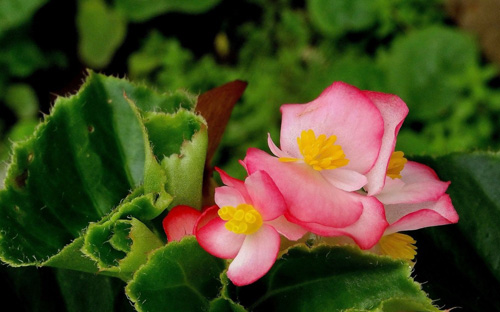
Propagation methods for wax begonias:
Wax begonias are mainly propagated by three methods: seed sowing, cuttings and division. For commercial cultivation, seed sowing is always used. Wax begonia seeds are tiny and short-lived; seeds that fall naturally into the potting soil often germinate quickly and grow into seedlings, but harvested seeds that are not sown promptly produce very few seedlings.
Cuttings are usually taken from March to May or from September to October, using plain sandy soil as the cutting medium. They can also be inserted directly into plastic flower pots, with the node inserted into the soil. Under shaded and warm conditions, roots form in just over 20 days. Perennial old plants can be divided, and pruned at the same time to encourage new side shoots and form a well-shaped plant.
Sowing method: In East China, spring from April to May and autumn from August to September are generally the most suitable. The seeds should be evenly scattered over the fine soil in the pot (no need to cover with soil). Then draw up water through the bottom of the sowing pot until it is fully absorbed, cover with a piece of glass and place in semi-shade; they will germinate after 10 days. Seedlings sown in spring will bloom in autumn of the same year.#p#Subtitle#e#
Cutting method: This can be done in all four seasons, but after the seedlings mature they branch less, so apart from double-petaled varieties, this method is generally not used for propagation.
① Cutting time. For home cuttings, it is best to do it between April and May, when the temperature rises above 20°C. At this time the air humidity is high, the temperature is warm, and management is simple, making it suitable for the rapid rooting of wax begonias.
② Cutting medium. Wash river sand, dry it in the sun, then place it in a pot. River sand that has been washed and then sun-dried has basically been sterilized, and the dried sand helps raise the temperature under daytime sunlight, promoting callus formation and rooting on the cut surface of the cuttings.
③ Selection of cuttings. Cut strong branches, each segment with 3-4 nodes, trim the top into a flat shape and the bottom into a horseshoe shape to enlarge the contact surface with the sand and promote rooting.
④ Cutting and management. Insert the cuttings into the sand pot at a plant-to-row spacing of 3 cm × 4 cm. Before inserting, use a bamboo stick the same thickness as the cutting to poke holes in the pot sand, then insert the wax begonia branch. Do not water for 2 days after insertion, to allow the cut surface to form a healing callus. On the 5th day, spray with water at about the same temperature as the sand, until water is seen flowing out of the bottom of the pot. Place in a cool spot and generally do not water again. After about 10 days, roots 3-4 cm long will have grown; at this point place the pot in sunlight and water according to the weather. After another 6-7 days, they can be potted up and planted out.
How do begonias propagate? Begonia propagation methods and precautions / cuttings / sowing
Begonia is a plant with high ornamental value and is a flower species unique to our country. It is loved by many people for its beautiful appearance and is a plant found in many gardens in our country. As for how begonias propagate, it can broadly be divided into three methods: cuttings, sowing and division. The propagation methods for begonias are described in detail below, so read on.
I. How do begonias propagate / cuttings / sowing
As for the question of how begonias propagate, there are actually two answers: propagation by sowing and propagation by cuttings. Of course, to propagate them well, the growing methods are also very closely related. This is explained in detail in the article on begonia growing methods, so I will not go into it too much here.
II. Begonia propagation methods
Propagation by cuttings
1. Cutting time
As for when it is most suitable to take begonia cuttings, it is best to choose spring and autumn, that is, the seasons when the temperature is neither too cold nor too hot. It is best not to choose summer for cuttings, because summer is the semi-dormant period for begonias; taking cuttings at this time makes survival very difficult, so keep this in mind.
2. Selection of cuttings
Generally, when choosing begonia cuttings for propagation, it is best to select relatively robust cuttings, with the length kept at about 6 cm for best results, and any flower buds must be removed. When taking cuttings, it is recommended to trim them: cut the bottom into a horseshoe shape and the top into a flat shape, which enlarges the contact surface with the sand.
3. Cutting method
Before taking cuttings, first wash the river sand to avoid introducing pathogens. After washing, dry it in the sun and place it directly in the pot. Then insert the begonia cuttings into the pot at a row spacing of 3-4 cm. Generally, after cuttings are taken, they must not be watered for two days, and after about 6-7 days they can be planted out.
Propagation by sowing
1. Container selection
For propagating begonias by sowing, it is generally best to choose a shallower flower pot, as this gives better aeration. After choosing the pot, it must first be sterilized to avoid pathogen infection. In addition, before sowing, it is best to place a piece of tile over the drainage hole at the bottom of the container as a spacer, so that water can drain freely when we water.
2. Medium selection
Among begonia propagation methods, sowing is a relatively common one, and the choice is fairly fixed: generally a looser soil is better, as this ensures the plant's drainage. Of course, after choosing the medium it does not mean it can be used directly; it must first be sterilized by exposure to strong sunlight, which helps the seeds germinate.
3. Sowing method
When sowing begonias, the coarser medium should be placed at the bottom and the finer medium on top, and it must not be too full. Then mix the seeds with the medium and sprinkle over the surface. Next, water a little to keep the soil moist, and keep the ambient temperature at around 15-22°. In this way, the begonias will germinate after about a week.
Wax begonia cutting method: how to propagate wax begonias by cuttings
Wax begonias are mainly propagated by three methods: seed sowing, cuttings and division. For commercial cultivation, seed sowing is always used. Wax begonia seeds are tiny and short-lived; seeds that fall naturally into the potting soil often germinate quickly and grow into seedlings, but harvested seeds that are not sown promptly produce very few seedlings. So how do you propagate wax begonias by cuttings? Today, wed114 wedding website brings you content related to wax begonia cutting methods. Let's take a look.
Wax begonia pictures
I. Introduction to wax begonias
Wax begonia, also known as four-season begonia or clam-flesh begonia, Latin name: Begonia semperflorens Link et Otto. It is a succulent herb in the family Begoniaceae, genus Begonia. The roots are fibrous; the stem is upright, succulent, hairless, much-branched at the base, and leafy. The leaves are ovate or broadly ovate, with a slightly oblique base, serrated and ciliate margins, and glossy on both sides; they are green, but the main veins are usually slightly red. It is native to Brazil. Wax begonia is the most common and most widely cultivated species among begonia plants. It has an elegant posture, tender and glossy leaf color, and clustered flowers that bloom in all four seasons, with a slight fragrance; it is one of the main potted flowers for indoor and outdoor decoration. People use it in flowerbed arrangements with excellent results. With the appearance of some relatively heat-tolerant varieties, the wax begonia is very likely to become one of the main flowerbed flowers in China, with advantages such as a neat plant shape, abundant and dense flowers, easy pairing with other flowerbed plants, and a long ornamental period, making it increasingly popular. It is generally cultivated in spring and autumn.
Wax begonia pictures
II. Wax begonia cutting method
1. Cutting time.
Wax begonias root very easily, but cutting in summer is not recommended; at high temperatures they are often semi-dormant, so cuttings do not survive easily and the cuttings tend to rot. It is best to take cuttings in spring and autumn, when the survival rate is very high. Generally no special treatment is needed; it is very simple. For home cuttings, it is best to do it between April and May, when the temperature rises above 20°C. At this time the air humidity is high, the temperature is warm, and management is simple, making it suitable for the rapid rooting of wax begonias.
2. Selection of cuttings.
For cuttings, generally choose a robust, disease-free growing tip, about 5-6 cm long, that is, 3-4 nodes, with at least 2 buds on each cutting. Cut at 1 cm below the node on the stem of the cutting. After cutting, the leaves near the base can be removed, and any flower buds should be removed. Trim the top into a flat shape and the bottom into a horseshoe shape to enlarge the contact surface with the sand and promote rooting, then take the cutting.
3. Cutting medium.
Wash river sand, dry it in the sun, then place it in a pot. River sand that has been washed and then sun-dried has basically been sterilized, and the dried sand helps raise the temperature under daytime sunlight, promoting callus formation and rooting on the cut surface of the cuttings.
4. Cutting and management.
Insert the cuttings into the sand pot at a plant-to-row spacing of 3 cm × 4 cm. Before inserting, use a bamboo stick the same thickness as the cutting to poke holes in the pot sand, then insert the wax begonia branch. Do not water for 2 days after insertion, to allow the cut surface to form a healing callus. On the 5th day, spray with water at about the same temperature as the sand, until water is seen flowing out of the bottom of the pot. Place in a cool spot and generally do not water again. After about 10 days, roots 3-4 cm long will have grown; at this point place the pot in sunlight and water according to the weather. After another 6-7 days, they can be potted up and planted out.
Wax begonia pictures
III. Wax begonia propagation methods
Sowing method
In East China, spring from April to May and autumn from August to September are generally the most suitable. The seeds should be evenly scattered over the fine soil in the pot (no need to cover with soil). Then draw up water through the bottom of the sowing pot until it is fully absorbed, cover with a piece of glass and place in semi-shade; they will germinate after 10 days. Seedlings sown in spring will bloom in autumn of the same year.
Cutting method
This can be done in all four seasons, but after the seedlings mature they branch less, so apart from double-petaled varieties, this method is generally not used for propagation.
Division method
Perennial old plants can be divided, and pruned at the same time to encourage new side shoots and form a well-shaped plant.
Wax begonia pictures
IV. Wax begonia care and management
Wax begonias have a long flowering period and many flower colors with rich variation; they are a flower with both beautiful flowers and foliage. They are suitable for outdoor cultivation in courtyards and flowerbeds, and are also excellent for decorating indoor home desks, tea tables, table tops and shop windows. After Qingming, potted plants can be moved outdoors under a shade awning for care. In East China, from April to October they must be cared for under all-day shade, but it is best to give them a little sunlight in the morning and evening; if the leaves are found to curl and develop scorched spots, this is a symptom of sunburn. After Frost's Descent, they must be moved indoors to prevent freezing and keep warm; otherwise, if exposed to frost, they will freeze to death; indoor placement should be in a sunny spot. If the room temperature stays above 15°C and a top dressing is applied, they can continue to bloom.
Light, water, fertilizer, temperature and pinching are the keys to growing wax begonias well. After planting out, wax begonias can take direct sunlight in early spring; as sunlight intensity increases, they must be appropriately shaded.
At the same time, attention should be paid to water management; too much water easily causes root rot, bud rot and branch rot; high temperature and high humidity easily produce various diseases. After planting out and the seedlings have recovered, apply a liquid fertilizer top dressing every 10 days. Prune long branches and old branches in time to encourage new side branches; strengthening pruning helps keep the plant shape attractive. The cultivation soil should be rich in humus and well-drained, neutral or slightly acidic soil; it fears both drought and waterlogging.