How to grow Conophytum best? A detailed guide to cultivation and care
Conophytum is the collective name for a genus of succulents in the family Aizoaceae. It has many varieties with somewhat differing forms, but they share the common traits of being small plants with a pair of very fleshy opposite leaves growing directly above the root. The leaf shapes include spherical and inverted-conical; their lower parts are fused into a single whole, and the top has a fissure of varying depth. The colors include dark green, emerald green, yellow-green and others, and some varieties even have patterns or spots on the leaves. Today, we bring you the cultivation and care methods for Conophytum. Let's take a look at the details.
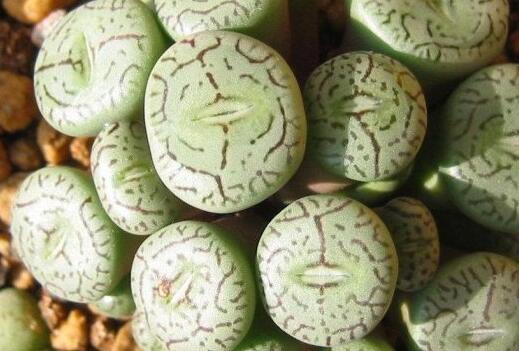
Cultivation and care methods for Conophytum:
1. Growth
The growth of Conophytum begins in the summer. With 1 to 2 waterings in this season, the new body will break through the grayish-white old skin and start vigorous growth. The splitting of bodies at this time becomes the greatest pleasure. It reflects good management from the previous year; poorly grown plants or old specimens are harder to split. The rate of body increase depends on the variety and cultivation skill. Instead of the ordinary doubling method for calculation, the increase in bodies proceeds by the so-called "mouse formula": 1 body, after 5 years, becomes more than 30 bodies; after 7 years, 100 bodies; after 10 years, more than 1000 bodies. With just the increase in the number of heads, its value increases correspondingly. Conophytum looks beautiful at this time. Looking at the richly colored flowers, the peculiar growth process, and the clustered beauty after the bodies multiply, especially the joy of "mouse formula" propagation, makes it a gem-grade plant. The growth and dormancy periods of Conophytum also differ. For those with only a few weeks of growing season, one must take into account their dormancy of nearly 40 weeks; the cultivation method used for these varieties is to water occasionally to keep them in a semi-dormant state. Their production cycle, besides the relationship of cold and heat, mainly consists of the relationship of dryness and moisture; such a cycle may be 200 days or 150 days. Do not consider it only by human cycles; take the native plant's own cycle as the standard.
2. Watering
During the high temperatures of summer, the plant is in a dormant state. It can be kept in a ventilated, cool place for care. Water only a small amount when the soil is excessively dry, or even cut off water entirely to prevent rot. When the weather turns cool in autumn, the plant begins to grow and blooms with beautiful flowers. It can then be moved to a bright location and watered appropriately. Vigorous plants can be given a once-monthly application of diluted, decomposed liquid fertilizer, and during flowering, take care to seize the right moment for hand pollination.
In winter, full sunlight is required. If the nighttime temperature can be kept above 12 degrees Celsius and the daytime temperature above 20 degrees Celsius, normal watering can continue, and some thin fertilizer can be applied as appropriate on clear mornings. If the temperature is lower, watering must be controlled and fertilizing stopped to let it go dormant.
In spring, as the plant grows, the fruit gradually matures and should be harvested in good time. By late spring and early summer, the old leaves of most varieties gradually thin, and 2 pairs of new leaves form progressively inside the old leaves. After the weather cools in autumn, the new leaves grow further, burst through the old leaves, and emerge.
During cultivation, rain exposure and waterlogging must be avoided at all times. During the growing season, it should receive plenty of sunlight, otherwise the plant will become leggy and fail to bloom. Repot once every 1 to 2 years. The potting soil can be leaf mold plus about 1/2 coarse sand or vermiculite; the particles should be coarse, not too fine.
During dormancy, the old skin completely envelops the plant, very cleverly preventing water evaporation from the new body. Being rained on during the plum rain season or excessive humidity in the greenhouse may trigger premature skin shedding. If such plants are still given no water as usual, the new body, because the evaporated water cannot be replenished, will soften and shrink. For this special situation, it is necessary to water frequently.
As for the watering method, for established bodies, keeping them moist is ideal (for plants in the skin-shedding stage with more old skin, note that after watering they do not dry easily). Due to constraints of time and labor, watering from above should be chosen on sunny days, with ventilation if conditions permit. Note that this method should not be used for single-headed plants or plants with too many heads. If the light level is 10, then that given to Conophytum is 8. Considering the diversity of Conophytum's forms and sizes, the issue of light must also be treated individually. It is common knowledge that large types generally take stronger light and small types weaker light.
3. Light
Considering the color of the body, or going further to consider the relationship between sunlight and flower color: yellow and white reflect the most light. Varieties with such flower colors in their native habitat must grow under fairly strong light. Next are brown-flowered, peach-flowered, red-flowered species, and so on, followed by the purple-flowered series. According to their respective habits, appropriate shading materials should be used. Lithops are commonly white-flowered or yellow-flowered; among Conophytum, large yellow-flowered types can be arranged according to the light requirements of Lithops. Varieties whose flower colors make it hard to reflect light should be shaded appropriately.
Insufficient sunlight during the growing season will cause the plant's varietal characteristics to degenerate, changing its shape and color. It is also a cause of weakening and rot.
Cultivation and care methods for Conophytum
The growth and dormancy of Conophytum are the easiest to judge among the "fairy" succulents. Dormant Conophytum will without doubt turn grayish-white and begin to shrink. The dormancy period generally runs from late May to late August, about 3 months as the standard, with some differences depending on locality and variety. Now let's take a look at the cultivation and care methods for Conophytum together with the editors of Boqii.
Conophytum
I. Growth
The growth of Conophytum begins in the summer. With 1 to 2 waterings in this season, the new body will break through the grayish-white old skin and start vigorous growth. The splitting of bodies at this time becomes the greatest pleasure. It reflects good management from the previous year; poorly grown plants or old specimens are harder to split. The rate of body increase depends on the variety and cultivation skill. Instead of the ordinary doubling method for calculation, the increase in bodies proceeds by the so-called "mouse formula": 1 body, after 5 years, becomes more than 30 bodies; after 7 years, 100 bodies; after 10 years, more than 1000 bodies. With just the increase in the number of heads, its value increases correspondingly. Conophytum looks beautiful at this time. Looking at the richly colored flowers, the peculiar growth process, and the clustered beauty after the bodies multiply, especially the joy of "mouse formula" propagation, makes it a gem-grade plant. The growth and dormancy periods of Conophytum also differ. For those with only a few weeks of growing season, one must take into account their dormancy of nearly 40 weeks; the cultivation method used for these varieties is to water occasionally to keep them in a semi-dormant state. Their production cycle, besides the relationship of cold and heat, mainly consists of the relationship of dryness and moisture; such a cycle may be 200 days or 150 days. Do not consider it only by human cycles; take the native plant's own cycle as the standard.
II. Watering
During the high temperatures of summer, the plant is in a dormant state. It can be kept in a ventilated, cool place for care. Water only a small amount when the soil is excessively dry, or even cut off water entirely to prevent rot. When the weather turns cool in autumn, the plant begins to grow and blooms with beautiful flowers. It can then be moved to a bright location and watered appropriately. Vigorous plants can be given a once-monthly application of diluted, decomposed liquid fertilizer, and during flowering, take care to seize the right moment for hand pollination.
In winter, full sunlight is required. If the nighttime temperature can be kept above 12 degrees Celsius and the daytime temperature above 20 degrees Celsius, normal watering can continue, and some thin fertilizer can be applied as appropriate on clear mornings. If the temperature is lower, watering must be controlled and fertilizing stopped to let it go dormant.
In spring, as the plant grows, the fruit gradually matures and should be harvested in good time. By late spring and early summer, the old leaves of most varieties gradually thin, and 2 pairs of new leaves form progressively inside the old leaves. After the weather cools in autumn, the new leaves grow further, burst through the old leaves, and emerge.
Cultivation and care methods for Conophytum
Conophytum is the collective name for a genus of succulents in the family Aizoaceae. It has many varieties with somewhat differing forms, but they share the common traits of being small plants with a pair of very fleshy opposite leaves growing directly above the root. The leaf shapes include spherical and inverted-conical; their lower parts are fused into a single whole, and the top has a fissure of varying depth. The colors include dark green, emerald green, yellow-green and others, and some varieties even have patterns or spots on the leaves.
The growth and dormancy of Conophytum are also the easiest to judge among the "fairy" succulents. Dormant Conophytum will without doubt turn grayish-white and begin to shrink. The dormancy period generally runs from late May to late August, about 3 months as the standard, with some differences depending on locality and variety.
II.Growth
The growth of Conophytum begins in the summer. With 1 to 2 waterings in this season, the new body will break through the grayish-white old skin and start vigorous growth. The splitting of bodies at this time becomes the greatest pleasure. It reflects good management from the previous year; poorly grown plants or old specimens are harder to split. The rate of body increase depends on the variety and cultivation skill. Instead of the ordinary doubling method for calculation, the increase in bodies proceeds by the so-called "mouse formula": 1 body, after 5 years, becomes more than 30 bodies; after 7 years, 100 bodies; after 10 years, more than 1000 bodies. With just the increase in the number of heads, its value increases correspondingly. Conophytum looks beautiful at this time. Looking at the richly colored flowers, the peculiar growth process, and the clustered beauty after the bodies multiply, especially the joy of "mouse formula" propagation, makes it a gem-grade plant. The growth and dormancy periods of Conophytum also differ. For those with only a few weeks of growing season, one must take into account their dormancy of nearly 40 weeks; the cultivation method used for these varieties is to water occasionally to keep them in a semi-dormant state. Their production cycle, besides the relationship of cold and heat, mainly consists of the relationship of dryness and moisture; such a cycle may be 200 days or 150 days. Do not consider it only by human cycles; take the native plant's own cycle as the standard.
II. Watering
During the high temperatures of summer, the plant is in a dormant state. It can be kept in a ventilated, cool place for care. Water only a small amount when the soil is excessively dry, or even cut off water entirely to prevent rot. When the weather turns cool in autumn, the plant begins to grow and blooms with beautiful flowers. It can then be moved to a bright location and watered appropriately. Vigorous plants can be given a once-monthly application of diluted, decomposed liquid fertilizer, and during flowering, take care to seize the right moment for hand pollination.
In winter, full sunlight is required. If the nighttime temperature can be kept above 12 degrees Celsius and the daytime temperature above 20 degrees Celsius, normal watering can continue, and some thin fertilizer can be applied as appropriate on clear mornings. If the temperature is lower, watering must be controlled and fertilizing stopped to let it go dormant.
In spring, as the plant grows, the fruit gradually matures and should be harvested in good time. By late spring and early summer, the old leaves of most varieties gradually thin, and 2 pairs of new leaves form progressively inside the old leaves. After the weather cools in autumn, the new leaves grow further, burst through the old leaves, and emerge.
Article source: http://www.yuhuagu.com
During cultivation, rain exposure and waterlogging must be avoided at all times. During the growing season, it should receive plenty of sunlight, otherwise the plant will become leggy and fail to bloom. Repot once every 1 to 2 years. The potting soil can be leaf mold plus about 1/2 coarse sand or vermiculite; the particles should be coarse, not too fine.
During dormancy, the old skin completely envelops the plant, very cleverly preventing water evaporation from the new body. Being rained on during the plum rain season or excessive humidity in the greenhouse may trigger premature skin shedding. If such plants are still given no water as usual, the new body, because the evaporated water cannot be replenished, will soften and shrink. For this special situation, it is necessary to water frequently.
As for the watering method, for established bodies, keeping them moist is ideal (for plants in the skin-shedding stage with more old skin, note that after watering they do not dry easily). Due to constraints of time and labor, watering from above should be chosen on sunny days, with ventilation if conditions permit. Note that this method should not be used for single-headed plants or plants with too many heads. If the light level is 10, then that given to Conophytum is 8. Considering the diversity of Conophytum's forms and sizes, the issue of light must also be treated individually. It is common knowledge that large types generally take stronger light and small types weaker light.
III. Light
Considering the color of the body, or going further to consider the relationship between sunlight and flower color: yellow and white reflect the most light. Varieties with such flower colors in their native habitat must grow under fairly strong light. Next are brown-flowered, peach-flowered, red-flowered species, and so on, followed by the purple-flowered series. According to their respective habits, appropriate shading materials should be used. Lithops are commonly white-flowered or yellow-flowered; among Conophytum, large yellow-flowered types can be arranged according to the light requirements of Lithops. Varieties whose flower colors make it hard to reflect light should be shaded appropriately.
Insufficient sunlight during the growing season will cause the plant's varietal characteristics to degenerate, changing its shape and color. It is also a cause of weakening and rot.
Article source: http://www.yuhuagu.com