A Detailed Guide to Water Cultivation Methods and Precautions for Pennywort
Pennywort (Hydrocotyle vulgaris) is a plant with extremely tenacious vitality. When grown in soil, even if its leaves accidentally droop from the sun, they may stand back up overnight after watering, and it is also very well suited to hydroponics. Let's take a look below at how to grow pennywort in water.
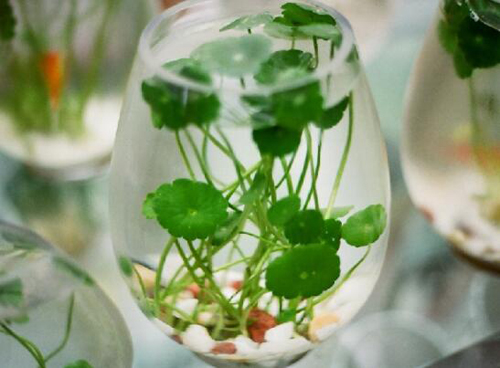
How to grow pennywort in water:
1. We need to prepare the pennywort rhizomes first. Because pennywort grows in connected clusters, for ease of arrangement we can cut it into single stems or groups of 1-3 stems, depending on the actual situation.
2. If the pennywort was previously planted in soil, the roots need to be rinsed clean, and care should be taken not to break the leaves or stems.
3. Next comes the arrangement. Gardeners should place the cleaned pennywort neatly in a container, then pour in clean water.
ps: It is worth reminding you here that sometimes pennywort cannot be secured in a hydroponic container. Gardeners can add some pebbles or similar items to hold it in place, or sand will also work.
4. After the pennywort is arranged, place it in a diffused-light environment to acclimatize. If there are any rotten leaves, just trim them off. #p#Subtitle#e#
Precautions for hydroponic pennywort:
1. Hydroponic pennywort should preferably not be exposed to direct sunlight for long periods, as this easily causes green algae to grow inside the container.
2. Pennywort has a strong phototropic tendency, so be sure to change the orientation of the container, otherwise the leaves will tend to grow leaning to one side, affecting its appearance.
3. Pennywort reproduces very quickly. Because hydroponic space is limited, excess leaves should be promptly removed for the sake of appearance.
4. Pennywort flowers are not attractive and consume a lot of nutrients, so if there is no need for them, promptly cut off the flower stems whenever flowering is noticed.
How to Grow Pennywort in Water: Hydroponic Methods for Pennywort
Pennywort, also called water coin, likes moist environmental conditions. So how do you grow pennywort in water? Below we will tell you the hydroponic methods for pennywort.
How to grow pennywort in water
1. Water quality: Pennywort does not have high requirements for hydroponic water quality. As long as the water does not smell bad or breed pests, ordinary tap water can be used directly for hydroponics. In summer, change the water about once every 3-4 days, replacing half the basin each time; in winter, change it once a week, replacing one third each time.
2. Fertilizing: Pennywort can produce the nutrients it needs for growth on its own through photosynthesis, so it can be fertilized relatively infrequently. If fertilizing is needed, ordinary chemical fertilizer can be dissolved in the water basin and allowed to be absorbed on its own, but be careful that the concentration is not too strong - a small amount is enough.
3. Light: Pennywort extremely loves sunlight when growing, so it is best to place the water basin outdoors or by a window with ample light. If grown indoors, the daily sun exposure time should be no less than 4-5 hours. In addition, a UV lamp or a strong fluorescent lamp can also be used to replace sunlight for lighting.
4. Pests: Pennywort generally does not attract pests, but soft-bodied animals such as water snails may gnaw on the roots and tender shoots. If such small creatures are found in the water, they should be removed by hand to prevent them from multiplying in large numbers.
5. Temperature: Pennywort is suited to growing in most of the hot and humid regions of the south, and especially in summer it reproduces particularly quickly. Its normal growth temperature is most suitable between 10-26°C; being too hot or too cold will inhibit the growth of pennywort.
6. Propagation: Pennywort is generally propagated by division. In summer, use scissors to cut at the position where the stolon has rooted, and transplant the front plant into another water basin to propagate. In addition, in summer pennywort will produce small flowers, and the seeds they set can also be used to propagate new plants.
Hydroponic methods for pennywort:
1. There is no need to change the water especially frequently. On the premise of ensuring there is enough water in the basin, changing it once a week is enough. In summer, the water can be changed a bit more frequently, mainly to prevent mosquitoes from laying eggs in it.
2. Maintain sufficient light. Only when it receives more than 4 hours of sunlight per day can pennywort grow luxuriantly and emerald green. Pennywort especially loves sunlight; under ample sunlight it can grow rapidly even without fertilizer. Conversely, if there is insufficient light or it is placed in a dark indoor spot for a long time, the leaves of pennywort will very easily turn yellow and wither.
3. As for fertilizing, there is no need to be too particular. If you keep goldfish at home, you can pour the water from changing the goldfish tank into the pennywort basin, which can make pennywort grow better.
4. In the south, it can survive well naturally if it grows well within a temperature range of 16-24°C. However, excessively high or excessively low temperatures will inhibit the growth of pennywort, and at high temperatures small insects are also more likely to appear in the water.
5. When growing pennywort in water, yellowing leaves will rot in the water and spoil the water quality, so we should regularly check the water container and promptly fish out any moldy or rotten leaves we find.
6. Vigorously growing pennywort can spread to fill the entire water basin within a month, so we should appropriately prune and divide it, transplanting overly dense pennywort into other water basins, so as to avoid mature leaves shading the light of tender leaves and affecting normal plant growth and metabolism.
Precautions for growing pennywort in water:
1. Pennywort is suited to rough, simple cultivation. As long as it is given enough sunlight and water, it can grow very quickly.
2. If indoors with no sunlight, artificial lighting can be used instead.
3. The water needs to be tap water that has been left to settle for two hours, or used the next day.
How to Grow Pennywort Hydroponically: Precautions for Cultivating Pennywort
Growing pennywort hydroponically is relatively speaking a method much loved by lazy gardeners. Below is a detailed introduction to hydroponic cultivation methods for pennywort, as well as the precautions during cultivation.
How to grow pennywort hydroponically
1. Pennywort's requirements for water quality: Just choose ordinary tap water. Change the water frequently. In summer, change the water once every 3-4 days, with the water level at half the bottle. In winter, change the water once a week. In winter the leaves transpire less, so replacing one third of the basin each time is enough.
2. Pennywort's requirements for light: This plant, pennywort, relatively likes light. I generally place pennywort somewhere the sunlight can reach, such as a windowsill. In summer the light duration can be longer. 4-5 hours is a must. In winter, if there is little light, a UV lamp or fluorescent lamp can be used to replace sunlight.
3. Pennywort's requirements for temperature: The editor is from the south, and growing pennywort hydroponically takes no effort at all. The southern climate is very suitable for cultivating pennywort. Keeping the normal temperature at 10-26°C is quite suitable. Being too hot or too cold is not suitable for pennywort growth.
4. How pennywort prevents pests: Pennywort's natural enemy is the water snail, which will eat pennywort's roots and tender shoots. If you see this kind of small creature in the water, you must absolutely not go easy on it. A large outbreak could be fatal to your pennywort.
5. Fertilizing pennywort: Personally, I do not particularly recommend fertilizing pennywort, because the nutrients produced by its own photosynthesis are enough. Of course, if you want it to be more luxuriant, you can apply a moderate amount of fertilizer. Ordinary chemical fertilizer can be dissolved in the water basin and allowed to be absorbed on its own, but be careful that the concentration is not too strong - a small amount is enough.
6. Pennywort's propagation method: Pennywort is generally propagated by division. In summer, use scissors to cut at the position where the stolon has rooted, and transplant the front plant into another water basin to propagate. In addition, in summer pennywort will produce small flowers, and the seeds they set can also be used to propagate new plants.
Precautions for cultivating pennywort
1. Get the soil, water and sunlight right: Pennywort has round leaves with wavy edges and long stems, and produces small yellow-green flowers in summer and autumn. It can be grown in water or on land. It likes warmth and moisture; the cultivation site is best in partial sun or shade, and it dislikes direct sunlight. It is not particular about the cultivation soil, but soft, well-draining cultivation soil is best. Propagation can use division or cuttings. It is easy to cultivate; keep the cultivation soil moist and it will root in about 1-2 weeks. Because the plant is tolerant of moisture and is an emergent type, it is also suitable for cultivation in water basins and ponds. If grown in water, be sure to change the water once a week and add a special nutrient solution for foliage plants.
2. Choose well-draining cultivation soil: Pennywort does not need a very large pot. It can also be grown in a larger bowl, and a narcissus basin for growing narcissus also works. For soil, use ordinary garden soil, mix in an appropriate amount of river sand, and add a small amount of organic fertilizer as base fertilizer. When planting pennywort, it can be planted flat, with the rhizome just slightly covered so it is not visible - never too deep. Then place it in partial shade for a week and wait for new leaves to grow before exposing it to sunlight.
3. Get the temperature right: Pennywort is afraid of cold. For pennywort placed outdoors in winter, all the water can be poured out and it can be placed in a south-facing, sunny, wind-sheltered spot; it can overwinter safely, though some leaves will die off, and the underground root system will sprout again the following spring. In cold northern regions without heating, you can make a cover and cover it together with the pot, pour out the water, keep it moist, and as long as the room temperature does not drop below zero it will likewise continue to grow the following year.