Rieger begonia (Begonia × hiemalis) cultivation methods and precautions: the growing temperature must be suitable
Rieger begonia is a herbaceous plant of the genus Begonia in the family Begoniaceae. The Rieger begonia has a full, compact plant form and is rarely reddish-brown. Its flower shapes are varied, mostly double-flowered, with rich colors; moreover, its flowering period is long, lasting from December through to the following spring in April. Below, let's talk about the cultivation methods and precautions for Rieger begonia.
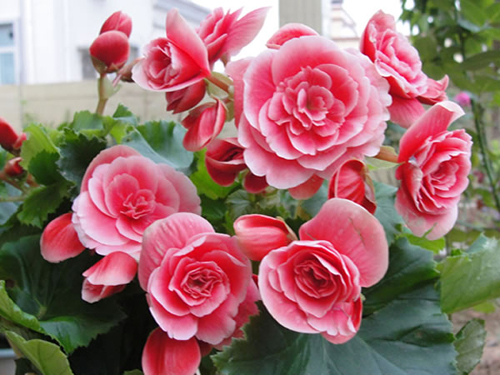
Cultivation methods for Rieger begonia:
1. Temperature: The suitable growing and development temperature for Rieger begonia is 18°C-22°C. For home care, the key point is to keep it warm in winter, and the lowest temperature must not fall below 15°C. Since Rieger begonia is still in its growth and flowering period in winter, it should be placed in a sunny, south-facing spot indoors as much as possible, such as on an indoor windowsill. But be careful not to place it too close to a heater, so as not to scorch the branches, leaves and flowers; when sustained high temperatures above 28°C occur in summer, cooling measures should be taken, such as placing it in an air-conditioned room or providing shade at noon.
2. Watering: The potting soil should remain moist, and must not dry out completely or become excessively wet; if too dry, it will cause water loss and wilting, and in severe cases the whole plant will die; if the potting soil is too wet, water fills the soil pores, causing severe oxygen deficiency in the soil, which in turn affects root respiration and causes death; overly wet potting soil also easily provides opportunities for fungal and bacterial diseases to infect, thereby affecting the ornamental value of the Rieger begonia.
3. Shaping and pruning: During the growing period, pinch out the growing tips to encourage the plant to sprout side branches, so as to achieve a full plant shape. Excess flower buds should also be removed in time, so as to avoid a large consumption of nutrients that would affect the development of other flowers.
4. Pests and diseases: Ginger juice mixed with water, sprayed at a ratio of 1:25, can prevent and control soft rot and the germination of other pathogenic spores.#p#Subtitle#e#
Precautions for cultivating Rieger begonia:
Fertilizer application: For young Rieger begonia seedlings, nitrogen fertilizer should be the main fertilizer to promote their growth and development into shape. As the plant grows, the amount of nitrogen fertilizer should be reduced, and the content of phosphorus and potassium fertilizer gradually increased. Before flowering, the amount of fertilizer should be increased, and foliar spraying of fertilizer can also be done appropriately. The concentration of the foliar fertilizer must not be too high, kept between 1% and 2%; the spray should be even, and both the front and back of the leaves should be sprayed. Rieger begonia is very sensitive to nutrient deficiency or excess nutrients, so fertilizer should be applied lightly; a compound fertilizer with a ratio of 15:5:15 or 20:10:20 can be used, maintaining the pH of the solution between 5.0 and 6.0. Based on the nitrogen content of the dissolved liquid fertilizer, when fertilizing once a week, the nitrogen concentration is 250-300 PPM; when fertilizing three or four times a week or every day, a nitrogen concentration of 100-200 PPM is more suitable. At the same time, a special fertilizer for Rieger begonia can also be used.
Key watering points: Usually, watering Rieger begonia should depend on climatic conditions. Generally, evaporation is fast in summer and the water requirement is relatively greater, so watering should be done in the morning or evening, and the frequency of watering depends on how moist the potting soil is. In winter, watering should preferably be done at noon on sunny days, and the water temperature should be close to the indoor air temperature, so as to avoid shocking the roots and causing death due to water that is too cold. To increase air humidity, a humidifier is best, or a sprayer can be used to spray a fine mist onto the leaves; it is enough to see the leaf surface become moist, but do not spray water mist onto the flowers.
Pruning essentials:
1. During the growing period, Rieger begonia should be pinched to encourage the plant to sprout side branches, so as to achieve a full plant shape. Excess flower buds should also be removed in time, so as to avoid a large consumption of nutrients that would affect the development of other flowers.
2. After the autumn cool arrives, Rieger begonia begins to sprout new branches from the base. When they have grown to a certain height, use a sharp knife to cut the old branches off at the base, and at the same time increase the amount of watering to promote the growth of the Rieger begonia. When the new branches have basically taken shape, keep 3 new branches per pot and cut off all the rest, so as to concentrate nutrients and allow the Rieger begonia to take shape as early as possible.
Repotting: Because the potting soil of purchased potted Rieger begonias meets the requirements, they do not need to be repotted for the first two years.
Rieger begonia cultivation methods and precautions: how to grow Rieger begonia
Rieger begonia is an ornamental flower with rich colors and beautiful flower shapes. The Rieger begonia's flowers are delicate and gorgeous, with large petals, making it very suitable for pot cultivation and display at home. So how is Rieger begonia cultivated? Today, the editor of wed114 wedding website brings you relevant content on the cultivation methods and precautions for Rieger begonia. Let's take a look.
Rieger begonia picture
I. Brief introduction to Rieger begonia
Rieger begonia (Latin scientific name: Begonia×hiemalis) is a herbaceous plant of the order Cucurbitales, genus Begonia, family Begoniaceae. Rieger begonia has a fibrous root system, a full plant form, alternate single leaves, asymmetrical heart-shaped, with leaf color mostly emerald green and rarely reddish-brown. Flower shapes are varied, mostly double-flowered, with rich colors including red, orange, yellow, white, etc. The flowers are large and brightly colored, with a unique posture, color and fragrance; moreover, the flowering period is long, lasting from December through to the following spring in April. The peak flowering periods are from April to June and from September to December. It likes warm, humid, semi-shaded environments. It is distributed in tropical and subtropical regions. It is suitable as an ornamental species.
Rieger begonia picture
II. Cultivation methods for Rieger begonia (basic knowledge):
Best propagation time: The best time for cutting propagation of Rieger begonia is late autumn and early winter.
Best growing soil: Rieger begonia likes well-drained substrates, such as coconut coir, peat soil, vermiculite, perlite, carbonized bark, etc. It is recommended to use 80% high-fiber peat soil and 20% perlite.
Growing humidity requirements: The early growth of Rieger begonia requires relatively high relative air humidity, and the relative humidity should be controlled at 80%-85%.
Best growing temperature: The suitable growing and development temperature for Rieger begonia is 18°C-22°C. For home care, the key point is to keep it warm in winter, and the lowest temperature must not fall below 15°C.
Best growing light: Rieger begonia is a quantitative short-day plant. When the summer temperature is above 25°C, more than 70% shading is needed. After late October, the light for Rieger begonia can be appropriately increased. After mid-November, short-day treatment should be carried out, and it should be allowed to receive as much light as possible to ensure growth and flowering.
Rieger begonia picture
III. Cultivation methods for Rieger begonia (specific operations):
1. Cultivation temperature
In terms of temperature, the suitable cultivation temperature for Rieger begonia is 18°C-22°C, and this temperature range leans toward the higher end. Therefore, Rieger begonia likes a warm living environment, and attention must be paid to the colder winter. When growing Rieger begonia at home, it is necessary to do a good job of keeping it warm in winter, and the overwintering temperature for Rieger begonia should preferably not be lower than 15°C.
It should be noted that Rieger begonia is still flowering in winter, so it needs to receive sufficient light after being dried. The pot of Rieger begonia can be placed in a spot that receives more sunlight, such as a south-facing balcony or windowsill. Do not place it near a heater. Also, in summer, attention must be paid to temperature; when the temperature is too high, cooling measures should be taken and shade should be provided in time.
2. Watering matters in cultivation
Watering work should be carried out according to specific conditions. For example, in summer when evaporation is high, more watering is needed, and it is best to water in the morning or evening; in winter, watering is best done at noon, and the water temperature should not be too low, so as not to freeze and damage the plant. Note that watering should be decided according to the condition of the potting soil.
In daily management, air humidity can be increased by spraying water. Note that when spraying, spray onto the leaf surface, not onto the flowers.
3. Cultivation light
In order to promote the growth of Rieger begonia, it needs to receive sufficient sunlight. However, during the growth process of Rieger begonia, light control must be done well. Shading in the early growth stage is indispensable. Secondly, Rieger begonia is a short-day plant and often needs artificial supplemental light, and dark treatment is also needed before flowering. How to do a good job of light control depends on the different climates of each region.
4. Fertilization
Fertilization is also a key point in the growth of Rieger begonia. The principle of fertilizing Rieger begonia is to apply light but frequent fertilizer.
Young Rieger begonia seedlings need some nitrogen fertilizer. When the plant gradually grows larger, the use of nitrogen fertilizer should be reduced, and more potassium and phosphorus fertilizer should be applied. Before flowering, more fertilizer should be applied to ensure sufficient nutrients for flowering. A not-too-concentrated foliar fertilizer can also be sprayed.
Rieger begonia picture
IV. Precautions for cultivating Rieger begonia:
Fertilizer application: For young Rieger begonia seedlings, nitrogen fertilizer should be the main fertilizer to promote their growth and development into shape. As the plant grows, the amount of nitrogen fertilizer should be reduced, and the content of phosphorus and potassium fertilizer gradually increased. Before flowering, the amount of fertilizer should be increased, and foliar spraying of fertilizer can also be done appropriately. The concentration of the foliar fertilizer must not be too high, kept between 1% and 2%; the spray should be even, and both the front and back of the leaves should be sprayed. Rieger begonia is very sensitive to nutrient deficiency or excess nutrients, so fertilizer should be applied lightly; a compound fertilizer with a ratio of 15:5:15 or 20:10:20 can be used, maintaining the pH of the solution between 5.0 and 6.0. Based on the nitrogen content of the dissolved liquid fertilizer, when fertilizing once a week, the nitrogen concentration is 250-300 PPM; when fertilizing three or four times a week or every day, a nitrogen concentration of 100-200 PPM is more suitable. At the same time, a special fertilizer for Rieger begonia can also be used.
Key watering points: Usually, watering Rieger begonia should depend on climatic conditions. Generally, evaporation is fast in summer and the water requirement is relatively greater, so watering should be done in the morning or evening, and the frequency of watering depends on how moist the potting soil is. In winter, watering should preferably be done at noon on sunny days, and the water temperature should be close to the indoor air temperature, so as to avoid shocking the roots and causing death due to water that is too cold. To increase air humidity, a humidifier is best, or a sprayer can be used to spray a fine mist onto the leaves; it is enough to see the leaf surface become moist, but do not spray water mist onto the flowers.
Pruning essentials:
1. During the growing period, Rieger begonia should be pinched to encourage the plant to sprout side branches, so as to achieve a full plant shape. Excess flower buds should also be removed in time, so as to avoid a large consumption of nutrients that would affect the development of other flowers.
2. After the autumn cool arrives, Rieger begonia begins to sprout new branches from the base. When they have grown to a certain height, use a sharp knife to cut the old branches off at the base, and at the same time increase the amount of watering to promote the growth of the Rieger begonia. When the new branches have basically taken shape, keep 3 new branches per pot and cut off all the rest, so as to concentrate nutrients and allow the Rieger begonia to take shape as early as possible.
Repotting: Because the potting soil of purchased potted Rieger begonias meets the requirements, they do not need to be repotted for the first two years.
Propagation essentials: Rieger begonia is propagated by sowing, cutting or tissue culture.
1. Sowing method. Because Rieger begonia seeds are very small, the small-seed sowing method must be used. Rieger begonia seeds are basically all imported, and are divided into coated and uncoated seeds. Coated seeds can be sorted, so plug trays can be used; uncoated seeds can only use seedling trays. The sowing substrate is 1 part peat soil and 1 part vermiculite powder, crushed and sterilized, then mixed and stirred, and left in a semi-moist state for use. Because peat soil is hydrophobic in a dry state and water cannot enter it, it cannot be used in a dry state. When sowing, first put the substrate into the seedling tray, then water thoroughly with a watering can.
2. Cutting method. In late autumn and early winter, when pruning and shaping the plant, the cut new shoots can be used as cuttings. Rieger begonia can be propagated by stem cuttings or leaf cuttings. For stem cuttings, the length of the branch should be moderate, and the lower part of the branch should be cut into a horseshoe shape with a blade; for leaf cuttings, choose vigorous leaves that are about 60% mature, and cut the lower end of the leaf stalk diagonally with a blade. The cutting substrate is vermiculite powder or clean sand; contaminated substrate must be disinfected before use. After inserting the cuttings, water thoroughly, but no water should accumulate on the leaf surface. Then cover them with plastic film, place them in diffused light, provide appropriate ventilation, and avoid high temperatures. After about 3 weeks, the cuttings can take root. When new leaves are seen growing, it means they have rooted. Plants obtained by stem cuttings do not have underground tubers. After 3 weeks, leaf cuttings can also grow fibrous roots from the lower part of the leaf stalk, but it takes another month and a half before adventitious buds can grow from the lower part of the leaf stalk and gradually emerge from the soil.
3. Tissue culture method. The tissue culture method is a way to quickly obtain a large number of flower seedlings. In the peak growing season, use well-developed leaves as explants, and through the culture of virus-free explants, subculture and rooting culture in a certain medium, a large number of virus-free seedlings can be obtained. This method requires a relatively large investment and is only used in large-scale production.
Pest and disease control: Home-grown Rieger begonia has relatively few pests and diseases. Regularly spray fungicides to prevent bacterial soft rot and powdery mildew; agricultural streptomycin at 200 ug/g and carbendazim at 1000 times solution can be sprayed; to prevent pesticide pollution of the air in the home, some homemade pesticides can be made, with good control effects. The following 2 common methods are: (1) Ginger juice mixed with water, sprayed at a ratio of 1:25, can prevent and control soft rot and the germination of other pathogenic spores. (2) 50 grams of dried chili peppers, add 50 times water, boil for half an hour, take the supernatant and spray on the leaf surface; it can effectively control aphids, red spiders and bud mites, inhibit plant growth, and make new leaves harden or become linear.
Rieger begonia picture
V. Small tips for cultivating Rieger begonia:
1. When temperatures are high in summer, Rieger begonia grows slowly or stops completely, entering a dormant or semi-dormant state. The remaining flowers and withered leaves should first be cut off, and 50% to 70% shading should be provided; watering should be controlled, and the soil should be kept only slightly moist, to prevent root and stem rot caused by overly wet potting soil.
2. In winter, Rieger begonia is still in its growth and flowering period, so it should be placed in a sunny, south-facing spot indoors as much as possible, such as on an indoor windowsill. When sustained high temperatures above 28°C occur in summer, cooling measures should be taken, such as placing it in an air-conditioned room or providing shade at noon.
[How to grow Rieger begonia] Rieger begonia cultivation methods and precautions
Rieger begonia is an excellent flower for beautifying indoor environments in winter, and it is also one of the main types of indoor flowering plants for all four seasons. Growing Rieger begonia at home is different from large-scale greenhouse production. If suitable environmental conditions can be created, Rieger begonia will certainly add some color to your home. Below is a compilation of the daily cultivation methods and precautions for Rieger begonia, hoping it is helpful to flower lovers.
How to grow Rieger begonia (daily cultivation and planting methods) 1. Rieger begonia cultivation: temperature adaptationThe suitable growing and development temperature for Rieger begonia is 18°C-22°C. For home care, the key point is to keep it warm in winter, and the lowest temperature must not fall below 15°C. Since Rieger begonia is still in its growth and flowering period in winter, it should be placed in a sunny, south-facing spot indoors as much as possible, such as on an indoor windowsill. But be careful not to place it too close to a heater, so as not to scorch the branches, leaves and flowers; when sustained high temperatures above 28°C occur in summer, cooling measures should be taken, such as placing it in an air-conditioned room or providing shade at noon.
2. Rieger begonia cultivation: appropriate wateringThe potting soil should remain moist, and must not dry out completely or become excessively wet; if too dry, it will cause water loss and wilting, and in severe cases the whole plant will die; if the potting soil is too wet, water fills the soil pores, causing severe oxygen deficiency in the soil, which in turn affects root respiration and causes death; overly wet potting soil also easily provides opportunities for fungal and bacterial diseases to infect, thereby affecting the ornamental value of the Rieger begonia. Usually, watering Rieger begonia should depend on climatic conditions. Generally, evaporation is fast in summer and the water requirement is relatively greater, so watering should be done in the morning or evening, and the frequency of watering depends on how moist the potting soil is. In winter, watering should preferably be done at noon on sunny days, and the water temperature should be close to the indoor air temperature, so as to avoid shocking the roots and causing death due to water that is too cold.
3. Rieger begonia cultivation: rational fertilizationIn the process of caring for Rieger begonia, regular fertilization is especially important. For young seedlings, nitrogen fertilizer should be the main fertilizer to promote their growth and development into shape. As the plant grows, the amount of nitrogen fertilizer should be reduced, and the content of phosphorus and potassium fertilizer gradually increased. Before flowering, the amount of fertilizer should be increased, and foliar spraying of fertilizer can also be done appropriately. The concentration of the foliar fertilizer must not be too high, kept at 1%-2%; the spray should be even, and both the front and back of the leaves should be sprayed.
4. Rieger begonia cultivation: shaping and pruningDuring the growing period, pinch out the growing tips to encourage the plant to sprout side branches, so as to achieve a full plant shape. Excess flower buds should also be removed in time, so as to avoid a large consumption of nutrients that would affect the development of other flowers.
5. Rieger begonia cultivation: pests and diseasesHome-grown Rieger begonia has relatively few pests and diseases. Regularly spray fungicides to prevent bacterial soft rot and powdery mildew; agricultural streptomycin at 200 micrograms/g and carbendazim at 1000 times solution can be sprayed; to prevent pesticide pollution of the air in the home, some homemade pesticides can be made, with good control effects.
Precautions for cultivating Rieger begonia 1. Do not fertilize during the flowering periodDuring the flowering period of Rieger begonia, it is best not to fertilize, and do not move the pot casually, otherwise the flower buds will drop. Watering should be moderate, and there should not be too much water, so as to avoid water accumulating in the pot and poor soil drainage.
2. Control of watering amountWhen watering, the water temperature needs to be close to room temperature. The suitable temperature for Rieger begonia growth is 15°C-22°C, and the temperature during flowering should be maintained between 15°C-17°C; after May, as the temperature gradually rises, Rieger begonia will enter a semi-dormant state, and watering should be reduced.
3. Winter precautionsRieger begonia will still bloom in winter, so maintain a suitable temperature. When caring for it indoors, place Rieger begonia in a sunny spot indoors; a south-facing windowsill is a very good choice.
4. Summer precautionsIn summer, the sunlight is strong, so Rieger begonia needs a little shading for it to grow well. However, if the shading is excessive, the plant will become leggy and flowering will be affected.
5. Pruning dead branches and remaining flowersAfter Rieger begonia finishes flowering, the dead branches and remaining flowers need to be cut off.