When to repot Bougainvillea? Key repotting points and routine care methods
Bougainvillea has large bracts and vivid colors, and its flowering period lasts a long time, making it very suitable for garden planting or potted display. Many flower enthusiasts grow it, but some who are growing Bougainvillea for the first time lack experience and do not know the right time to repot it, fearing that the wrong season will cause problems. Below, the editor brings you detailed information on when to repot Bougainvillea, hoping it will help everyone.
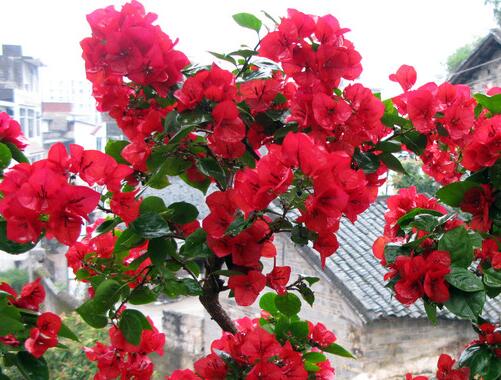
When to repot Bougainvillea:
The timing of repotting Bougainvillea is related to the method. Generally, spring and autumn each year are the most suitable, though for experienced flower enthusiasts, other seasons are also possible for repotting. For example, when repotting in spring and autumn, more old soil and old fine roots can be removed, while when repotting in other seasons, as much old soil and old fine roots as possible should be retained. For beginners, repotting should keep the root ball intact as much as possible, so there is no risk.
Key points for repotting Bougainvillea:
(1) Before repotting, it is best to do it when the potting soil is relatively dry, because this makes it easier to remove old soil and old fine roots. Do not repot right after watering.
(2) When repotting, it is best to remove only one-third or one-half of the old soil (keeping the root ball from breaking apart). This is relatively safe. If you are not confident, do not clean off all the soil. #p#Subtitle#e#
Routine care of Bougainvillea:
1. Plenty of sunlight:
Bougainvillea is a plant that likes high temperatures and strong sunlight, so potted Bougainvillea should always be placed in a sunny spot. This is not only beneficial to its vegetative growth, but also favorable to reproductive growth. Practice has proved that plants treated with strong sunlight have shorter internodes, more substantial growth, more flowers, deeper flower color, and a longer flowering period.
2. Regular pruning:
Bougainvillea has a long growth period and fast growth speed, so timely pruning and pinching are necessary to fix and maintain the plant shape. Pinching also helps promote new branches and make it bloom more -- because flowers only bloom at the tips of new branches. Pruning is generally carried out in spring and summer. Pruning after mid-August will affect flowering and should not be done again. The targets of pruning are inner branches, weak branches, leggy branches, crossing branches, etc. Some overly long branches should also be shortened to leave 1-2 buds.
3. Strictly control watering:
Purple Bougainvillea should begin water restriction about 5 weeks before flowering (that is, around mid-August). After watering once, water again only after the leaves and tender buds droop. The degree of water restriction is based on the plant not dying of drought. Repeat this treatment until flower buds begin to appear in the leaf axils at the branch tips, then gradually resume normal watering. Water restriction increases the concentration of cell sap, thereby promoting flower bud differentiation and formation.
4. Timely topdressing:
Bougainvillea is very sensitive to urea. If the fertilization period or ratio is improper, it may produce the phenomenon of luxuriant branches and leaves but few flowers, so extra caution is needed when applying urea. In summer, with high temperatures and more rain, plants are prone to leggy growth, so urea should not be applied alone; some fertilizer made from fermented waste vegetables can be applied. When conditions permit, a 0.2-0.3% potassium dihydrogen phosphate solution can be used as foliar topdressing, once every half month. In the early stage of flower branch growth, urea still needs to be applied once to benefit flower branch growth. Among the above four measures, the most important are the last two. If these two are mastered well, the adverse effects caused by insufficient sunlight can be completely overcome.
How to grow Bougainvillea? Cutting methods and planting techniques for Bougainvillea
According to the editor's understanding, Bougainvillea is very easy to grow and very easily fills a pot. If planted well, it is an excellent bonsai. Below, the editor shares with everyone the cutting methods and key planting points for Bougainvillea.
1. Growth habits of Bougainvillea
Bougainvillea is a vine plant with vigorous vitality. It can be planted in some areas in both the north and south, and Bougainvillea in the south grows better. It likes a warm and humid environment and likes loose soil with good water permeability and air permeability. It is afraid of waterlogged soil, and its flowering period can last as long as eight months.
2. Cutting methods for Bougainvillea
For cuttings, it is best to choose spring, and choose sandy soil with strong water permeability as the growing medium. Choose semi-lignified branches from the current year that have grown for some time. This kind of branch has a relatively high rooting rate. In addition, the branches should not have diseases and pests, and the branches should be healthy and robust. Generally cut about ten centimeters. After cutting the branch, be sure to disinfect the cut end of the cutting, and cut off the flowers and leaves, leaving only two or three leaves, and remove the flower buds. Rooting hormone can be used according to the instructions to help rooting. Ensure the moisture of the growing medium. After cutting, place it in a cool place. Generally after about one month, Bougainvillea can basically be cared for normally.
3. Key points of routine care
Water: Bougainvillea blooms more and grows faster, so it has a relatively large demand for water. Generally, the amount of watering is determined according to air humidity and evaporation. In summer, when evaporation is relatively high, pay attention to spraying water on the leaves in time, and water once each in the morning and evening. In spring and autumn, the amount of watering can be appropriately reduced. In winter, according to the dryness and wetness of the pot, water again when the pot is dry.
Fertilizer: Bougainvillea has a long flowering period and needs more fertilizer. Usually, once every two weeks, diluted decomposed cake fertilizer can be applied to supplement nitrogen. During flowering, some phosphorus and potassium fertilizer can be added. In winter, do not fertilize, as it easily damages the roots.
Light: Bougainvillea is suitable for growing in a place with plenty of sunlight, which helps the growth of its branches and leaves and helps improve flower color. If there is not enough light, it easily causes Bougainvillea leaves to fall off.
In the editor's view, Bougainvillea has beautiful flower colors and beautiful flower posture, and is an excellent flowering plant. The above are the planting techniques for Bougainvillea, hoping to be helpful to you.
Bougainvillea | Bougainvillea pictures | How to grow Bougainvillea
Introduction to Bougainvillea, Bougainvillea picturesIn the south, Bougainvillea is planted in courtyards and parks, while in the north it is cultivated in greenhouses. It is a beautiful ornamental plant. This article includes Bougainvillea pictures and how to grow Bougainvillea. It covers how to grow Bougainvillea well, Bougainvillea propagation techniques, Bougainvillea cutting propagation, key points of Bougainvillea care techniques, and Bougainvillea pest and disease control.
[Contents] 1. Propagation methods of Bougainvillea 2. How to grow Bougainvillea well? How to make Bougainvillea bloom more? 3. Brief analysis and control of Bougainvillea pests and diseases 4. Key points of Bougainvillea care techniques
1. Propagation methods of Bougainvillea
First, let me introduce the propagation methods of Bougainvillea to readers:Bougainvillea is mostly propagated by cuttings, and can also be propagated by air layering and grafting. Cuttings are suitable from March to June. Generally, at a temperature of about 25°C, humidity of 90%, and shading of 70%, roots can form in about 30 days. Air layering and grafting propagation take about one month to root.
2. Sand bed treatment before cutting:
New river sand does not need disinfection; just expose it to the sun. Used sand must first have impurities removed, and it is best to expose it to the sun and then level the sand bed, disinfecting it with fungicide or potassium permanganate.
3. Selection of cuttings: Healthy branches free of pests and diseases can all be used for cuttings. It is best to use semi-lignified branches, which root quickly. Generally, the length of the cuttings is 20-30 cm. Lignified and thick ones can be left at a length of 30 cm, while semi-lignified ones are about 20 cm. Cut the bottom of the branch into a slanted opening and the top into a flat opening. A little yellow mud slurry can be placed at the flat opening to preserve moisture and prevent evaporation.
4. Routine management and care: After cutting, immediately water thoroughly to settle the roots. Pay attention to moisture retention and shading. After rooting, transplant into pots in time. After the roots are established, place it in a sunny place. During the growth period and flowering period, pay attention to controlling water and fertilizer to achieve the effect of abundant flowers and bright colors. According to the growth of the seedlings, timely weed, loosen the soil, repot, and change the soil. Bougainvillea is prone to leggy branches. If allowed to grow naturally, its appearance is not attractive, so the main work in Bougainvillea management is pinching, pot curling, and pruning to control the tree shape. When designing the shape, it should be carried out in time before the branches are completely lignified, to shorten the time needed to cultivate the required shape. Generally, a small amount of fertilizer can be applied to the soil during the growth period and flowering period. For soil with poor fertility, pay attention to the ratio of N, P, and K fertilizers, otherwise it will affect flower bud differentiation and cause the plant to only grow branches without blooming. With good management and care, it can bloom in one year.
2. How to grow Bougainvillea well? How to make Bougainvillea bloom more?
Next, let us understand together how to grow Bougainvillea well and how to make Bougainvillea bloom more.Bougainvillea stands out among potted flowers for its unique petals and delicate fragrance. Bougainvillea is also called leaf flower. It is native to Brazil and is cultivated in various places in China. It likes a warm, sunny environment. Its stems are curved and densely covered with fine hairs. The single leaves are alternate, ovate, covered with thick fine hairs, and rounded and blunt at the tip. The flowers grow at the tips of new shoots, usually 3 flowers clustered within 3 relatively large bracts, with the pedicel fused to the midvein of the bract. The bracts are leaf-like, elliptical, bright red, and there are also varieties in white, brick red, orange, and other colors. The perianth tube is densely covered with soft hairs, with 5 to 10 stamens, and the ovary has 1 locule. The flowering period is from June to December. In warm southern regions, it is often used as greening material for trellises and hedges, and can also be grown as a potted ornamental plant.
The key points for making its potted flowering period long and flower color vivid are briefly described as follows:
First, scientific water management. That is, the three points of watering, water control, and heavy watering are combined. In the early summer growth season, water once a day to ensure branch and leaf growth. From June to July, according to different varieties, appropriately control water 3 to 4 times. The degree of water control is to make the branch tips and leaves slightly wilt. At this time, spray water on the leaves 1 to 2 times a day, and after 2 to 3 days, water thoroughly. Repeated water control or watering every other day can promote flower bud differentiation. When flower buds appear on new shoots, water heavily once each in the morning and evening, and spray water on the leaf surface 1 to 2 times. After October, water appropriately according to the dryness and wetness of the soil. After moving indoors in winter, keep to not watering when not dry, and water thoroughly when watering.
Second, proper fertilization. Bougainvillea blooms a lot and has a long flowering period, consuming much nutrition. In addition, the potting soil is limited, so fertilizer must be supplemented regularly. When repotting in spring, apply sufficient base fertilizer. According to the size of the pot, apply 10 to 15 grams of decomposed dried chicken manure or cake fertilizer per pot. After moving outdoors, topdress with quick-acting nitrogen fertilizer. During the vigorous growth period, apply decomposed cake fertilizer water every 7 days to accelerate flower bud differentiation. When flower buds appear in the leaf axils, more fertilizer and heavier fertilizer can be applied, mainly phosphorus and potassium fertilizer. During the full flowering period in summer, apply alum fertilizer water once every 3 to 5 days, and spray 0.3% potassium dihydrogen phosphate every 7 days. From August to October, even more heavy fertilizer and heavy water are needed, using fertilizer instead of water, watering with alum fertilizer water or cake fertilizer water.
Third, the sunshine should be long and the light should be strong. For potted Bougainvillea, as long as light, temperature, water, and fertilizer are sufficient, it can bloom all year round. With 10 to 12 hours of sunshine per day, strong light, and good ventilation conditions, the flowering period can reach 180 to 200 days. Among them, purple Bougainvillea can bloom until the Spring Festival, and after being moved outdoors at Qingming, it can bloom again brilliantly at May Day.
How to make Bougainvillea bloom more
3. Brief analysis and control of Bougainvillea pests and diseases
To grow Bougainvillea well, attention must be paid to pest and disease control. How to control Bougainvillea pests and diseases?
Bougainvillea brown spot disease harms leaves, producing yellow-brown to light brown lesions with a diameter of 0.1-0.5 cm on the leaf surface. When a small number of diseased leaves are found, remove and burn them in time. In the early stage of the disease, use 70% mancozeb wettable powder 400 times solution, spraying once every 10 days, for 3 to 4 consecutive times.
Bougainvillea leaf spot disease: the lesions are initially yellow-brown, surrounded by a yellow-green halo, then expand into nearly round or irregular lesions with dark brown edges. In the later stage, small black dots appear on the lesions. When a small number of lesions are found, miconazole nitrate cream can be applied on them, and the branches with more disease can be cut off. In the early stage of the disease, 50% carbendazim wettable powder 500 times solution can generally be used for control, spraying once every 7-10 days. In severe cases, according to actual experience, spray once again on the fourth day, and then spray once every 7 days. For 3-4 consecutive times, the control effect is good.
Scale insects: In environments with poor light, poor ventilation, and high temperature and high humidity, various scale insects are prone to piercing and sucking damage. They can be killed by spraying 45% malathion emulsifiable concentrate 1000 times solution.
4. Key points of Bougainvillea care techniques
Finally, let us summarize the key points of Bougainvillea care techniques:1. Watering
Scientific watering is an important part of ensuring normal flowering of Bougainvillea. When red Bougainvillea is in the growth period, it needs a relatively large amount of water. It should be watered thoroughly and moistly, keeping the soil moist. The soil should drain well to prevent long-term waterlogging from accumulating water, causing root rot and leaf drop, and directly affecting normal growth or delaying flowering. When entering the flowering period, watering should be timely, the soil should remain moist, and the amount of water should be appropriate. If too much water is given, it will cause branches and leaves to grow luxuriantly without flowering or with few flowers; after the flowering period, the number of waterings can be appropriately reduced. Because after continuous flowering, the nutrients in the plant have been consumed too much, and most leaves turn yellow and fall off. If watered too much and the soil is too wet, the roots will rot. Purple Bougainvillea needs less water and can be managed extensively. It must be done as follows: do not water when not dry, and water thoroughly when watering, otherwise it will lead to excessive vegetative growth, which is not conducive to reproductive growth and directly affects flowering quality.
2. Promoting flowering
The normal full flowering period of Bougainvillea is in April and November, while Xiamen's major event, the September 8 Fair, is in September, followed closely by National Day. In order to make Bougainvillea bloom profusely during this period, water restriction is needed to promote flowering so that it enters the full flowering period earlier. This is especially true for purple Bougainvillea on important traffic routes, such as the purple Bougainvillea on the median strip of Lianqian East Road leading to the Convention and Exhibition Center. Before flowering, intermittent water restriction should be carried out to promote flowers all over the branches. That is, around late July, choose robust adult plants and carry out intermittent water restriction to promote flowering according to sunny or cloudy weather and dry or humid air conditions. You can refrain from watering for 10-12 consecutive days. Observe the soil. When the soil is dry and whitish, the branches slightly droop from water loss, and the leaves are withered and yellow, water a little, then continue water restriction. Repeat this 2-3 times to stop apical growth, concentrate nutrients, and promote flower bud differentiation. When red halos appear at the tops of the branch tips, water thoroughly again, and apply calcium phosphate once every two weeks. After 40-50 days, it can enter the full flowering period. Hormone regulation can also be used, spraying CCC, so that vegetative growth is controlled and transformed into reproductive growth, producing flower bud differentiation and flowering earlier.
3. Fertilization
Red Bougainvillea likes fertilizer more than purple Bougainvillea. Red Bougainvillea is fertilized 4-5 times a year, about once every two months during the growth period and flowering period, and about once every four months during the dormant period, mainly with compound fertilizer. During the flowering period, it needs more nutrients, so before flowering, phosphorus fertilizer should be applied 2-3 times. Usually do not apply too much fertilizer, to avoid rampant branch growth without flowering. Purple Bougainvillea only needs fertilizer 2-3 times a year. The first time is in spring before the temperature rises and vigorous growth begins, and the second time is in late autumn, mainly with compound fertilizer. The fertilization concentration should be appropriate, avoiding too high a concentration that damages the root system and causes fertilizer damage, and too low a concentration that insufficiently supplies the needed nutrients and affects normal flowering of the plant. Generally, quick-soluble fertilizer is controlled at 0.5-1 gram/kg. Note that it is not suitable to apply too much nitrogen fertilizer, so as not to affect flowering.