What to do when the leaves of the Aglaia odorata (mock lime) turn yellow? Don't overlook these cultivation precautions
Aglaia odorata (mock lime) likes warmth, sunshine and plenty of fertilizer. Its optimum growing temperature is 20°C-25°C. Normally, with ample sunlight and a fairly high temperature (around 30°C), the flowers it produces will have a strong fragrance. The mock lime has green leaves and small flowers with a rich aroma, yet the size and color contrast between the leaves and the flowers is just right. So what should you do when the leaves of the mock lime turn yellow? Below, the editor brings you the detailed information.
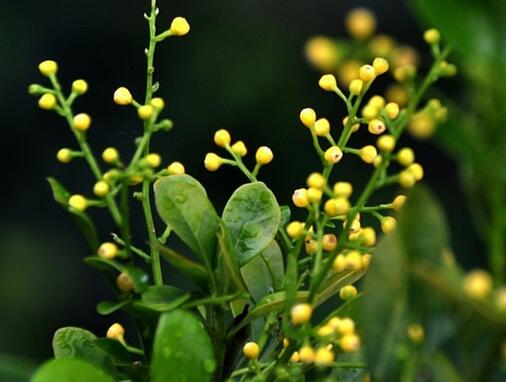
Causes of yellowing leaves in Aglaia odorata (mock lime):
Low temperature
Yellowing leaves on the mock lime often appear in winter, and the main cause is temperature being too low. The mock lime likes a warm environment; when the overwintering temperature drops below 5°C, it will suffer cold damage. The early stage of cold damage shows as leaves gradually turning yellow and then dropping off. Another point is exposure to cold winds: overnight, the mock lime's leaves turn yellow. Once the plant is frostbitten or hit by cold wind, it is very hard to save, and it will affect flowering the following year, so when winter sets in, be sure to do a good job of keeping it warm.
Improper watering
The mock lime likes moisture. If it has not been repotted for a long time, the nutrients in the soil decrease and oxygen is reduced; after watering, the root system stays wet for a long time, respiration is inhibited, and part of the root system becomes necrotic, causing leaves to yellow and drop. At this point you need to stop watering immediately; if the potting soil is too wet, you can take the plant out of the pot and replant it. In addition, in hot seasons, if watering is not timely and the potting soil stays dry for a long time, the leaves will also turn yellow in a short time. At this point, do not water it thoroughly all at once; proceed gradually so the plant can recover slowly.
Insufficient light
The growth of the mock lime requires ample sunlight. If it is kept in a shaded environment for a long time, photosynthesis accumulates fewer nutrients, which leads to leaves yellowing and dropping. At this point, immediately move the mock lime into the sunlight and rotate it every month so it receives light evenly. Even if the leaves have turned yellow, it will slowly recover.
Soil pH
The mock lime likes slightly acidic soil. If the soil is on the alkaline side, it will cause the leaves to turn yellow. Most soil in the north is alkaline, and this situation is hard to avoid. The simplest method is to try to change the soil's pH. In the north, water with alum fertilizer water 3-5 times a year to lower the soil's alkalinity; repot once a year, and for the growing medium choose field soil, pine needle soil plus a small amount of river sand. Most soil in the south is weakly acidic, so you can cultivate it directly with river-pond mud and repot once every 1-2 years.
Poor ventilation
The growth of any plant requires fairly good air quality and normal air circulation. If the mock lime grows for a long time in a place without air flow, it is also prone to yellowing leaves. Usually pay attention to opening windows for ventilation, and promptly prune away the overly dense inner branches and leggy branches to ensure good light and ventilation.#p#Subheading#e#
Precautions for cultivating Aglaia odorata (mock lime):
As long as the mock lime is given a suitable temperature, it can fill its branches with wonderful fragrance, and in summer this period the floral scent is the strongest; the most suitable temperature for flowering is 30°C. When cultivating it, note that the temperature should be kept at 25°C for it to normally produce beautiful flowers full of fragrance.
The mock lime needs sunlight all year round, with the best being 12 hours of sunshine, so the mock lime is best placed on a balcony or planted in a courtyard; only then can you ensure the leaves stay vividly green and the flowers beautifully fragrant.
If the mock lime cannot be given timely and reasonable fertilizer supplementation, it will wilt. Because flowering multiple times a year leads to insufficient nutrients, and if fertilizer is lacking, it will not flower, or the flowers will drop before opening. So after flowering, fertilizer needs to be applied in time to prepare for the next flowering. During the growing period it can be slightly more concentrated, and during the flowering period it can also be appropriately increased.
Reasonable watering is essential for its growth. If it lacks water, it will not grow large; but if there is too much water, the roots will rot and the leaves will turn yellow. So it is recommended to water twice a day.
What to do when the mock lime drops its leaves: cultivation methods and precautions for Aglaia odorata
Aglaia odorata (mock lime) is a flower with a very beautiful name; it is an evergreen shrub or small tree, and its flower meaning is "with love, life will bloom." As long as we care for it attentively, it will grow. However, the mock lime is a bit delicate, and with the slightest inattention it will drop its leaves. Next, the editor will briefly introduce what to do when the mock lime drops its leaves, as well as the cultivation methods and precautions for the mock lime, to serve as a reference for everyone growing it.
I. What to do when the mock lime drops its leaves
There are many reasons the mock lime drops its leaves; you must find the cause to prescribe the right remedy. The following are several reasons the mock lime drops its leaves and how to deal with them.
1. Improper watering, too much or too little
With too much watering, the roots of the mock lime will rot, and the leaves will also be affected, showing leaf drop; with too little watering, moisture is insufficient, yellow leaves appear, and the leaves will also fall off.
Treatment: adhere to the principles of not watering until dry and "water when dry, stop when wet." Generally, water once every 2 days, and be sure to water thoroughly each time. In summer and autumn, water once a day; in winter and spring, water once every 2-3 days.
2. Improper fertilizing, too much or too little
Too much fertilizer will damage the roots, and after the mock lime's leaves are affected they will also drop; too little fertilizer means the leaves do not have enough nutrients, so they will also turn yellow and drop.
Treatment: adhere to the principle of applying thin fertilizer frequently, fertilizing once a month. You can also add an appropriate amount of superphosphate to the fertilizer, so the mock lime will grow better.
3. Insufficient light
The mock lime likes a warm, humid environment with ample sunlight. If it is placed in a dark environment to grow, with insufficient light, growth will be affected and the leaves will turn yellow and drop.
Treatment: cultivate the mock lime under bright, indirect light.
4. Impact of pests and diseases
Affected by leaf spot disease and pests such as scale insects and red spider mites, the mock lime's leaves will wither, turn yellow and drop.
Treatment: spray pesticide regularly, carrying out pest and disease control every 15-20 days.
II. Cultivation methods and precautions for the mock lime
1. Temperature
The mock lime likes a warm, humid environment. Its optimum growing temperature is 20°C-25°C, and its cold tolerance is relatively weak. When overwintering in winter, attention should be paid to moving it to an environment with a temperature no lower than 10°C.
2. Light
The mock lime likes an environment with ample sunlight, especially bright, indirect light. When the summer sun is fierce, it needs appropriate shading or should be moved indoors, avoiding direct sunlight; in winter, let it be exposed to sunlight more, ensuring 12 hours of sunshine per day.
3. Watering
The mock lime likes a humid environment. Generally, water once every 2 days. When watering, adhere to the principles of "do not water until dry" and "water when dry, stop when wet." In summer, when water evaporates relatively quickly, you need to spray water on the leaves frequently.
4. Soil
The mock lime grows best in loose, fertile, slightly acidic soil. Therefore, when cultivating it, you should loosen the soil frequently, keep the soil loose and drainage unobstructed, and apply fertilizer appropriately to maintain the soil's acidity and the mock lime's normal growth.
5. Pest and disease control
The mock lime can suffer from leaf spot disease and sooty mold, and be affected by pests such as scale insects, red spider mites and aphids; its growth will be hindered, so pest and disease control is needed regularly. You can mix plant ash with superphosphate to make a clear liquid and spray it on the leaf surface once every 15-20 days, or buy specialized pesticide on the market and spray it.
The mock lime not only has ornamental value but also edible and medicinal value, with many uses, so it is worth growing. However, if it is not cared for properly, the mock lime will drop its leaves. When cultivating it, be sure to keep the temperature no lower than 10°C, do not let direct sunlight hit it in summer, ensure the soil is moist and fertile, and control pests and diseases regularly.
Cultivation methods for the mock lime: precautions for cultivating Aglaia odorata
The mock lime can purify the air and is very suitable for growing in the living room. There are many cultivation methods and precautions for the mock lime; to grow high-quality mock lime, you need to understand these precautions.
Cultivation methods for the mock limeThe mock lime, a type of landscape tree, has small leaves and small flowers, generally mostly yellow, and is a large-leaved variety of Aglaia odorata. The mock lime is loved by everyone because when it blooms, the flowers are extremely fragrant and it stays evergreen through the four seasons, so it is also called four-season mock lime; because its flowers are relatively small, it is also called broken mock lime. It is mostly grown by families in the south.
The mock lime is native to southern Asia, mostly in the tropics. Its corolla generally has five petals, a round flower, and it is a bisexual plant. The flowers are yellow, with a fresh, rich fragrance, and it has seeds. Its flowering period is generally July and August in summer. Moreover, the mock lime is an edible flower; its flowers can be used to extract internal spices to make essence. And as a green plant, the mock lime can absorb some harmful gases in the home, making it quite practical.
Actually, the mock lime is a warmth-loving plant that likes sunny places. As long as there is good sunlight, the flowers will look beautiful and smell fragrant. Because of its growing environment, it is not suitable for growing in cold periods or cold regions; its shade tolerance is average, and it quite likes sunlight. The most suitable temperature is generally around 23°C. In winter it must not be lower than 10°C.
How to grow the mock lime
1. The mock lime likes a warm climate, so it is generally recommended to grow it in a greenhouse. In summer it can be placed outside, but attention should be paid to shading; appropriate shading is still fine. Generally, keep the temperature at around 25°C. In the hottest part of summer, water appropriately to lower the temperature. In winter it must not be lower than 10°C, otherwise it will suffer cold damage.
2. The mock lime likes moisture, so it needs timely watering, especially during the growing period, but remember that waterlogging must not occur, because too much watering will cause a series of problems such as yellowing leaves and root rot. So generally watering twice a day is enough, and in summer the leaves need appropriate sprinkling.
3. The mock lime does not have very high fertilizer requirements, but because it blooms many times a year, this causes a shortage of nutrients, so after flowering it needs a timely application of a little fertilizer, not too much.
4. For soil, just choose acidic soil, with humus mainly composed of leaf mold, or you can buy specialized fertilizer on the market.
When choosing a potted mock lime, you should frequently turn the soil to ensure air and drainage flow. Generally, repot once every 2 years, and during the growing period fertilize the potting soil every 2 weeks. Seedlings must not be exposed to the scorching sun
Precautions for cultivating the mock limeAs long as the mock lime is given a suitable temperature, it can fill its branches with wonderful fragrance, and in summer this period the floral scent is the strongest; the most suitable temperature for flowering is 30°C. When cultivating it, note that the temperature should be kept at 25°C for it to normally produce beautiful flowers full of fragrance.
The mock lime needs sunlight all year round, with the best being 12 hours of sunshine, so the mock lime is best placed on a balcony or planted in a courtyard; only then can you ensure the leaves stay vividly green and the flowers beautifully fragrant.
If the mock lime cannot be given timely and reasonable fertilizer supplementation, it will wilt. Because flowering multiple times a year leads to insufficient nutrients, and if fertilizer is lacking, it will not flower, or the flowers will drop before opening. So after flowering, fertilizer needs to be applied in time to prepare for the next flowering. During the growing period it can be slightly more concentrated, and during the flowering period it can also be appropriately increased.
Reasonable watering is essential for its growth. If it lacks water, it will not grow large; but if there is too much water, the roots will rot and the leaves will turn yellow. So it is recommended to water twice a day.