Propagation Methods and Pest and Disease Control Tips for the Lipstick Plant
The lipstick plant gets its name because its appearance and shape closely resemble a lipstick. This flower originates from the tropical regions of Indonesia and eastern India. It prefers a warm, semi-shaded environment with bright light. Its leaves are opposite, thick and fleshy, bright and verdant. The stems are distinctly angular, flowers bloom at the tips of the stems, and the flower colors include peach red and scarlet, with a pale yellow center, resembling a chrysanthemum, with narrow petals. Today, the editor brings you content related to the propagation methods of the lipstick plant. Let's take a look at the details.
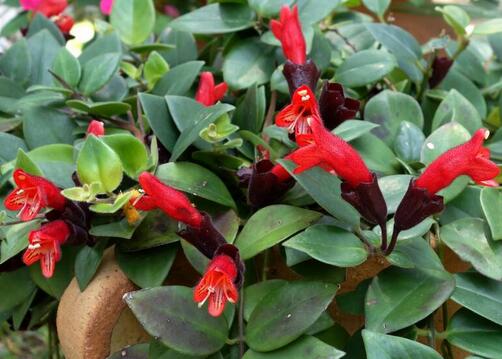
Propagation methods for the lipstick plant:
The lipstick plant can be propagated by cuttings. Spring and autumn are the suitable periods. Select healthy, thick stems, cut each 7-10 cm into 1 segment, and insert them into loose sandy soil, or a potting mix made of 50% fine tree fern fiber, 20% perlite and 30% coarse sand. Maintain appropriate humidity, receive about 50-60% sunlight, and after about 30-40 days roots will develop into seedlings. Once the root system grows vigorously, transplant into pots or cultivate in flower beds.
Landscape uses
The lipstick plant is a very easy-to-survive and easy-to-grow flower. It can be enjoyed for both its flowers and its foliage, making it one of the flowers with great ornamental and cultivation value. It grows quickly, has dense branches and leaves, and a long flowering period. It is suitable for hanging plant cultivation, for placement on home balconies and indoor sunny spots. In landscapes, it is mostly used for desert scenery arrangements.
Pest and disease control
The plant is robust and not prone to pests and diseases. However, if the potting soil is waterlogged and ventilation is poor, besides causing root rot, root rot disease may also occur. When the disease occurs, spray or water the affected plants with a 1000-fold dilution of 40% root rot nemesis; or drench the roots with a 1500-fold dilution of 80% 402 emulsifiable concentrate.
Management is extensive and maintenance is simple. The cultivation soil is best as loose, fertile sandy loam, with good drainage. The cultivation site must be cool and well-ventilated, with about 50%-70% sunlight, avoiding direct strong light. The optimal growth temperature is about 15-25°C. From March to September, during the peak growth period, the water requirement is relatively high, so water and mist frequently to increase humidity; after autumn, gradually reduce watering to improve the plant's cold resistance. Throughout the year, except for the strong light at noon in midsummer which should be appropriately shaded, sufficient light should be given at other times, especially in winter. It prefers a semi-shaded environment. If the placement location has too strong or insufficient light, the leaves will easily turn pale green or yellow-green, lacking vitality, losing their proper ornamental value, and may even wither and die; if exposed to direct sunlight and dry air, it is most prone to scorching, so it should be placed in a cool, ventilated area, and attention should be paid to maintaining environmental humidity. Avoid continuous high temperature and high humidity; poor drainage and ventilation will cause rot. #p#Subtitle#e#
How to grow the lipstick plant:
Soil
The lipstick plant's soil is best as loose, fertile sandy loam, with good drainage. Potting soil is best slightly acidic; a potting mix made of peat soil, sand and vermiculite can be used, with an appropriate amount of superphosphate added. The lipstick plant normally requires less fertilizer. When potting, an appropriate amount of livestock hoof and horn pieces and crushed bone pieces can be added as base fertilizer, which can make it grow well.
Light
The lipstick plant prefers a semi-shaded environment. Throughout the year, except for the strong light at noon in midsummer which should be appropriately shaded, sufficient light should be given at other times, especially in winter. If the placement location has too strong or insufficient light, the leaves will easily turn pale green or yellow-green. The cultivation methods for the lipstick plant require attention: insufficient light easily causes the stems to grow leggy and makes it difficult to bloom; too strong light turns the leaves reddish-brown. For a home-grown lipstick plant, it is most suitable to hang it about 1 m from a south-facing window.
Temperature
The lipstick plant should be placed in a cool, ventilated area, and attention should be paid to maintaining environmental humidity. Avoid continuous high temperature and high humidity; poor drainage and ventilation will cause rot. The lipstick plant is not cold-tolerant and needs to be brought indoors to overwinter. The lipstick plant is not strict about air humidity and can adapt as long as indoor air is not too dry. The optimal growth temperature for the lipstick plant should be around 25°C, and the overwintering temperature should be above 12°C. If the leaves are found to turn red, it is either due to too strong light or too low room temperature; the room temperature should be raised promptly. If the room temperature is too low, it will cause leaf drop and stem drying.
How to propagate the lipstick plant, propagation methods for the lipstick plant / high cutting survival rate
As the beauty among spider plants, the lipstick plant is widely popular because its flowers look like lipstick, and it is kept in many flower lovers' homes. The lipstick plant has strong benefits, and as more and more people learn about this, it is being propagated in large quantities. So how do you propagate the lipstick plant? Below are the propagation methods for the lipstick plant. Follow the editor to learn more.
I. How to propagate the lipstick plant, cuttings / water culture
As a beginner, mastering the cultivation methods of the lipstick plant is enough. But if you are experienced, you should also understand the propagation methods of the lipstick plant, because only then will growing it be more enjoyable. As for how to propagate the lipstick plant, there are mainly two methods: cutting propagation and water culture propagation. For the specific operations, let's continue reading below.
II. Two propagation methods for the lipstick plant
(1) Cutting method for the lipstick plant
1. Cutting time
The cutting propagation of the lipstick plant is generally carried out in spring or autumn. This is the rapid growth period of the lipstick plant, with strong vitality and a high cutting survival rate.
2. Selection of cuttings
In the cutting method for the lipstick plant, the most important thing is good cuttings. If they are selected well, the overall cutting success rate will be very high. You can choose healthy stems and cut each 7-10 cm into 1 segment as a cutting. Place the stems in a cool place to dry, or coat them with plant ash for disinfection.
3. Cutting substrate
To take cuttings, you need soil. The cutting substrate for the lipstick plant can be loose sandy soil, or a potting mix made of 50% fine tree fern fiber, 20% perlite and 30% coarse sand.
4. Starting the cuttings
The cutting method for the lipstick plant now officially begins. Insert the cuttings into the prepared substrate, water after insertion to ensure sufficient humidity, then ensure 50%-60% light every day. After about 30-40 days, they will develop roots into seedlings. Once the root system grows vigorously, transplant into pots or cultivate in flower beds.
(2) Water culture propagation of the lipstick plant
1. Water culture time
To propagate the lipstick plant by water culture, you naturally first need to choose a time. For this, you can choose to do it during the Qingming period, because at this time spring is warm and flowers are blooming, and the lipstick plant is more likely to root.
2. Container selection
The lipstick plant is a plant with relatively strong propagation ability and roots very easily in water culture. After choosing the time, select a transparent glass container, medium-sized is fine, so you can better observe the root growth of the lipstick plant, then add water to 2/3 of the container.
3. Selecting water culture seedlings
For water culture propagation of the lipstick plant, after the bottle and water are ready, it is time to select the water culture seedlings. From the lipstick plant, choose some healthy, pest-free stems as water culture seedlings, as these root more easily.
4. Water temperature / water quality
Insert the water culture seedlings into the prepared glass container. Room temperature water is fine, but if using tap water, you need to leave it in the sun for two days in advance to remove the chlorine. Of course, cooled boiled water also works; no need to sun it, just use it directly.
5. Rooting / care
One month after cutting, the water-cultured lipstick plant will basically have grown new roots. After that, once the plant has completely survived, place it on a balcony to grow. Be careful to change the water frequently and keep the air humid.
Overall, whether by cutting propagation or water culture propagation, the lipstick plant can survive. But for ordinary flower lovers, just choose the method you are best at. If you have a lipstick plant and happen to want to grow another one, then you might as well try it yourself. Regarding the propagation methods of the lipstick plant, the editor has introduced them here, hoping to be of help to everyone.
How to grow the lipstick plant, propagation methods for the lipstick plant
The lipstick plant gets its name because its leaves are shaped like lipstick. It originates from South Africa. Its leaves are thick and fleshy, bright and verdant. The stems are distinctly angular, and the flower colors include peach red and scarlet, with a pale yellow center, resembling a chrysanthemum, with narrow petals. The lipstick plant is not prone to pests and diseases, so it is a very good choice for potted cultivation. So, what are the cultivation methods and precautions for the lipstick plant?
How to grow the lipstick plant?
1. Suitable soil: The lipstick plant's soil is best as loose, fertile sandy loam, with good drainage. Potting soil is best slightly acidic; a potting mix made of peat soil, sand and vermiculite can be used, with an appropriate amount of superphosphate added.
2. Light: It prefers a semi-shaded environment. Throughout the year, except for the strong light at noon in midsummer which should be appropriately shaded, sufficient light should be given at other times, especially in winter. If the placement location has too strong or insufficient light, the leaves will easily turn pale green or yellow-green.
3. Temperature: The lipstick plant should be placed in a cool, ventilated area, and attention should be paid to maintaining environmental humidity. Avoid continuous high temperature and high humidity; poor drainage and ventilation will cause rot. The lipstick plant is not cold-tolerant and needs to be brought indoors to overwinter.
4. Watering frequency: The potting soil should be kept moist frequently, and never allow water to accumulate in the pot, to avoid causing root rot. From March to September, during the peak growth period, the water requirement is relatively high, so water and mist frequently to increase humidity; in autumn, as the weather gradually turns cold, gradually reduce the amount of watering and fertilizing. In winter, the potting soil should be slightly dry.
5. Pruning tips: During vigorous growth, pinch appropriately to promote branching. After the winter flowering period, promptly cut off the spent stems that have already bloomed, which can save nutrients, promote new branches, and make it produce more buds and flowers.
Propagation methods for the lipstick plant
The lipstick plant can be propagated by cuttings. Spring and autumn are the suitable periods. Select healthy, thick stems, cut each 7-10 cm into 1 segment, and insert them into loose sandy soil, or a potting mix made of 50% fine tree fern fiber, 20% perlite and 30% coarse sand. Maintain appropriate humidity, receive about 50-60% sunlight, and after about 30-40 days roots will develop into seedlings. Once the root system grows vigorously, transplant into pots or cultivate in flower beds.
When does the lipstick plant bloom?
We have been talking about the flowering period of the lipstick plant above, so when exactly does the lipstick plant bloom? If the room temperature is suitable, the lipstick plant's flowering period will be concentrated from December to February of the following year. If the lipstick plant does not bloom at this time, it means the cultivation method must be wrong. It may be due to improper water and fertilizer, or it may be light, temperature, pest invasion, etc. In addition, during cultivation, the lipstick plant may also show symptoms such as leaf drop. This is 70% likely due to a watering problem, and the lipstick plant in this season cannot be exposed to the sun and should be appropriately shaded.
What benefits does the lipstick plant have?
Besides being used as a potted ornamental and purifying indoor air, the lipstick plant also has certain medicinal value:
1. Treating bruises and injuries: Grind the dried whole plant of the lipstick plant into powder, take 9 grams per dose, and take it warm with wine.
2. Treating swelling and pain from bruises: Mash the lipstick plant leaves, fry them with wine until hot, and apply to the affected area.
3. Treating wind-toxin nodules that persist without dispersing: Wash the fresh whole plant of the lipstick plant including the roots, mix with glutinous rice and a little table salt, mash and apply to the affected area.
4. Treating cough due to lung heat: 30 grams of lipstick plant root, 30 grams of rock sugar, decoct in water and take.
In addition, the price of the lipstick plant is also very affordable. A potted lipstick plant costs about 20-30 yuan, so friends who like growing flowers and plants can consider buying a pot of lipstick plant to take home.