Dragon Bone Cactus (Euphorbia trigona) is best suited for growing at home; a detailed explanation of cultivation methods and precautions
Dragon Bone Cactus likes warmth and warm air. It prefers partial shade; under strong direct sunlight the plant turns yellow. The optimum growing temperature is 25-35°C. It is sensitive to low temperatures; below 5°C the stem segments rot easily. It likes fertile loam rich in humus. For potting soil, use equal parts of leaf mold, coarse sand and rotted manure mixed together. Below, the editor brings you the cultivation methods and precautions for Dragon Bone Cactus, for fellow flower lovers' reference.
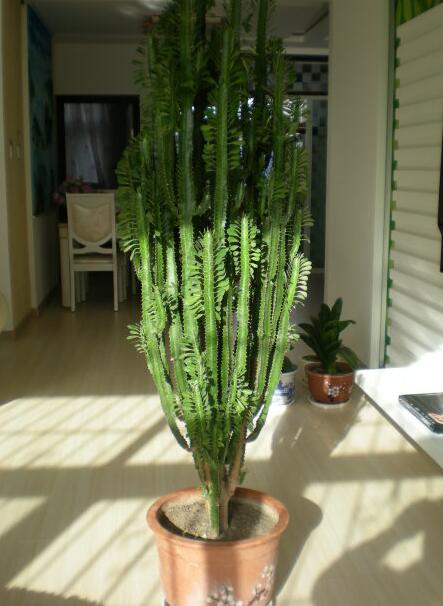
Cultivation methods for Dragon Bone Cactus:
Planting
It likes loose, fertile soil rich in humus. For potting soil, use 1 part leaf mold and 1 part coarse sand mixed together with a small amount of rotted chicken manure or cow manure as the growing medium.
Light
Light and temperature: In summer, keep it in a partially shaded environment. In winter it requires ample light, so place it in a sunny spot indoors, with the temperature kept above 10°C; below 10°C it is prone to cold damage.
Fertilizing
Watering and fertilizing: In spring, do not water too much; watering once every 10-15 days is enough, but mist the plant daily to increase air humidity. In summer, water once a day, preferably in the morning or evening. In winter, the potting soil should be kept moderately dry; you can wrap the pot with plastic film to protect it through the winter. The overwintering environment should maintain both a relatively high temperature and relatively high air humidity.
Management
To grow night-blooming cereus (dragon fruit cactus), you can take advantage of its climbing habit: choose waste land unsuitable for other crops, or spots along walls and trees in front of or behind the house. You can also build raised beds 1.5-2 m high and 30 cm wide in the field, or grow it against a brick wall, or set up a trellis with bamboo poles or concrete posts. Night-blooming cereus generally does not set fruit. Mostly one-year-old or older fleshy stems are chosen, cut into 20-30 cm segments and inserted obliquely into the soil for vegetative propagation. Cuttings can be taken in all four seasons, at a planting density of 10×100 cm. After cuttings are taken, water frequently to keep the soil moist, promote adventitious root growth and ensure survival and development. Plants from spring cuttings may bloom in winter of the same year in some cases, but are not sold as commercial produce. From the second year, after entering the flowering period, each year in January-February apply a growth-promoting fertilizer to encourage new shoots; in March-April apply a strengthening fertilizer to promote thickening of the stems; in May-June apply a bud fertilizer to promote flower formation; during the harvest period, apply 1-2 applications of a restorative fertilizer depending on plant vigor. Topdressing should use rotted organic fertilizer as much as possible. If chemical fertilizer is used, choose a complete nutrient mixed fertilizer. The third year is when night-blooming cereus enters its peak growth period. To prevent the plant from aging too early and to keep the base vigorous, besides rational fertilizing, pruning is also necessary.
Pruning
First, cut off old branches that bloom very little.
Second, taking advantage of the vigorous new buds at the top and their tendency to bloom heavily, remove the weak buds growing below so that the terminal buds develop and extend fully, giving play to apical dominance. Night-blooming cereus blooms from May to November, in about 7-8 flushes, with intervals of about 20 days. The flowers reach full size 25-30 days after budding. This is also the best harvest period. The best harvest time is the morning or afternoon of the day after the flowers open. The flowers for market and export are processed into dried flowers. (Fortune telling www.azg168.com)
Storage and processing
The cuttings of night-blooming cereus (Hylocereus undatus) actually use the plant's fleshy stems. Because it is very drought-tolerant, being left in the air for several days or even dozens of days usually does it no harm, so its post-harvest management is relatively easy. Usually the fleshy stems are cut at the stem nodes, then pre-cooled and graded, then tied in bundles of 10 and packed into boxes. Immediately place the prepared cuttings in an environment with relative humidity of 70%-80% and a temperature of 4-6°C for storage. The cuttings of night-blooming cereus can usually be stored for 7-10 days under the above conditions without affecting their performance. Packaging materials usually use 60 cm×45 cm×30 cm film-lined corrugated cardboard boxes. Note that ventilation holes should be made in the film lining and the corrugated boxes. #p#Subtitle#e#
Precautions for growing Dragon Bone Cactus:
Dragon Bone Cactus likes a warm, humid environment; under strong direct sunlight the plant turns yellow. It is drought-tolerant but afraid of low temperatures and frost. The optimum growing temperature is 25-35°C. The overwintering temperature in winter must not be lower than 7°C, otherwise it is prone to cold damage and the stem segments rot easily. When cultivating, pay attention to the following points:
1. Planting: Dragon Bone Cactus is extremely easy to grow and likes sandy soil rich in humus. If such sandy soil is hard to find, you can just find some relatively soft soil; Dragon Bone Cactus is not very demanding about soil, and ordinary soil can support it.
2. Light and temperature: Since Dragon Bone Cactus turns yellow under strong direct sunlight, in summer it should be kept in a partially shaded environment, while in winter it requires ample light, placed in a sunny spot indoors, with the temperature kept above 10°C, and the pot rotated at regular intervals. In winter, in the north, Dragon Bone Cactus cannot be kept indoors for cultivation, as it is prone to frostbite and freezing to death.
3. Care: Dragon Bone Cactus is drought-tolerant, so watering should be moderate. In summer, watering once every five days is enough; if the potting soil stays too wet for a long time, root rot will occur. During the winter dormant period, watering once every 1-2 months will not dry it to death.
4. Fertilizing: To make it grow well, apply nitrogen fertilizer once a month during the growing period; homemade fertilizer is preferable. Crush soybeans or peanuts and bury them in the flower pot, or soak soybeans or peanuts until soft and then bury them in the soil as fertilizer. But the fertilizer must not be too concentrated, to avoid fertilizer burn causing root rot. Dragon Bone Cactus.png
5. Propagation: Dragon Bone Cactus is propagated by cuttings. Cut off a branch of more than 10 cm, wash off the milky sap that flows out, and after drying for twelve hours, insert it as a cutting (or insert it directly after cutting, which can also survive, just with a slightly lower survival rate). After a week, when the new Dragon Bone Cactus begins to lose water and wilt, water lightly; the sandy soil should be kept dry rather than wet, to prevent the cut end from rotting. Place it in partial shade; rooting is easy.
The role of Dragon Bone Cactus
Every different plant has a different role in home decoration. Today, the editor of Shengduoduo Home Decoration Network takes you to learn about the role and cultivation methods of Dragon Bone Cactus in the home!
1. Introduction to Dragon Bone CactusDragon Bone Cactus, also called Dragon Bone, has a three-angled plant body, much branched, blue-green, 4 m to 5 m tall, with very short small spines along the edges. Dragon Bone Cactus blooms white flowers in summer, 4 to 9 of them, clustered on the upper areoles, opening by day and closing at night (potted plants generally do not bloom easily). The berry is small and round, blue-purple, and edible.
2. Cultivation methods for Dragon Bone Cactus
Dragon Bone Cactus likes a warm, humid environment; under strong direct sunlight the plant turns yellow. It is drought-tolerant but afraid of low temperatures and frost. The optimum growing temperature is 25-35°C. The overwintering temperature in winter must not be lower than 7°C, otherwise it is prone to cold damage and the stem segments rot easily. When cultivating, pay attention to the following points:
1. Planting: Dragon Bone Cactus is extremely easy to grow and likes sandy soil rich in humus. If such sandy soil is hard to find, you can just find some relatively soft soil; Dragon Bone Cactus is not very demanding about soil, and ordinary soil can support it.
2. Light and temperature: Since Dragon Bone Cactus turns yellow under strong direct sunlight, in summer it should be kept in a partially shaded environment, while in winter it requires ample light, placed in a sunny spot indoors, with the temperature kept above 10°C, and the pot rotated at regular intervals. In winter, in the north, Dragon Bone Cactus cannot be kept indoors for cultivation, as it is prone to frostbite and freezing to death.
3. Care: Dragon Bone Cactus is drought-tolerant, so watering should be moderate. In summer, watering once every five days is enough; if the potting soil stays too wet for a long time, root rot will occur. During the winter dormant period, watering once every 1-2 months will not dry it to death.
4. Fertilizing: To make it grow well, apply nitrogen fertilizer once a month during the growing period; homemade fertilizer is preferable. Crush soybeans or peanuts and bury them in the flower pot, or soak soybeans or peanuts until soft and then bury them in the soil as fertilizer. But the fertilizer must not be too concentrated, to avoid fertilizer burn causing root rot.
5. Propagation: Dragon Bone Cactus is propagated by cuttings. Cut off a branch of more than 10 cm, wash off the milky sap that flows out, and after drying for twelve hours, insert it as a cutting (or insert it directly after cutting, which can also survive, just with a slightly lower survival rate). After a week, when the new Dragon Bone Cactus begins to lose water and wilt, water lightly; the sandy soil should be kept dry rather than wet, to prevent the cut end from rotting. Place it in partial shade; rooting is easy. 6. Management: Dragon Bone Cactus grows fast and is easy to cultivate, with low management demands. You can keep or prune branches as you please, but each pruning should not be too long; it is best to wait until the Dragon Bone Cactus has grown to more than half a meter before shaping and pruning.
3. Matching Dragon Bone Cactus with home styles
Dragon Bone Cactus is a succulent plant and cannot be placed casually in home arrangements; attention must be paid to its placement to avoid committing major feng shui taboos.1. Among succulents, the cactus family are feng shui plants for dispelling negative energy, and should not be placed at entrance and exit areas of the front door. Pointed plants carry the implication of confrontation and verbal disputes, so try not to place them.
2. There is negative energy under a beam, but this kind of negative energy presses downward, so spiny plants should not be used; therefore, when placing succulents, choose varieties without spines, such as Crassulaceae, Fouquieriaceae, and so on.
3. In the bedroom, do not place succulents that are feng shui plants for dispelling negative energy, as they can easily cause allergic reactions in skin and mucous membrane cells.
Succulents are common as home decoration plants and are easy to keep alive, but when placing them, pay attention to feng shui issues and put them in suitable positions.
4. Feng shui applications of Dragon Bone Cactus
The dragon, an animal in Chinese folk legend, can summon wind and call rain and overturn rivers and seas, and has been regarded as a symbol of auspiciousness since ancient times. In feng shui, mountain ranges are likened to dragons, earth is the dragon's flesh, stone is the dragon's bone, vegetation is the dragon's scales, and the continuous direction of a mountain range is the dragon's vein.Feng shui holds that the appearance of Dragon Bone Cactus is very distinctive: its stem grows upright and upward, shaped like an upright dragon's spine, full of power, with a strong effect of resisting external negative energy, and the short spines on the stem can repel inauspicious energy, so Dragon Bone Cactus is a good plant for dispelling negative energy and protecting the home. For a long time, in some places in the south, Dragon Bone Cactus has often been planted in front of and behind houses.
5. The role of Dragon Bone Cactus in the home
Ornamental valueDragon Bone Cactus comes in many forms, including clumping form, three-column form, nine-column form, and so on. The author considers the nine-column and twelve-column forms spectacular. The specific shaping method is: when a nine-column plant has grown to 20 cm to 30 cm, cut off the top with a sharp knife and immediately seal it with plant ash; after the plant grows branches, keep only the three branches at the top, one at each angle, and remove the rest. When the second tier has grown to 25 cm to 30 cm, cut off the top again; after branches emerge, still select three branches, 3 at each angle, forming the 1, 3, 9 form of Dragon Bone Cactus. The method for selecting angles for the twelve-column form is the same as above, except that when the 9-column form has grown to 20 cm to 30 cm, cut off the top and then cultivate three more branches, selecting 1 or 3 at each angle. Remove the remaining small branches as they grow, to keep the tree shape uniform.
For the clumping-column form, when the plant has grown to 40 cm to 50 cm, or 30 cm to 40 cm, cut off the top and let it grow naturally to form a multi-headed Dragon Bone Cactus, but the retained shoots should be orderly and not chaotic. When Dragon Bone Cactus reaches a height of 2 m to 3 m, it forms many branch heads, which easily makes it top-heavy and unstable, so it should be tied to support sticks in time for fixation. Dragon Bone Cactus needs ample sunlight; its branches are blue-green and its leaves are like fish scales, glistening in the sunlight. With many bodies standing like a forest and peaks like sharp swords, it is very spectacular and an excellent potted flower.
Practical value
In home applications, besides having the effect of dispelling negative energy, it also has a good purifying effect. For newly renovated homes and buildings between office spaces, it has a very good adsorption effect on formaldehyde, benzene, radon, ammonia, and TVOC.