Why won't marigolds bloom? Fertilizing technique is the key
Marigolds are often sown in spring, and because their flowers are large and their blooming period is long, they are commonly used for flowerbed landscaping. The suitable growing temperature for marigolds is 15-25°C, the suitable temperature during the blooming period is 18-20°C, and the relative air humidity of the growing environment is required to be 60-70%. So why won't marigolds bloom?
Marigold blooming time:
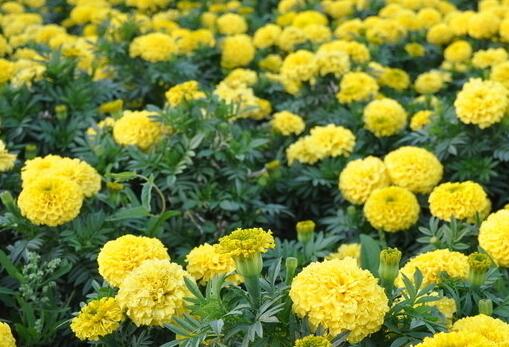
The blooming period of marigolds is very long. They bloom from June to October each year, and sometimes the flowers do not fade until mid-November. Marigolds produce yellow or orange-yellow flowers, with large and brilliantly colored blooms, layer upon layer of petals, and full flower shapes that are very beautiful.
Why won't marigolds bloom:
Generally, as long as routine care is done well, marigolds will grow robustly and bloom profusely. However, if marigolds do not receive sufficient light during growth, the plants will become leggy and weak, resulting in fewer flowers.
Secondly, when fertilizing marigolds, you must master the fertilizing technique and must not apply too much fertilizer, especially nitrogen fertilizer, otherwise marigolds will also be affected in flowering because the plants grow too luxuriantly, and may even never bloom in their lifetime.#p#Subheading#e#
How to make marigolds bloom more:
When marigolds bloom sparsely or fail to bloom, certain measures need to be taken to encourage them to bloom more.
When planting marigolds, a certain amount of base fertilizer can be applied to make them branch more, which can increase the number of blooms. Before marigolds bloom, some side buds can be removed to reduce nutrient consumption, so that the remaining buds have sufficient nutrient supply and the flowers will bloom more brilliantly. After marigold flowers fade, the spent flowers and withered flowers should be cut off promptly, and the branches and leaves should be pruned. At the same time, pay attention to pest control, so that they can bloom again.
In addition, marigolds can also be propagated by cuttings. Marigolds grow into mature plants very quickly; by pinching promptly and fertilizing before blooming, they can also bloom continuously.
Also, a suitable temperature can extend the blooming period of marigolds. The suitable temperature during the blooming period is 18-20°C. Maintaining this temperature can appropriately extend the blooming period of marigolds.
Why won't marigolds bloom
The blooming of marigolds
The blooming period of marigolds is very long. They bloom from June to October each year, and sometimes the flowers do not fade until mid-November. Marigolds produce yellow or orange-yellow flowers, with large and brilliantly colored blooms, layer upon layer of petals, and full flower shapes that are very beautiful.
Why won't marigolds bloom
Generally, as long as routine care is done well, marigolds will grow robustly and bloom profusely. However, if marigolds do not receive sufficient light during growth, the plants will become leggy and weak, resulting in fewer flowers.
Secondly, when fertilizing marigolds, you must master the fertilizing technique and must not apply too much fertilizer, especially nitrogen fertilizer, otherwise marigolds will also be affected in flowering because the plants grow too luxuriantly, and may even never bloom in their lifetime.
How to make marigolds bloom more
When marigolds bloom sparsely or fail to bloom, certain measures need to be taken to encourage them to bloom more.
When planting marigolds, a certain amount of base fertilizer can be applied to make them branch more, which can increase the number of blooms. Before marigolds bloom, some side buds can be removed to reduce nutrient consumption, so that the remaining buds have sufficient nutrient supply and the flowers will bloom more brilliantly. After marigold flowers fade, the spent flowers and withered flowers should be cut off promptly, and the branches and leaves should be pruned. At the same time, pay attention to pest control, so that they can bloom again.
In addition, marigolds can also be propagated by cuttings. Marigolds grow into mature plants very quickly; by pinching promptly and fertilizing before blooming, they can also bloom continuously.
Also, a suitable temperature can extend the blooming period of marigolds. The suitable temperature during the blooming period is 18-20°C. Maintaining this temperature can appropriately extend the blooming period of marigolds.
When do marigolds bloom and how to make them bloom more
Marigold is an annual herbaceous plant of the genus Tagetes in the Asteraceae family, with an upright, stout stem that has longitudinal fine ridges, and branches spreading upward and flatly. The leaves are pinnately divided; there are a few glands along the leaf margins. The flower heads are solitary; the involucre is cup-shaped with toothed tips at the apex; the ligulate flowers are yellow or dark orange; the tubular flowers have yellow corollas. The achenes are linear, narrowed at the base, black or brown, covered with short fine hairs; the pappus has 1-2 long awns and 2-3 short, blunt scales. The blooming period is July-September. So when do marigolds bloom?
When do marigolds bloom:
1. Time
The time for harvesting marigolds is generally from July 10 to September 25. The staminate part of the flower center is partly open or not open, and when it reaches eight or nine tenths ripe, the yield is relatively high. However, because current techniques are mature, marigolds can be sown all year round, usually sown in spring and blooming in autumn, or sown in summer and blooming in autumn.
2. Harvesting method
At harvest, the flowers should have no water droplets and should not be damaged, and the flower stalk length should not exceed 1cm. The daily picking time is from 9:00 to 17:00, and the interval between two pickings is generally no less than 7 days. In addition, do not pick on cloudy days, do not pick with dew on them, and do not pick unripe flowers.
How to make marigolds bloom more:
When marigolds bloom sparsely or fail to bloom, certain measures need to be taken to encourage them to bloom more.
When planting marigolds, a certain amount of base fertilizer can be applied to make them branch more, which can increase the number of blooms. Before marigolds bloom, some side buds can be removed to reduce nutrient consumption, so that the remaining buds have sufficient nutrient supply and the flowers will bloom more brilliantly. After marigold flowers fade, the spent flowers and withered flowers should be cut off promptly, and the branches and leaves should be pruned. At the same time, pay attention to pest control, so that they can bloom again.
In addition, marigolds can also be propagated by cuttings. Marigolds grow into mature plants very quickly; by pinching promptly and fertilizing before blooming, they can also bloom continuously.
Also, a suitable temperature can extend the blooming period of marigolds. The suitable temperature during the blooming period is 18-20°C. Maintaining this temperature can appropriately extend the blooming period of marigolds.