Detailed Guide to Zinnia Sowing Time and Cultivation Management Techniques
Zinnia belongs to the genus Zinnia and is an annual herbaceous plant. It is robust, fond of warmth, intolerant of cold, loves sunlight, and is relatively drought-tolerant. The optimum germination temperature is 22-25°C. When sowing, a little soil should be covered over the seeds, and they should be placed in a dark spot. Once true leaves emerge, transplant immediately. So when should zinnias be sown?
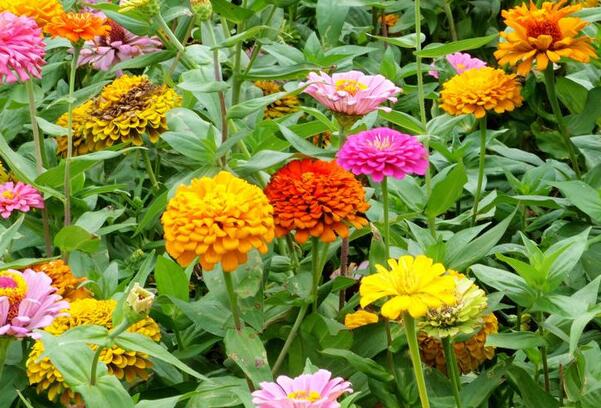
When to sow zinnias:
In North China, sowing can be done in open-ground seedbeds in mid-April, and seedlings emerge uniformly 7 days after sowing. If sown too early and the temperature drops below 15°C after emergence, the seedlings will stop growing and will remain poor thereafter. When seedlings reach 5-8 cm in height, transplant them once.
In late May, move them to flower beds for final planting.
To expand propagation, side shoots can be cut for cuttings in mid-June. After inserting, provide shade and protect from rain, otherwise the cuttings rot easily.
To have flowers for viewing during the "May Day" holiday, sow in pots in a greenhouse in early February, prick out and plant into "No. 3 tub" pots in late March, 1 plant per pot; in early April, transfer into "No. 1 tub" pots, and in late April, remove from pots and plant out.
When growing in garden plots, the plant spacing is 10-20 cm; when planting out in flower beds, the spacing is 50 cm for tall varieties, 40 cm for medium varieties, and 30 cm for dwarf varieties.
The main stem tip of zinnia blooms first, then side shoots emerge node by node, and flowers successively appear at the tips of the side shoots. Therefore, fertilizer and water management should be strengthened to improve flower head quality. When midsummer arrives, flowering stops; at this time, stop topdressing but keep the soil moist to prevent wilting and death. After the Start of Autumn, the plant can joint and bloom again.
Dwarf varieties can be grown in pots, but they should be pinched repeatedly to encourage more side shoots, thus forming a low, full plant cluster.
Tall varieties can only be grown in the ground. To prevent branch breakage and lodging from strong winds, it is best to plant them concentrated in patches.
Cultivation and management techniques for zinnia:
Although the height of zinnia varieties differs, it is generally controlled between 20-30 cm. They are suitable for use in flower beds and flower borders, and are also an excellent material for artistic flower arrangements. Sowing and seedling raising: For zinnia, each gram contains about 125 seeds for large-flowered types, about 300 for medium-flowered types, and about 1,500 for multiflora types. The largest use is in flower beds, flower arrangements, and flower borders during the National Day period. The sowing time is generally best controlled from June to July. Some trial autumn sowing has also been done, but due to the influence of temperature and other factors, it has a certain effect on flower color and plant shape, so autumn sowing is generally not adopted. The sowing medium uses a relatively loose artificial medium. Bed sowing and tray sowing can be used, and plug tray seedling raising can also be used where conditions permit. The medium requires a pH of 5.8-6.2 and an EC value of 0.75. After disinfection treatment, the sowing medium is kept at 22-24°C, and seedlings emerge in 3-5 days.
Stage 1:
Three days after sowing, the radicle emerges. The medium should be relatively drier rather than too moist, as excessive moisture easily causes seed rot. However, at this stage it is very important to keep the area around the seeds moist and provide sufficient oxygen, so covering with a thin layer of coarse vermiculite or loose rice husk ash after sowing is very beneficial for seed germination. The covering thickness should be such that the seeds are no longer visible. For open seedling raising, shade netting must be added to ensure humidity and lower temperature (when sowing in a germination chamber environment, appropriate supplemental lighting can be given). No fertilization is needed at this stage.
Stage 2:
Keep the soil relatively moist, neither too wet nor too dry. Too wet easily causes disease, while too dry causes seedling wilting. At this time, the main root grows to 1-2 cm, the cotyledons unfold, and the first pair of true leaves begins to grow. The seedlings can gradually be exposed to light. Fertilization can begin, generally using 0.05% urea or 50 ppm of a 20-10-20 water-soluble fertilizer. Nitrogen promotes vegetative growth.
Stage 3:
The seedlings enter a rapid growth period, and water management should be strengthened, carrying out a cycle from dry to wet and then to dry. This benefits root growth and also avoids leggy growth. At this stage, attention should be paid to pest and disease control. Topdressing with 0.1% urea or compound fertilizer can be done appropriately. The compound fertilizer type can use an N-P-K ratio of 15-15-15 (or according to market supply, the N and K contents can be slightly higher and the P content can be lower). If conditions permit, the medium and ambient temperature can be appropriately lowered to about 20°C, but when sowing in bed culture under protected conditions, temperature control is very difficult. This stage also requires a full-light environment, otherwise it easily causes leggy growth of seedlings. According to seedling growth, control water appropriately. Pay attention to ventilation in the larger environment to prevent disease. Spray chlorothalonil or thiophanate-methyl about once a week. If leggy growth appears at this stage, spray B9 immediately to control height.
Stage 4:
The root system has formed well. When there are 3-4 pairs of true leaves, if leggy growth appears, spray B9 immediately to control height. Temperature and humidity requirements are the same as Stage 3. After the hardening-off stage, prepare for transplanting and potting.
Transplanting/potting: For plug tray seedlings, when there are 2-3 pairs of true leaves, they can be transplanted and potted; for tray-sown and bed-sown seedlings, when there are 3-4 pairs of true leaves, they can also be directly potted. According to plant height and plant diameter requirements, 12×13 nutrient pots are generally used for potting. This can be done in one step, without further repotting. Plug tray seedlings have less root damage and are easy to transplant and survive; for open seedling raising, when lifting seedlings, carry as much soil as possible, and choose evening or cloudy days for transplanting to improve the survival rate.
Light regulation: Zinnia is a sun-loving plant, and both growth and flowering require sufficient sunlight. Insufficient sunlight easily causes stem node elongation and affects the ornamental effect. After potting, the entire growth period does not require shading.
Temperature regulation: Although zinnia likes warmth, under hot summer conditions its growth vigor is somewhat weak and the flowering effect is not ideal. The optimum temperature for growth and flowering is 15-20°C. The sowing date of zinnia is controlled in summer to prepare flowers for National Day. If high temperatures above 35°C occur during the growth period, growth is generally not affected.
Cultivation management: During the plum rain season, excessive rain easily causes too rapid internode elongation. Attention should be paid to draining accumulated water and spraying B9 at the appropriate time. In summer, long periods of clear weather and little rain, being too dry, easily weaken growth vigor and affect flower color. At this time, attention should be paid to water and fertilizer management. Throughout the growth period, control water appropriately. Alternating dry and wet conditions in the pot soil is beneficial for root development and height control. For potted plants, fertilize generally once every 7-10 days. Depending on growth, topdressing can be done, using 0.2% urea and compound fertilizer alternately, and stop applying urea after one month. After flowering, depending on growth, the interval for topdressing compound fertilizer can be appropriately extended. Because the side shoots of zinnia have the habit of terminal bud formation and flowering, if natural growth is not controlled, the flowering position will become higher and higher, affecting the beauty of the plant shape. Pinch timely before and after transplanting to control plant shape. Pinching generally retains 2-3 pairs of true leaves. Zinnia can be pruned, but growth after pruning is poor, so this method is generally not adopted.
Pests and diseases: The main diseases of zinnia are: damping-off at the seedling stage, bacterial wilt during the growth period, stem rot, and leaf spot; the main pests are: noctuid moths, red spiders, cabbage caterpillars, etc.
Cultivation and Management Technical Regulations for Zinnia "Dalishi"
1. Plot selection
"Dalishi" is a new-generation intraspecific hybrid variety of sweet sorghum. It has three major adaptive characteristics: drought resistance, waterlogging tolerance, and saline-alkali tolerance. Therefore, it has the ability to adapt to various soils. Thus, the requirements for plot selection are not very strict. However, in order to obtain high yield, choosing good cultivated land can significantly improve quality and yield, so as to give play to the genetic potential of this variety. Generally, sandy loam, clay loam, or weakly acidic soil can all be used for planting, but when planting on barren soil, attention should be paid to rational fertilization. Farmers can plant it in front of houses, behind courtyards, beside ponds, or in mountain terraces. It should be noted that in the cold Northeast region, some paddy fields are cold in early spring, the soil temperature at the bottom of the field rises very late, and soil permeability is poor, so planting in such plots is not recommended, but in other provinces normal growth is not affected.
2. Land preparation
If high yield is desired, intensive cultivation is required. Before land preparation, apply 1,000-1,500 kg of farmyard manure per mu as base fertilizer. Break up the soil and harrow it fine.
3. Sowing period
"Dalishi" sweet sorghum likes warmth and is relatively sensitive to low temperature and frost damage. Mature plants have a certain cold resistance, but seedlings are easily damaged at 0°C, so in the Northeast region, late spring cold should be prevented. Generally, seeds begin to germinate at 7-8°C, but sowing is mostly done at temperatures above 12°C. The growth period also requires relatively high temperatures, with a suitable growth temperature of 18°C to 30°C. In the cold Northeast region, it is recommended to sow at 15°C, while in other regions such as Jiangsu, Gansu, Henan, and other places, sowing can be done at 12°C. If sown too early, low soil temperature and high humidity can easily cause seed rot, the so-called "powdery seed." According to production needs, sowing can also be done in stages to extend the utilization period. In various places in the Northeast, including Inner Mongolia, Gansu, **, and other places, sowing is mostly done from mid-April to early May. Generally speaking, sowing Dalishi should be 1 to 2 weeks later than sowing corn.
When to sow zinnias: zinnia sowing propagation / sow in March, bloom in June
Zinnia, although called a grass, we all know that it will bloom and bear fruit, and its flowers are very beautiful. Regarding the propagation method of zinnia, because it bears fruit, it has seeds, so naturally it can be propagated by sowing. So when should zinnias be sown? Below, the editor will introduce the sowing propagation method of zinnia. Friends who want to grow a few more pots of zinnia should definitely take a look~
1. When to sow zinnias, March-June
As for when to sow zinnias, this is actually determined according to the flowering time. Generally speaking, sow 2-3 months before flowering. Also, because the flowering period of zinnia is June-October, the sowing time of zinnia is generally from March to June during the spring season.
2. Sowing propagation method for zinnia
1. Seed/soil disinfection
Before sowing and propagating zinnia, both the soil and seeds must undergo strict disinfection treatment to prevent pests and diseases during the growth period. Among these, for seed disinfection, soak the seeds in 1% potassium permanganate solution for 30 minutes.
Sowing substrate: mix and prepare 2 parts leaf mold, 1 part river sand, 2 parts peat, and 2 parts perlite. For soil disinfection, 0.05% potassium permanganate or 1,000-fold formalin can be used. In addition, high-temperature fumigation can also be used to kill pathogens, pests, and weed seeds in it.
2. Sowing method
It is understood that the lifespan of zinnia seeds is 3 years, and the germination rate is about 60%. Therefore, when carrying out sowing propagation, we should choose plump seeds from the previous year to increase the seed germination rate. Seeds can be sown in spots or broadcast, and about 1 cm of thin soil should be covered. Water after sowing.
Notes: Before sowing, moisten the substrate and then sow in spots. Zinnia is a light-avoiding flower seed, so after sowing, a layer of vermiculite must be covered.
3. Post-sowing care
After zinnia is sown, at a temperature of 21-23°C, it can germinate in 3-5 days. The germination period does not require light. After germination, keep the seedbed at 50%-60% moisture content. It must not be too wet, so as to avoid root rot or damping-off. When seedlings grow 2 leaves and reach 5-8 cm in height, transplant once.
From final planting to flowering, depending on the variety, 60-70 days are needed. The suitable growth temperature is 15-30°C. Except that seedlings need shading and rain protection, sufficient sunlight is required at all times. According to the cultivation method of zinnia, for potting after final planting, use 3 parts humus soil, 1 part sawdust, and 1 part river sand, and mix them evenly.
3. Propagation method of zinnia: cuttings
In addition to sowing, the propagation method of zinnia also includes cuttings, but cuttings are not as uniform as sown seedlings. Method: choose 10 cm side buds for cuttings. They generally root in 5-7 days. Afterward, cultivation management is the same as for sowing, and they can leave the nursery after 30-45 days. Cuttings can be combined with pinching for dwarfing. As for how to pinch zinnia, there is a detailed introduction earlier, so it will not be repeated here.
When to sow zinnias? After reading the above content, everyone should know! If you want zinnias to bloom early, sow in March; if you want zinnias to bloom late, sow before June. Overall, zinnias have strong vitality, so you might as well try propagating them yourself. It is very fulfilling~