What Flowers Bloom in the Twelfth Lunar Month? A Detailed Guide to Care Methods
When it comes to the twelfth lunar month, everyone knows it is unbearably cold, and plants are quite sensitive to the cold too. Let's take a look at what flowers bloom in the twelfth lunar month and how to care for flowers during this month:
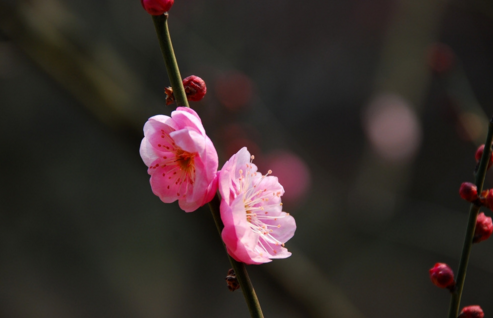
What flowers bloom in the twelfth lunar month:
1. Plum blossom
When it comes to flowers that bloom in winter, I believe everyone's first impression is plum blossoms. Wintersweet is also called yellow plum blossom, fragrant plum, and fragrant wood. Wintersweet has a well-developed root crown, with opposite leaves that are oblong in shape and relatively rough on the surface. Its flowering period is from December to February of the following year. Common varieties of wintersweet mainly include Suxin wintersweet, Qingkou wintersweet, Xiaohua wintersweet, and Gouzhua wintersweet.
Li Zhongli, a traditional Chinese medicine researcher of the Ming Dynasty, recorded the effects of plum blossoms in his book "Bencao Yuanshi He Leigong Paozhi" (also known as "Bencao Yuanshi") as follows: "Clears the head and eyes, benefits lung qi, removes phlegm congestion and upper heat." Modern medical research has also confirmed that plum blossom buds contain volatile oils, mainly benzaldehyde, isoeugenol, and benzoic acid, which promote gastrointestinal motility, increase appetite, aid digestion, and have a certain stomachic effect; at the same time, they have an inhibitory effect on various bacteria, making them an excellent medicinal and edible product.
2. Camellia
Camellia, also known as tea flower, is a plant of the genus Camellia in the family Theaceae. Camellia flowers are plump and elegantly dignified, and are one of China's traditional top ten famous flowers. The flowering period varies by variety, with blooms from October to April of the following year. Camellia is used in cosmetics to smooth and soften the skin and remove dark spots.
Camellia is non-toxic, and the petals are rich in various vitamins, proteins, fats, starch, and various trace minerals and other nutrients. After consumption, it can strengthen the spleen and stimulate appetite, and can also treat dysentery and other conditions. It is a natural food with significant health benefits.
3. Scarlet sage
Scarlet sage, sometimes also called wall-side red, is a plant of the family Lamiaceae. Its main flowering period is from December to May of the following year. The flowers are small and tube-shaped, with a brilliant and passionate red color, arranged in verticillaster inflorescences. When in bloom, the overall appearance resembles strings of red firecrackers, hence the alternate name "firecracker red." Scarlet sage has many varieties with rich colors, including pink-white, red-white bicolor varieties, as well as blue-white and purple-white varieties, making the indoor environment more elegant and unique.
The entire scarlet sage plant can be used as medicine, and it can be harvested throughout the growing season, used fresh or dried for later use. It has effects such as clearing heat, cooling blood, and reducing swelling, and can be used to treat boils. For boils that have just appeared, take an appropriate amount of fresh scarlet sage, mash it, and apply externally.
4. Cymbidium sinense
Cymbidium sinense, also called Chinese orchid, is a terrestrial plant with 3-5 leaves that are dark green. The flower color varies considerably, most commonly dark purple or purple-brown with a lighter-colored lip, and there are also yellow-green, peach-red, or white ones, generally with a relatively strong fragrance. The flowering period is from October to March of the following year. It prefers shade and avoids strong light.
When placing Cymbidium sinense at home, note that in summer the environment should be kept ventilated, and slightly lower temperatures in winter are not a problem. Cymbidium sinense likes a well-ventilated environment. When ventilating under conditions of relatively low humidity, it is best to spray water at the same time, which helps increase air humidity and prevent leaf tips from drying.
5. Clivia
Clivia is a perennial herbaceous plant of the genus Clivia in the family Amaryllidaceae. The plant is elegant and handsome, with the bearing of a gentleman, and its flowers resemble orchids, hence the name. The flowering period lasts 30-50 days, mainly in winter and spring, and it also blooms around New Year's Day to the Spring Festival.
The Clivia plant, especially its broad and thick leaves, has many stomata and fine hairs that can secrete a large amount of mucus. Through air circulation, it can absorb large amounts of dust, dirt, and harmful gases, filtering indoor air, reducing the dust content in indoor spaces, and making the air clean. Therefore, Clivia is praised as an ideal "absorption machine" and "dust remover."
6. Kalanchoe
Kalanchoe: Narcissus jonquilla L. Crassulaceae, Kalanchoe genus. Native to southern Europe. A succulent plant, forming low clumps of thick, glossy leaves, evergreen year-round. In spring, summer, and autumn, it is planted in open ground as a border material, and from December to April of the following year, it produces dazzlingly brilliant flowers, with each flower branch bearing as many as dozens of flowers. The flowering period lasts over 4 months, which is how kalanchoe got its name. It is an ideal potted flower for gifting to relatives and elders during New Year's Day and the Spring Festival.
7. Cineraria
Perennial herb, often cultivated as an annual or biennial. Divided into tall and dwarf varieties, ranging from 20-90 cm. The entire plant is covered with fine hairs, and the leaves are large and shaped like melon leaves, green and glossy. Flowers are terminal, with numerous capitula aggregated into corymbose inflorescences, densely covering the top of the branches, often forming a pot-bottom shape. Flower colors are rich, with all colors except yellow, and there are also red-and-white bicolor varieties. The flowering period is from January to April.
8. Freesia
Leaves are linear and hard in texture; blooms in early spring, with yellow, white, purple, red, pink, and other colors. Spike inflorescences, flowers borne on one side, narrow below the middle of the tube, unequal segments, with a fragrant scent.
9. Cymbidium goeringii
Also known as Duolan, Pudi orchid, Youlan, Duoduo fragrant, and Caolan, it is one of the Chinese orchids with the longest cultivation history and is one of the most beloved types. Traditional famous varieties and rare treasures are extremely rich. The plant is generally relatively small, with a spherical pseudobulb that is also relatively small. Leaf margins have fine serrations. Flowers are mostly single or in pairs, not rising above the leaves; flower colors are mostly green and light brownish-yellow.
10. Throatwort
Annual herb, 8-15 cm tall, the entire plant covered with white fine soft hairs. Basal leaves clustered, arranged in a rosette flat on the ground, with fine petioles; leaf blades nearly circular, about 15 mm in diameter, base slightly heart-shaped, margins crenate, upper surface green, sometimes partially purplish-red.
11. Poinsettia
Poinsettia is usually 60 cm to 3 m tall, with dark green leaves about 7 to 16 cm long. Its topmost leaves are fiery red, red, or white, which are often mistaken for flowers, while the true flowers are in the center of the leaf cluster. The flowering period lasts from December to February of the following year, coinciding with Christmas and New Year's Day, making it very suitable for the festive atmosphere.#p#Subtitle#e#
How to care for flowers in the twelfth lunar month:
I. Temperature
1. For flowers that can tolerate cold and low temperatures (5-12°C, below 5°C), such as pomegranate, Chinese rose, wintersweet, osmanthus, palm, Chaenomeles speciosa, and crape myrtle, they can be placed outdoors in courtyards or in sunny spots on balconies.
2. For flowers that need to be kept at moderate temperatures (12-20°C), such as white orchid, camellia, azalea, Michelia figo, Clivia, fuchsia, and begonia, they must be moved indoors before the temperature drops to 10°C.
3. For flowers that can only grow normally at high temperatures (18-30°C), such as Aglaia odorata, hibiscus, jasmine, croton, narcissus, epiphyllum, night-blooming cereus, cactus, ball cactus, and aloe, they must be moved indoors before the temperature drops to 12°C. Before the temperature drops to 5°C, cover the flower pots with plastic bags, tie the plastic bags tightly, and leave a small number of air holes in the bags for ventilation. Around noon on clear, windless days, move them outdoors to sun for a few hours, then move them back indoors to keep warm.
II. Pruning
Before potted flowers overwinter, they should be pruned and trimmed in a timely manner to reduce nutrient consumption and reduce the space they occupy indoors during winter.
III. Fertilizing
Apply fertilizer once before overwintering and water thoroughly. During overwintering, flowers generally should stop being fertilized.
IV. Watering
Generally, keep the pot soil dry and water less. In December, the best watering time is the 3 to 4 hours around noon, and the water temperature should be kept basically consistent with the air temperature and soil temperature to avoid adverse reactions in potted flowers caused by water temperature being too low.
V. Ventilation
Note to ventilate regularly, preferably on sunny days or at noon when the temperature is higher. When ventilating and exchanging air, also be careful not to let cold wind blow directly on the plants, to avoid adverse reactions.
VI. Early Spring
Early next spring, generally during the period from the Spring Equinox to Qingming, overwintered flowers can gradually be moved outdoors, and given fertilizer and water, such as bio-organic fertilizer, yellow-leaf treatment, trace element water-soluble fertilizer, etc., so that the flowers grow normally in spring.
VII. Pest and Disease Control
For flowering trees and shrubs whose leaves are prone to pests and diseases, such as begonia, rose, and camellia, collect the dead branches and fallen leaves under the plants and burn them, which can reduce the occurrence of diseases next year. At the same time, spray carbendazim for sterilization and disinfection. For ** disease, rust disease, and gray mold of primrose, use triadimefon or thiophanate-methyl for timely control respectively. For flower species that often have aphids on potted plants when ventilation is poor, such as white orchid and Aglaia odorata, use imidacloprid for control. For scale insects, of course, the highly targeted scale insect treatment must be used for control.
That concludes the introduction to flowers that bloom in the twelfth lunar month. The twelfth lunar month is quite cold, so be sure to take good care of your flowers.
Learn How to Grow Clivia from Seeds - Master the Key Points and Growing Flowers Is Not Hard at All
Clivia itself is one of the more noble flowers, and its growing conditions are considerably higher than those of other flowers. Only by paying attention to Clivia's habits can you grow it well. First, when choosing a pot for planting, many people think that planting it in a small pot is fine, but Clivia actually prefers a large pot. When first planted, it may look very small, but as it grows, its roots go deep, so choosing a larger pot allows more soil and is conducive to rooting.
After choosing a suitable pot, the next step is choosing soil suitable for growth. Many people casually put some yellow soil in the pot. Clivia needs soft black soil to grow well; using hard yellow soil makes rooting very difficult and greatly reduces the survival rate.
Next, put the prepared soil into the flower pot, then plant the Clivia in the pot, but do not plant it too deep. This can easily cause root rot. Just cover it with a little bit of soil, so that the Clivia roots can slowly grow in.
After planting, it is time to water. The first watering of a newly planted Clivia must be generous to water it thoroughly. After watering, leave it outside for half an hour so the water can mostly penetrate. Then bring it indoors and place it in a cool, ventilated spot, with the temperature ideally kept at about 19°C. After about half a month, the Clivia will grow new small buds. Because the buds are relatively tender, do not put them in direct sunlight.
Growing this way, it can bloom normally in about a year and a half. When Clivia blooms, it is very beautiful, and it basically blooms most vigorously during the twelfth lunar month. During the Spring Festival, it is just right for viewing and is very beautiful.
Twelve-Month Flower Care Rhyme - Growing Flowers Is No Longer Difficult
Remember these rhymes, and growing flowers will no longer be difficult.
In the first lunar month, the weather is cold; do not take them out of the room. Beware of dry soil causing damage from drying out. When the pot and basket are thoroughly dry and the soil pulls away from the shell, it is excellent to water in stages with fermented organic slurry.
In the second lunar month, at the Spring Equinox, there is a slight breeze; water with two or three cups of river water. The size of the flower pot should be considered; do not water into the center of the flowers.
In the third lunar month, when spring is mild and the days are warm, give extra care to orchids regarding wind and dew. Although the east wind is strong, it is completely harmless; avoid the fierce northwest wind.
In the fourth lunar month, clear and mild weather is truly good for growing; thunderstorms are no problem. If there is prolonged rain, place them under the eaves; a slight breeze through is harmless.
In the fifth lunar month, the sun is slightly like fire; water at night, sun early, and shelter for three hours. Shade them after noon until the hours of Shen and You; once new shoots have emerged, they will not be harmed.
In the sixth lunar month, under scorching heat, water morning and evening; roots will run and new seedlings will emerge. If the seedlings are still thin, how to treat them? A secret passed down is to water with human milk.
In the seventh lunar month, when the beginning of autumn arrives, new roots flourish and grow new shoots. If you see roots and soil caked in the pot, loosening the soil should be done with fingertips.
In the eighth lunar month, at Mid-Autumn, frost and dew are heavy; fill the pot with grass juice. With strong roots and sturdy leaves, the autumn bulbs will develop well, and new flowers will bloom differently.
In the ninth lunar month, at Double Ninth, the wind gradually turns cold; the soil surface in the pot should not be dry. I advise you to sprinkle and moisten with dew more often; naturally new bulbs will push through the soil surface.
In the tenth lunar month, in the little spring season, cold and heat alternate; be careful to guard against wind, rain, and severe frost. When the weather is mild, sun them by the window; when it is cold, it is better to keep them in a warm room.
In the eleventh lunar month, when the weather is cold, do not take them out of the room; even if mild, close the window against the wind. It is best to spread pine? on the pot surface; otherwise cotton is also fine.
In the twelfth lunar month, keep the windows tightly closed; in extreme cold and freezing conditions, use a silver basin. When the pot is thoroughly dry, water lightly; scrape open on all sides but do not damage the center.