The Benefits and Uses of Weigela florida and Its Four-Season Care and Management
Suitable for mass planting at courtyard wall corners and by lakesides; it can also be used as a hedge or in grouped plantings at the edge of groves; and as an accent on rockeries and slopes. Weigela florida has strong resistance to hydrogen chloride and is a good pollution-resistant tree species. Flowering branches can be used for vase arrangements. Today, we bring you the benefits and uses of Weigela florida; let's take a look at the details.
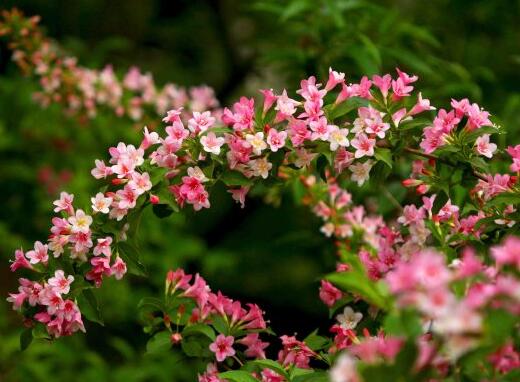
The Benefits and Uses of Weigela florida:
1. Ornamental value
The flowering period of Weigela florida is from April to June, when few other flowers are in bloom.
Weigela florida has dense branches and leaves, brilliantly colored flowers, and a long flowering period. When in bloom it is dazzlingly splendid, like a beautiful brocade sash, and the flower shape is very beautiful. It is an ornamental flowering plant with extremely high ornamental value. Therefore, Weigela florida is often used in garden planting and is a major flower species in North China and Northeast China.
2. Economic value
The value of Weigela florida is also reflected in its economic value. As a flowering shrub, Weigela florida is often used in North China and Northeast China. Weigela florida blooms beautifully and is not expensive, so it is loved by many flower enthusiasts, has a certain economic value on the market, and its market prospects are quite considerable.
3. Landscape value
Weigela florida has long branches and abundant flowers, brilliant as a brocade sash. It is a major landscape flower in early spring; when spring flowers fade and summer flowers are scarce, Weigela florida adds a different kind of scenery to the monotonous garden. Weigela florida has very high landscape value.
Weigela florida can also be mass planted at courtyard wall corners and by lakesides, or used as a flowering hedge or in grouped plantings. Using Weigela florida as an accent on rockeries and slopes is also a very good landscape application.
Weigela florida has strong resistance to hydrogen chloride, is a good pollution-resistant tree species, and has the effect of beautifying the environment. Flowering branches can also be used for vase arrangements.
4. Cultural value
Weigela florida blooms beautifully and has always been loved by people. Weigela florida has a long cultural history; as early as the Song Dynasty, there were poems and verses praising Weigela florida.
Weigela florida has become a favorite subject of artists and appears in various literary works. Therefore, Weigela florida also has a certain cultural value.#p#Subtitle#e#
Four-Season Management and Care of Weigela florida:
1. Spring care
Spring is the main flowering period of Weigela florida, with blooms from May to June. Applying decomposed compost once before early spring flowering replenishes sufficient nutrients for Weigela florida and can make the flowers bloom abundantly.
When Weigela florida begins to grow in spring, gradually increase watering, watering once or twice a month to keep the soil moist. Fertilize once every half month.
Spring is the season for pruning Weigela florida; dead branches and old, weak branches can be cut off to promote new growth.
Spring is the main season for propagating Weigela florida. In spring, Weigela florida can be propagated by cuttings and by sowing, and can also be propagated by division.
2. Summer care
Weigela florida grows vigorously in summer, but because of high temperatures and strong sunlight, high temperature and drought combined with strong light easily cause the leaves to turn yellow and dry and scorch. Therefore, in summer, ensure a sufficient water supply and spray water to lower the temperature; when the light is strong, Weigela florida can be moved to a semi-shaded, moist place for care. Because Weigela florida is afraid of waterlogging, pay attention to preventing waterlogging during the rainy season and avoid water accumulation.
Weigela florida can be propagated by cuttings in summer, but pay attention to the high summer temperatures, which can easily cause the cuttings to rot.
3. Autumn care
The fruiting period of Weigela florida is in October. After the fruit matures, there are seeds; in autumn, the seeds can be harvested for sowing and propagation the following year.
In autumn, Weigela florida can also be propagated by cuttings and by division.
4. Winter care
The suitable growing temperature for Weigela florida is between 15-35 degrees, and the suitable temperature during the flowering period is between 18 and 22 degrees. It is relatively cold-hardy, and in northern regions it can also overwinter outdoors, in a sheltered, sunny spot.
In winter, Weigela florida grows slowly and is in a dormant state; a trench can be opened at the base of Weigela florida to apply fertilizer once.
Four-Season Management of Weigela florida
Spring and Summer Care of Weigela florida
Spring Care of Weigela florida
Spring is the main flowering period of Weigela florida, with blooms from May to June. Applying decomposed compost once before early spring flowering replenishes sufficient nutrients for Weigela florida and can make the flowers bloom abundantly.
When Weigela florida begins to grow in spring, gradually increase watering, watering once or twice a month to keep the soil moist. Fertilize once every half month.
Spring is the season for pruning Weigela florida; dead branches and old, weak branches can be cut off to promote new growth.
Spring is the main season for propagating Weigela florida. In spring, Weigela florida can be propagated by cuttings and by sowing, and can also be propagated by division.
Summer Care of Weigela florida
Weigela florida grows vigorously in summer, but because of high temperatures and strong sunlight, high temperature and drought combined with strong light easily cause the leaves to turn yellow and dry and scorch. Therefore, in summer, ensure a sufficient water supply and spray water to lower the temperature; when the light is strong, Weigela florida can be moved to a semi-shaded, moist place for care. Because Weigela florida is afraid of waterlogging, pay attention to preventing waterlogging during the rainy season and avoid water accumulation.
Weigela florida can be propagated by cuttings in summer, but pay attention to the high summer temperatures, which can easily cause the cuttings to rot.
Autumn and Winter Care of Weigela florida
Autumn Care of Weigela florida
The fruiting period of Weigela florida is in October. After the fruit matures, there are seeds; in autumn, the seeds can be harvested for sowing and propagation the following year.
In autumn, Weigela florida can also be propagated by cuttings and by division.
Winter Care of Weigela florida
The suitable growing temperature for Weigela florida is between 15-35 degrees, and the suitable temperature during the flowering period is between 18 and 22 degrees. It is relatively cold-hardy, and in northern regions it can also overwinter outdoors, in a sheltered, sunny spot.
In winter, Weigela florida grows slowly and is in a dormant state; a trench can be opened at the base of Weigela florida to apply fertilizer once.
Summer Care and Management of Household Plants and Flowers (June-August)
June Flower TasksSolar terms in June: June 6, Grain in Ear; June 21, Summer Solstice.
I. Propagation: Flowering tree seeds that can be harvested in June
After harvesting wintersweet (Chimonanthus praecox) seeds, if nursery conditions do not allow, the extracted seeds can also be dry-stored until the following spring for sowing, without affecting their germination rate; peach, apricot, etc. should be sown immediately after harvesting, or their seeds can be sand-stored until they crack and sprout before being sown in the ground; osmanthus seeds harvested in June should have the fleshy fruit skin removed and be washed clean, then stored in moist sand to promote after-ripening of the seed embryo, and when they germinate, a nursery site can be selected for sowing.
II. Transplanting, establishing, and potting up
In June, a considerable number of herbaceous flowers need to be transplanted, established, or potted up. They are: evening primrose, cleome, impatiens, New Guinea impatiens, primrose, ornamental pepper, winter cherry, red-flowered tobacco, petunia, marigold, French marigold, zinnia, globe amaranth, scarlet sage, dragon's-mouth flower, Kochia scoparia, sulfur cosmos, cockscomb, red-and-green amaranth, etc. As summer arrives, some large flowering trees are no longer transplanted, to avoid affecting their survival rate and post-transplant growth. But for some small flowering shrubs, such as Japanese fatsia, mahonia, leatherleaf mahonia, Hypericum, gardenia, golden-edged privet, red-leaf barberry, and boxwood species, under special circumstances, balled transplanting is also acceptable, just as the old saying goes: "Transplant at any time, but do not let the tree know." However, after transplanting, misting and shading management must be strengthened.
III. Flower management
Flower species that enter semi-dormancy or dormancy in summer. Semi-dormant ones such as: red wood sorrel, geranium, fuchsia, clivia, calla lily, begonia species, etc. When the temperature reaches 30°C or above, because their growth activity is very weak and their metabolic level is low, watering should be reduced, and it is enough to keep the potting soil moist; deeply dormant species such as: cyclamen, Lycoris (species), ranunculus, Dutch peony, etc., under high temperatures show withered aboveground stems and leaves and dead underground nutrient fibrous roots, and they overwinter in summer in the soil as underground stems or tuberous roots. For these, watering must be stopped, and they should be moved to a cool place, keeping the potting soil from becoming excessively dry. If there is continuous rain, after the rain stops, comprehensively check the potted flowers; if water accumulation is found in the pots, pour it out as soon as possible, and after the potting soil dries, loosen the soil once, to avoid causing root rot in the plants; or before heavy rain arrives, lay the potted flowers down, and after the rain stops, set the potted flowers upright again. 1. Watering.
Watering potted flowers in June should pay attention to the following aspects: First, watering time, preferably at 10 a.m. or 5 p.m.; under normal circumstances, watering once a day is enough. Second, watering temperature; the irrigation water and potting soil temperature should be kept basically consistent. If the difference between water temperature and soil temperature is too great, it will stimulate the roots and leaves of the potted flowers and then affect their growth. Third, combine watering and misting. When there have been several days without rain, in addition to watering the pots, also mist the leaf surfaces and the area around the potted flowers, to increase the humidity of the local space. If there is continuous cloudy weather, decide whether to water and mist according to the wetness or dryness of the potting soil.
2. Fertilizing.
For vigorously growing species, such as Monstera deliciosa, spider plant, Syngonium, arrowroot species, sword fern, Philodendron bipinnatifidum, sago palm, Aspidistra, Philodendron 'Green Giant', red (green) gem, green emperor, green queen, rubber tree, Anthurium, Excoecaria cochinchinensis, palm bamboo, Norfolk Island pine, Brazilian iron, Buddhist pine, money tree, wintersweet, Chinese rose, Michelia alba, Aglaia odorata, jasmine, Chloranthus, plum blossom, camellia, sasanqua, Daphne odora, azalea, Osmanthus 'Rixianggui', Lantana camara, clerodendrum, shrimp plant, bitter orange, lemon, kumquat, pomegranate, crape myrtle, firethorn, etc., a topdressing of fully fermented dilute cake fertilizer water can be applied once every half month. For species currently in bloom, an appropriate amount of phosphorus and potassium fertilizer should also be applied to meet the needs of growth, flowering, and fruiting. For those flower species in dormant and semi-dormant states, fertilizing must be stopped; especially for those succulent flower species, such as jade plant, Christmas cactus, Haworthia cymbiformis, Senecio articulatus, squirrel's tail, Lampranthus, stapelia, and sedum species, when the temperature reaches 35°C or above, fertilizing must be stopped to avoid rotting.
3. Pruning and bud pinching.
(1) Prune vigorously growing species such as Chinese elm, Sageretia thea, Buddhist pine, Fujian tea, Chinese juniper, Sabina chinensis 'Pyramidalis', water willow, Sabina chinensis, Ilex cornuta, holly, trident maple, Fontanesia, tamarisk, firethorn, etc. Branches that affect the shape should be pruned or cut back early, which can keep the plant clearly layered and in good shape, and can promote more short shoots and more new buds, forming a perfect shape early.
(2) Pinch buds on flowers such as Aglaia odorata, jasmine, Chloranthus, Chinese rose, etc.; their spent flowers and stems should be removed in time, and the flowering branches should be appropriately cut back to promote the lower lateral branches or flower buds to bloom again. For flowering trees such as Michelia alba, bitter orange, azalea, camellia, wintersweet, plum blossom, crabapple, etc., in order to promote good plant shape and more flower buds, more blooms, and better blooms in the current year or the next, the excessively vigorous branches should be topped and buds pinched to inhibit the growth of the main and lateral shoots and promote the sprouting of lateral buds.
4. Pest and disease control.
(1) Chinese juniper, Sabina chinensis 'Pyramidalis', Chinese elm, papaya, firethorn, Buddhist pine, crabapple species, etc. are easily damaged by trunk-boring longhorn beetles, and poisoned sticks should be used promptly to block and control them.
(2) Chinese rose, Rosa multiflora, rose, etc. are prone to powdery mildew and brown spot during the plum rain season, and Bordeaux mixture should be sprayed early for control.
(3) Michelia alba, plum blossom, wintersweet, etc. are easily damaged by aphids, and appropriate pesticides should be selected early for spraying and killing.
(4) Orchid leaves are easily infected with anthracnose, and fungicides such as carbendazim should be sprayed early for control.
(5) Bitter orange, lemon, kumquat, fingered citron, etc. have tender leaves that are easily eaten by citrus swallowtail butterfly larvae, and contact poisons, stomach poisons, and other pesticides can be sprayed to kill them.
IV. Bonsai shaping
The plant species that can be shaped in June are mainly some highly adaptable, wire-tolerant woody ornamental plants, and they must be plants that were potted and hardened off in early spring or grown in the ground. They are: Buddhist pine, winter jasmine, Elaeagnus pungens, Armand pine, Sabina chinensis 'Pyramidalis', Sabina chinensis, Ilex cornuta, holly, Chinese wolfberry, five-needle pine, Malus halliana, Malus micromalus, plum blossom, ornamental peach, trident maple, Serissa japonica, black pine, boxwood, Chinese elm, tamarisk, water willow, Chinese juniper, ginkgo, Fontanesia, firethorn, etc. Shaping in June must be careful, with light and slow wiring; never rush or use excessive force.
July Flower Tasks
Solar terms in July: July 7, Minor Heat; July 23, Major Heat.
Weather characteristics in July: On July 11, the Jianghuai region ends the plum rain season. On July 18, the dog days begin, and on August 17, the dog days end; most parts of the country enter the hottest period of the year. The average July temperature in most parts of our country is 24°C or above, and in the Jianghuai and southern regions it is 28°C; only northern Northeast China and the Qinghai-Tibet Plateau have an average July temperature below 20°C.
I. Flower propagation
1. Sowing.
Herbaceous flowers that can be sown in July include: cineraria, four-season primrose, ornamental kale, campanula, etc. When sowing, attention should be paid to moisture retention, shading, and increasing ventilation and light transmission. Ripe fruits of plum, Mao peach, mountain peach, Prunus triloba, etc. can also be picked, the flesh washed off, and then sown in furrows immediately; or the cleaned stone fruits can be stored in moist sand until they crack and then sown; wintersweet seeds can be sown immediately after harvesting, or the seeds extracted from the fruit capsule can be dry-stored until the following spring for sowing, without affecting their germination rate.
2. Cuttings.
Herbaceous flower species suitable for propagation by cuttings in July include: Scutellaria indica, begonia species, coleus, Pilea cadierei, scarlet sage, marigold, French marigold, globe amaranth, geranium, Dutch chrysanthemum, purple loosestrife, umbrella plant, Boston ivy, coral flower, pepperomia, Rhaphidophora, Polygonum chinense, bryophyllum, pothos, etc. Woody flowering species suitable for propagation by cuttings include: Excoecaria cochinchinensis, nandina, poinsettia, crown of thorns, Hypericum, Hypericum kouytchense, Weigela florida, hydrangea, Weigela florida, snowflake, Daphne odora, gardenia, Edgeworthia chrysantha, Magnolia sieboldii, bougainvillea, Aglaia odorata, jasmine, Chloranthus, Schefflera, mahonia, pomegranate, crape myrtle, hibiscus, firethorn, Cordyline, Chinese hibiscus, Serissa japonica, Michelia figo, coral tree, rubber tree, Viburnum macrocephalum, Viburnum sargentii, boxwood species, fig, Magnolia liliiflora, osmanthus, azalea species, camellia, sasanqua, Salix babylonica 'Tortuosa', golden willow, etc. Amaryllis can also be propagated by scale cuttings. In addition, in July, some flowering trees can also be propagated by water cuttings. They are: gardenia, oleander, Chinese rose, jasmine, Chloranthus, fig, pomegranate, fuchsia, crape myrtle, hibiscus, etc. To propagate flowering trees by water cuttings, first prepare a thick foam plastic board of 1 cm to 2 cm, and use it as a fixing material for cuttings after punching holes; second, keep the water used for cuttings clean; a few pieces of charcoal can be added for preservation.
3. Grafting.
One-year-old mountain peach or Mao peach seedlings can be used as rootstock to propagate ornamental peach, longevity peach, red-leaf peach, plum blossom, Prunus triloba, red-leaf plum, beauty plum, etc. by bud grafting; using cuttings of wild rose, Rosa multiflora, and 'Ten Sisters' as rootstock, bud graft to propagate variety roses, cut-flower roses, and roses, etc.; using potted Magnolia liliiflora and Magnolia denudata seedlings as rootstock, approach graft to propagate Michelia alba, Michelia figo, etc.; using potted 2-year-old seedling wintersweet seedlings as rootstock, approach graft to propagate superior wintersweet varieties; 2-year-old wintersweet seedlings can also be used as rootstock, using the method of softwood side grafting with bagging for moisture retention, grafting at 3 cm to 4 cm above the ground; after 7 to 10 days, it can be determined whether they have survived; using 'Purple Butterfly' and 'Jade Butterfly' among Mao azaleas as rootstock, split graft or side graft to propagate Belgian azalea or Western azalea; using cherry seedlings as rootstock, bud graft to propagate superior cherry blossom varieties; using current-year seedling seedlings of Malus baccata, Malus hupehensis, or Malus halliana and crabapple as rootstock, perform "T"-shaped bud grafting to propagate superior crabapple species; using Japanese maple seedlings as rootstock, bag graft to propagate red maple, feather maple, and other seedlings.
4. Layering.
Flowering tree species that can be propagated by layering in July include: Aglaia odorata (air layering), wintersweet, honeysuckle, hydrangea, trumpet vine, Viburnum macrocephalum, oleander, Weigela florida, broom, osmanthus, gardenia, Magnolia liliiflora, jasmine, Chloranthus, climbing rose, winter jasmine, etc.
5. Division.
Ornamental plant species that can be divided in July include: hosta, purple calyx, Acorus species, umbrella plant, Aspidistra, Rhoeo discolor, bromeliad species, Haworthia, spider plant, Ophiopogon species, Reineckea carnea, Zephyranthes, sword fern, iris, Tradescantia zebrina, etc.
II. Harvesting seeds, transplanting, establishing, and potting up
1. Harvesting seeds.
Herbaceous flower seeds that can be harvested in July include: hollyhock, mallow, morning glory, baby's breath, petunia, phlox, foxglove, Coreopsis, sweet pea, daisy, delphinium, pansy, Lampranthus, etc. Flowering tree seeds that can be harvested include: wintersweet, plum, Mao peach, mountain peach, Prunus triloba, etc.
2. Transplanting.
In July, trees are generally not transplanted, but under some special circumstances, balled transplanting of some flowering shrubs is also feasible, such as mahonia, Hypericum, golden-leaf privet, red-leaf barberry, Aucuba, Sabina chinensis 'Globosa', etc. However, targeted pruning must be done, shade sheds should be built in time, and the number of misting should be increased. After they basically survive, switch to normal management; never be careless.
3. Potting up.
July is the main period for potting up herbaceous flowers for display during National Day. The herbaceous flowers transplanted and potted at this time can be seedlings from sowing or cuttings; after 3 months of careful care, they will bloom exactly during National Day for holiday decoration. They are mainly: scarlet sage, early chrysanthemum, globe amaranth, small dahlia, New Guinea impatiens, dragon's-mouth flower, marigold, French marigold, Kochia scoparia, China aster, sulfur cosmos, cockscomb, etc.
III. Flower management
1. Watering. Flower species that enter a semi-dormant state under high temperatures, such as red wood sorrel, geranium species, fuchsia, clivia, calla lily, begonia species, sedum, kalanchoe, cactus species, Haworthia cymbiformis, Stapelia gigantea, string of pearls, Senecio rowleyanus, Daphne odora, Christmas cactus, Portulacaria afra, aloe, etc., because the temperature is too high, their growth activity basically stops and their metabolic level is very low. Watering should be reduced, the potting soil kept moist, and attention paid to shading and ventilation to create a relatively cool environment for them. If watered too much, it easily causes root rot and also seriously affects their recovery growth after autumn. Flower species that enter a deep dormancy state under high temperatures, such as cyclamen, Lycoris species, ranunculus, bleeding heart, etc., in July show withered aboveground stems and leaves and dead underground nutrient fibrous roots, and they overwinter in summer in the soil as underground stems or tuberous roots. For flowers in a deep dormant state, stop watering, move them to a cool place, and keep the potting soil from becoming too dry.
For vigorously growing flower species, especially foliage plants, such as sago palm, Aspidistra, Monstera deliciosa, rubber tree, Michelia alba, jasmine, Aglaia odorata, Chloranthus, Norfolk Island pine, arrowroot species, Syngonium species, red (green) gem, Philodendron 'Green Giant', green emperor, green queen, pink-striped arrowroot, Brazilian iron, money tree, camellia, sasanqua, Aucuba, firethorn, bitter orange, lemon, Buddhist pine, pomegranate, redbud, wisteria, Chinese rose, etc., not only should the amount and frequency of watering be increased, but also appropriate leaf misting should be given, combining watering and misting. Especially during continuous cloudy days, because the temperature is relatively high and the air is dry, watering and misting should likewise be given; never be careless. Once the potting soil is found to be too dry and the leaves wilted, first mist the leaf surfaces, and after the leaves recover and stand up, then water the roots. Never pour water heavily at the roots, otherwise it is very easy to cause woody flowering plants to "drop green leaves," or cause the plant's nutrient fibrous roots to rot, or even cause the plant to die.
For potted plum bonsai, because July to August is its flower bud differentiation period, appropriate "water withholding" should be given to promote normal flower bud differentiation. The method is: keep the leaves of the potted plant slightly curled inward on both sides to control vegetative growth; if the vegetative growth of the branches cannot be controlled, when the second new shoot produces 2 to 3 leaves, keep only one leaf at the base and pinch off the rest; flower buds can still differentiate in the axils of this leaf.
In July, when watering potted flowers, avoid the hours around noon; watering before 10 a.m. and after 4 p.m. is preferable, to avoid too great a difference between water temperature and soil temperature, which affects the growth of potted ornamental plants. If there is continuous rainy weather this month, check the flower pots promptly after the rain; if water accumulation is found in the flower pots, pour it out in time, and after the potting soil is slightly dry, loosen the soil once more, to avoid causing root rot in the potted plants.
2. Fertilizing.
There are four major categories of ornamental plants that should have their fertilizing management strengthened in July. First, species with an especially long flowering period, blooming from spring and summer into autumn, such as Magnolia denudata, Chinese rose, Aglaia odorata, jasmine, etc.; second, species that bloom abundantly in autumn, such as chrysanthemum, osmanthus, cotton rose, etc.; third, species for winter flower viewing and fruit appreciation, such as bitter orange, nandina, wintersweet, azalea, etc.; fourth, foliage plants, such as palm bamboo, Monstera deliciosa, Philodendron bipinnatifidum, rubber tree, etc. As for the types of fertilizer, for the first three categories, in addition to applying necessary nitrogen fertilizer, an appropriate amount of phosphorus and potassium fertilizer should also be applied to meet the plant's comprehensive needs for nitrogen, phosphorus, and potassium and provide sufficient nutritional guarantee for bud formation, flowering, and fruiting; for foliage plants, dilute cake fertilizer liquid or urea liquid should be the main choice. As for the fertilizing method, dilute liquid fertilizer applied by watering is preferable.
Herbaceous flowers that should have fertilizing strengthened in July include: scarlet sage (white, purple, pink), cockscomb, China aster, zinnia, globe amaranth, chrysanthemum, black-eyed Susan, petunia, gold shrimp plant, shrimp plant, Jianlan orchid, marigold, four-o'clock, dragon's-mouth flower, etc. Woody flowers include: crape myrtle, pomegranate, poinsettia, Michelia figo, osmanthus, camellia, sasanqua, Chinese hibiscus, jasmine, Michelia alba, Aglaia odorata, night-blooming jasmine, Chinese rose, crabapple species, Brunfelsia, bougainvillea, azalea, Chloranthus, wintersweet, hibiscus, cotton rose, etc. There are many kinds of foliage plants, such as bromeliad species, Brazilian iron, palm bamboo, Norfolk Island pine, Syngonium, arrowroot, Philodendron 'Green Giant', red gem, sago palm, rubber tree, Monstera deliciosa, Cordyline, etc. In July, for ornamental plants in a dormant or semi-dormant state, fertilizing must be stopped; especially for those succulent ornamental plants, such as sedum species, Senecio articulatus, Lampranthus, stapelia, etc., fertilizing must be stopped to prevent the plants from rotting.
3. Pruning and bud pinching.
Ornamental plants that can be topped and pinched in summer must be species that grow vigorously, have strong sprouting ability, and tolerate pruning. Topping means directly pinching off the tender terminal bud of the shoot with the fingers. Bonsai plants suitable for topping mainly include: Chinese elm, Sageretia thea, Syzygium buxifolium, Euonymus bungeanus, boxwood, wintersweet, firethorn, Buddhist pine, tamarisk, Elaeagnus pungens, water willow, Vitex negundo, Forsythia, Celtis sinensis, Fujian tea, ficus, Fraxinus chinensis, trident maple, crape myrtle, Serissa japonica, Murraya paniculata, etc. Pruning means using scissors to cut off part of the new shoot to promote the sprouting of lower lateral buds and form beautiful crown layers or tree shapes. Bonsai plant species suitable for pruning are mostly woody ornamental plants that are not convenient for finger pinching, such as Juniperus rigida, Platycladus orientalis, Sabina chinensis, Juniperus procumbens, Xylosma, Ilex cornuta, Chinese juniper, etc. For potted flower species that continue to bloom for a long time, such as Aglaia odorata, Chinese rose, jasmine, Chloranthus, etc., their spent flowers and stems should be removed in time, and the flowering branches should be given necessary cutback, which can promote the sprouting of lower lateral buds and reblooming. For azalea, camellia, sasanqua, crabapple, wintersweet, plum blossom, etc., overly long branches protruding from the crown should also be cut back to form a better crown shape.
4. Shading.
July is the month with the strongest sunlight and the highest temperatures of the year, so special attention should be paid to shading management for potted ornamental plants. For those ornamental plants that like shade or semi-shade, they must be moved under a shade shed to avoid damage to the plants from scorching sun. Such as ferns, hosta, purple calyx, Monstera deliciosa, camellia, sasanqua, azalea, Chloranthus, bird of paradise, orchid species, palm bamboo, rubber tree, red (green) gem, Philodendron bipinnatifidum, pink-striped arrowroot, pothos, pepperomia species, Aspidistra, Tradescantia zebrina, Brazilian iron, Rhaphidophora, bromeliad species, arrowroot species, Reineckea carnea, etc. For light-loving species, sufficient light can be given, such as pomegranate, wisteria, crape myrtle, firethorn, jasmine, Serissa japonica, sago palm, Sabina chinensis, Platycladus orientalis, peach blossom, plum blossom, wintersweet, Chinese elm, Sageretia thea, trident maple, black pine, water willow, Xylosma, Pinus thunbergii, Michelia alba, Aglaia odorata, Chinese rose, etc. For Buddhist pine, Podocarpus nagi, Michelia figo, Damnacanthus, cloud bamboo, hedge bamboo, five-needle pine, etc., it is necessary to give appropriate shading. For small, miniature, and shallow-pot bonsai, because the temperature is too high this month and the air is relatively dry, in addition to necessary shading, the flower pots must also be buried in wet sand, which can reduce evaporation from the potting soil surface and also help protect the plant's nutrient fibrous roots.
5. Flowers in air-conditioned rooms.
In air-conditioned rooms, choose flower species with a relatively high degree of leathery leaves, or with a thicker cuticle layer on the leaf surface, slightly tolerant of dry environments, and with strong resistance, such as rubber tree, Japanese fatsia, mahonia, sago palm, Norfolk Island pine, golden hibiscus, fan palm, palm bamboo, Canary Island date palm, bromeliad species, Philodendron bipinnatifidum, Monstera deliciosa, Schefflera, Aspidistra, Aucuba, etc., and it is not advisable to choose sword fern, coleus, Philodendron 'Green Giant', Syngonium, etc. In addition, during management, attention should be paid to combining watering and misting, and keeping away from air-conditioning vents to prevent wind from directly blowing on the plants and causing their leaf tips to wither and edges to scorch. 6. Pest and disease control.
(1) When orchid new shoots unfold leaves in July, the leaf tips are easily infected with anthracnose, which gradually spreads to the whole plant and, in severe cases, can cause the plant to wither and die. This disease can occur throughout the year; poor ventilation, high temperature and high humidity, and continuous overcast rain are more conducive to the reproduction and spread of the pathogen. Ventilation should be strengthened, and during the disease period, spray 75% chlorothalonil wettable powder at 800 times dilution or folpet at 500 times dilution for control.
(2) When reddish-brown sawdust-like insect frass accumulates on the root crowns or main trunks of plum blossom, peach blossom, crabapple species, red-leaf plum, cherry blossom, Prunus triloba, etc., it is mostly caused by the larvae of the peach red-necked longhorn beetle boring and feeding. Methods such as manual extraction and killing, injection of systemic pesticide, insertion of poisoned sticks, and soil application of carbofuran can be used for control, and can effectively kill the larvae inside the tree trunk. Note that when injecting pesticides, avoid dimethoate, omethoate, etc., to prevent phytotoxicity.
(3) In July, promptly control the boxwood leaf roller moth that harms boxwood, boxwood, sharp-leaf boxwood, and pearl boxwood; when this pest occurs severely, it can completely eat all the leaves. Once discovered, promptly spray pesticides such as trichlorfon, dimethoate, or fenvalerate. If a certain pesticide has been used for a long time and the pest has developed resistance, switch to a new type of pesticide.
(4) In July, in some areas, citrus swallowtail butterfly larvae will continue to harm the new shoot leaves of bitter orange, kumquat, kumquat, fingered citron, lemon, citron, and rue, and stomach-poison pesticides should be sprayed promptly to kill them.
(5) The white wax insect that harms privet, small-leaf privet, water ash, and white ash has its emergence period from late July to late August. The right time should be chosen to spray pesticides such as Supracide for control, which can prevent the white wax insect from causing damage again the following year.
(6) The Japanese wax scale is a major pest harming large-leaf boxwood, London plane, Pittosporum tobira, camellia, red-leaf plum, deodar cedar, etc. In severe cases, the insect bodies often cover the branches and leaves. Early July is the peak hatching period of its nymphs, and pesticides such as dimethoate and Supracide can be sprayed promptly for control.
IV. Bonsai shaping.
In July, because the temperature is high, air humidity is low, and plants are in a vigorous growth period, branch injuries are easily infected by pathogens and difficult to heal and recover, so most tree stump species are no longer suitable for wiring and shaping. Those that can still be shaped are some highly adaptable, wire-tolerant plant species, and they must be plants potted and hardened off in spring or grown in the ground. They are: winter jasmine, ginkgo, Buddhist pine, arborvitae, Sabina chinensis 'Pyramidalis', Serissa japonica, black pine, boxwood, water willow, etc.
In July, plant shaping must be careful and meticulous, with light and slow wiring, gradually applying force; do not operate hastily or use excessive force, otherwise it is very easy to cause the plant's branches and trunk to break and endanger its survival.
August Flower Tasks
Solar terms in August: August 7, Start of Autumn; August 23, End of Heat.
Weather characteristics in August: The dog days end on August 17, and August 23 is End of Heat, meaning the heat stops here; from then on, temperatures gradually decline in most parts of our country. Compared with July, August temperatures, although somewhat lower, are much higher than the average temperature in June, making it the month with the second-highest average monthly temperature of the year. Nationwide, August precipitation is less than in the plum rain season, belonging to a hot, dry month, and it poses a great threat to quite a number of foliage plants, especially to flower species that like cool, moist environments. For this reason, fertilizing, watering, shading, and other management of flowers must not be treated lightly. August flower management mainly includes the following contents.
I. Flower propagation
1. Sowing.
Annual and perennial flowers that can be sown and propagated in August include: baby's breath (Gypsophila), lupine (Lupinus), petunia, snapdragon, coneflower (Echinacea), red woodsorrel (Oxalis), campanula, foxglove, columbine, yarrow (Achillea millefolium), nasturtium, pyrethrum, delphinium, Lychnis coronata, and others. Greenhouse flowers that can be sown include: calceolaria, gloxinia, cyclamen, cineraria, schizanthus, Chinese primrose (Primula obconica), wax begonia, and pot marigold (grown as a potted plant), among others. Woody flowers that can be sown include peony, flowering almond (Prunus triloba), red camellia (Camellia chekiangoleosa), and others; they can be sown immediately after collection, or the seeds can be stored in sand until germination and then sown in the ground; after pomegranate fruits are harvested, the seeds are separated, rubbed and washed to remove the fleshy layer outside the seeds, stored in sand until germination, and then sown.
2. Cuttings.
Using a medium of half fine sand and half rice-hull ash as the cutting substrate, woody flowers that can be propagated by insulated cuttings include: firethorn (Pyracantha), mahonia, Michelia figo, bougainvillea, coral tree (Erythrina), Aucuba japonica 'Variegata', French holly (Viburnum tinus), Viburnum macrocephalum, hibiscus (Hibiscus rosa-sinensis), Chinese lantern (Physalis alkekengi), jasmine, Chloranthus, rubber tree (Ficus elastica), Podocarpus macrophyllus, Schefflera octophylla, Cordyline fruticosa, Daphne, hydrangea, and Aglaia odorata, among others. Flowers and trees propagated by cuttings in ordinary sandy loam seedbeds include: boxwood species, purple magnolia (Magnolia liliiflora), pomegranate, hibiscus (Hibiscus syriacus), spirea, Spiraea thunbergii, French holly (Viburnum tinus), Boston ivy (Parthenocissus tricuspidata), golden-edged privet (Ligustrum ovalifolium 'Aureum'), red-leaf barberry (Berberis thunbergii var. atropurpurea), nandina, fig, oleander, crape myrtle, Serissa japonica, and Forsythia, among others. Using the full-light misting method, large numbers of dawn redwood (Metasequoia), pond cypress (Taxodium ascendens), and bald cypress (Taxodium distichum) can be propagated by cuttings.
Using sandy loam as a seedbed, scarlet sage (purple, white, pink), globe amaranth (white), marigold, French marigold, and sulfur cosmos can continue to be propagated by cuttings; after they take root, they can be potted and used for street flower displays from October to November.
3. Grafting.
In August, using purple magnolia (Magnolia liliiflora) or white magnolia (Magnolia denudata) seedlings as rootstock, superior varieties of white magnolia and Yulan magnolia (Magnolia × soulangeana) can be propagated by bud grafting; using current-year seedling peach (Prunus persica) as rootstock, ornamental peach, purple-leaf peach, red-leaf plum (Prunus cerasifera), longevity peach, Meiren plum (Prunus mume 'Meiren'), Japanese apricot, and flowering almond can be propagated by bud grafting; using cherry seedlings as rootstock, Japanese cherry (Prunus serrulata) and others can be propagated by bud grafting; using seedling peach or wild apricot as rootstock, double-flowered dwarf cherry plum (Prunus glandulosa) can be propagated by bud grafting; using rooted cuttings of wild rose as rootstock, variety roses can be propagated by bud grafting; using current-year seedlings of Malus baccata and Malus hupehensis as rootstock, M. micromalus, M. halliana, and M. spectabilis can be propagated by bud grafting; using green maple (Acer palmatum) as rootstock, red maple and laceleaf maple can be propagated by crown replacement grafting.
4. Layering.
Ornamental plants that can be propagated by layering in August include: honeysuckle, Chinese trumpet creeper (Campsis grandiflora), weigela, hydrangea, oleander, Viburnum macrocephalum, broom (Caragana), winter jasmine, Forsythia, gardenia, osmanthus, purple magnolia (Magnolia liliiflora), jasmine, Chloranthus, and climbing roses, among others.
5. Division.
Ornamental plants that can be propagated by division in August include: Reineckea carnea, hosta, purple hosta (Hosta ventricosa), iris, red woodsorrel (Oxalis), delphinium, Rohdea japonica, Aglaonema, Platycodon grandiflorus, Michaelmas daisy (Aster novi-belgii), Acorus species, Spathiphyllum, bromeliads, Aspidistra, sword fern (Nephrolepis), Eupatorium, pyrethrum, nandina, goldenrod (Solidago), rain lily (Zephyranthes), and daylily, among others. Flower species whose small bulbs can be divided and planted include: Lycoris, calla lily, freesia, and taro (Alocasia), among others.
II. Seed Collection and Transplanting and Setting Out
1. Seed collection.
Annual flowers whose seeds can be collected in August include: strawflower (Helichrysum), cypress vine (Ipomoea quamoclit), scutellaria (Scutellaria barbata), four-o'clock (Mirabilis jalapa), snow-on-the-mountain (Euphorbia marginata), gaillardia, phlox, coreopsis (Coreopsis tinctoria), sweet pea, California poppy, and Lampranthus, among others; the seeds of the perennial herbaceous peony mature around August to September, when the fruit splits open to reveal black spherical seeds; they can be sown immediately after collection, or the collected seeds can be stored in moist sand until germination and then sown. Woody flower species whose seeds can be collected include: peony, pomegranate, flowering almond (Prunus triloba), and red camellia (Camellia chekiangoleosa), among others.
2. Transplanting and setting out.
In August, trees are generally not transplanted; for small shrubs such as Chinese privet (Ligustrum sinense), golden-edged thuja (Platycladus orientalis 'Aurea'), dragon juniper (Juniperus chinensis), Sabina chinensis, red-leaf barberry (Berberis thunbergii var. atropurpurea), golden-leaf privet (Ligustrum × vicaryi), boxwood balls, Hypericum, Aucuba japonica 'Variegata', and French holly (Viburnum tinus), they can be transplanted with larger root balls after heavy pruning, but careful watering, misting, and shading management must be provided after transplanting; only after they recover their vigor can ordinary management methods be used, otherwise the transplanted flowering shrubs are very likely to die. To decorate flower beds or street green spaces during National Day, potted marigold, French marigold, scarlet sage, globe amaranth, cockscomb, and others can be removed from their pots and then transplanted and set out; or small seedlings can be transplanted from the cutting beds with their original soil to street green spaces, while strengthening water and fertilizer management after transplanting, to ensure they can bloom in time during National Day.