How to propagate camellia and fig by cuttings so they root quickly?
Cuttings are a propagation method for many plants. Taking cuttings looks very simple, but in many cases they are very hard to keep alive. Let's look at how to get flowering plants to root quickly from cuttings. The cutting methods really are a bit different for different flowers:
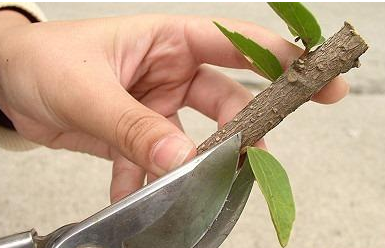
1. Spray the mother tree with rooting liquid.
Two or three days before taking the cuttings, spray the mother plant evenly with rooting liquid. After being absorbed through the young buds and tender bark, it is transported within the tree, which can clearly reduce the growth-inhibiting substance tannin in the branches, strengthen sprouting ability, and make the cuttings root quickly after planting.
2. It is best to cut the branches in the morning. In the morning the branches of flowering plants have sufficient water content, so after cutting the wounds heal quickly, rooting is easy, and the survival rate is high.
3. For branch selection, post-bloom branches are best. Post-bloom branches have the highest nutrient content and are relatively thick and plump, giving a high survival rate for cuttings and fast root and leaf growth.
4. For osmanthus, camellia, fig and others, strong shoots with a heel are recommended for cuttings.
5. Ring-barking before taking cuttings helps the cuttings produce adventitious roots. The ring-barking width is 5 mm to 7 mm.
6. Soak the cuttings in water before planting, as with persimmon and walnut, soaking them thoroughly in clean water and changing the water several times so that the tannin in them is leached out, which helps the cuttings root.
7. For flowering shrubs with thin, long and soft branches, use layering into the soil one or two months before taking cuttings to promote rooting.
8. Soak in potassium permanganate solution for 10 hours, take out and plant immediately, which can promote rooting in flowering plants.
9. Soak in a white sugar solution at a concentration of 5% to 10% for 24 hours, take out, rinse clean and then plant, which can also promote rooting.
10. Soak in vitamin B12 solution for 5 minutes, take out, let it dry slightly and then plant; the rooting-promoting effect is fairly good.
11. For cuttings taken in winter and early spring, appropriately raise the temperature of the cutting bed to promote sprouting and rooting.
That is all for the methods of propagating flowering plants by cuttings. There really is a method to this; be careful not to simply kill the flowering plant with your cuttings.
11 methods to make flowering plant cuttings root quickly
After the New Year, as the temperature warms up, many flowering plants are suitable for cuttings. Taking cuttings is easy, but rooting requires some small tricks. Today I will categorize them for everyone; those who need it can take a look.
To improve the survival rate of flowering plant cuttings, you can do this:
1. Spray the mother tree with rooting liquid.
Two or three days before taking the cuttings, spray the mother plant evenly with rooting liquid. After being absorbed through the young buds and tender bark, it is transported within the tree, which can clearly reduce the growth-inhibiting substance tannin in the branches, strengthen sprouting ability, and make the cuttings root quickly after planting.
2. It is best to cut the branches in the morning.
In the morning the branches of flowering plants have sufficient water content, so after cutting the wounds heal quickly, rooting is easy, and the survival rate is high.
3. For branch selection, post-bloom branches are best.
Post-bloom branches have the highest nutrient content and are relatively thick and plump, giving a high survival rate for cuttings and fast root and leaf growth.
4. For osmanthus, camellia, fig and others, strong shoots with a heel are recommended for cuttings.
5. Ring-barking before taking cuttings helps the cuttings produce adventitious roots. The ring-barking width is 5 mm to 7 mm.
6. Soak the cuttings in water before planting, as with persimmon and walnut, soaking them thoroughly in clean water and changing the water several times so that the tannin in them is leached out, which helps the cuttings root.
7. For flowering shrubs with thin, long and soft branches, use layering into the soil one or two months before taking cuttings to promote rooting.
8. Soak in potassium permanganate solution for 10 hours, take out and plant immediately, which can promote rooting in flowering plants.
9. Soak in a white sugar solution at a concentration of 5% to 10% for 24 hours, take out, rinse clean and then plant, which can also promote rooting.
10. Soak in vitamin B12 solution for 5 minutes, take out, let it dry slightly and then plant; the rooting-promoting effect is fairly good.
11. For cuttings taken in winter and early spring, appropriately raise the temperature of the cutting bed to promote sprouting and rooting.
Hurry and propagate new growth for the flowering plants at home, and wait for spring, when flowers will fill the balcony!
What should be done to make flowering plants root quickly?
The weather in May is really unsettled, sunny and cloudy by turns. After a light rain a touch of coolness arrives, which is really a bit hard to handle. Recently quite a few flower lovers have asked me how we should make flowering plants root quickly. Taking this opportunity today, I will look into with everyone how we can make flowering plants root quickly and what measures should be taken.
To prompt rooting in flowering plants that are difficult to root, such as milan, crape myrtle, honeysuckle, wintersweet, osmanthus, camellia, azalea and white magnolia, besides using growth hormones such as naphthalene acetic acid, some economical and simple methods can also be used to prompt them to root.
Measures to take:
(1) Dip the base of the cuttings 2 cm into a 0.1% to 0.5% potassium permanganate aqueous solution and soak for 12 to 14 hours, then take out and plant immediately.
(2) Treat the cuttings with a white sugar aqueous solution. The concentration used for herbaceous flowers is about 2% to 5%; for woody flowering plants it is about 5% to 10%. Dip the base of the cuttings 2 cm into the above solution for about 24 hours, take out, rinse the sugar liquid clinging to the cuttings clean with clean water, and then plant.
(3) Dilute medical-grade vitamin B12 injection with an equal amount of cool boiled water, dip the base of the cuttings into it, take out after about 5 minutes, let it dry a little, and plant once the liquid has been absorbed.
(4) For some flowering plants that are difficult to root, during the growth period you can also ring-bark the base of the branch or tie it with wire and the like, so that nutrients accumulate greatly at the ring-barked part, and in the dormant period cut off along the ring-barked part for cuttings, which can promote rooting.
(5) Cuttings with a heel. When cutting osmanthus, camellia, fig and other flowering plants, keeping a little of the previous year's growth at the base of the cutting makes rooting easy.
(6) Increase the bottom temperature of the cutting bed. If using cuttings, in winter they can be placed on a radiator or heated brick bed with a wooden board laid on top. If conditions allow, using an electric heating bed for cuttings gives even better results. If a large number of difficult-to-root flowering plants need to be prompted to root, ABT rooting powder can be used. This powder can not only shorten rooting time and increase the rooting rate, but also promote robust root development. The usual method is to use a 50 ppm to 100 ppm solution, soak the base of one-year-old softwood shoots for about 0.5 to 1 hour, take out and insert immediately into the growing medium. Its rooting effect is better than that of naphthalene acetic acid and indolebutyric acid.