What to do when Kalanchoe leaves won't grow big and it won't bloom
Speaking of this Kalanchoe, its flowering period is relatively long, and it generally blooms red flowers. Let's see what to do when Kalanchoe leaves won't grow big and what to do when it won't bloom:
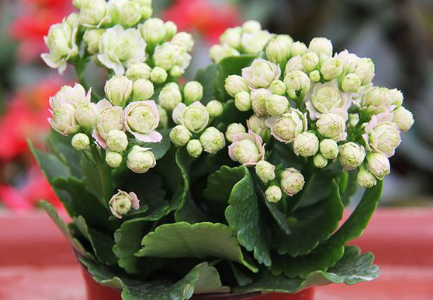
What to do when Kalanchoe leaves won't grow big:
1. Heavy, sticky soil
Kalanchoe needs loose, fertile soil with good drainage. Soil that is too heavy and sticky will cause poor development in Kalanchoe.
It is best to use equal parts leaf mold and garden soil, mixed with some river sand and bone meal. This kind of soil is slightly acidic and suitable for root growth.
2. Overwatering
Kalanchoe has a strong ability to store water and does not need much watering, especially in winter, when 1—2 times a month is enough. Too much watering can cause root rot. If the roots are unhealthy and cannot absorb nutrients, Kalanchoe naturally cannot grow vigorously.
3. Insufficient light
Kalanchoe likes light. Being kept out of sunlight for a long time will make its branches thin and long and its leaves thin and small.
Gardeners who place Kalanchoe on windowsills or balconies should note that Kalanchoe is phototropic, so the pot should be turned frequently to let the plant receive light evenly and prevent it from growing to one side and ruining its shape.
4. Insufficient nutrients
During the growing period, Kalanchoe can be given a diluted compound liquid fertilizer once every half a month. After flower buds form, nitrogen fertilizer should be controlled, and potassium dihydrogen phosphate can be applied at a ratio of about 2:1000 to increase nutrition for the flowers and reduce the consumption of the whole plant's nutrients by the flowers.
5. Effect of the flowering period
If Kalanchoe is blooming, most of the plant's nutrients are absorbed by the flowers, so the plant almost stops growing. Gardeners should not worry. After the flowering period passes, a healthy Kalanchoe will slowly grow larger.
What to do when Kalanchoe won't bloom:
1. Ensure the plant receives even light
In fact, Kalanchoe's light exposure is easy to control. Place it in a sunny spot on the balcony, just provide proper shade in summer, and give normal light at other times, ensuring more than 4 hours of sunlight each day. To make the Kalanchoe bloom evenly, care should be taken to frequently change the direction of the pot so the plant receives light evenly. On building balconies, the pot should be turned 180 degrees every half a month.
2. Supplement nutrients in time
From the time Kalanchoe is brought indoors at Frost's Descent to October of the following year is exactly the late stage of flower bud differentiation and the full flowering period, and also the time when it builds up nutrients. The demand for fertilizer is very high. Therefore, apply a fishy-smelling fertilizer mainly containing phosphorus and potassium once a week to support flower bud differentiation.
Kalanchoe has a long flowering period, which is also the period of “showing results.” During this period, apply a diluted nitrogen-phosphorus-potassium fertilizer or a 0.2% potassium dihydrogen phosphate solution once a month, so that the later flowers do not become smaller and paler due to lack of fertilizer.
That covers the reasons why Kalanchoe won't grow big and why it won't bloom. With these, you can grow Kalanchoe well.
What to do when Kalanchoe leaves become soft and what to do when Kalanchoe drops leaves
During care, Kalanchoe sometimes develops soft leaves and leaf drop. What should we do? Let's look at the answers together below.
What to do when Kalanchoe leaves become soft
1. Root rot. Double-petaled Kalanchoe should be re-propagated by cuttings about every 2 years, otherwise the roots easily rot. Gardeners can check whether their Kalanchoe has root rot.
2. Excessive exposure to strong sun. Although Kalanchoe likes light, if it is exposed to too much sunlight, the leaves can become soft and the leaf edges can turn dry and yellow.
3. Dormancy period. In midsummer, Kalanchoe is almost in a dormant state, and even if it grows, it is very slow. At this time, it is best to care for it in a cool place. If it continues to be exposed to strong sun, the leaves will become soft.
4. Lack of water. Some potting soil has very good water permeability, so it needs frequent watering, otherwise it easily becomes short of water.
Kalanchoe cannot be kept in the same pot for a long time like other woody plants. Gardeners can cut off branches or leaves for cuttings, so that even if one pot has problems, this type of flower is not lost.
Care precautions for Kalanchoe:
In winter, place it indoors on a south-facing windowsill, mainly to ensure temperature and light. Kalanchoe will not die above 5 degrees, and to bloom it needs above 15 degrees. Usually it is very important to keep the soil on the dry side, because it is a succulent plant and fears moisture rather than dryness. In winter, apply some phosphorus-containing fertilizer or slow-release fertilizer, and in summer shade it from excessively strong sun.
What to do when Kalanchoe drops leaves
1. Insufficient light: If Kalanchoe does not get enough light during daily care, not only will the branches be weak and slender, the leaves thin and the plant shape unattractive, but the number of flowers will also decrease, the flower color will be less vivid, and a large number of leaves will fall off, causing it to lose its ornamental value.
2. Dark environment: A too-dark care environment can also easily cause leaf drop. Even a plant that has already bloomed, if placed in a shady spot, will have duller flower color and then the flowers will fall off and wither.
Reasons for automatic leaf drop in Kalanchoe and what to do about automatic leaf drop in Kalanchoe
Christmas kalanchoe, also known as “Kalanchoe,” is a perennial succulent herb and also an ornamental plant. Many people also like to grow this plant as a potted plant. During cultivation, some problems are unavoidable. So what are the reasons for automatic leaf drop in Kalanchoe? This is a relatively common situation. What exactly should be done about automatic leaf drop in Kalanchoe? Let's explain it below. Let's take a look.
Reasons for automatic leaf drop in Kalanchoe:
1. Watering too frequently, root rot
2. Potting soil too dry, lack of water
3. Leaves turning white, powdery mildew
4. Insufficient light
5. Insects
What to do about automatic leaf drop in Kalanchoe?
1. Watering too frequently, root rot problem analysis
Kalanchoe is cold-tolerant and afraid of moisture. As a succulent plant, it already stores a large amount of water in its body. If it is given too much water under sufficient light, the root system can easily rot.
Solution
Usually Kalanchoe can be watered once every 7~10 days, but with temperatures this low now, it will not matter if it is not watered for ten days to half a month. Check the Kalanchoe at home. If the soil is too wet, do not water for now. Turn over the surface soil to let the moisture evaporate as quickly as possible. If there is still no improvement after a week, it needs to be removed from the pot to check the root system. If the roots are too severely rotted, cut them off and replant.
2. Potting soil too dry, lack of water problem analysis
Kalanchoe generally will not die of drought. In some cases, too little watering can also cause severe leaf drop. For example, if you suffer from extreme laziness and did not water it throughout autumn and after the start of winter, half a month or a month is still okay, but...... reflect on yourself properly!
Solution
Before all the leaves drop off, replenish water gradually, a little at a time, do not water too heavily, slowly moisten the root system, and let the roots drink their fill.
3. Leaves turning white, powdery mildew problem analysis
A layer of white misty or spotted material appears on Kalanchoe leaves. When it is kept on an open balcony or outside a window, the dust and white spots on the leaves are ignored by many gardeners, which leads to leaf drop, wilting, and even death in Kalanchoe.
Solution
Use edible baking soda and mix it with water to spray the leaves. Reference dosage: pinch a small amount with three fingers and mix with 200ML of water. Spray once every 2~3 days. If the white material is mild, one spray will remove it; if severe, spray several more times.
4. Insufficient light problem analysis
In daily care, insufficient light or an overly dark environment will not only make the branches weak, but also cause large-area leaf drop.
Solution
On sunny days, adjust the position to let Kalanchoe receive more sunlight. More sunlight is also very beneficial for blooming!
5. Insects problem analysis
When Kalanchoe has pest problems, leaf drop can also occur. Check carefully. There may be small notches on the leaf surface and underside where insects have eaten, or look for small white and green insects. The most common ones are leafworms and aphids. Once found, remove them promptly.
Solution
When insects are found on the leaves, immediately cut off the leaves, then spray insecticide to eliminate future trouble. For severe infestations, you can spray a little Huahuashen. In ordinary situations, you can use homemade insecticides: soapy water, citrus peel liquid, baking soda liquid.