Wintersweet Blooming Time and Analysis of Reasons for Not Blooming
Wintersweet usually blooms in the depths of winter when all other flowers have withered, braving the cold and defying frost, growing in mountain forests. Let's take a look below at when wintersweet blooms!
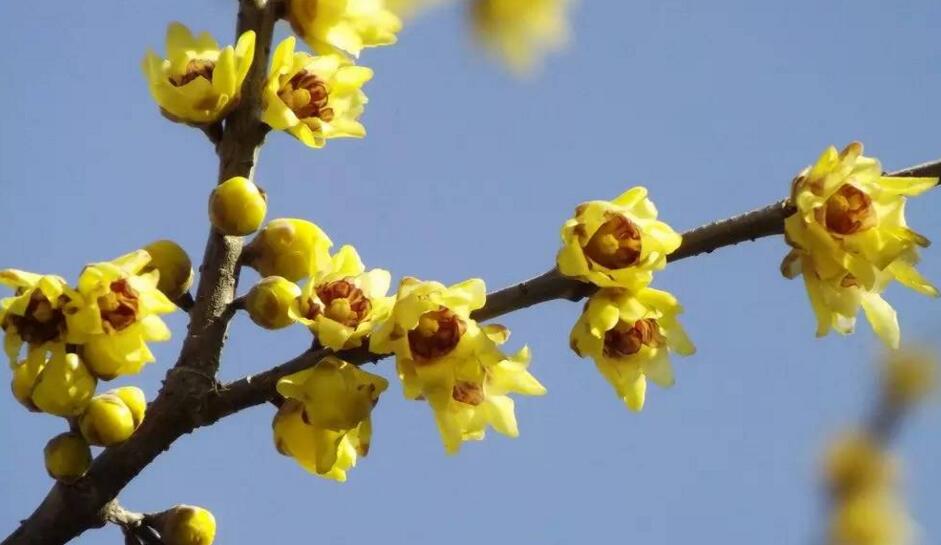
When does wintersweet bloom:
In southwest China, wintersweet blooms from December to January of the following year; in central China, from February to March; in north China, from March to April. Typically, wintersweet takes 4 to 7 days from the first flowers to full bloom, and 15 to 20 days to the end of blooming.
Reasons why wintersweet does not bloom:
1. Excessive nitrogen fertilizer: Some wintersweet plants suffer from uncontrolled water and fertilizer, especially excessive nitrogen, causing rampant growth of branches and leaves, affecting flower bud differentiation and resulting in no blooming. Therefore, in spring, wintersweet should be given nitrogen fertilizer; from early summer and into autumn, phosphorus and potassium fertilizers should be increased, with little or no nitrogen fertilizer, to promote early flower bud differentiation.
2. Excessive shade and moisture: Wintersweet loves light, and insufficient light will affect flower bud differentiation. Waterlogged potting soil or an overly shady and damp location is also unfavorable for flower bud differentiation. For this reason, in late summer and early autumn, "water withholding" should be practiced, and the plant should always be placed in a sunny spot, which greatly benefits flower bud formation and swelling.
3. No topping or pinching: For wintersweet that has entered the blooming stage, if during the spring and summer vegetative growth period it is allowed to sprout branches freely without necessary topping to control shoots, flower bud differentiation and growth will likewise be affected by uncontrolled vegetative growth. Generally, when 3 to 5 pairs of leaves have emerged at the shoot tip, the top 1/3 should be promptly pinched off to promote the sprouting of lower lateral buds and normal flower bud differentiation. In late summer and early autumn, topping and pinching must not be neglected.
How to grow wintersweet:
1. Soil: For potted wintersweet, use loose, fertile sandy loam rich in humus.
2. Watering: Wintersweet is drought-tolerant and afraid of waterlogging. If moisture is too high and the soil is too wet, the plant grows poorly and flower bud differentiation is affected. Therefore, for potted wintersweet, the soil should be kept on the dry side; normally, do not water unless dry, and water thoroughly when you do. However, during the "dog days" of high summer heat, water more to maintain normal plant growth and allow normal flower bud development.
3. Temperature: Wintersweet likes sunlight and also tolerates partial shade. It fears wind and is relatively cold-hardy, overwintering safely when temperatures do not drop below -15°C. It can be grown outdoors in areas south of Beijing. If temperatures reach -10°C during the blooming period, the flowers will suffer frost damage.
4. Pruning: Wintersweet has strong branching ability, hence the saying "wintersweet never lacks branches." Timely pruning encourages more strong flowering branches and more blooms. Generally, prune at the right time after flowers fade but before leaves emerge, removing dead branches, overly dense branches, crossing branches, and diseased or pest-infested branches. For one-year-old branches, keep 2 to 3 pairs of buds at the base and cut off the upper portion to encourage branching.
5. Fertilizing: Wintersweet is a flowering plant that loves fertilizer. Timely fertilization promotes flower bud differentiation and more blooms. Fertilizing wintersweet should focus on phosphorus and potassium, with less nitrogen; the approximate ratio of phosphorus, potassium, and nitrogen is 2:1:0.5. Fertilizing this way makes wintersweet flowers larger, more numerous, and more fragrant.
6. Pests: Wintersweet has fewer diseases but more pests, commonly including aphids, scale insects, slug moths, and leaf-roller moths. Aphids suck sap on tender shoots, young leaves, and flower buds; scale insects suck sap on branches; slug moths and leaf-roller moths chew leaves, new buds, and flower buds. To reduce pollution of the gardening environment, traditional methods can also be used to kill pests: for example, scale insects can be killed with a vinegar solution, aphids can be killed with laundry detergent water, and if there are only a few, they can be caught by hand.
When Does Wintersweet Bloom and Why Doesn't Wintersweet Bloom
When does wintersweet bloom? It usually blooms in the depths of winter when all other flowers have withered, braving the cold and defying frost, growing in mountain forests. So why doesn't wintersweet bloom?
When does wintersweet bloom
In southwest China, wintersweet blooms from December to January of the following year; in central China, from February to March; in north China, from March to April. Typically, wintersweet takes 4 to 7 days from the first flowers to full bloom, and 15 to 20 days to the end of blooming.
Reasons why wintersweet does not bloom
1. Excessive nitrogen fertilizer: Some wintersweet plants suffer from uncontrolled water and fertilizer, especially excessive nitrogen, causing rampant growth of branches and leaves, affecting flower bud differentiation and resulting in no blooming. Therefore, in spring, wintersweet should be given nitrogen fertilizer; from early summer and into autumn, phosphorus and potassium fertilizers should be increased, with little or no nitrogen fertilizer, to promote early flower bud differentiation.
2. Excessive shade and moisture: Wintersweet loves light, and insufficient light will affect flower bud differentiation. Waterlogged potting soil or an overly shady and damp location is also unfavorable for flower bud differentiation. For this reason, in late summer and early autumn, "water withholding" should be practiced, and the plant should always be placed in a sunny spot, which greatly benefits flower bud formation and swelling.
3. No topping or pinching: For wintersweet that has entered the blooming stage, if during the spring and summer vegetative growth period it is allowed to sprout branches freely without necessary topping to control shoots, flower bud differentiation and growth will likewise be affected by uncontrolled vegetative growth. Generally, when 3 to 5 pairs of leaves have emerged at the shoot tip, the top 1/3 should be promptly pinched off to promote the sprouting of lower lateral buds and normal flower bud differentiation. In late summer and early autumn, topping and pinching must not be neglected.
How to grow wintersweet
1. Soil: For potted wintersweet, use loose, fertile sandy loam rich in humus.
2. Watering: Wintersweet is drought-tolerant and afraid of waterlogging. If moisture is too high and the soil is too wet, the plant grows poorly and flower bud differentiation is affected. Therefore, for potted wintersweet, the soil should be kept on the dry side; normally, do not water unless dry, and water thoroughly when you do. However, during the "dog days" of high summer heat, water more to maintain normal plant growth and allow normal flower bud development.
3. Temperature: Wintersweet likes sunlight and also tolerates partial shade. It fears wind and is relatively cold-hardy, overwintering safely when temperatures do not drop below -15°C. It can be grown outdoors in areas south of Beijing. If temperatures reach -10°C during the blooming period, the flowers will suffer frost damage.
4. Pruning: Wintersweet has strong branching ability, hence the saying "wintersweet never lacks branches." Timely pruning encourages more strong flowering branches and more blooms. Generally, prune at the right time after flowers fade but before leaves emerge, removing dead branches, overly dense branches, crossing branches, and diseased or pest-infested branches. For one-year-old branches, keep 2 to 3 pairs of buds at the base and cut off the upper portion to encourage branching.
5. Fertilizing: Wintersweet is a flowering plant that loves fertilizer. Timely fertilization promotes flower bud differentiation and more blooms. Fertilizing wintersweet should focus on phosphorus and potassium, with less nitrogen; the approximate ratio of phosphorus, potassium, and nitrogen is 2:1:0.5. Fertilizing this way makes wintersweet flowers larger, more numerous, and more fragrant.
6. Pests: Wintersweet has fewer diseases but more pests, commonly including aphids, scale insects, slug moths, and leaf-roller moths. Aphids suck sap on tender shoots, young leaves, and flower buds; scale insects suck sap on branches; slug moths and leaf-roller moths chew leaves, new buds, and flower buds. To reduce pollution of the gardening environment, traditional methods can also be used to kill pests: for example, scale insects can be killed with a vinegar solution, aphids can be killed with laundry detergent water, and if there are only a few, they can be caught by hand.
What Color Is Wintersweet, When Does Wintersweet Bloom / Blooms from November to March
What color is wintersweet
Because there are many varieties of wintersweet on the market, and some people even confuse it with plum blossoms, some people do not understand its flower color. So what color is wintersweet? The answer is yellow, with some varieties accompanied by red-purple. Let's look below at the differences among several common wintersweet varieties.
1. Qingkou wintersweet: Petals are relatively round, deep yellow, with a purple center and strong fragrance. Because its flower center is purple, it is also called sandalwood wintersweet.
2. Golden Bell wintersweet: Flowers are large and yellow, shaped like golden bells, double-petaled, with a strong fragrance as well.
3. Suxin wintersweet: Also called lotus wintersweet. What color is this wintersweet? Its flowers are pale yellow with a pure white center and a rich fragrance, because its flowers are relatively large.
4. Tiger Hoof wintersweet: Flowers are large and yellow, petals relatively round, with the small central petals slightly tinged with red-purple; the flowers resemble tiger hooves, with a strong fragrance and early blooming.
5. Dog Tooth wintersweet: Petals are pointed and relatively small; the outer whorl of petals is pale yellow, while the inner whorl has purple stripes; fragrance is faint. Because its flowers have nine parts, it is also called Nine-Inch wintersweet.
When does wintersweet bloom
Wintersweet generally blooms from November to March, with a relatively long blooming period. It usually blooms in late winter or early spring, and the blooming period is affected by environmental factors. For example, if wintersweet is planted in a windy spot, small flower buds may fail to open, and petals may be scorched and wither, delaying the blooming period.
How to care for wintersweet after the flowers fade
Wintersweet is a perennial plant; it does not die after blooming. With proper care, it can bloom every year. So how do you care for wintersweet after the flowers fade? Attention should be paid to watering, pruning, repotting, and other issues.
1. Pruning
After the flowers fade, promptly prune away spent flowers, dead leaves, and old branches. This avoids unnecessary waste of nutrients absorbed by the wintersweet, and withered spent flowers may also cause pests and diseases, so they must be pruned promptly.
2. Watering
After pruning dead branches and spent flowers, pay attention to timely watering. Each watering should soak through, but do not let water accumulate in the soil. Keeping the soil moist allows wintersweet to recover growth quickly and sprout new flowering branches.
3. Repotting
From growth to blooming, wintersweet consumes a large amount of nutrients, and the nutrients contained in the soil are limited. Therefore, after the flowers fade, repot and change the soil promptly, providing fresher soil rich in humus, which can promote renewed growth of wintersweet.