How much does one Guzmania (Vriesea) pot cost? Detailed guide to growing methods and precautions
When it comes to this Guzmania, many people like to grow it; the flowers it blooms are super gorgeous and beautiful, and its name is also quite auspicious. Let's take a look at what the growing methods and precautions for Guzmania are. How much does a Guzmania pot cost:
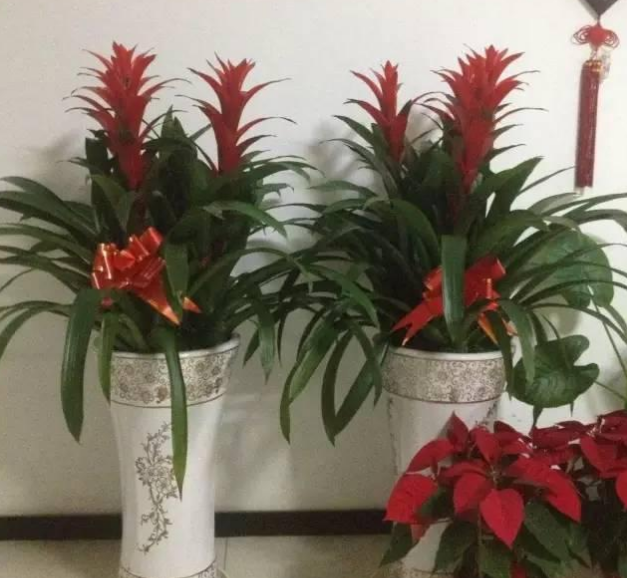
Guzmania growing methods and precautions:
1. Soil: Besides needing to contain humus and be fertile, more importantly it needs to be loose, well aerated, well drained, and slightly acidic.
2. Light: Guzmania likes scattered light. In summer you can place it under a big tree to cool off; if there is no big tree, place it in a bright, cool spot. In winter it needs at least 4 hours of direct sunlight every day.
3. Temperature: Bromeliads like a warm, humid environment; the suitable growing temperature is 15°C to 22°C. In winter the room temperature needs to stay above 15°C, and the lowest temperature must not drop below 10°C.
4. Watering: When watering, it is better to use clear water that has been left standing for 2-3 days. During the growing season you can water generously, and you can also pour some water into the rosette leaf cup. After each watering, wait until the potting soil is fairly dry before watering a second time; do not overwater. In winter the potting soil should be a bit drier. Just spraying the leaf surface is enough.
5. Fertilizing: For Guzmania flowers, during the peak growing season from May——September, apply a trace amount of compound fertilizer solution once every half month. In addition, phosphorus and potassium fertilizer should also be applied two extra times.
6. Location: Try to avoid placing it at air-conditioning vents or next to a television.
Precautions: If the leaves of Guzmania turn yellow or curl, it may be caused by the following situations: 1. Temperature too high or too low; 2. Overwatering or underwatering; 3. Improper fertilizing; 4. Light not up to standard; 5. Soil quality; 6. Pests and diseases or improper control; 7. Wrong placement location.
How much does a Guzmania pot cost:
This depends on the quality of the Guzmania. A better one sells for around 160, and if bought at a flower shop, it sells for around 200.
That is all for the introduction to Guzmania growing methods. Buying a pot of Guzmania is still not easy; it is a bit pricey.
Guzmania growing methods and precautions_Guzmania growing methods_Guzmania flower
The uses of the Guzmania flower:
The uses of the Guzmania flower: ornamental, auspicious symbolism, and purifying indoor air. Guzmania is also known as "hongyun dangtou" (good fortune arrives), and some people mistakenly write it as "hongyun dangtou" (red fortune arrives), or search for things like "how to grow hongyun dangtou." The flower language and symbolic meaning of the Guzmania flower (pineapple flower): perfection. The Guzmania flower goes from sprouting, to growing, and then to blooming brilliantly. Numerous small flowers cluster densely on the flower stem, forming a thick flower spike, and the bracts at the tip of the spike extend in a radial pattern. It is a perennial herbaceous flower, native to the tropical rainforest regions of the Americas. This variety has a long flowering period, a bright red flower core, and is auspicious and noble; it is a fine product among flowers. Guzmania is an indoor ornamental flower for winter and spring, evergreen all year round, with beautiful and varied inflorescences and rich colors. Commonly cultivated varieties include bright red, pink, golden yellow, rose red and others. Now let's introduce the growing methods for the Guzmania flower:
Guzmania flower pictures:
Guzmania growing methods and precautions:
Guzmania likes a warm, humid environment. The suitable growing temperature is 21-28°C during the day and 18-21°C at night, and the maximum temperature must not exceed 35°C. High temperatures are unfavorable for growth, but being in a 10°C environment for a long time easily causes slow plant growth and loss of color such as leaves or bracts turning red or white. If the temperature continues to drop, it will cause the plant to die.
Air humidity should be high, generally 75-85% is best. When it is below 50%, the plant will show phenomena such as leaf shrinkage and curling. Light is best at 18000-**** lux. When the light is too strong, the leaves are easily scorched; when too weak, growth will also be poor. Ventilation is also extremely important. When the temperature is not high its effect is not obvious, but in hot seasons it is especially prominent. Ventilation not only makes the plant grow robustly, but also reduces infection by diseases.Guzmania does not need fertilizing during the flowering period. After flowering, promptly cut off the flower and supplement fertilizer. Fully water-soluble fertilizer can also be poured into the leaf cup along with watering, but others such as cake fertilizer and granular chemical fertilizers should not be applied in the leaf cup. After small offsets grow out, you can use a sharp knife to cut them off from the mother plant and plant them separately. Generally, the old plant will not bloom again, and can later be used as a mother plant to propagate new plants.As long as the light at the maintenance location is suitable and watering is proper, Guzmania is generally very easy to grow. In addition, when watering, try to avoid the flower bracts to prevent rot.
Guzmania blooms only once in its lifetime. After flowering, one to several offset buds will grow from the base of the old plant; at this time it should not be divided too early, otherwise it is not easy to survive. The division method is: first cut off the flower stem from the base, then leave 5-8 cm of the old plant's leaves and remove all the rest. The base of the remaining leaves just forms a tube shape that can store water. When cutting, be sure not to injure the small buds. Wait until the buds are about 10 cm tall, then gently cut them apart from the connection point between the bud and the mother plant with a sharp knife, plant the small buds into potting soil made of leaf mold, and after careful care for one year, they can bloom gorgeous flowers again.
Guzmania-type flowers generally bloom after three years of planting, but it is difficult for them to set seed after flowering. They are usually propagated by division, with division carried out in spring together with repotting and soil replacement. Cut off the suckers that grow from the base of the plant, trim the cut surface flat, and plant them in plain sandy soil; put a plastic bag over the pot mouth to keep warm and moist. Place in a lightly shaded, ventilated environment, and under 25°C conditions they will quickly take root. They can be planted with sphagnum moss alone, or with a mix of leaf mold, sphagnum moss, peat soil, vermiculite, river sand, etc. In short, loose and permeable is the standard. During the growing period, the potting soil should be kept moist often, the surrounding environment should maintain relatively high humidity, the leaf surface should be sprayed with water often, and shading should be moderate. Once a week, a dilute solution of nitrogen-phosphorus-potassium compound fertilizer can be applied, and it can be applied directly into the leaf tube. In the winter dormant period, pay attention to appropriately controlling moisture; only spraying the leaf surface is enough, and the environment should be kept clean with fresh air.Because of its beautiful and varied flower shape and long ornamental period, the Guzmania flower has always been regarded as a symbol of good fortune and prosperity. In fact, caring for ornamental bromeliads is extremely easy; as long as you grasp their habit of liking high temperatures, humidity, and semi-shade, they can be placed in a warm, bright room all year round. In winter they can receive full sun; in spring and autumn they should have morning and evening light; in summer do not expose them to direct sunlight. The overwintering temperature should preferably not be lower than 10°C; above 20°C is not favorable for the plant's dormancy and will affect the next year's growth and flowering. In daily care, ornamental Guzmania should be placed in a semi-shaded, ventilated spot and grown with scattered light. Strong light easily scorches the leaves and causes mottled spots; but be careful not to place it in too shady a spot for a long time, as the beautiful color of the leaves often becomes lighter and paler because of this, causing regret in ornamental value. With bright light, the leaf surface color is vivid. In conditions of dry climate, stuffiness, and low humidity, the leaf margins and leaf tips of Guzmania very easily become scorched and withered, so the potting soil should be kept moist, and you can spray clear water on the leaf surface 1-2 times a day; the cup-shaped part in the center of the leaf rosette can be filled with clear water. From late spring to autumn during the growing period, the amount of watering can be appropriately increased, and some clear water can also be poured into the leaf tube; you should change the water once every half month to prevent the water from spoiling and smelling bad. Spray the leaf surface with water often. In winter the pot should be on the dry side, but not too dry. From May——September, apply nitrogen fertilizer once a week, and appropriately increase phosphorus and potassium fertilizer before flowering to promote larger flowers and brighter color. When flowering, do not pour water into the tube; storing it in a place away from sunlight can prolong the flowering period. After flowering it enters the dormant period, and the flower stalk must be cut off to reduce nutrient consumption. In winter do not pour water into the tube.Plants of the Guzmania family were originally parasitic plants, with a root system that is not well developed. They have no main root, only small and short roots, and some roots even like to contact air, so be sure not to apply too much fertilizer, to prevent root rot and yellowing leaves; apply thin fertilizer water instead. Planting in a small, shallow pot will grow and develop better than in a large, deep pot. The potting soil is best made of leaf mold plus a small amount of garden soil, or half-and-half peat soil and perlite mixed.After ornamental Guzmania blooms, the central leaf rosette dies, and small buds will continuously grow from the leaf axils at the base. When they grow 5-6 leaves (the offset is 15 cm tall), they can be cut off for cutting propagation, and in about 1 month they can grow root hairs. Doing this can only be "passed down from generation to generation singly," and the number propagated is limited. Therefore, it is best to combine spring repotting, cut off the small tubers growing from the tuber part of the mother plant for cuttings, or divide the rooted tender shoots sprouting from the roots of the old plant. In all cases, avoid light and keep moisture and warmth. When the root system grows to 2-3 cm, they can be planted out. If cultivated properly, one mother plant can propagate about 10 plants each year. For Guzmania planting soil, it is best to choose loose peat soil, leaf mold, and tree fern fragments mixed as the growing medium.Guzmania growing methods and precautions
Guzmania is a common indoor ornamental flower, evergreen all year round, with beautiful and varied inflorescences, rich colors, lush flowers and leaves, and bright red flowers, giving a very festive feeling. Guzmania is an auspicious and noble flower, so there are quite a few flower lovers growing Guzmania. Below we introduce Guzmania growing methods and precautions.
Guzmania growing methods and precautions 1. Guzmania growing method: fertile soilGuzmania is suitable for growing in loose, fertile, humus soil. For home cultivation, you can choose 2 parts peat soil mixed with 1 part fine sand to make the growing soil.
2. Guzmania growing method: sufficient lightGuzmania likes scattered light. In summer the seedling pot should be placed in the shade of a tree; in winter there must be at least 4 hours of direct sunlight every day. When the light is too strong, the leaves are easily scorched; when too weak, growth will also be poor.
3. Guzmania growing method: warm and humid temperatureBromeliads like a warm, humid environment; the suitable growing temperature is 15°C to 22°C. In winter the room temperature needs to stay above 15°C, and the lowest temperature must not drop below 10°C.
4. Guzmania growing method: ample wateringGuzmania likes a humid environment. When watering, it is better to use clear water that has been left standing for 2-3 days, and water moderately to keep the potting soil moist. In the winter dormant period, pay attention to appropriately controlling moisture; only spraying the leaf surface is enough.
5. Guzmania growing method: proper fertilizingFor Guzmania flowers, during the peak growing season from May——September, apply a trace amount of compound fertilizer solution once every half month. Guzmania has its flowering period in winter and requires sufficient fertilizer; usually apply a thin organic liquid fertilizer once every two weeks, for example soybean cake or sesame paste residue soaking liquid (a concentration of 20% is suitable). Soybean soaking liquid or fermented rice washing water can also be used.
6. Guzmania growing method: sufficient moistureGuzmania likes a humid environment; keeping the potting soil moist on ordinary days is enough, and generally do not water on rainy days. For home cultivation, it is best to use water that has been left standing or rainwater. Do not directly use tap water for watering. Generally, the lower the salt content of the water, the better. Guzmania is a flower that is both for enjoying flowers and foliage. It is best to spray clear water on the leaf surface once a day to remove dust, make the leaf color bright, and at the same time help photosynthesis and promote robust plant growth.
7. Guzmania growing method: pest and disease controlIn an environment with high temperature and humidity and poor ventilation, the Guzmania flower is prone to pest and disease damage. Move the Guzmania flower outdoors and spray carbendazim; for pests, omethoate can be sprayed.
Guzmania growing precautions1. In conditions of dry climate, stuffiness, or low temperature, the leaf margins and leaf tips of Guzmania will very easily become scorched and withered, so the potting soil should be kept moist, and you can spray clear water on the leaf surface 1-2 times a day. When watering, the water should be poured into the middle cup shape, not directly into the flower pot. The cup-shaped part in the middle of the leaf rosette can be filled with clear water. But remember not to water too frequently, and pay attention to the middle cup shape, feeling the moisture inside to control the amount of water, and the water should be clean. Change the water once every half month to prevent the water from spoiling and smelling bad.
2. It is worth noting that the root system of Guzmania is not well developed, with only small and short roots, so do not apply too much fertilizer, to prevent root rot and yellowing leaves; use thin fertilizer water for cultivation. Appropriately increase phosphorus and potassium fertilizer before flowering to promote larger flowers and brighter color. No fertilizing during the flowering period. After flowering it enters the dormant period, and the flower stalk must be cut off to reduce nutrient consumption.