Balcony Planting Methods for Potted Strawberries and the Best Months
Strawberries are something many people absolutely love. Nowadays many of us live in tall buildings, so what can you do if you want to grow strawberries? The only option is potted planting. Let's take a look at how to grow strawberries in pots on a balcony. What month should you plant balcony potted strawberries:
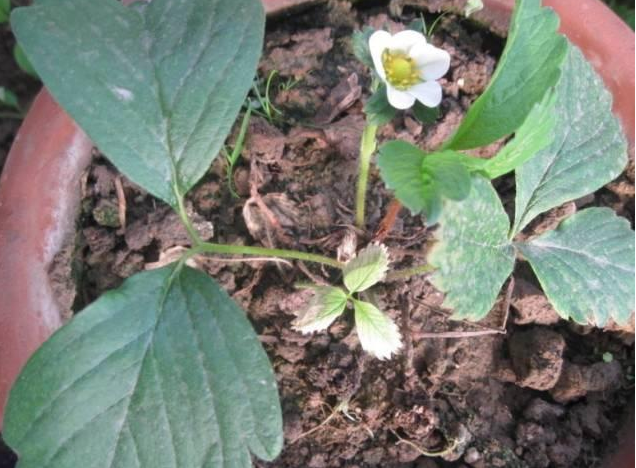
Balcony potted strawberry planting methods:
1. Planting time: do not plant in summer or winter. This is because summer temperatures are too high, and strawberries grow rather slowly; winter weather is cold and also not very suitable. Both spring and autumn are fine;
2. The flower pot must be the kind that has holes for air permeability, and the pot must not be too small. You can choose a multi-purpose flower pot, and spread a layer of stones on the surface of the soil, so that when watering it is not easy for mud to splash onto the strawberries;
3. The soil should be fertile and have good drainage;
4. Strawberries like places with plenty of sunlight, so we had best put the strawberries on the balcony;
5. After planting the strawberries, water them thoroughly; afterwards water less. If there is too much water, the stem below the leaves is prone to rotting, and they will not survive.
6. When the strawberries begin to bear fruit and turn red, be careful not to let birds peck at them; you can put a net over the strawberries, or cover the strawberries with a wooden basket.
If you have a greenhouse at home, it is best to move the strawberries into the greenhouse. After the strawberry fruiting period is over, we then move them out of the greenhouse and put them outdoors to overwinter.
In a sense, if the strawberry plants undergo some frost, it is even more beneficial for increasing yield the following year.
What month should you plant balcony potted strawberries:
Generally, strawberries are planted in spring and autumn, when it is neither too cold nor too hot.
That is all for the balcony potted strawberry planting methods. Hurry and add more color to your balcony.
Potted Strawberry Planting Methods - How to Grow Strawberries on a Balcony?
Strawberries are a fruit everyone loves. They are herbaceous plants and perennial, and can be planted in the ground in a yard or in flower pots. Plant a few at home every year, and you can enjoy strawberries at home for a long time. Strawberries need to be planted in a sunny, warm environment, and the soil should also have good drainage.
When strawberries bear fruit, the strawberries and the soil need to be separated, so growing strawberries in flower pots is a fairly good choice. You can choose a multi-purpose flower pot and spread a layer of stones on the surface of the soil in the pot, so that when watering it is not easy for mud to splash onto the strawberries. If planting in the ground, you can use some dry grass, or a mat to protect the strawberries.
I. Choosing Pots, Soil and Varieties
For potted planting, choose clay pots or plastic pots with a diameter of 20-30 cm. For the potting soil, choose soil with relatively high humus content. For home planting, it is best to use everbearing varieties, so that they bear fruit continuously and you always have fruit to eat. It is best to use everbearing strawberry varieties such as ELAN, Baoer, Climbing AR, Climbing H, and Saiwa for potting. They can bloom and bear fruit multiple times throughout the year. Single-season varieties are also fine, but the fruiting period is short; however, the fruit tastes superb, such as the Japanese cream strawberries Zhangji, Hongyan and so on.
II. Cultivation Techniques
The best time for potting is spring or autumn, when the survival rate is high. Choose robust seedlings; when lifting the seedlings, keep more soil on them, remove old and damaged leaves, and trim the seedling roots to about 10 cm. Let the root system spread out and plant it into the potting soil. The planting depth should follow the principle of not exposing the roots and not burying the crown. Firm the soil, fix the seedling position, and keep the soil surface 3-4 cm below the rim of the pot. After planting, water thoroughly, place in a cool place for 3-5 days, then move to a place with plenty of light.
III. Fertilizer and Water Management
Everbearing strawberries bloom and bear fruit multiple times a year, consuming a lot of nutrients, so nutrient supplementation should be strengthened. You can use animal hooves, fish bones, poultry innards, soybean cakes, etc., add water, let them decompose and ferment, and make them into liquid fertilizer water. Be sure to dilute it with water until very weak before watering, otherwise the strawberries will die from fertilizer burn. Alternatively, apply compound fertilizer as a top dressing. When applying top dressing, keep it farther from the roots, and do not let the fertilizer touch the roots. For outdoor potted plants, to prevent them from dying of dryness in summer, it is best to water once each morning and evening. When watering, the water should be warmed in the sun first before use. Never directly use well water or tap water for irrigation.
IV. Seedling Management
Potted strawberries should have strengthened plant management. First, thin buds, remove leaves and remove runners at the appropriate times. That is, appropriately thin out ineffective high-level flowers during the bud dispersal stage. Remove old leaves, damaged leaves, diseased leaves and excess runners to reduce nutrient consumption and improve fruit quality. Second, build fruit supports. That is, use wire or bamboo skewers to make fruit supports of different shapes, place them in the flower pot and prop up the fruit clusters, to promote ventilation and light penetration for the fruit clusters, even coloring of the fruit, prevent soil from contaminating the fruit, and reduce pest and disease damage. Third, for pest and disease control, corresponding integrated control measures should be adopted.
V. Repotting
After potted strawberries have borne fruit for 2 years, they should be repotted or given fresh potting soil after fruiting. When repotting, first take the plant out of the pot, cut off aged roots, dead roots and the lower aged rhizomes, then plant it into new potting soil.
The above are the potted strawberry planting methods provided by Duorou Huapu for everyone. We hope they are helpful to you. Welcome to keep following Duorou Huapu to learn more little tips!
Balcony Vegetable-Growing Potted Strawberry Planting Methods
Step 1: Material PreparationMaterials needed: seedlings, garden soil, peat, chicken manure, soybean cake, containers, gardening trowel, spray bottle
a. Seedlings: all strawberry varieties are suitable for potting. Relatively ideal home varieties include everbearing strawberry, European Sijihong, Baojiao Zaosheng and so on. Seedlings can be purchased from flower markets, strawberry bases, seedling stations, and local vegetable and flower research institutions.
b. Soil: strawberries are fertilizer-loving plants. When mixing nutrient soil, apply sufficient organic fertilizer and use as little chemical fertilizer as possible. For the nutrient soil, it is best to mix half fertile vegetable garden soil and half peat soil, and add chicken manure to make it.
c. Container: choose the cultivation container according to the amount of space, and place it on a windowsill or indoors. Strawberries have well-developed root systems, so the cultivation container should be about 20 cm deep. Choosing a flower pot with a diameter of 20 cm is enough, with a single plant per pot; if planting a larger quantity, you can choose large rectangular pots and round pots, with multiple plants per pot. Generally, ceramic pots are used for cultivation, as they have good ventilation, drain easily, and come in many styles.
Step 2: Planting
a. Before planting, first fill the pot with nutrient soil, with the soil surface 3-4 cm below the pot rim, water thoroughly, and let it sit for 2 days before planting.
b. Before planting, choose robust seedlings with well-grown roots, cut off damaged roots, old leaves and runners, and keep 2-3 small leaves. Dig holes in the pot suitable for the depth of the strawberry root system.
c. When planting, place the strawberry root system vertically and spread out in the hole, then press the soil flat. The planting depth should preferably not bury the crown.
d. After planting, water an appropriate amount, and cover the pot with a plastic bag to reduce water evaporation, keep the temperature and humidity in the pot stable, and benefit strawberry growth.
Step 3: Daily Management
a. Temperature management: the suitable temperature for strawberry plant growth is 15-30°C, the suitable temperature for root growth is 15-20°C, and the suitable temperature during the flowering and fruiting period is 15-20°C.
b. Water management: after planting, strawberries should be watered frequently in small amounts to keep the soil in the pot moist, and it must not be too dry or too wet. Home growers easily overlook air humidity management. During strawberry growth, air humidity must not be too high. On the premise of suitable temperature, after watering, open the windows appropriately for ventilation to reduce humidity.
c. Fertilizer management: potted strawberries should mainly be given organic fertilizer water. You can water with decomposed soybean cake water once every 7 days, and the concentration should not be too high.
d. Pruning: during cultivation, old leaves that turn yellow should be removed directly; strawberries produce vines during growth, and during the flowering and fruiting period the vines should be removed in time. Small plants will grow on the vines, and these can be cut off and planted directly.
Step 4: Repotting
Strawberries decline after bearing fruit for two years. Therefore, after 2 years of planting, strawberries need to be replaced with new seedlings, or repotted from a small pot into a large pot. When repotting, the pot should be filled again with nutrient soil, then the seedling planted in and watered, with the same management as above.
Precautions:
a. Watering should be done in the morning or evening.
b. During flowering, air humidity should not be too high, as it affects fruit set and fruit quality.
c. Potted strawberries can be planted all year round, but the survival rate is highest when transplanted in autumn, in September-October.
d. In the winter in the north, the pots should be moved indoors to increase the temperature; in summer high temperatures, the pots should be moved to a cool place to lower the temperature.