Spider Lily Growing Methods, Precautions, and How to Tell It Apart from the Poison Bulb
Spider Lily: does the name make you think it has something to do with spiders? It really has nothing to do with spiders. Let's take a look at the growing methods and precautions for the Spider Lily, and what the differences are between the Spider Lily and the Poison Bulb:
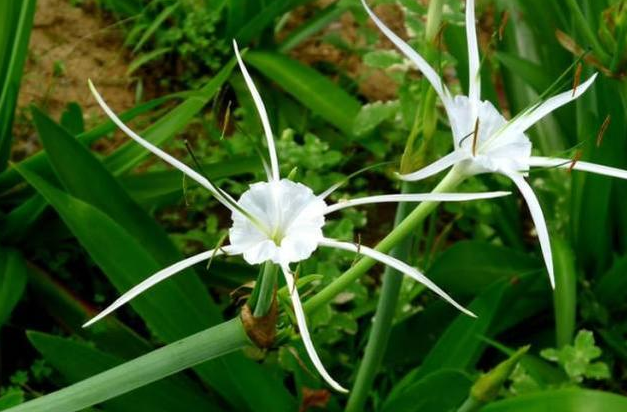
Growing methods and precautions for the Spider Lily:
1. Light
It likes plenty of sunlight and tolerates slight shade. Except during the high-temperature midday heat of summer, it can be kept in a spot with ample light at all other times. It likes warmth and tolerates slight cold. The optimum growing temperature is 20°C-25°C, and it can overwinter safely at around 5°C.
2. Water
It likes moisture, fears waterlogging, and tolerates slight drought. In spring, as temperatures rise, watering can be increased, preferably once a day. In summer, watering frequency can be increased, with a thorough watering once in the morning and once in the evening. During summer's high temperatures, humidity should be increased while ventilation is also increased, otherwise rot easily occurs. After autumn arrives and temperatures drop, keep it slightly dry. In winter, keep it dry. Overall, water so that there is no standing water and no drought occurs.
3. Soil
It likes acidic sandy loam rich in humus, loose, fertile and well-drained. During the growing period, apply a compound fertilizer or cake fertilizer solution once every half month. During the flowering period, apply manure or phosphorus and potassium fertilizer once every 10-15 days to promote flowering. Stop fertilizing during the dormant period.
There is also a very interesting thing. A design inspired by the Spider Lily——the world's tallest building, the Burj Khalifa.
The Y-shaped floor plan of the Burj Khalifa was inspired by the desert flower the Spider Lily. This design maximizes the structural integrity of the building and allows people to fully enjoy the fascinating views of the Arabian Gulf. At the center of the tower is a hexagonal “buttressed core” made of reinforced concrete. The floors are arranged in a spiral, able to withstand raging desert storms. The Burj Khalifa's award-winning design inherits the distinctive style of Islamic architecture.
Differences between the Poison Bulb and the Spider Lily:
1. Similarities between the Poison Bulb and the Spider Lily
Both the Poison Bulb and the Spider Lily are plants of the orchid family. Their stems and leaves are very stout, emerging from the leaf cluster, with umbels made up of many flowers borne at the top of the scape, all white.
Both the Poison Bulb and the Spider Lily have strong tillering ability. On the stem disc of perennial old plants, small suckers can sprout, which can be separated and planted individually. When dividing, there is no need to remove the plant from the pot. When the suckers grow to about 15 cm, first loosen the surrounding potting soil, then use a small knife to cut deep into the potting soil at the point where it connects to the mother plant's stem disc, and it can be lifted out together with its young roots. Suckers without young roots are not easy to survive after planting.
The Poison Bulb and the Spider Lily grow quickly. A four-year-old divided plant can grow into a large potted specimen, with a spread of 50-60 cm. When grown at home, in order to control the amount of growth for easy display, try not to plant them in large pots, and do not repot and change the soil every year. As long as the potting soil is kept moist, they will bloom, and there is no need for additional fertilizing. They are both shade plants, and outdoor display must be shaded; exposure to blazing sun for one hour will cause the leaves to scorch. Move them indoors in early to mid-October; they will not freeze as long as the room temperature is not below 6°C.
2. Differences between the Poison Bulb and the Spider Lily
The Poison Bulb and the Spider Lily are not plants of the same genus, and the main difference between the Poison Bulb and the Spider Lily is that the Poison Bulb's leaf surface is not glossy, and the entire leaf is undulating and wavy, with a gradually pointed tip. The Spider Lily's leaves are narrower, with a flat, sword-shaped, glossy surface.
That's all for the growing methods of the Spider Lily. Although the Spider Lily and the Poison Bulb are quite similar, there are still differences, and attention should be paid to telling them apart.
Control Methods for Leaf Blight of the Spider Lily
The Spider Lily is also called the Water Ghost Banana. The Spider Lily not only has ornamental value but also high medicinal value, and can also be grown on a large scale as an economic crop. Large-scale planting will produce diseases. Today we introduce the control methods for leaf blight of the Spider Lily.
Symptoms of leaf blight of the Spider Lily: When leaves are infected, small red spots or wound spots initially appear, mostly expanding longitudinally into larger round spots, brown, and in severe cases the leaves dry up. There are small brown dots on the lesions. When flowers and bulbs are infected, light brown to dark red spots also appear, causing the peduncle to dry up or no longer produce flowers. In addition, when the Spider Lily is wounded, the injured tissue, upon exposure to air, also turns red on the surface. This is a special manifestation of the Spider Lily, the Poison Bulb, the Amaryllis and others, and attention should be paid to examining the pathogen to distinguish them.
The pathogen of leaf blight of the Spider Lily is Pleurocytospora sp., called a coelomycete, belonging to the Deuteromycetes fungi. The pycnidia are dark brown, flattened spherical to flask-shaped, initially immersed, with the ostiole exposed after maturity, measuring 190-339.6 x 150-165 (μm), solitary or several clustered together, some multi-loculate, mostly single-loculate at maturity. The conidiophores are colorless, branched at the base or upper part, measuring 12-24 x 1-1.5 (μm). The conidia are single-celled and colorless, straight or slightly curved, with bluntly rounded ends, sausage-shaped, measuring 3.8-6.3 x 1-1.3 (μm).
Occurrence pattern of leaf blight of the Spider Lily: The pathogen overwinters in diseased tissues as mycelium or pycnidia. The following spring it releases conidia, which spread via wind, rain and watering, invading through micro-wounds to cause primary infection and secondary infection. Humid and rainy weather makes it prone to occur and spread. It occurs from January to November each year. Under greenhouse conditions it can occur year-round.
Control methods for leaf blight of the Spider Lily
(1) When repotting in spring, apply sufficient base fertilizer, place it under a shade shed, and topdress in a timely manner during the growing period. Strengthen ventilation indoors, avoid direct sunlight, and maintain a certain humidity. When lesions are found, prune them off promptly. Water from the edge of the pot, do not let water drip into the heart leaf, and often clean dust from the leaf surface to keep the leaves glossy and reduce pathogen infection. When the Clivia enters its dormant period, watering should be controlled.
(2) When necessary, spray 50% Shajunwang water-soluble powder at 1000 times dilution, or 40% chlorothalonil suspension at 500 times dilution, 30% copper oxychloride colloidal suspension at 600 times dilution, 40% duobromofol wettable powder at 700 times dilution, or 80% duo-fu-zinc (Lüheng No. 2) wettable powder at 800 times dilution, once every 7-15 days, for 3-4 applications.
Have you learned the control methods for leaf blight of the Spider Lily? To learn more about the Spider Lily, please follow Huobao Agricultural Materials News.