Money Tree Cutting Propagation Method Illustrated Guide, Water Propagation Works Too
The money tree (Pachira aquatica) is a very auspicious plant, and many people grow it at home. Let's take a look at the illustrated guide for money tree cutting propagation:
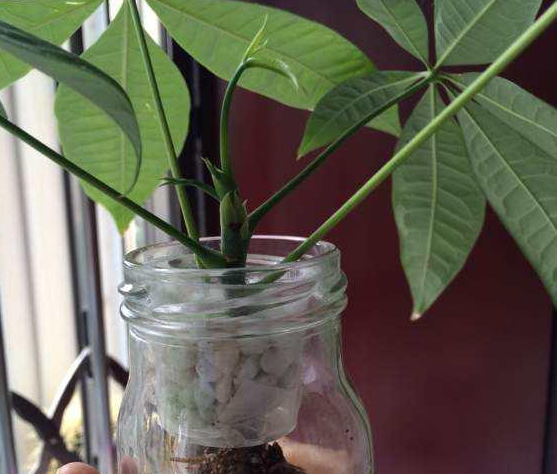
The simple version: propagate directly in water
Select a healthy, undamaged money tree branch and place it directly into a glass filled with water, changing the water every three days. The branch should not touch the bottom of the glass. The whole process requires patience, and it takes about half a year before it can be transplanted.
Drawback: Although it is relatively easy, it takes quite a long time.
Also simple: you can try propagating in sand.
Find a container of suitable size, fill it with fine sand, keep the sand slightly moist, and insert the prepared branch into the sand. Roots will form in about one month.
Drawback: You need to constantly monitor the moisture level of the sand.
Using an insulated bucket gives a higher success rate, but the weather is about to warm up soon, so personally I think it may not be necessary. Also, the flower sister is just too lazy, so for methods that are slightly more troublesome, she won't consider them. However, no matter which propagation method you use, try to choose a thicker branch, as ones that are too tender won't survive to sprout.
That's all for the money tree propagation methods and illustrated guide. Hurry up and give it a try. With one money tree, you can grow many more at home.
Money Tree Growing Methods | Money Tree Growing Methods and Precautions | How to Grow a Money Tree
The benefits of the money tree:
The benefits of the money tree: ornamental value, auspicious symbolism, and purifying indoor air. Ornamental function: The money tree is evergreen year-round, with a graceful shape, and its name sounds like the number "8", symbolizing wealth, making it a common decorative green plant for offices and homes. Air purification function: The money tree can absorb ammonia and other substances to purify stale air, and its dense leaves can effectively increase indoor air humidity, balancing the dryness in air-conditioned rooms. Now let's introduce the money tree growing methods:
Money tree pictures:
Small money tree pictures:
The small money tree is propagated from seeds or cuttings. The ones with a swollen base are seed-grown seedlings, while those without a swollen base are cutting-grown seedlings. Its growth habits are the same as the large money tree, with a height of about 30 cm. It is small and adorable, making it an excellent plant for tabletop display.Money tree growing methods:
The money tree likes warm, humid environments with sunny or slightly shaded conditions, and its optimal growing temperature is 20°C to 30°C. The high-temperature, high-humidity summer season is very favorable for the money tree's growth, and it is the period of fastest growth, so during this stage, fertilizer and water management should be strengthened to make it grow robustly. In winter, the temperature should not drop below 5°C, and it is best to maintain 18°C to 20°C. It dislikes cold and damp conditions; in humid environments, the leaves are prone to developing ulcer-like cold spots, which detracts from its ornamental value.
The money tree is not strict about light requirements and can adapt to both strong sunlight and low-light indoor conditions. However, full sun can make the stem nodes shorter and the plant shape more compact and full, and it especially helps thicken the swollen trunk, which is the main ornamental part. With insufficient light, the cultivated tree grows more slowly. Place young seedlings in a shaded area, but not too dark, otherwise the plant will grow thin and tall, prematurely reaching the height for braiding, which affects the shape. No matter what environment it is cultivated in, do not suddenly change its location; changing positions should be a gradual adaptation process. If the plant is suddenly moved from shade to strong light, the leaf surface will get scorched and the edges will burn, affecting its appearance.
Normally keep the potting soil moist; in winter, keep the potting soil on the dry side and avoid wetness; otherwise, the leaf tips are prone to scorching and leaves may even drop. Prune and repot every 1 to 2 years, switching to a slightly larger pot each year, while adding base fertilizer and replacing with new nutrient soil to promote vigorous growth. Nutrient soil can be made by mixing 5 parts garden soil, 2 parts sawdust, 2 parts sand, and a small amount of peanut cake powder, plus 1 part sifted garbage and coal cinder, stirred evenly. Generally, apply a light fertilizer every 20 days or so. For flowering plants, apply more phosphorus fertilizer to promote swelling of the stem base and enhance ornamental value. During the peak growing season, apply less nitrogen fertilizer to prevent leggy growth; frequently spray water on the leaves to keep them moist, and it will grow robustly.
What to do if the money tree's leaves turn yellow?
1) Overwatering: The potting soil stays too wet for a long time, causing a lack of oxygen in the soil, which rots some fibrous roots, hinders normal respiration and the absorption of water and nutrients, and causes leaves to turn yellow and drop. After damage, the young leaves first turn pale yellow, then the old leaves gradually yellow as well. Immediately control watering, stop fertilizing, and frequently loosen the soil to improve soil aeration.
(2) Drought and dehydration. Missing watering or long-term half-watering (i.e., wet on top and dry at the bottom) affects nutrient absorption and can also cause dull, lusterless leaves that wilt and droop. First the lower old leaves age, then gradually turn yellow and drop from bottom to top. At this point, water lightly and spray water to help it gradually recover, then return to normal watering.
(3) Long-term fertilizer deficiency. Not applying nitrogen fertilizer or not repotting or changing soil for a long time leads to a lack of nitrogen and other nutrients in the soil, causing weak branches and leaves, and thin, yellow leaves. Promptly tip out the pot, replace with new loose, fertile potting soil, and gradually increase applications of dilute decomposed liquid fertilizer or compound flower fertilizer.
(4) Overfertilization. Too much fertilizer causes new leaves to be thick and uneven, and old leaves to have dry tips, scorched edges, and drop. Immediately stop fertilizing, increase watering so the fertilizer flows out through the drainage holes at the bottom of the pot, or immediately tip out the pot, rinse the root ball with water, and replant it in the pot.
(5) Hot, high temperatures. In summer, if flowers that prefer cool conditions (such as cyclamen, fuchsia, and wax begonia) are placed in a hot location under direct strong sunlight, the tips and edges of young leaves are very likely to scorch, or the leaves may yellow and drop. Promptly move them to a well-ventilated, cool, shady spot.
(6) Excessive shading. If sun-loving flowers are kept in shade or in a place with insufficient light for a long time, the branches and leaves will turn yellow.
(7) Soil and water too alkaline. In most areas of the north, the soil and water contain more salt and alkali. When growing acid-loving flowers such as rhododendrons, camellias, banana shrubs, gardenias, orchids, white magnolias, and osmanthus, the leaves gradually turn yellow because the soil lacks absorbable soluble iron and other elements. When planting, choose acidic soil and frequently water with alum fertilizer water during the growing period.
(8) Too dense and poorly ventilated. If too much nitrogen fertilizer is applied, the branches and leaves grow too luxuriantly, and coupled with a long period without pruning, the inner branches and leaves lack light, which easily causes leaves to yellow and drop. Fertilize reasonably and strengthen pruning to improve ventilation and light penetration.
(9) Dry air. When indoor air is too dry, some flowers that prefer humid environments, such as spider plants and orchids, often develop dry leaf tips or scorched leaf edges. Take measures such as spraying water and covering with plastic film to increase air humidity.
(10) Improper temperature. If the indoor temperature is too low in winter, flowers that prefer high temperatures are often susceptible to cold damage, causing leaves to turn yellow and, in severe cases, to wither and die. If the indoor temperature is too high, the plant's transpiration becomes excessive, and the roots cannot supply enough water and nutrients, which also causes leaves to turn yellow. Please adjust the room temperature promptly.
(11) Soil too acidic. Red soil in the south is acidic, and magnesium and other elements are easily leached away. When planting trees and flowers that tolerate alkali or prefer slightly alkaline soil, such as oleander, boxwood, and winter jasmine, the old leaves often show yellowing between the veins. Apply calcium magnesium phosphate fertilizer or spray with magnesium sulfate solution.
(12) Damage from pests and diseases. Leaf spot disease caused by fungal and other pathogenic infections easily causes localized necrosis of leaves, with yellow spots or patches appearing, and in severe cases the entire leaf withers, yellows, and drops. After infection by mosaic virus, yellow-green mottled patches appear on the leaves. Damage from scale insects, red spiders, and others can also cause localized yellowing and withering of leaves, and even the entire leaf to wilt, yellow, and drop. All should be promptly treated with pesticide sprays.
(13) Strong chemical irritation. Using pesticide at too high a concentration when controlling pests and diseases, or contamination by toxic gases in the air, or suddenly watering with cold water when temperatures are high, can all easily cause the leaf tips or parts of the leaf surface to turn yellow and scorch, and even the entire plant to wither and die. Therefore, use pesticides reasonably and try to eliminate air pollution sources. In midsummer, avoid watering flowers with cold water around noon. Finally, it should also be mentioned that yellow leaves on potted flowers are sometimes caused by a single factor, but are often the result of multiple factors. A correct diagnosis should be made before treating the root cause.
Money Tree Planting and Cultivation Techniques and Indoor Growing Management Methods
The money tree, also known as the Guava Chestnut or Malabar Chestnut, belongs to the Bombacaceae family as an evergreen small tree. It is native to Mexico and Costa Rica and is now widely cultivated in southern China. Because the name "money tree" represents good fortune and prosperity, and because it has a graceful form, bright green leaves, and is easy to manage, it is suitable for indoor decoration and beautification when potted. During festivals and holidays, hotels, restaurants, and citizens alike rush to purchase them. Therefore, in recent years, the money tree has developed rapidly in China's flower market, and cultivating money trees has become a good project for many growers to make a fortune. Today we will introduce the cultivation techniques for money trees.
Biological Characteristics of the Money Tree
1. Morphological characteristics of the money tree: The money tree is an evergreen tree with an upright main trunk, and the tree can reach a height of about 10 m. It has a thick, fleshy root system and a swollen stem base. The bark of young trunks is smooth and emerald green, and can be braided into a plait shape. The leaves of the money tree are palmately compound, with petioles 10-28 cm long, bearing 5-9 leaflets. The fruit of the money tree is a hard capsule; when the fruit matures, the skin changes from green to yellow-brown. Each fruit contains 10-20 seeds, with a light brown seed coat and an umbilical scar on the belly. The flowers of the money tree are pale yellow, with slender filaments and 2-3 small bracts.
2. Growth habits of the money tree: The money tree likes light but also tolerates shade, and can grow under full sun, partial sun, or shaded conditions, but long-term lack of light will weaken its growth. The suitable growing temperature for the money tree is 20-30°C; it can still grow below 10°C, but below 5°C it is prone to disease, with mild cases causing leaf drop and severe cases leading to death. The money tree has a swollen root and stem base that can store a large amount of water, so it is relatively drought-tolerant; too much soil moisture will cause the fleshy roots to rot. The money tree is not very demanding about soil, and as long as drainage is good, it can grow normally.
3. Shapes of the money tree: The shapes of the money tree can be divided into single-trunk shapes and braided shapes. The braided shape is more traditional, and common ones on the market include "Three Dragons," "Five Dragons," and "Seven Dragons." It has the soft, graceful beauty of intertwined branches, elegant and charming. The single-trunk shape, on the other hand, is natural and beautiful, with strong vitality, and can grow into a spectacular large tree stump, very impressive, making it a new favorite on the market. For growers, the cultivation techniques for both are basically the same.
Propagation of the Money Tree
The propagation of the money tree can be divided into seed propagation and cutting propagation. Because cutting propagation has the drawbacks of a non-swollen head stem and an unattractive stalk, it is rarely used in horticultural production. Seed sowing and seedling propagation, however, has the characteristics of uniform emergence, straight roots and smooth seedlings, being easy to braid, and being able to grow a round, adorable "radish head," making it the propagation method commonly used by flower growers. The specific method is as follows:
1. Seed collection and selection: The money tree blooms twice a year and can also be harvested for seeds twice. The first flowering is in April-May, with fruit maturing in July-August; the second flowering is in September-October, with fruit maturing in December. Growers should select mature, plump seeds and remove shriveled, cracked, and moldy seeds. Seeds from inferior trees or trees with obvious diseases should not be used.
2. Sowing: Before sowing, the land should be deeply plowed and finely harrowed, and seedbeds suitable for seed growth should be divided. At both ends of the seedbed, stretch a rope, insert a bamboo stick every 0.3 m to mark the row spacing, and use a wooden board connecting the bamboo sticks on both sides to draw a straight shallow furrow. In this shallow furrow, sow one seed every 0.1 m. About 10,000 seedlings can be raised per mu (approximately 667 sq m). When placing the seeds, make sure the seed hilum faces down, so that the money tree grows straight and upright. The soil covering the seeds should be about 2-3 cm thick, not too thick, to avoid affecting the emergence of the money tree. After covering with soil, also cover the seedbed with black shade netting to prevent the seeds from being scorched by the hot sun. Only when the seeds germinate can the shade netting protection be removed.
3. Daily management during the seedling stage: After 4 days, the seedlings will emerge. After emergence, the following management should be carried out.
① Watering: After removing the shade netting, water once every 1-2 days. A sprinkler head should be installed at the front of the hose; do not water directly with a faucet. Water until the surface soil is fully moist. After all seedlings have emerged, water once every 3-5 days. After 1-2 months, water appropriately according to weather and temperature conditions.
② Fertilizing: During the entire seedling-raising period, fertilizer can be applied 3-5 times. The first time is after all seedlings have emerged, using compound fertilizer at about 2.5 kg per mu, applied by hand broadcasting. Since the root system of a single seedling occupies a very small area, it is very important to spread the fertilizer evenly over the soil. This requires the fertilizer applicator to be especially experienced, with the speed of hand movement and walking kept uniform and consistent. After fertilizing, rinse the leaf surfaces with water so the fertilizer can be absorbed quickly. After that, fertilize once every 1-2 months, gradually increasing the amount, with 2.5-7.5 kg per mu.
③ Weeding: Because the seedlings are planted at high density and need large amounts of nutrients, if there are too many weeds in the seedbed, it will affect the growth and development of the seedlings. Therefore, growers should promptly pull out the weeds in the seedbed.
Field Management of the Money Tree
1. Lifting seedlings: Be careful when lifting seedlings with a hoe; move slowly and do not damage the roots of the money tree. The dug-out seedlings need two treatments. The first is root pruning: cut off excessively long roots, leaving only about 25 cm. The second is branch pruning: cut off branches above the stem base and below 1.2 m to ensure sufficient nutrient supply to the main trunk. Since the development level of each money tree seedling may not be the same, growers should also grade the seedlings by height and not plant them mixed together. Here, growers should be especially reminded that braided money trees are lifted earlier; when the seedlings grow to 0.6 m, they should be lifted, while single-trunk money trees must wait until the seedlings grow to 1.5 m before being lifted and planted.
2. Field planting: The field planting of money trees is divided into braided planting and single-plant planting. Braided planting means that before the seedlings are transplanted to the field for cultivation, they must first be braided. Below, we will use the "Five Dragons" shape as an example to introduce in detail the braiding method for money trees:
① Seedling selection: First, the five money tree seedlings we select must be consistent in size and thickness, and none of the plants may have disease or bruising. Then, place these seedlings in a cool place for 2-3 days to dehydrate them and make the stems softer.
② Braiding method: First, number the five seedlings. Then place No. 1 and No. 2 diagonally to the right, then place No. 3 and No. 4 diagonally to the left, and finally place No. 5 in the middle. Then use a rubber band to tie the roots of the five seedlings together and fix them in place. Next, use No. 1 to press down the two plants beside it, namely No. 2 and No. 5; then use No. 4 to press down the two plants beside it, namely No. 3 and No. 1; then use No. 2 to press down No. 5 and No. 4; then use No. 3 to press down No. 1 and No. 2, and so on. We always use the outermost seedling to press down the two seedlings immediately beside it. Finally, use a rubber band to tightly tie the end of the braid to prevent it from coming apart. Growers should note that the distance between each braid should be even, so that the money tree grown in the future will be beautiful. During the operation, the braid body will naturally bend to one side, and we need to press it straight with a heavy object in a cool place. Finally, plant the straightened money tree into the field. Apart from the different shaping, the field planting technique for braided planting and single-plant planting is completely the same.
③ Generally, plant at a density of about 450 plants per mu. The spacing between seedlings is 0.75 m, and the row spacing is 2 m. Following these standards, growers dig holes 30 cm deep and 30 cm wide in the ground, then place 50-100 g of base fertilizer in each hole, and use a hoe to mix the fertilizer evenly with the soil in the hole. When planting, stand the seedling vertically in the hole, backfill soil in layers and firm it. When backfilling, protect the trunk so it remains upright, and the backfill depth should be roughly the same as the depth at which the seedling was buried in the seedbed. Newly planted seedlings should be watered once with settling water, using about 3 jin of water per plant.
3. Daily management: After field planting, money trees need strengthened care and management to ensure their survival and healthy growth and development. We need to pay attention to the following items.
① Watering: During the growing period, the money tree is not very demanding about water. After field planting, watering once every two months is sufficient. If the weather is hot and dry, the number of waterings can be increased as appropriate. The irrigation amount should be sufficient and thorough. Never let the surface soil get wet while the subsoil remains dry. Generally, water should penetrate to a depth of 80 to 100 cm.
② Fertilizing: In the first year after field planting, apply fertilizer once every six months using the hole application method. Hole application is a method of concentrated fertilization and economical use of fertilizer. The specific method is as follows: First, between every two trees, about half a meter from the base of the trunk, dig a hole 10 cm deep and 20 cm wide. Then place 25 g of compound fertilizer in each hole. Finally, cover with soil to prevent fertilizer loss. In dry seasons, growers can also mix compound fertilizer into water, using an average of 3 jin of water per hole, applying it as water-fertilizer, which can accelerate root absorption by the seedlings and improve fertilizer utilization. In the second and third years, apply fertilizer once each year, with each application being twice the amount of the first year.
③ Pruning: Pruning should be done in summer, preferably from early June to early July. The first pruning technique is thinning: for example, for money trees planted for less than 1 year, the main trunk is relatively low, so generally select vigorous, upright branches as the main trunk, and thin out the remaining branches according to the situation, mainly removing overly dense side branches and water sprouts in the crown. The second is heading back: that is, cutting off upright, strong side branches. Based on the principle of suppressing the strong and retaining the weak, and removing the upright and retaining the horizontal, cut back in stages at the middle, leaving small branches below the cut, and do not cut from the base, to avoid weakening the tree's growth.
4. Common pests and diseases and their control: The money tree has strong disease resistance, and under normal conditions there are few pests and diseases. However, during high temperature and high humidity, pests and diseases are prone to occur. The common pests of the money tree are mainly moth larvae, such as the stinging rose caterpillar and swallowtail butterfly larvae, which can be treated by spraying with abamectin solution diluted 1500-2000 times. The main diseases of the money tree are anthracnose, gray blight, and stem base rot. Below we will introduce the treatment methods for each of these diseases.
① Anthracnose: Its main symptoms are that the lesions mostly spread from the leaf tip downward, and the lesion color is dark brown to gray-brown. The control method is to apply less nitrogen fertilizer, more phosphorus fertilizer, reduce leaf surface humidity, change leaf surface watering to base watering, and maintain good ventilation. For chemical control, spray with carbendazim wettable powder at 600 times dilution, for 2-3 consecutive applications, once every 7 days.
② Leaf blight: Its main symptoms are that the lesions are yellow-white to gray-yellow, irregular in shape, and when humidity is high, needle-tip-like scattered small particles appear. The control method is to keep the environment clean, promptly remove diseased leaves, strengthen fertilizer and water management, and enhance plant disease resistance. For chemical control, use copper oxychloride suspension concentrate + mancozeb wettable powder at a 1:1 ratio diluted 800 times, spraying once every 10-15 days.
③ Stem base rot: Its main symptoms are that the cortex at the stem base has an abnormal color, ranging from grayish dark to grayish black, and spreads deep into the xylem, ultimately causing the entire tree to wither and die. The control method is to operate carefully during the lifting, planting, and transport of money trees to minimize artificial wounds. For mildly diseased plants, first scrape off the diseased area with a small knife, then soak and disinfect with potassium permanganate at 600 times dilution. For severely diseased plants, thoroughly cut off the infected parts.
After two years of cultivation, when the stem of the money tree becomes thick and sturdy, it can be transferred to pots and sold on the market.
Indoor Management of the Money Tree
In the vast northern regions of China, winter temperatures are relatively cold, and money trees cannot survive outdoors, so they are generally grown indoors in pots. Money trees have good shade tolerance, and indoor potted care is relatively simple. We should pay attention to the following items:
1. Light: The money tree tolerates shade but likes light. If kept in shade for a long time, growth will slow, leaf color will fade, and it will lose its luster. Therefore, potted plants should be placed in a place with relatively strong light, such as near a window, and must also be regularly moved to a balcony or outdoors to receive light to restore vitality. However, moving from indoors to outdoors should be done gradually: first for a short time, such as 1-2 hours, then for a longer time, such as 1-2 days; first weak light, then stronger light, and never expose it to blazing sun.
2. Temperature and humidity: The money tree likes warmth and fears cold. In winter, the room temperature should be kept above 15°C. Below 5°C, the money tree may die. The first principle of watering is to prefer dry over wet. In the hot summer season, water more; in winter, water less.
3. Pruning: Indoor potted money trees are generally pruned twice a year, once in spring and once in autumn. When pruning, first cut off newly grown buds on the trunk, with the cut close to the trunk. Remove aged and yellowed leaves and excess weak branches inside the crown. Elongated branches at the top should also be properly cut back to maintain a beautiful crown.
4. Repotting: The money tree has a well-developed root system and grows relatively fast. After 1-2 years as an indoor potted plant, when its vigor weakens, it should be repotted promptly. Repotting is generally done in late autumn or winter. Do not water before repotting. If it is difficult to remove, use a shovel inserted along the pot wall to separate the soil from the sides of the pot, then grasp the root stem and shake it back and forth to pull the money tree out of the pot, and place it into a prepared container. Never dig out the potting soil, to avoid damaging the roots. When repotting, prune the roots appropriately according to their length, remove rotten roots and excessive tangled fibrous roots, then place it into well-draining acidic sandy loam soil, which should account for about one-third of the pot. Add 5-10 g of compound fertilizer, mix evenly with the soil, then plant the pruned money tree back into the pot. Finally, water until water flows out of the drainage holes at the bottom of the pot.
The money tree has an elegant posture and stays evergreen year-round, and has become an outstanding ornamental plant. We sincerely hope that farmers, relying on scientific cultivation methods and carrying the beautiful wish of "prosperity," will embark on a true path to wealth.