Reasons for Yellowing Leaves on Alocasia macrorrhizos, Prevention Methods, and Benefits of Growing It
The ornamental value of Alocasia macrorrhizos lies mostly in its lush, verdant leaves. When watered or when the air humidity is high, water droplets drip from the edges of the leaves, which is very endearing. Let's learn more about Alocasia macrorrhizos.
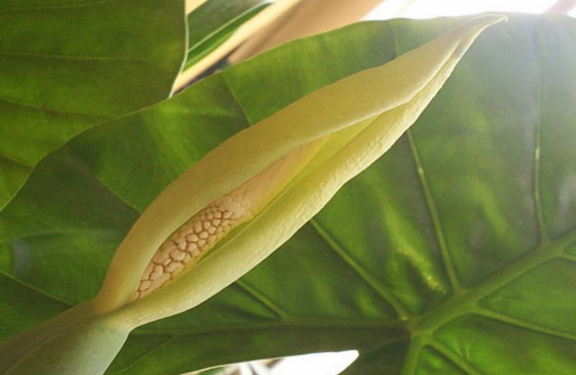
Reasons for Yellowing Leaves on Alocasia macrorrhizos and Prevention Methods
The causes of yellowing or drooping leaves on Alocasia macrorrhizos can be roughly divided into the following aspects:
1. Light exposure.
Keeping Alocasia macrorrhizos in a living room, bedroom, or other spot lacking light for a long time will cause insufficient light for photosynthesis, thereby affecting the plant's life activities. The effects of insufficient or no light on plant growth and morphogenesis: under such conditions, the plant's internodes become especially long, the leaves are underdeveloped and small, and they lack chlorophyll and appear yellow.
2. Improper watering.
Alocasia macrorrhizos has a relatively high water demand. During the growing season, keep it moist rather than dry; during the winter dormant period, watering should be controlled as much as possible. Pay attention to the method when watering, as improper watering can easily cause yellowing leaves. One incorrect watering method is giving "half-hearted water," meaning watering is not thorough and does not reach the point where water seeps out from the bottom of the pot. This watering method fails to meet the water needs of Alocasia macrorrhizos and can easily cause the root tips to be deprived of water for a long time, leading to yellow leaves. Another watering mistake is watering without regularity, watering whenever one thinks of it, causing the potting soil to remain overly wet or overly dry for long periods, which is unfavorable to its growth.
3. Unsuitable soil conditions.
If the soil used for cultivating Alocasia macrorrhizos is too alkaline or the soil is not changed for a long time, it will lead to a lack of nutrients in the soil, affecting the plant's growth and resulting in collapsed leaves, yellow leaves, and drooping.
4. Weather reasons.
Alocasia macrorrhizos is a tropical plant and is susceptible to cold when temperatures are low in winter. If the temperature of its growing environment is not changed in time, the root system can be frostbitten, causing leaves to turn yellow. In addition, after overwintering, if Alocasia macrorrhizos is rushed outdoors and placed in a warm spot to sunbathe, it may temporarily be unable to adapt to the sudden climate change, which can also cause leaves to turn yellow.
5. Ventilation environment.
If Alocasia macrorrhizos is kept in a poorly ventilated environment for a long time, it will develop yellow leaves due to "difficulty breathing."
6. Cleaning of the leaf surface.
Leaves are the main site for plant photosynthesis. If the leaf surface is not sprayed and cleaned for a long time, dust will accumulate, hindering photosynthesis, causing insufficient nutrients and yellowing leaves.
7. Disease effects.
The main pest that can cause leaves to turn yellow is the red spider mite, which likes to suck sap on the underside of leaves. After being damaged, the leaves turn yellow and develop many small white spots, soon withering and falling off. They often breed in high-temperature, low-humidity environments. Pay attention to prevention and control.
8. Human-caused damage.
Human-caused damage to the leaves and branches of the plant will damage the plant's transport system, preventing nutrients from reaching the leaves and causing them to turn yellow.
Methods to prevent yellowing leaves on Alocasia macrorrhizos:
To prevent and treat yellowing leaves on Alocasia macrorrhizos, start from the causes and treat the symptoms accordingly.
1. Reasonable light and ventilation
Provide Alocasia macrorrhizos with reasonable light conditions. Alocasia macrorrhizos prefers semi-shaded environments, so pay attention to shading during care, but remember not to keep it in a dark environment for a long time. In addition, also pay attention to ventilation in the environment and keep the air flowing.
2. Watering requirements for Alocasia macrorrhizos
Alocasia macrorrhizos has a high water demand. Water whenever the soil begins to dry, and water thoroughly at one time until water flows out from the bottom of the pot. Watering should be regular; do not let the potting soil remain overly dry or overly wet for long periods. While watering, use a spray bottle to clean the leaves as well, keeping them clean, and you can also enjoy the sight of water rolling off the leaves.
3. Soil requirements for Alocasia macrorrhizos
Alocasia macrorrhizos does not have high soil requirements, but the fertility of the potting medium must be ensured. Choose sandy loam or humus loam containing organic matter, change the soil in time, and increase nutrients. To increase the plant's own resistance, do not use only nitrogen and phosphorus fertilizers; combine them alternately with organic fertilizers. Applying a little ferrous sulfate will make the leaves larger and greener.
4. Maintain a suitable temperature
Keep the living environment of Alocasia macrorrhizos warm and humid. When the weather is cold in winter, move it indoors in time. Gradually change the living environment of Alocasia macrorrhizos so that it adapts to changes in ambient temperature. Remember not to place Alocasia macrorrhizos in an environment where the temperature fluctuates abruptly.
5. Avoid human-caused damage
Prevent human-caused damage to Alocasia macrorrhizos. The sap of Alocasia macrorrhizos is toxic, so try to avoid contact with its body. When red spider mites appear on the plant, spray with a 1000-times dilution of 40% dimethoate emulsion or a 1000-1500-times dilution of 80% dichlorvos.
What are the benefits of growing it
1. Is Alocasia macrorrhizos toxic?
Alocasia macrorrhizos is a common household plant. The plant is beautiful and elegant, and when the air humidity is high, water droplets fall from the leaf tips, which is very cute. However, many people ask whether Alocasia macrorrhizos is toxic. Is it really true?
The rhizome of Alocasia macrorrhizos is toxic, and the white milky sap will also cause adverse reactions if ingested, so Alocasia macrorrhizos is indeed toxic. However, although Alocasia macrorrhizos is toxic, its leaves do not release toxic substances, so it can be kept at home with peace of mind. Just keep an appropriate distance; do not play with or touch it at will; and do not casually eat the plant.
Alocasia macrorrhizos has many benefits, so there is absolutely no need to keep it at a respectful distance.
1. Benefits of Alocasia macrorrhizos for the human body
Purifying the air:
The green leaves of Alocasia macrorrhizos can absorb carbon dioxide from the air and release oxygen at the same time. Alocasia macrorrhizos also has the effect of removing dust from the air. Nowadays, people pay more and more attention to air quality. After renovation, many harmful substances always remain indoors, and Alocasia macrorrhizos can effectively absorb toxic gases such as formaldehyde.
It can effectively improve the home environment, purify indoor air, and bring people a fresh feeling. Breathing fresh air that is different from the turbid smog outside makes one feel much more refreshed.
Medicinal value:
Alocasia macrorrhizos has the functions of clearing heat and detoxifying, promoting qi circulation and relieving pain, and dispersing nodules and reducing swelling. Alocasia macrorrhizos can also treat malarial fevers, acute vomiting and diarrhea, leukorrhea with reddish or whitish discharge, carbuncles and swellings, atrophic rhinitis, typhoid fever, rheumatic pain, hernia, scrofula, boils, scabies, and snake and dog bites, etc.
Seeing these traditional Chinese medicinal values of Alocasia macrorrhizos, do you still think its toxicity outweighs its benefits?
2. Feng shui role of Alocasia macrorrhizos in the home
Beautifying the environment:
Alocasia macrorrhizos has very large leaves and is very eye-catching when placed in a room. Looking at its glossy green leaves, many people's worries will surely be swept away. Using it to adjust indoor colors and enhance the home atmosphere is a very good choice.
This kind of ornamental plant is often used as the background of the home "picture," so it goes without saying that a plant with such a strong presence as Alocasia macrorrhizos is very suitable for setting off a grand home backdrop. Therefore, whether the home style is European or Chinese, Alocasia macrorrhizos is quite suitable for placement.
Attracting wealth and averting misfortune:
Placing some thick-leaved or large-leaved evergreen plants in the prosperous direction of the home can achieve a "life-generating" effect. Because Alocasia macrorrhizos belongs to the type of plant that does not leak wealth, placing it in the wealth position will have a very good wealth-attracting effect.
We know that placing green plants in the home requires great care, and plants with pointed leaves must not be placed, because from a feng shui perspective, that can easily lead to loss of wealth. According to feng shui masters, if one wants to place such plants, they should be tied with a red ribbon, which can compensate for the feng shui effect of wealth loss.
But this is only a small minority. For most people, plants placed at home are still better with round leaves, and the larger and thicker the leaves, the better. Therefore, plants with large, generous, and thick leaves like Alocasia macrorrhizos are quite suitable for home placement.
Reasons for Yellowing Leaves on Alocasia macrorrhizos and What to Do About It
I believe everyone has grown Alocasia macrorrhizos at home. Alocasia macrorrhizos can not only purify the air but also play a decorative role. When growing Alocasia macrorrhizos, we will encounter many problems. Next, let's learn about the reasons for yellowing leaves on Alocasia macrorrhizos and what to do when its leaves turn yellow.
First, let's look at what the reasons are for yellowing leaves on Alocasia macrorrhizos.
1. Light exposure. Keeping Alocasia macrorrhizos in a living room, bedroom, or other spot lacking light for a long time will cause insufficient light for photosynthesis, thereby affecting the plant's life activities. The effects of insufficient or no light on plant growth and morphogenesis: under such conditions, the plant's internodes become especially long, the leaves are underdeveloped and small, and they lack chlorophyll and appear yellow.
2. Improper watering. Alocasia macrorrhizos has a relatively high water demand. During the growing season, keep it moist rather than dry; during the winter dormant period, watering should be controlled as much as possible. Pay attention to the method when watering, as improper watering can easily cause yellowing leaves. One incorrect watering method is giving "half-hearted water," meaning watering is not thorough and does not reach the point where water seeps out from the bottom of the pot. This watering method fails to meet the water needs of Alocasia macrorrhizos and can easily cause the root tips to be deprived of water for a long time, leading to yellow leaves. Another watering mistake is watering without regularity, watering whenever one thinks of it, causing the potting soil to remain overly wet or overly dry for long periods, which is unfavorable to its growth.
3. Unsuitable soil conditions. If the soil used for cultivating Alocasia macrorrhizos is too alkaline or the soil is not changed for a long time, it will lead to a lack of nutrients in the soil, affecting the plant's growth and resulting in collapsed leaves, yellow leaves, and drooping.
4. Weather reasons. Alocasia macrorrhizos is a tropical plant and is susceptible to cold when temperatures are low in winter. If the temperature of its growing environment is not changed in time, the root system can be frostbitten, causing leaves to turn yellow. In addition, after overwintering, if Alocasia macrorrhizos is rushed outdoors and placed in a warm spot to sunbathe, it may temporarily be unable to adapt to the sudden climate change, which can also cause leaves to turn yellow.
5. Ventilation environment. If Alocasia macrorrhizos is kept in a poorly ventilated environment for a long time, it will develop yellow leaves due to "difficulty breathing."
6. Cleaning of the leaf surface. Leaves are the main site for plant photosynthesis. If the leaf surface is not sprayed and cleaned for a long time, dust will accumulate, hindering photosynthesis, causing insufficient nutrients and yellowing leaves.
7. Disease effects. The main pest that can cause leaves to turn yellow is the red spider mite, which likes to suck sap on the underside of leaves. After being damaged, the leaves turn yellow and develop many small white spots, soon withering and falling off. They often breed in high-temperature, low-humidity environments. Pay attention to prevention and control.
8. Human-caused damage. Human-caused damage to the leaves and branches of the plant will damage the plant's transport system, preventing nutrients from reaching the leaves and causing them to turn yellow.
Now that we know the reasons for yellowing leaves, we should know what to do when leaves turn yellow.
1. Provide Alocasia macrorrhizos with reasonable light conditions. Alocasia macrorrhizos prefers semi-shaded environments, so pay attention to shading during care, but remember not to keep it in a dark environment for a long time. In addition, also pay attention to ventilation in the environment and keep the air flowing.
2. Alocasia macrorrhizos has a high water demand. Water whenever the soil begins to dry, and water thoroughly at one time until water flows out from the bottom of the pot. When Alocasia macrorrhizos leaves turn yellow, watering should be regular; do not let the potting soil remain overly dry or overly wet for long periods. While watering, use a spray bottle to clean the leaves as well, keeping them clean, and you can also enjoy the sight of water rolling off the leaves.
3. Alocasia macrorrhizos does not have high soil requirements, but the fertility of the potting medium must be ensured. To solve yellowing leaves on Alocasia macrorrhizos, choose sandy loam or humus loam containing organic matter, change the soil in time, and increase nutrients. To increase the plant's own resistance, do not use only nitrogen and phosphorus fertilizers; combine them alternately with organic fertilizers. Applying a little ferrous sulfate will make the leaves larger and greener.
4. Keep the living environment of Alocasia macrorrhizos warm and humid. When the weather is cold in winter, move it indoors in time; gradually change the living environment of Alocasia macrorrhizos so that it adapts to changes in ambient temperature. Remember not to place Alocasia macrorrhizos in an environment where the temperature fluctuates abruptly.
5. Prevent human-caused damage to Alocasia macrorrhizos. The sap of Alocasia macrorrhizos is toxic, so try to avoid contact with its body. When red spider mites appear on the plant, spray with a 1000-times dilution of 40% dimethoate emulsion or a 1000-1500-times dilution of 80% dichlorvos to prevent and treat yellowing leaves on Alocasia macrorrhizos.
How to Grow Alocasia macrorrhizos and What to Do When Its Leaves Turn Yellow
Alocasia macrorrhizos is a common potted plant. It has the effect of removing dust from the air, so it has also gained the favor of many consumers. Many consumers are quite concerned about how to grow Alocasia macrorrhizos. Next, here is a summary of how to grow Alocasia macrorrhizos and what to do when its leaves turn yellow.
1. We all know that Alocasia macrorrhizos is a plant that prefers shade and coolness, but it also needs an appropriate amount of light. However, the light should not be too strong. If the light is too strong, Alocasia macrorrhizos will become "wilted." You should know that Alocasia macrorrhizos likes a warm, humid, and shaded environment, but during the flowering period it needs sufficient sunlight; otherwise, the spathe will be tinged with green, affecting quality. Therefore, Alocasia macrorrhizos still needs an appropriate amount of light time. Ensuring about three hours of light per day should be about right, and this point should also be kept in mind.
2. To grow Alocasia macrorrhizos well, you must know that it can only grow well at temperatures not lower than 18 degrees. If the temperature is lower than 18 degrees, Alocasia macrorrhizos will enter a dormant state and also stop growing. Temperature selection is also a necessary prerequisite for growing Alocasia macrorrhizos well, and this point is also very important.
3. Alocasia macrorrhizos is also a plant that likes fertilizer. It should be given nitrogen, phosphorus, and potassium fertilizer every month so that it can grow rapidly. Fertilizing Alocasia macrorrhizos about every twenty days can make its leaves larger, thicker, and greener. If Alocasia macrorrhizos is not fertilized for a long time, the lower part of the stem will become bare and empty, and yellow leaves or smaller leaves will appear. Therefore, an appropriate amount of fertilization is also very critical.
4. Due to the influence of the growth habits of Alocasia macrorrhizos, it needs more water in summer, but not excessively; it is enough to roughly maintain soil moisture. There must not be standing water in the soil, otherwise the tubers of Alocasia macrorrhizos will rot. In winter, it goes dormant and should be watered less. Always follow the growth habits of Alocasia macrorrhizos when planting.
Reasons for Yellowing Leaves on Alocasia macrorrhizos
1. Light exposure. The effects of insufficient or no light on plant growth and morphogenesis: under such conditions, the plant's internodes become especially long, the leaves are underdeveloped and small, causing yellowing leaves on Alocasia macrorrhizos.
2. Improper watering. Alocasia macrorrhizos has a relatively high water demand. During the growing season, keep it moist rather than dry; during the winter dormant period, watering should be controlled as much as possible. Pay attention to the method when watering, as improper watering can easily cause yellowing leaves on Alocasia macrorrhizos.
3. Unsuitable soil conditions. If the soil used for cultivating Alocasia macrorrhizos is too alkaline or the soil is not changed for a long time, it will lead to a lack of nutrients in the soil, affecting the plant's growth and resulting in collapsed leaves, yellow leaves, and drooping.
4. Weather reasons. Alocasia macrorrhizos is a tropical plant and is susceptible to cold when temperatures are low in winter. If the temperature of its growing environment is not changed in time, the root system can be frostbitten, causing Alocasia macrorrhizos leaves to turn yellow. In addition, after overwintering, if Alocasia macrorrhizos is rushed outdoors and placed in a warm spot to sunbathe, it may temporarily be unable to adapt to the sudden climate change, which can also cause Alocasia macrorrhizos leaves to turn yellow.
5. Ventilation environment. If Alocasia macrorrhizos is kept in a poorly ventilated environment for a long time, it will develop yellow leaves due to "difficulty breathing."
6. Cleaning of the leaf surface. Leaves are the main site for plant photosynthesis. If the leaf surface is not sprayed and cleaned for a long time, dust will accumulate, hindering photosynthesis, causing insufficient nutrients and yellowing leaves on Alocasia macrorrhizos.
7. Disease effects. The main pest that can cause Alocasia macrorrhizos leaves to turn yellow is the red spider mite, which likes to suck sap on the underside of leaves. After being damaged, the leaves turn yellow and develop many small white spots, soon withering and falling off. They often breed in high-temperature, low-humidity environments. Pay attention to prevention and control.
8. Human-caused damage. Human-caused damage to the leaves and branches of the plant will damage the plant's transport system, preventing nutrients from reaching the leaves and causing Alocasia macrorrhizos leaves to turn yellow.
9. No matter what kind of plant it is, water is also very important. For a plant like Alocasia macrorrhizos, the water demand in summer is relatively high. At noon every day in midsummer, spray water on the leaves to increase air humidity, so that the leaves of Alocasia macrorrhizos can be large and thick. If it is too shady, the leaves will become larger but thinner, which still greatly affects the ornamental appeal of Alocasia macrorrhizos. Therefore, the water requirement is also indispensable.
Solutions for Yellowing Leaves on Alocasia macrorrhizos
1. Provide Alocasia macrorrhizos with reasonable light conditions. Alocasia macrorrhizos prefers semi-shaded environments, so pay attention to shading during care, but remember not to keep it in a dark environment for a long time. In addition, also pay attention to ventilation in the environment and keep the air flowing.
2. Alocasia macrorrhizos has a high water demand. Water whenever the soil begins to dry, and water thoroughly at one time until water flows out from the bottom of the pot. Watering should be regular; do not let the potting soil remain overly dry or overly wet for long periods. While watering, use a spray bottle to clean the leaves as well, keeping them clean, and you can also enjoy the sight of water rolling off the leaves.
3. Alocasia macrorrhizos does not have high soil requirements, but the fertility of the potting medium must be ensured. Choose sandy loam or humus loam containing organic matter, change the soil in time, and increase nutrients. To increase the plant's own resistance, do not use only nitrogen and phosphorus fertilizers; combine them alternately with organic fertilizers. Applying a little ferrous sulfate will make the leaves larger and greener.
4. Keep the living environment of Alocasia macrorrhizos warm and humid. When the weather is cold in winter, move it indoors in time; gradually change the living environment of Alocasia macrorrhizos so that it adapts to changes in ambient temperature. Remember not to place Alocasia macrorrhizos in an environment where the temperature fluctuates abruptly.
5. Prevent human-caused damage to Alocasia macrorrhizos. The sap of Alocasia macrorrhizos is toxic, so try to avoid contact with its body. When red spider mites appear on the plant, spray with a 1000-times dilution of 40% dimethoate emulsion or a 1000-1500-times dilution of 80% dichlorvos.