Mallow cultivation methods, precautions, and differences from hollyhock
Mallow is a beautiful flower with a rather distinctive flower shape and lovely colors. Cultivating mallow requires good daily care, and neither watering nor fertilizing can be neglected.
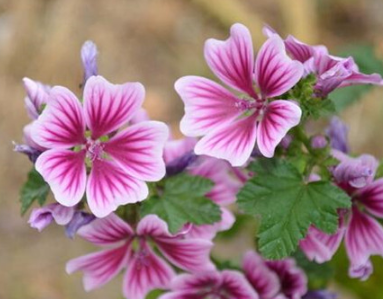
Mallow cultivation methods and precautions
Mallow cultivation methods:
1. Soil
Mallow has low requirements for soil. You can choose sandy soil, or use slightly acidic nutrient soil or leaf mold. After potting the mallow, first place the potted mallow in a sunny spot for half a day, which can encourage it to bloom.
2. Light and temperature
Mallow likes a sunny environment and prefers cooler conditions, and it is cold-tolerant. For cultivating mallow, the suitable growing temperature is between 18°C and 25°C, with sufficient sunlight ensured. In cold winter, the potted mallow needs to be placed indoors in a warm, sunny spot, with the temperature kept at 3°C-5°C.
3. Watering and fertilizing
In terms of water and fertilizer, watering should lean toward dry rather than wet to avoid root rot, especially in harsh winter and hot summer. Because mallow blooms abundantly, it needs relatively more nutrients, so during the growing period you can apply some compound fertilizer with nitrogen and phosphorus; during the flowering period, fertilizer mainly based on phosphorus should be applied to promote flowering.
4. Propagation methods
Mallow propagation generally uses cuttings and layering. For cuttings, you can choose healthy branches to root cuttings, and they will take root in about one month. Layering mainly includes air layering and ordinary layering.
Mallow cultivation precautions:
1. Pruning
During the growth of mallow, it needs frequent pruning. Cut off dead branches, diseased branches, weak branches, crowded branches, and spent flowers. This helps ventilation and light penetration and encourages more branching and flowering.
2. Pests and diseases and their control
During care, mallow may develop some diseases, mainly sooty mold, which can be treated by spraying with a chemical agent, while also paying attention to ventilation to avoid disease. During care, mallow sometimes also suffers from pests, mainly aphids and scale insects. When these pests appear on mallow, a 2000-fold dilution of 10% omethoate can be sprayed for control.
Differences from hollyhock
Differences between mallow and hollyhock: plant form
Mallow is a biennial or perennial upright herbaceous plant, with a plant height of about 50-90 cm, many branches, and sparsely covered with coarse hairs. Hollyhock is a biennial upright herbaceous plant, far taller than mallow, reaching up to 2 m in height, and its stems and branches are densely covered with bristles.
1. Differences between mallow and hollyhock: leaf form
Compared with mallow, hollyhock's leaves are larger, and hollyhock's petioles are also much longer than mallow's.
Mallow's leaves are hairless on both sides or only sparsely covered with short rough appressed hairs on the veins, while hollyhock has hairs on both sides, sparsely covered with stellate soft hairs and rough on the upper side, and covered with stellate long stiff hairs or down on the lower side.
Mallow's stipules are gradually pointed at the tip; hollyhock's stipules have 3 points at the tip.
2. Differences between mallow and hollyhock: flower form
Mallow's flowers are smaller, with monotonous flower color, generally purplish pink; hollyhock's flowers are larger, with rich and varied colors, including white, red, pink, and yellow. Hollyhock's flowering period is from June to August, and mallow's flowering period is from May to October.
Friends, can you tell mallow and hollyhock apart now?
Marsh mallow cultivation methods and precautions
Chinese scientific name: Marsh mallowLatin scientific name: A. officinalisBinomial name: Althaea officinalis L.Kingdom: PlantaeDivision: AngiospermsClass: DicotyledonsOrder: MalvalesFamily: MalvaceaeGenus: AlthaeaSpecies: Marsh mallowDistribution area: grows at field edges, roadsides, and wild areas.Perennial herb, about 1 m tall. Stems upright, densely covered with stellate long rough hairs. Stipules small, linear, about 0.5 cm long; petioles 1-4 cm long, densely covered with stellate tomentum; leaf blades ovate or broadly ovate, usually not lobed, rarely 3-lobed, base nearly heart-shaped to rounded, apex obtuse-acute, margins serrate, both sides densely covered with stellate tomentum;1. Basic information
Chinese name: Marsh mallowLatin name: Althaea officinalis L.
Family name: Malvaceae
Chinese medicinal material name: Marsh mallow
Habitat: grows at field edges, roadsides, and wild areas.
2. Morphological characteristics
Perennial herb, about 1 m tall. Stems upright, densely covered with stellate long rough hairs. Stipules small, linear, about 0.5 cm long; petioles 1-4 cm long, densely covered with stellate tomentum; leaf blades ovate or broadly ovate, usually not lobed, rarely 3-lobed, base nearly heart-shaped to rounded, apex obtuse-acute, margins serrate, both sides densely covered with stellate tomentum; calyx cup-shaped, persistent, 5-lobed, lobes lanceolate, about 1 cm long, densely covered with stellate tomentum; flowers pale red, 2-3 cm in diameter; petals 5, obovate-oblong; stamens numerous, filaments united into a tube; carpels numerous. Fruit disc-shaped, 6-8 mm in diameter, each carpel separating from the central axis when mature. Seeds kidney-shaped, reddish brown, 2 mm long. Flowering period June-August, fruiting period August-September.3. Medicinal value
Medicinal part: RootMedicinal components: Contains mucilage, pectin, starch, and sugars.
Functions and indications: Has the effects of relieving the exterior and dispelling cold, promoting urination, relieving cough, and reducing inflammation and detoxifying. Treats sores, boils, and swellings, cough, bronchitis, and wind-cold common cold, etc.
How to grow hollyhock? Hollyhock cultivation methods and precautions
Hollyhock, also known as yizhanghong, dashuji, wukui, etc., is a biennial upright herbaceous plant in the genus Althaea of the family Malvaceae. Hollyhock has rich flower colors, either fresh and elegant or rich and brilliant, and has high ornamental value, so it is often potted indoors in courtyards. So, how to grow hollyhock? The cultivation methods and precautions for hollyhock are introduced below.
Image: Hollyhock
1. Hollyhock cultivation methods
1. Light:Hollyhock prefers a sunny environment and tolerates partial shade. In ordinary cultivation, hollyhock should be placed in a spot with direct sunlight to receive sunlight.
2. Temperature:Hollyhock is cold-tolerant. In winter, the aboveground branches wither and die, but the underground perennial roots can overwinter naturally in open ground and sprout new buds the following year. In North China, it can overwinter safely in open ground. Hollyhock's growing temperature is 25°C—30°C, and the most suitable temperature during the flowering period is 26°C—28°C. An average monthly temperature below 17°C affects flowering, and growth is poor when the nighttime temperature is below 14°C.
3. Watering:Pay attention to watering at ordinary times to keep the soil moist, but do not overwater, as hollyhock is afraid of waterlogging. During the flowering period, hollyhock should be watered appropriately to prolong the flowering period and increase the number of flowers.
4. Soil:Hollyhock has strong adaptability to soil and strong tolerance to saline-alkali soil, and can still grow in soil with 0.6% salt content. It grows best in loose, fertile, well-drained sandy soil rich in organic matter.
5. Fertilizing:Before planting hollyhock, deeply turn the soil and add base fertilizer to the soil. During the growing period, apply liquid fertilizer mainly based on nitrogen and potassium fertilizer once or twice. After flower buds form, apply liquid fertilizer mainly based on phosphorus and potassium fertilizer once or twice more.
Image: Hollyhock
2. Precautions for hollyhock cultivation
1. Timely pruning:After hollyhock blooms, promptly cut off the aboveground parts, and new buds can still sprout.
2. Provide partial shade in summer:Because sunlight is strong in summer, hollyhock should try not to be exposed to direct sun for long periods, so as not to affect plant growth. Appropriate shading should be provided, and scattered light should be received.
3. Control plant height:To dwarf the plant, root cutting can be used to control height, that is, during the growing period, use a spade to vertically cut the root system at 10 cm to the left and right of the plant base, and 2—3 weeks after cutting, similarly cut the front and back two places. The more times root cutting is done, the shorter the plant becomes, making it suitable for potting.
[Editor's concluding remarks]Hollyhock likes a sunny environment and tolerates partial shade, but it dislikes waterlogging, so special attention is needed during care. The above introduced the cultivation methods and precautions for hollyhock, hoping it can help everyone!