What Are Carnivorous Plants? A Detailed Guide to Their Care
Plants - many people assume they are vegetarian, but that is not actually the case; some plants do eat meat. Let's take a look at what carnivorous plants there are and how to grow them:
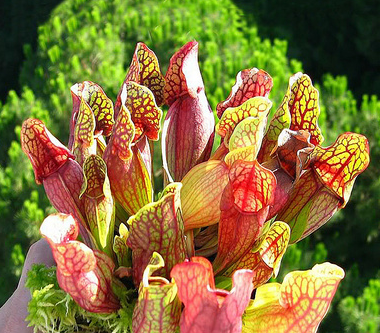
Pitcher Plant
Pitcher plants differ from other carnivorous plants in that they do not only eat small flying insects, but also small animals as large as a mouse. Moreover, pitcher plants are arguably the most beautiful of the carnivorous plants; each of their leaves is like a vase, which is why they are called pitcher plants, and every leaf blade is a insect trap.
Tropical Pitcher Plant (Nepenthes)
The tropical pitcher plant (Nepenthes) is arguably the most famous of the carnivorous plants; its insect-trapping pouch, that is, the little pitcher hanging down, is quite attractive to insects. The smooth rim of the pouch and the usually half-open lid also bear nectaries, which can secrete sweet nectar to lure insects. When these “little prey” fly in to eat the nectar, a single slip sends them sliding into the pouch, falling into the “liquid pool” at the bottom, becoming the Nepenthes' “delicacy”.
Venus Flytrap
The Venus flytrap can be said to have the strongest insect-catching ability in nature; it has two leaf lobes shaped like a clamp, usually open with the leaves curving outward. If an insect touches the Venus flytrap, it immediately snaps shut, leaving half of the insect's body inside the leaf while the other half struggles; the more it struggles to break free, the tighter it gets. #p#Subtitle#e#
Butterwort (Pinguicula)
A small carnivorous plant with a delicate, graceful character; succulent lovers seeing a butterwort for the first time will probably think they are some kind of succulent from the Crassulaceae family, Echeveria genus. Although they look succulent (the leaves really are fleshy), they are not succulents, but rather carnivorous fleshy bodies. The leaves are as beautiful as a flower that blooms forever, covered with glands that secrete mucus; when a small insect comes near, they can stick to it like flypaper and digest and absorb it.
Sundew (Drosera)
A very exquisite and charming small carnivorous plant, with glandular hairs on the leaves; the dew color is generally green, and under good light it can appear bright red or yellow-green, and its shape is also very variable. It can secrete mucus, and its appearance is like being covered in dewdrops, crystal clear; it can stick to insects like flypaper and digest and absorb them.
Now let's take a look at how to grow carnivorous plants! First, we need to understand that the way carnivorous plants obtain nutrients is by catching insects, so their roots are not well developed and their absorption is very poor. Moreover, the potting soil sold on the market contains too much fertilizer, so it is not suitable for growing carnivorous plants. What is suitable for carnivorous plants is fertilizer-free peat, perlite, sphagnum moss, sand, akadama, etc.
Also, the vast majority of carnivorous plants love humid environments, so you might as well lay wet sphagnum moss on the pot and spray more water. In addition, carnivorous plants are best given water with a low mineral content; friends might as well use rainwater for watering.
That's all for the introduction to carnivorous plants. Have you ever seen any? The care methods for carnivorous plants are all similar, so come and take a look.
What Carnivorous Plants Are There and How to Grow Them
Summer is about to arrive, and especially in the south the weather will become very hot and humid; a humid environment very easily attracts mosquitoes, and having mosquitoes at home is undoubtedly the most annoying thing. So what can be done to solve this? Growing carnivorous plants at home is the best solution, as they can both repel insects and green up the environment. Today, the editor will show you what carnivorous plants there are, as well as how carnivorous plants look and how to grow them.
I. What Carnivorous Plants Are There
There are many kinds of carnivorous plants in nature; the editor will introduce a few common ones for you!
1. Pitcher plant: Pitcher plants differ from other carnivorous plants in that they do not only eat small flying insects, but also small animals as large as a mouse. Moreover, pitcher plants are arguably the most beautiful of the carnivorous plants; each of their leaves is like a vase, which is why they are called pitcher plants, and every leaf blade is an insect trap.
2. Tropical pitcher plant (Nepenthes): Among carnivorous plants, the Nepenthes is arguably the most famous; it comes with its own insect-trapping pouch, the rim of which is very smooth, and inside there are also nectaries distributed, which can secrete sweet nectar to attract and eliminate mosquitoes.
3. Venus flytrap: The Venus flytrap can be said to have the strongest insect-catching ability in nature; it has two leaf lobes shaped like a clamp, usually open with the leaves curving outward. If an insect touches the Venus flytrap, it immediately snaps shut, leaving half of the insect's body inside the leaf while the other half struggles; the more it struggles to break free, the tighter it gets.
II. How to Grow Carnivorous Plants
Now let's take a look at how to grow carnivorous plants! First, we need to understand that the way carnivorous plants obtain nutrients is by catching insects, so their roots are not well developed and their absorption is very poor. Moreover, the potting soil sold on the market contains too much fertilizer, so it is not suitable for growing carnivorous plants. What is suitable for carnivorous plants is fertilizer-free peat, perlite, sphagnum moss, sand, akadama, etc. Also, the vast majority of carnivorous plants love humid environments, so you might as well lay wet sphagnum moss on the pot and spray more water. In addition, carnivorous plants are best given water with a low mineral content; friends might as well use rainwater for watering.
The above is all the content on how to grow carnivorous plants. I wonder if you clever readers have learned it? The scorching summer is about to arrive; if you do not want mosquitoes flying all over your home, then hurry up and plant a few pots of carnivorous plants!
How to Grow Carnivorous Plants?
[Common Questions] How to grow carnivorous plants?
[Expert Answer]
Image: Carnivorous plants
● Poor soil
The common substrates suitable for cultivating carnivorous plants mainly include: fertilizer-free peat, perlite, sphagnum moss, sand, akadama, etc. Commercially sold potting soil is not suitable for growing carnivorous plants because it contains more fertilizer, so special attention must be paid!
Common substrates and formulas:
Peat : perlite or coarse sand = 2:1 —— suitable for most carnivorous plants, cheap and widely adaptable.
Peat : perlite = 1:1 —— suitable for the tray method (pots sitting in a water tray) or for plants that like dry, airy conditions. (Such as Nepenthes, North Australian sundews, etc.)
Peat : perlite : sphagnum moss = 5:3:2 —— can improve the substrate's water retention and aeration.
Pure peat —— suitable for growing moisture-loving plants. Coarse peat chunks can also be used for growing plants that like airy conditions or for large-pot planting.
Pure sphagnum moss —— suitable for moisture-loving plants or for breeding and cuttings; it has good water retention and aeration, but the surface layer rots easily and needs to be replaced in time; it can also be placed at the bottom of the pot or spread on the pot surface to prevent soil and water loss or to raise air and substrate humidity.
Granular soil (akadama, kanuma, diatomaceous earth, etc.) —— suitable for the tray method or for plants that like dry, airy conditions; a small amount of peat can be mixed in to retain moisture and add nutrients.
Coconut chunks, coconut fiber, coconut coir —— mainly used for growing Nepenthes and butterworts; can also be mixed with other media such as peat, perlite, sphagnum moss, etc. They need to be desalinated and washed several times with water before use; not recommended to try without experience.
Vermiculite —— a small amount can be added when growing butterworts or sowing seeds.
Note: When planting in large pots, the proportion of large granular media should be increased to improve the substrate's aeration and drainage.
● Pure water source
To provide carnivorous plants with a medium of low mineral concentration, the water source is very important. Relatively ideal watering sources include rainwater, bottled water (including purified water and mineral water; although mineral water contains a small amount of minerals, it is only one-fifth to one-tenth that of tap water), water from a water purifier, condensed water (from air conditioners, refrigerators), etc.
Only tap water with low mineral concentration can be used for carnivorous plants. The mineral concentration of tap water can be measured with a commercially available TDS pen. Generally, tap water with total dissolved solids below 100PPM is suitable for use; tap water with total dissolved solids of 100-200PPM can be used, but when yellow-white mineral deposits appear on the pot soil surface, the soil or surface substrate should be replaced in time; tap water with total dissolved solids above 200PPM is not recommended. Before use, tap water is best left to stand for one or two days to eliminate residual chlorine.
● Humid environment
Most carnivorous plants like humid environments; methods of humidifying and retaining moisture can be used to raise substrate and air humidity.
Moisture retention: Use a relatively enclosed environment, such as placing them in a fish tank or greenhouse, or covering them with a transparent disposable cup with holes or a plastic bag. (In an enclosed environment, take care to prevent exposure to direct sunlight, to avoid heat being unable to dissipate and the plants dying of heat.)
Humidifying: Use the tray method (pots sitting in a water tray), spread wet sphagnum moss on the pot surface, spray water frequently, use automatic misting or a humidifier, etc. In a humid environment, fungi also breed easily, so avoid excessive shade, ventilate frequently, and light also helps sterilize.
● Sufficient light
Most carnivorous plants need sufficient light, which is conducive to rapid growth and makes the plant's color more vivid. However, when growing in an enclosed environment, even more attention should be paid to the greenhouse effect; to prevent excessive temperature, ventilate or shade appropriately, or place the plants in a spot without direct sunlight but with bright scattered light. Generally, plants need shading from the strong midday sunlight in summer (except for North Australian sundews such as Drosera paradoxa), otherwise the leaves will be scorched by the sun; shade-loving or heat-sensitive plants should also be given bright scattered light. If growing indoors, poor light requires artificial supplementary lighting; various electric lamps or special plant grow lights can be used. To make full use of light efficiency while preventing plants from being dried out, generally fluorescent lamps and LED lamps should be 10-30 cm from the plants, and incandescent lamps, halogen lamps, etc. should be 20-100 cm from the plants depending on their heat output, providing about 12 hours of light per day.
● Suitable temperature
Temperature is also a very important factor for carnivorous plants; beyond the range they can tolerate, they will stop growing or go dormant, or even die. The vast majority of carnivorous plants can grow normally within the range of 10-35 degrees, and many carnivorous plants cannot adapt to the year-round temperature changes in most regions of our country. Therefore, when purchasing carnivorous plants, you should understand the temperature range they can adapt to; if the temperature of your growing environment cannot meet their requirements, you should consider heating or cooling measures.
Heating: Generally, an enclosed environment is needed to prevent heat loss; heating equipment such as heating rods, heating mats, heat lamps, and fan heaters can be used, and the simplest method is to use a box plus a desk lamp for temporary heating. The most important thing when heating is safety; do not place the heat source too close to flammable materials or plants, and heating rods must be prevented from dry burning.
Cooling: A simple method is to use a container (do not use a glass bottle, as it will crack from freezing) filled with water, freeze it into ice in the refrigerator, then place it together with the plants in a large container (such as a fish tank). If there are many plants that need cooling, cooling equipment such as automatic misting, refrigerated cabinets, and air conditioners can be installed.
● Nutrient supply
Carnivorous plants are insect-eating plants; this is the unique way this group obtains nutrients. If there are insects in the growing environment, they can generally catch insects on their own and obtain the nutrients they need. You can also hand-feed small insects or high-protein food, which is one of the great pleasures of growing carnivorous plants. When feeding, be careful not to feed too much or too large, to avoid being unable to digest it, causing rot, and affecting hygiene and appearance. To avoid these problems, it is recommended to provide nutrients by fertilizing, generally using the spraying method, and diluting the fertilizer solution to about 1/5 the concentration used for ordinary plants. Use general-purpose compound fertilizer etc. during the growing season; if the product instructions say to dilute one thousand times for ordinary plants, it should be diluted about five thousand times for carnivorous plants, sprayed over the whole plant or poured into the insect traps, 1-2 times a month. When fertilizing, it is better to apply thin fertilizer frequently; never use too high a concentration, to avoid the serious consequences of fertilizer burn or even fertilizer death. Do not fertilize casually without experience.
[Editor's Summary]
Carnivorous plants are a relatively rare group, mostly living in alpine wetlands or swamps, so their cultivation requirements differ from ordinary flowers and plants. In this article, the editor of First Agricultural Economics introduces how to grow carnivorous plants from the aspects of soil, water quality, environment, light, temperature, and nutrients, hoping it will be helpful to you.