Monkey Face Orchid Division Precautions and Common Pest Control Methods
There are four propagation methods for the Monkey Face Orchid: seed sowing, division, tissue culture, and sterile propagation. Tissue culture and sterile propagation have somewhat higher requirements, so ordinary hobbyists do not use them, and seed sowing takes a long time to wait, so what hobbyists commonly use is the division method.
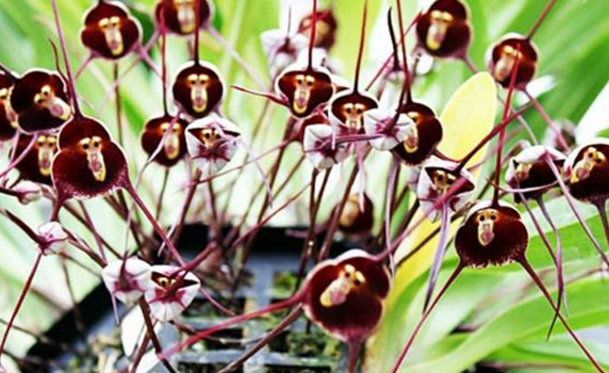
What to pay attention to when dividing the Monkey Face Orchid
1. Choosing the time for dividing the Monkey Face Orchid
For dividing the Monkey Face Orchid, it is best to do it in early spring after the soil thaws, that is, in February to March.
Take the mother plant out of the flower pot, shake off the excess potting soil, separate the roots that are tangled together as much as possible, and cut it open with a sharp knife into two or more plants. Each divided plant must have a considerable amount of roots, and its leaves should be properly trimmed to help it survive.
2. Monkey Face Orchid division precautions: potting and disinfection
Soak the divided small plants in a 1500-fold solution of chlorothalonil for five minutes, then take them out and let them dry, and they can be potted. You can also drench the roots with chlorothalonil immediately after potting.
3. Management after dividing the Monkey Face Orchid
After the divided plants are potted, drench the roots or water once thoroughly. Because its root system has been greatly damaged, its water absorption capacity is very weak, and it takes about 3 to 4 weeks to recover and sprout new roots. Therefore, within 3 to 4 weeks after division, watering should be moderated to avoid root rot, but the transpiration of its leaves is not affected. In order to maintain the water balance of the leaves, it is necessary to mist the leaf surface 1 to 3 times a day (mist more when the temperature is high, and mist less or not at all when the temperature is low). Do not apply fertilizer during this period either. After division, also pay attention to excessively strong sunlight, and it is best to place it in a shade shed for care.
4. Transplanting after dividing the Monkey Face Orchid
When potting the small seedlings, first put a 2 to 2 cm thick layer of coarse-grained substrate or ceramsite at the bottom of the pot as a drainage layer, sprinkle a layer of fully decomposed organic fertilizer on top as a base fertilizer, about 1 to 2 cm thick, then cover with a layer of substrate about 1 to 2 cm thick, and then place the plant in, so as to separate the fertilizer from the roots and avoid burning the roots.
5. Substrate selection for potting divided Monkey Face Orchids
You can choose one of the following: peat + perlite + ceramsite = 2 parts + 2 parts + 1 part; peat + furnace slag + ceramsite = 2 parts + 2 parts + 1 part; sawdust + vermiculite + medium-coarse river sand = 2 parts + 2 parts + 1 part. After potting, water once thoroughly and place it in a slightly shady environment for one week of care.
When transplanting small seedlings, first dig the planting hole, sprinkle a layer of organic fertilizer at the bottom of the planting hole as a bottom fertilizer (base fertilizer), about 4 to 6 cm thick, then cover with a layer of soil and place the seedling in, so as to separate the fertilizer from the roots and avoid burning the roots.
Common pests and control methods
1. Common pest of the Monkey Face Orchid: aphids
Symptoms of aphid damage on the Monkey Face Orchid:
They often gather in groups to harm the young leaves, flower buds, and other parts of the Monkey Face Orchid, with nymphs and adults piercing and sucking the sap.
Control methods for aphids on the Monkey Face Orchid:
For a small number, they can be brushed off with a writing brush. For treatment, spray 1000-fold solution of aphid-and-thrip-killing wettable powder, or 2000-3000-fold solution of 2.5% deltamethrin emulsifiable concentrate, or 1000-fold solution of 40% methomyl, or 1500-fold solution of acetamiprid emulsifiable concentrate, etc.
2. Common pest of the Monkey Face Orchid: scale insects
Symptoms of scale insect damage on the Monkey Face Orchid:
Adults and nymphs suck sap on the leaf stalks, leaf bases, and leaf surfaces, producing yellow spots. In poorly ventilated environments, scale insects are prone to reproduce and cause damage.
Control methods for scale insects on the Monkey Face Orchid:
Ensure ventilation and air circulation. Once scale insects occur, promptly spray 25% buprofezin wettable powder at 1000-fold solution or 40% methidathion emulsifiable concentrate at 800-1000-fold solution, once every 7 days, for 2-3 consecutive times.
3. Common pest of the Monkey Face Orchid: snails
Symptoms of snail damage on the Monkey Face Orchid:
They mostly nibble on new buds, new leaves, flower buds, and roots at night. From June to October, in humid environments, timely control is needed.
Control methods for snails on the Monkey Face Orchid:
Spread lime powder on the ground, or spread 8% metaldehyde granules in places where they appear, or spray pesticides such as trichlorfon on the leaf surface to kill them.
4. Common pest of the Monkey Face Orchid: slugs
Symptoms of slug damage on the Monkey Face Orchid:
Also called water slug, in some areas of southern China it is called yanyou (not yanyou centipede), commonly known as the slug, it is a mollusk and together with some snails forms the order Pulmonata. Hermaphroditic, it looks like a snail without a shell, with a moist and slimy body surface, very disgusting.
Control methods for slugs on the Monkey Face Orchid:
This is a method passed down among the people, which is to sprinkle salt on the slug's body and let it dehydrate to death. It is very cruel, but who told it to harm our senior brother, the Monkey Face Orchid!