How to grow Vanda orchids? Key care points and how they differ from Ascocenda orchids
Vanda orchids originated in India, and the name refers to orchids that hang from trees. As the national flower of Singapore, they come in a rich variety of cultivars and are a rare powerhouse among orchids. When in bloom, the flowers are robust and bold in form.
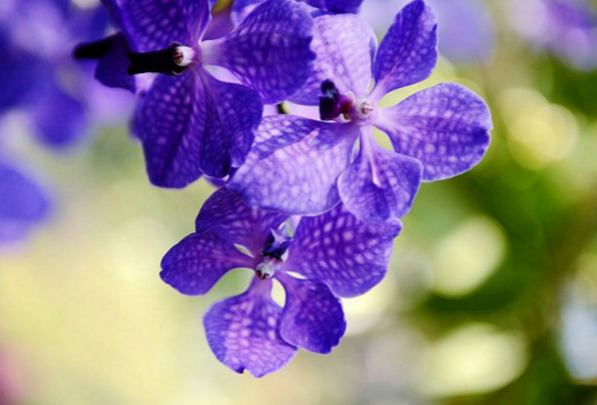
Key care points for Vanda orchids
What Vanda orchid care requires
1. Bask in sunlight
The breath of sunshine will make it grow very sturdy. In excessive heat, shade it from half the sunlight, and it can handle the rest. In winter, let the sunlight come on even stronger!
2. Give it some warmth
Vanda orchids are tropical plants, and you must satisfy this need. Ideally around 25°C. If there is no frost or snow locally, it will bloom happily all year round.
3. It actually needs water
All things cannot do without the nourishment of water. Although it is drought-tolerant, it still cannot do without suitable moisture. In the dry season it needs you to water it, and keeping air humidity at around 80% is enough; it will be very happy.
4. Nutrients are essential
People need nutrition, and so do plants. Never mind giving it vitamins. Just give it a 10:10:5 nitrogen, phosphorus, potassium fertilizer. Once about every 8 days is enough, and it will be very happy.
5. The nourishment of Mother Earth
The soil in the pot must have very good drainage and aeration. Just like a person's home. No one wants their home flooded and with PM2.5 levels over the limit.
6. Move house less often
If there are pests, then repotting is imperative. But if it is living perfectly well, why keep changing the pot? Of course, after three to five years, repotting is normal too!
7. Offspring are not only needed by humans
First of all! Vanda orchids can be propagated once their stems have grown larger. Doing so can ensure the survival rate of its offspring. Please use sterilized tools for the operation, and remember to apply medicine to the wound! No one enjoys being cut. Pain is a shared sensation among living things.
8. When it is sick, it needs your care
Even the strongest have fragile moments, and even the fragile have strong moments. When it is sick and needs you, give it more care. In fact, as long as you pay more attention to it in daily life, it will still be very sturdy.
The difference between Vanda orchids and Ascocenda orchids
Both are orchids, one called Ascocenda and one called Vanda. What differences are there between them?
1. Vanda orchids and Ascocenda orchids
You may be more familiar with the name "orchid", but when encountering different types of orchids, people do not really know their names. Next, we will introduce one type of orchid - Ascocenda and Vanda.
Orchids are also known as tropical orchids, with many varieties, such as Phalaenopsis, Dendrobium, Oncidium, Vanda, and so on. Orchid flowers are very large, and their flower shapes are also relatively unusual, with a flowering period lasting as long as 3 months. What is more special about orchids is that they need to be grown on media such as bark and moss. They rarely suffer from pests and diseases, which is why flower lovers like them.
2. Vanda orchids
It is the general term for plants in the genus Vanda. This genus has roughly 60 to 80 species, with an extremely wide distribution range, found in China, India, Malaysia, the Philippines, Hawaii in the United States, as well as New Guinea, Australia, and other places; Vanda is a typical epiphytic orchid; its sepals are well developed, and the two lateral sepals are larger, making them the most eye-catching part of the whole flower, but Vanda's petals are relatively small, and the lip is even smaller; Vanda's flower forms are very diverse, some recurved and twisted, some round and flat; Vanda's flowering period is very long, and a single flower can even bloom continuously for several weeks.
3. Ascocenda orchids
Ascocenda is produced by crossing Ascocentrum and Vanda. Its plants are relatively short, about only half the size of Vanda; Ascocenda comes in a riot of colors, and there are varieties of Ascocenda that bloom throughout the year, but most still concentrate in spring or summer and autumn; the color variation of Ascocenda is also very rich, with diverse colors.
Key cultivation points for Vanda orchids and Ascocenda orchids
The genera Vanda and Ascocenda are typical aerial orchids, with a robust nature, native to Southeast Asia, and they love high temperatures. The flowering period is from spring to autumn. If grown from seedlings, it takes five years to bloom. At present, Thailand has the most success in cultivating and breeding this genus.
Location: They can be grown outdoors, but if grown in an orchid shed, the plants will be more beautiful.
Planting: The roots of Vanda and Ascocenda are thick and fleshy, and they extremely love being exposed to the air, so most are grown in wooden frames or other containers with very good aeration. The growing medium should be coarse, such as charcoal, brick pieces, tree fern blocks, and so on.
Light: They require relatively strong light, similar to Dendrobium. Usually small seedlings are shaded by about 30% to 40%, and after reaching the intermediate seedling stage they are shaded by 20% to 30%. Mature plants should receive as much sunlight as possible, and in spring and autumn they can be grown outdoors.
Temperature: In winter, small seedlings should be kept warm below 10°C to prevent cold damage. After reaching maturity, they can develop normally within the range of 18°C to 35°C, and between 24°C and 32°C is most favorable for growth and flowering.
Water: Because Vanda and Ascocenda are mostly planted in wooden frames, and the planting material is very coarse and does not easily retain water, they must rely heavily on air to supply moisture, so in addition to watering, air humidity should be increased as much as possible. But once they enter the flowering stage, reduce watering; a slightly dry environment is beneficial for the formation of flower stalks.
Fertilizer: If grown in wooden frames, wrap slow-release fertilizer in gauze and hang it near the roots. This genus of orchids also commonly uses chemical fertilizers. Every 10 to 15 days, spray a water-soluble quick-acting fertilizer diluted about 2000 times. Increasing phosphorus and potassium fertilizer in autumn and winter can promote flowering.
The difference between Vanda orchids and Ascocenda orchids
A brief introduction to Vanda orchids and Ascocenda orchids
You may be more familiar with the name "orchid", but when encountering different types of orchids, people do not really know their names. Next, we will introduce one type of orchid - Ascocenda and Vanda.
Orchids are also known as tropical orchids, with many varieties, such as Phalaenopsis, Dendrobium, Oncidium, Vanda, and so on. Orchid flowers are very large, and their flower shapes are also relatively unusual, with a flowering period lasting as long as 3 months. What is more special about orchids is that they need to be grown on media such as bark and moss. They rarely suffer from pests and diseases, which is why flower lovers like them.
Vanda orchids and Ascocenda orchids are different varieties
Vanda is the general term for plants in the genus Vanda. This genus has roughly 60 to 80 species, with an extremely wide distribution range, found in China, India, Malaysia, the Philippines, Hawaii in the United States, as well as New Guinea, Australia, and other places. Ascocenda is produced by crossing Ascocentrum and Vanda.
Vanda orchids and Ascocenda orchids differ in morphological characteristics
Vanda is a typical epiphytic orchid; its sepals are well developed, and the two lateral sepals are larger, making them the most eye-catching part of the whole flower, but Vanda's petals are relatively small, and the lip is even smaller; Vanda's flower forms are very diverse, some recurved and twisted, some round and flat; Vanda's flowering period is very long, and a single flower can even bloom continuously for several weeks.
Ascocenda's plants are relatively short, about only half the size of Vanda; Ascocenda comes in a riot of colors, and there are varieties of Ascocenda that bloom throughout the year, but most still concentrate in spring or summer and autumn; the color variation of Ascocenda is also very rich, with diverse colors.