How much does it generally cost to graft Golden Bullet (Diospyros cathayensis)? Grafting tips included
Golden Bullet (Diospyros cathayensis) is dioecious. Surely many flower lovers have tried grafting it by the branch grafting or bud grafting method and failed; there is a certain amount of technique involved.
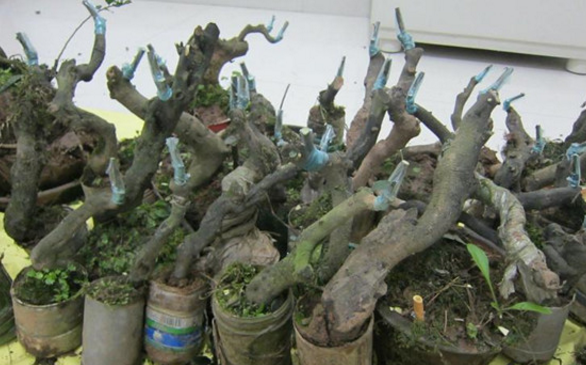
Grafting techniques for Golden Bullet
1. The grafting time for Golden Bullet
Early May is the best period for grafting Golden Bullet.
2. Grafting techniques for Golden Bullet
Here we take a potted Golden Bullet stump as an example for illustration.
A Golden Bullet stump generally needs to keep 3-5 robustly growing branches; cut off the branches not used for grafting from the base, and the retained branches need to be appropriately shortened in strength, keeping about 5 cm at the base. Then use a sharp cleft grafting knife to split a single vertical cut right along the center of the cross-section, with a cut depth of about 2 cm; be careful not to make it too deep.
Afterward, from a female plant that has reached the fruiting age, cut off a thick branch; its thickness can refer to the branch of the rootstock being grafted, and roughly similar is fine. One with a terminal bud, about 5 cm long and with 4-5 axillary buds, is better, as this gives a higher success rate. Next, use a sterilized blade to peel off the cortex on both sides of the base of the scion, with the cut surface about 2 cm long, basically consistent with the depth of the rootstock split, and cut until the xylem is just slightly exposed. Then insert the wedge-shaped end of the prepared scion base into the split of the rootstock so that the cambium on at least one side is aligned, and only then use a tying band to bind the rootstock-scion junction.
Finally, put on a plastic bag, cover the entire scion (including the rootstock-scion junction), and tie the plastic bag tightly. As long as you pay a little attention to later management and care, the grafting can be considered basically successful. Of course, patience is indispensable in the grafting process.
How much does a bonsai generally cost?
Golden Bullet bonsai has very high ornamental value, and its price depends on the styling; generally it is higher than bonsai of the same grade. Because Golden Bullet is a good material for making bonsai and its branches and trunk have relatively high density, its market price is relatively high. A 4—5 cm mature stump basically costs 200—500 yuan. The price of a non-leaf-shedding Golden Bullet bonsai is 285 yuan, and the price of a Golden Bullet tree stump bonsai is 2260 yuan. Prices come from the internet and are for reference only.
Grafting techniques for Golden Bullet
The grafting time for Golden Bullet
Early May is the best period for grafting Golden Bullet.
Grafting techniques for Golden Bullet
Here we take a potted Golden Bullet stump as an example for illustration.
A Golden Bullet stump generally needs to keep 3-5 robustly growing branches; cut off the branches not used for grafting from the base, and the retained branches need to be appropriately shortened in strength, keeping about 5 cm at the base. Then use a sharp cleft grafting knife to split a single vertical cut right along the center of the cross-section, with a cut depth of about 2 cm; be careful not to make it too deep.
Afterward, from a female plant that has reached the fruiting age, cut off a thick branch; its thickness can refer to the branch of the rootstock being grafted, and roughly similar is fine. One with a terminal bud, about 5 cm long and with 4-5 axillary buds, is better, as this gives a higher success rate. Next, use a sterilized blade to peel off the cortex on both sides of the base of the scion, with the cut surface about 2 cm long, basically consistent with the depth of the rootstock split, and cut until the xylem is just slightly exposed. Then insert the wedge-shaped end of the prepared scion base into the split of the rootstock so that the cambium on at least one side is aligned, and only then use a tying band to bind the rootstock-scion junction.
Finally, put on a plastic bag, cover the entire scion (including the rootstock-scion junction), and tie the plastic bag tightly. As long as you pay a little attention to later management and care, the grafting can be considered basically successful. Of course, patience is indispensable in the grafting process.
Sharing Golden Bullet grafting experience
For people who love nature and like plants, surely they will place quite a few potted plants at home. The feeling of being surrounded by flowers and plants is very nice, as if being in the middle of a forest, and the mood will be much more relaxed, which is also greatly beneficial for health. For most potted plant lovers, surely they all know Golden Bullet; as a landscape, it is an excellent choice.
Golden Bullet, whose scientific name is Chinese Persimmon (Diospyros cathayensis), may be confused by many people with the persimmon we often eat, thinking they might be relatives. Golden Bullet is a semi-evergreen shrub or small tree; when it flowers and bears fruit, it can form a beautiful scenic line and is a first choice for garden design. Golden Bullet is called Golden Bullet because its fruit is golden yellow, oval, and the fruit is long-lasting, hence the name Golden Bullet. Although Golden Bullet bears fruit and has the scientific name Chinese Persimmon, its fruit cannot be eaten. Its fruit has a certain toxicity and is harmful to the body, so Golden Bullet can only be looked at, not eaten; it feels a bit like a vase, only suitable as decoration.
Golden Bullet is dioecious, so surely many people have tried the branch grafting or bud grafting methods to graft it but without success. There is a certain technique involved. Today I will share with everyone a few points of experience about Golden Bullet grafting.
The low success rate when branch grafting and bud grafting Golden Bullet is not because branch grafting and bud grafting are unsuitable for Golden Bullet grafting, but because there are certain problems, or mistakes, in the grafting time and method. When Golden Bullet is grafted for crown replacement and variety improvement, it is best to graft in early May; this is the best period. Here we take a potted Golden Bullet stump as an example and introduce it in detail. On the Golden Bullet stump, 3-5 robust branches should be kept; at the positions of the retained branches, cut off the remaining branches not intended for grafting from the base, and strongly shorten the retained branches, keeping only 4 cm-5 cm at the base. Then use a sharp cleft grafting knife to split a single vertical cut right along the center of the cross-section, with a cut depth of about 2 cm; be careful not to make the cut too deep. Next is to cut off a thick branch from a female plant that has reached the fruiting age; its thickness should be similar to the branch of the rootstock being grafted, and it is best if it has a terminal bud, about 5 cm long, with about 4-5 axillary buds on it, as this gives a relatively high success rate. Then use a sterilized blade to peel off the cortex on both sides of the base of the scion, with the cut surface about 2 cm long, comparable to the depth of the rootstock split, and cut until the xylem is slightly exposed. Then insert the wedge-shaped end of the prepared scion base into the split of the rootstock so that the cambium on at least one side is aligned, and only then use a tying band to bind the rootstock-scion junction. Finally, put on a transparent plastic bag, cover the entire scion including the rootstock-scion junction, and tie the bag tightly. In this way, the grafting is basically more than half successful; as long as you pay a little attention to careful later care, the grafting is basically successful.
Grafting not only requires technique; most importantly, it requires patience. The grafting process is relatively time-consuming, and you must be careful and patient everywhere, so the success rate will only increase and not decrease.