The correct cultivation methods and wintering techniques for Sageretia bonsai
Sageretia is a shrub and a high-quality material for making bonsai. In ancient China it was known as one of the “Seven Sages” and is a tree of great elegance and dignity, mainly produced in the Yangtze River basin and the southeastern coastal areas.
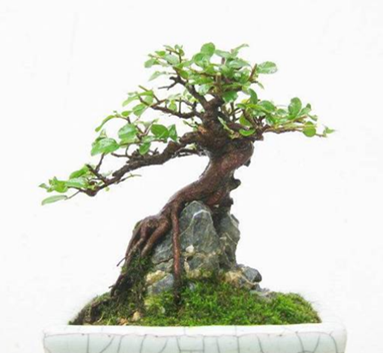
How to correctly cultivate Sageretia bonsai
The roots and trunk of Sageretia bonsai are unusual, and the tree has a vigorous, ancient and elegant appearance, making it very suitable for ornamental use.
1. Watering Sageretia bonsai
Sageretia bonsai is suitable for growing in a humid environment. During the growing season, the pot soil should be kept moist, but water must not accumulate, as this easily causes root rot. In hot summer weather, water more, and also spray some water on the leaves and trunk to lower the temperature and increase moisture. In winter, reduce watering.
2. Light for Sageretia bonsai
Sageretia bonsai likes light but is not cold-tolerant, and should be kept in a well-ventilated, humid environment. In summer, provide appropriate shade and avoid direct exposure to the sun.
3. Temperature for Sageretia bonsai
Sageretia bonsai fears severe cold. In the northern regions of China, after late autumn it should be moved indoors for care, ensuring the indoor temperature stays above 8°C. In the southern regions of China, in winter it can be placed in a wind-sheltered, sunny spot to overwinter.
4. Fertilizing Sageretia bonsai
During the growing season of Sageretia bonsai, apply a diluted cake fertilizer liquid and manure liquid once every half month. No fertilization management is needed in summer and winter.
5. Repotting Sageretia bonsai
Sageretia bonsai should be repotted once every 2-3 years, with repotting time in February-March when buds sprout. Part of the old soil should be replaced. While repotting, some base fertilizer can be added, and corresponding root-raising treatment can also be carried out.
6. Pest and disease prevention for Sageretia bonsai
Sageretia bonsai is susceptible to damage from leaf roller moths, longhorn beetles, scale insects, aphids, and others. It can be prevented and controlled by spraying phosalone emulsion and omethoate emulsifiable concentrate. The most direct method is manual washing and removal, and applying lime sulfur mixture for control.
How Sageretia bonsai overwinters
Sageretia bonsai is not cold-tolerant. How should it be cared for in winter? Especially in the northern regions of China, how can we ensure Sageretia bonsai overwinters safely?
1. Watering Sageretia bonsai in winter
In winter, watering of Sageretia bonsai should be controlled. Natural water is best, such as river water and rainwater. If tap water is used, store it for one or two days to let the chlorine dissipate, keep the water temperature close to the indoor temperature, and then water. In winter, Sageretia bonsai enters dormancy and has a low demand for water, so watering appropriately is enough.
2. Temperature for Sageretia bonsai in winter
Sageretia bonsai is not cold-tolerant in winter and should be kept indoors for care, especially in the northern regions of China, where it should be kept in a place with good indoor light. If kept outdoors, it should be wrapped in plastic film, and every two days at noon when the temperature is higher, the film can be uncovered to let the Sageretia breathe.
3. Humidity for Sageretia bonsai in winter
Sageretia bonsai likes a humid environment. It is best to keep the relative air humidity at 70~80%. If the relative air humidity is too low, the lower leaves turn yellow and fall off, and the upper leaves lose their luster. In the northern regions of China, indoor heating is used in winter, making the room rather dry, so water should be sprayed on the leaves to maintain environmental humidity.
4. Light for Sageretia bonsai in winter
In winter, keep sunlight abundant in winter and place Sageretia bonsai in a place with good light as much as possible, such as the living room, bedroom, study, balcony, and other places. After keeping it indoors for a period, move it outdoors to a shaded place for a period, and then move it back indoors.
5. Fertilizing Sageretia bonsai in winter
During the winter dormant period, the growth of Sageretia bonsai basically stagnates, its demand for fertilizer is low, and no fertilization is needed.
Sageretia bonsai care knowledge and a complete collection of making pictures
Since ancient times, because of people's reverence for and closeness to nature, people have always held special feelings for the various plants created by nature. In recent years, with the popularity of plant decoration in home life, various plant bonsai have attracted great attention from more people. Sageretia bonsai has long been one of the very famous bonsai in China since ancient times and is known as one of the "Seven Sages." So how should Sageretia bonsai be cared for? Below let us take a look at pictures of making Sageretia bonsai and learn about Sageretia bonsai care knowledge.
Sageretia bonsai care knowledge
1. Soil: Sageretia is a unique tree species, and the plant usually grows in wild areas, so the plant's root system is relatively developed. If care is slightly improper, problems easily arise. Therefore, for the soil it is best to choose acidic or neutral calcareous soil. During cultivation, a little more soil can be placed appropriately, and new soil needs to be replaced once every two days.
2. Temperature: Sageretia actually does not have particularly high requirements for temperature, but the plant's cold tolerance is truly relatively poor, so in winter when cultivating the bonsai it needs to be placed in a mild indoor place, and attention should be paid to keeping it warm.
3. Light: Sageretia likes a semi-shaded light environment, but the plant also needs sufficient light to grow more healthily. However, in summer when the light is intense, the bonsai still needs at least about 50 percent shade. A place with good indoor light is a place where the plant bonsai can be placed, but in winter it can be exposed to more sunlight.
4. Watering: Plants need sufficient water to grow normally. For Sageretia bonsai, natural water such as drinking water or rainwater is generally best. If only tap water is available, it needs to be sealed and stored for one day before watering.
5. Fertilizing: Fertilizing Sageretia is very particular. If the fertility is too strong, the plant will grow excessive branches and leaves; if the fertility is insufficient, the plant will become weak and turn yellow. Therefore, fertilizing needs to be carefully controlled. In spring and summer, the plant needs more fertilizer; entering autumn, fertilizer should be appropriately reduced; and after winter arrives, fertilization should be stopped.
6. Pruning: Since Sageretia bonsai is a bonsai, its ornamental value is very important. Therefore, in order to maintain the beautiful shape of the bonsai, pruning work needs to be carried out at all times, thinning out excessive and withered yellow branches and leaves.
Appreciation of Sageretia bonsai making pictures
1. Sageretia bonsai picture one
Sageretia bonsai is a very elegant plant bonsai, and like most plant bonsai, its shapes and styles are diverse. But most Sageretia bonsai look very ancient, elegant, and natural. The emerald green leaves sway gently in the wind on the thick branches, and the bonsai is natural, comfortable, and very beautiful. In fact, most bonsai have a natural flavor, but this kind of Sageretia bonsai gives people a particularly rich sense of greenery, probably because the plant is green all over, very natural and comfortable.
2. Sageretia bonsai picture two
Sageretia bonsai is beautiful and approachable; looking at the bonsai, one can tell that the bonsai is natural and comfortable. Nowadays people emphasize light renovation and heavy decoration. This kind of bonsai is not only antique and elegant in shape, but also full of the vitality unique to plants, making this bonsai more decorative than many plants can compare with. Thus, when Sageretia bonsai is placed indoors, its decorative effect is very unexpected. In addition, the trunk of Sageretia bonsai is naturally unusual, and the bonsai plant's tree form is vigorous, ancient, and elegant. It is indeed a very high-grade plant bonsai, and placing it indoors can elevate the grade of the room.
Summary: Sageretia bonsai is a very famous bonsai in China, and since ancient times its bonsai has always been deeply loved by people, so if you like it, you might as well grow some.
How to grow potted Chinese rose and its cultivation methods
Chinese rose is a flower that can bloom all year round. Its flower colors include red, pink, white, yellow, and others. It is a plant with high ornamental value. The place of origin of Chinese rose is China. Its flowers are elegant and beautiful, with diverse colors, blooming in all four seasons, and deeply loved by people. It is one of the ten famous flowers of China. Today, let us look at how to grow potted Chinese rose and what its cultivation methods are.
Introduction to Chinese rose
Chinese rose is called the queen of flowers. It is an evergreen or semi-evergreen low shrub that blooms in all four seasons. Its flower colors include red, pink, yellow, white, and other different colors. It can be used as an ornamental plant and is also a plant with medicinal value. The flowering period of Chinese rose is from August to April of the following year. The flowers are large, spreading from the inside outward, and have a rich fragrance. Chinese rose has very strong adaptability and is relatively cold-tolerant. It can be planted either in the ground or in pots.
How to grow potted Chinese rose
When growing Chinese rose in pots, the flowerpot used for cultivation is relatively important. Generally, the size of the flowerpot for planting Chinese rose should match the size of the plant. The flowerpot must not be too small. When the Chinese rose plant grows until the roots and stems fill the flowerpot, the flowerpot should be replaced in time to satisfy the continued development of its roots and stems. During the planting period, Chinese rose should be kept in sufficient light and with air circulation. When the temperature is relatively high, certain shading treatment should be carried out. Especially in summer when it is hot and evaporation is high, potted Chinese rose should be watered every day, and in the evening sufficient water should be given. But special attention should be paid to the fact that when watering, water must not accumulate. In midsummer, fertilizer is generally not applied as a top dressing; only for robustly growing plants, apply thin fertilizer frequently, 1-2 times per week.
Soil for potted Chinese rose cultivation methods:When growing potted Chinese rose, for its soil it is best to choose sandy soil rich in humus and slightly acidic and fertile. Alkaline soil should not be used. You can also use garden soil: leaf mold: rice husk ash in a 5:3:2 ratio to make cultivation soil for growing it.
Light:Chinese rose is a light-loving plant, so during its growing season it must have sufficient sunlight, at least more than 6 hours of light every day. If the light is insufficient, it will only grow leaves and not bloom. Even if flower buds form, the flowers that open will not be brightly colored and will have no fragrance.
Watering:When watering Chinese rose, it is very particular. Be sure to follow the practice of watering when dry and stopping when wet, and not watering when not dry. Chinese rose is relatively afraid of waterlogging, so there must be no water accumulation in its pot. In summer, watering once a day at most is enough; water when the surface of the pot soil turns white. During the winter dormant period, be sure to water less and keep it semi-moist.
Fertilizing:Chinese rose likes fertilizer. When growing it in pots, fertilize frequently. During its growing season, apply dilute wastewater once every ten days. No matter what fertilizer is used, do not use it excessively, to prevent fertilizer damage and harm to the seedlings. During the dormant period of Chinese rose, stop fertilizing it.
Temperature:Chinese rose is a plant that likes a cool and warm climate environment and fears high temperatures. Its best growing temperature is 18-28°C. If the temperature exceeds 32°C, its flower bud differentiation will be inhibited. Therefore, Chinese rose does not bloom in summer when the temperature is too high. Generally, only a small number bloom, and their flower colors are not as good as flowers that bloom at suitable temperatures.
Repotting:Potted Chinese rose should have its pot soil replaced once every year before new buds sprout in spring, to facilitate vigorous growth. Changing the soil helps the rose bloom that year. You can also repot, trim roots, and change soil around each overwintering period, increasing the pot diameter year by year, with clay pots being best.
Summary:The flowering period of Chinese rose is very long, making its ornamental value relatively high. When used as a potted plant, the flowers it produces are very beautiful. The above is the editor's introduction to how to grow potted Chinese rose and the cultivation methods for potted Chinese rose. After reading the editor's introduction, I believe everyone has gained some understanding. You can also grow some potted Chinese roses at home. During their flowering season, they are very ornamental.
▌Related recommendations
☑Cervical pillow ☑Office carpet ☑Cartoon wallpaper ☑Magnetic paper-cutting ☑Chinese hackberry bonsai
☑Computer embroidery ☑Suzhou embroidery tutorial ☑Bonsai appreciation ☑Sageretia bonsai☑Safety mat