How to grow Schefflera arboricola in water, and can it bloom?
Most of the Schefflera arboricola plants in growers' homes are lush and tender green, grown for their foliage all year round, and their flowers are rarely seen. Good luck does exist, but it depends on who it lands on. Although Schefflera arboricola does produce small yellow-white flowers, its value as a flowering plant is not high compared with its foliage, but it still counts as a rare and exquisite sight. So when does this plant bloom? And how is it grown in water?
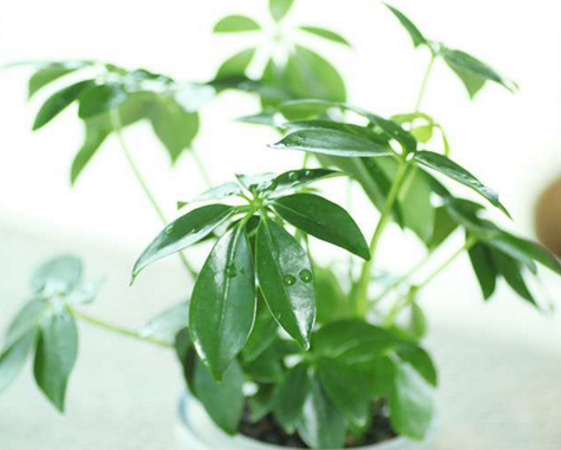
Water culture methods for Schefflera arboricola
A small pot of Schefflera arboricola at home can give everyone a natural and fresh environment, and planting it in a courtyard can also create a natural and harmonious green environment.
Water culture methods for Schefflera arboricola
Method one: water-culturing cuttings
Cut a 10 cm semi-lignified branch from the Schefflera arboricola plant, with more than 2 to 3 leafy branches, remove the lower branches and leaves, and keep only 1 to 2 palmate compound leaves. Then insert two-thirds of the branch into water and place it in a spot with plenty of sunlight.
Keep the ambient temperature above 15°C. Usually after about 10 days, white callus tissue will form at the cut, and after a few more days, adventitious roots will form.
1. Rooting of water-cultured Schefflera arboricola
After about 45 days, the water-cultured Schefflera arboricola can grow roots of about 6 cm, and at this point it can be managed normally.
Method two: root-washing water culture of soil-grown plants
Take the soil-grown Schefflera arboricola out of the soil, wash off the soil from the roots, and put the plant into a glass bottle filled with clean water (tap water needs to be left to stand for 2 to 3 days).
In the early stage of water culture, change the water once every 2 to 3 days, keep the temperature above 15°C, provide appropriate light, and add a few drops of nutrient solution to the water when changing it.
1. Growing methods for water-cultured Schefflera arboricola
Change the water in time:
Water-cultured Schefflera arboricola needs the water changed once a week, and each time you change the water, add a few drops of nutrient solution to make the roots stronger. The water level in the water culture container should not be too high, and should not cover the trunk.
Control the temperature:
The suitable growing temperature for Schefflera arboricola is 15 to 25°C, and it can also grow normally above 30°C. In winter, the temperature must not be lower than 5°C, otherwise the leaves will fall off.
2. Care methods for water-cultured Schefflera arboricola
Sufficient light:
The growth of Schefflera arboricola requires sufficient light, and abundant sunlight can make its foliage bright. But Schefflera arboricola is shade-tolerant, and can also maintain dark green leaves in partial shade. However, water-cultured Schefflera arboricola needs regular sun exposure, but in summer it needs moderate shading.
Can Schefflera arboricola bloom?
1. The flowering period of Schefflera arboricola
Schefflera arboricola is native to Guangzhou, Fujian and other places in China, where the climate is warm and humid. Most varieties bloom in November, with a flowering period of about two months. In the landscaping of Guangzhou, Fujian and other places, variegated Schefflera arboricola is often planted together with other flowers that bloom in spring and summer, which exactly fills the gap of few flowers in winter. In gardens, patches of Schefflera arboricola bloom with small white flowers, and that scene is quite beautiful.
2. What are the benefits of Schefflera arboricola blooming?
Although the flowers of Schefflera arboricola are inconspicuous, in the south, those small white flowers are the main nectar source plants for bees producing honey in winter.
The flowering period of a single Schefflera arboricola flower is not long, and it soon withers after blooming. After the petals wither, the calyx part grows into a green spherical fruit, about the size of a mung bean, and its fruit can be used as medicine.
How to grow Schefflera octophylla in water? Water culture and care tips for Schefflera octophylla
Schefflera octophylla is the famous landscaping seedling "Schefflera arboricola", whose leaf shape resembles a duck's foot, and it is evergreen all year round, with very good landscaping effects. When it blooms, the fragrance fills the air and the flowers are white. It can generally be planted in courtyards or as potted plants. Below are detailed cultivation and management tips for Schefflera octophylla, so don't miss them.
1. Water culture method
(1) Because the leaves of Schefflera octophylla are palmate and relatively large, it is advisable to choose a relatively stable round or square glass container.
(2) Take the soil-grown plant out of the pot and remove the soil, first rinse the roots with clean water, then put the root system into the water culture container, and add a small amount of carbendazim water for antiseptic disinfection to induce the growth of water roots; fix the plant in the upper part with ceramsite or gravel.
(3) After water roots grow, appropriately add diluted nutrient solution. In summer, add water once every 4-5 days; in winter, add clean water once every 10 to 20 days, and change the nutrient solution once a month.
2. Care guide
(1) Light. Schefflera octophylla is a light-loving plant and can grow under full sun, half sun or partial shade. But the intensity of light will affect the color of the leaves. In strong light the leaf color tends to be lighter, while in partial shade the leaf color is dark green.
(2) Temperature. Schefflera octophylla is suitable for survival in a warm, humid, semi-shaded environment. The suitable growing temperature is 15-30°C, and the minimum winter temperature should not be lower than 5°C. The relative air humidity is 50%-70: when the relative air humidity is too low, the lower leaves turn yellow and fall off, while the upper leaves lose their luster.
(3) Pruning. Schefflera octophylla grows relatively slowly and is prone to sprouting side branches and leggy branches, so it still needs to be pruned well.
(4) Pest and disease control. There are relatively few diseases, and the main pests are red spiders and scale insects.
Schefflera octophylla is a very good landscaping seedling. It can effectively absorb nicotine or harmful gases indoors, and it can be grown in water or in soil. The planting method is simple, and you only need to pay attention to light and temperature. The above are detailed cultivation methods, so you can take a look.
Water culture techniques for flowers
Soilless cultivation method for Pachira aquatica
Pachira aquatica has a graceful posture, a majestic leaf crown and emerald green leaves. Placed in a family living room, it is both elegant and generous, and also very likable.
Pachira aquatica is a perennial evergreen shrub, native to the Malay Peninsula and the South Sea Islands. In recent years, through cultivation and selection, it has widely entered urban and rural households in China. For home cultivation, according to its living habits of liking high temperature and high humidity, and not tolerating frost or dryness, you should focus on grasping the following four points:
First, pay attention to sunlight. Pachira aquatica likes high temperature, humidity and sunlight, and cannot be shaded for a long time. Therefore, during care and management, it should be placed in a place with sufficient indoor sunlight. When placing it, the leaf surface must face the sunlight. Otherwise, because the leaves tend to grow toward the light, the entire branches and leaves will twist. In addition, every 3 to 5 days, spray water on the leaves once with a spray bottle. This not only helps photosynthesis proceed, but also makes the branches and leaves look more beautiful.
Water culture method for Catharanthus roseus
Apocynaceae, Catharanthus genus, also known as five-petal plum.
Biological characteristics: Catharanthus roseus is native to eastern Africa. It likes a warm, slightly dry and sunny environment. The suitable growing temperature is 18-24°C from March to July, and 13-18°C from September to March of the following year. The winter temperature should not be lower than 10°C.
Catharanthus roseus dislikes moisture and fears waterlogging, so the pot soil should not be watered too much, as excessive moisture affects growth and development. Especially for plants overwintering indoors, watering should be strictly controlled, and it is better to keep them dry, otherwise they are very easily damaged by cold. For open-field cultivation, during heavy summer showers, pay attention to timely drainage to avoid waterlogging causing the whole patch to die.
Catharanthus roseus is a light-loving plant. During the growing period, it must have sufficient sunlight, so the leaves are dark green and glossy and the flower colors are vivid. If it grows in a shaded place for a long time, the leaves turn yellow and fall off.
It is suitable for fertile and well-drained loam, and tolerates poor soil, but must absolutely avoid alkaline soil. Compacted clay soil with poor aeration results in poor plant growth, yellow leaves and no flowering.
Propagation methods: commonly by sowing, cuttings and propagation.
Cultivation management: When the seedlings have 3 pairs of true leaves, transplant them into 10 cm pots, with 3 plants per pot. When the seedlings are 7-8 cm tall, pinch once, and then pinch 2 more times to encourage more branching and more flowering. During the growing period, fertilize once every half month, or use 15-15-30 "Huiyou" special fertilizer for pot flowers. For potted plants or flowerbed planting after being removed from pots, flowering lasts from late May to early November, more than 5 months. During the flowering period, remove spent flowers at any time to prevent them from becoming moldy and affecting plant growth and ornamental value. August to October is the seed collection period for Catharanthus roseus, and seeds should be collected as they ripen to avoid seed loss.
Pest and disease control: There are often leaf rot, rust and root-knot nematode damage. For leaf rot, spray with 500 times liquid of 65% zineb wettable powder. For rust, spray with 2000 times liquid of 50% carboxin wettable powder. For root-knot nematodes, spray with 50 times liquid of 80% dichloropropane emulsifiable concentrate for control.
Water culture method for Euphorbia tirucalli
Euphorbiaceae, Euphorbia genus, also known as triangle milkbush. Native to South Africa.
Characteristics
Euphorbia tirucalli is a perennial succulent plant. The stem is upright, with 3 to 4 ridges, dark green, and the center of the stem has irregular beautiful gray-green markings. The ridge edges have tooth-like protrusions, and obovate leaves grow at the protrusions. There are many branches, all growing vertically upward, forming a unique plant shape. The whole plant contains irritating milky sap. Euphorbia tirucalli has a strange shape and rich exotic flavor, and is a fine choice for table landscaping decoration.
Habits
Euphorbia tirucalli likes partial shade, but requires sufficient scattered light. It can tolerate a low temperature of 5 degrees. Euphorbia tirucalli likes dryness and avoids long-term moisture, yet it is very suitable for water culture conditions.
Propagation
Euphorbia tirucalli is usually propagated by cuttings. From May to September, take side branches of about 10 cm from the mother plant as cuttings. The cut cuttings should not be inserted immediately, as immediate insertion will cause the cut to rot and lead to failure of the cutting. The cut of Euphorbia tirucalli will exude milky sap, so when cutting it should be dipped in plant ash or carbon powder, and dried in a cool place for several days. After the cut is fully dry, carry out the cutting, and it roots very easily.
Key points for water culture and care
1: If scale insects appear, besides moving it to a ventilated and well-lit place, you can brush off the scale insects with a toothbrush and then spray with 250 times liquid of washing powder to kill them.
2: The white milky sap in the stem of Euphorbia tirucalli is toxic. Be especially careful not to get it into your eyes.
Methods for obtaining water culture materials
Cuttings and root washing. The cut branches should first be dried in a cool and ventilated place for several days, and only after the cut is dry should they be inserted into water, otherwise they will rot. After one month, new roots can grow.
Water culture method for Reineckea carnea
Reineckea carnea, also known as Guanyin grass, is a perennial evergreen herbaceous plant of the Liliaceae family, Reineckea genus. The leaves are clustered, broadly linear, with the midrib sunken and the tip gradually pointed, 15 to 40 cm long; the stem is creeping and rhizomatous, rooting at the nodes; the flowering period is September to October, the flowers are light purple, upright, in terminal spikes about 6 cm long; the fruit is bright red and spherical; it is native to the southwestern region of China, likes a warm and humid environment, is relatively cold-tolerant and shade-tolerant, has low soil requirements and strong adaptability. Because Reineckea carnea has a graceful plant shape and verdant leaves, if we use its growth habits of cold tolerance and shade tolerance, put it into various goldfish tanks or other glass vessels for water culture, and then place it on a bar counter or coffee table, then there is water in the tank, stones in the water, roots among the stones, clear and mutually visible, it can serve as a kind of exquisite and elegant artwork. Below are the cultivation methods.
1. Material selection. Select plants with dark green leaves, vigorous growth and no pests or diseases, carefully dig them out of the soil with a shovel, and wash the roots clean. During digging, be careful to dig as deep as possible and bring as much soil as possible. The purpose of doing this is twofold: first, to avoid damaging the roots, which is beneficial for growth in water culture; second, because water is transparent, complete roots can display a unique beauty in the water.
2. Pressing stones. Choose pebbles or Yuhua stones used for paving garden paths, wash them clean, first spread a layer on the bottom of the glass jar, place Reineckea carnea upright on the stones, then press its roots firmly with stones so it does not fall over, and pour clean water into the glass vessel until the entire root system is submerged. The transparency of the water determines that pressing stones should also involve certain aesthetic techniques, and the grower can design through their own creativity to highlight individuality.
3. Management. Because the roots of Reineckea carnea are soaked in water for a long time, the water easily develops an odor over time, so the water should be changed frequently, preferably once a week. As for fertilizing, regularly drip a few drops of nutrient solution or potassium dihydrogen phosphate solution. Reineckea carnea is relatively shade-tolerant, and 1 to 2 hours of fluorescent lamp exposure every night can meet its photosynthesis needs.
Water culture method for Cyclamen
Selecting Cyclamen and container selection. Choose 1-year-old to 3-year-old Cyclamen plants that are free of pests and diseases, growing vigorously, and with buds about to open. Plants grown in soilless culture media such as perlite, vermiculite, sawdust and other media are best, as after a change of environment they do not damage roots, do not need to recover from transplanting, and adapt quickly. The water culture container is simple and economical, and in daily life can serve to reuse waste. Any container that can hold water, such as a fish tank, teacup, beverage box, wine bottle or vase, is fine; transparent containers are best, as roots, stems, leaves, flowers and fruits can all be fully viewed. No matter what container is used, its size, height and color must be coordinated with the Cyclamen plant, so that the exquisite, crystal-clear and elegant charm of water-cultured Cyclamen can be shown.
Water culture time and method. The flowering period of Cyclamen is generally from October to June of the following year, so the water culture time is generally from September to April of the following year. Take the selected Cyclamen plant out of the pot, wash the medium attached to the roots with 20°C warm water, and be careful not to damage the roots. Then put it directly into a previously prepared container. The water depth should be level with the root zone, and at most must not exceed 1/3 of the corm, to avoid corm rot. Finally place it in a suitable indoor position, regularly add water and nutrient solution. After two to three months of water culture, after the flowers fade, take the plant out and plant it in cultivation medium to spend the summer.
Water quality and water temperature. The water used for water-cultured Cyclamen is best mountain spring water or magnetized water, with clean water quality, not turbid, without sediment, and containing various trace elements necessary for plants. During the entire water culture period, there is no need to change the water. Tap water contains chlorine, which is unfavorable for flower growth, and it easily becomes turbid and forms sediment, so the water must be changed every few days, and it should be avoided as much as possible. The water temperature should be close to the indoor temperature at the time, generally 10°C to 20°C.
Light and indoor temperature. Cyclamen likes a sunny environment. The water culture container should be placed on an indoor tabletop or windowsill with sufficient sunlight, and not directly on a radiator. The most suitable indoor temperature is 15°C to 20°C, preferably not higher than 25°C and not lower than 10°C. Adding nutrient solution. Water-cultured Cyclamen also needs regular nutrient supplementation during the flowering period. Generally every 10 days, add 50 ml per plant of 1:100 diluted flowering plant nutrient solution, and mountain spring water should also be used to prepare the nutrient solution. If yellow leaves, small leaves or small flowers are found, after ruling out root rot, an appropriate amount of additional nutrient solution may be added as needed.
Water culture of Arrhenatherum elatius
Chinese name: Libang grass
Alias: silver-edged grass
Family and genus name: Poaceae
Latin scientific name: Arrhenatherumelatius
Traits: perennial herb
Plant height: 50-100 cm tall
Flowering period: summer (June-August)
Cold resistance: cold-resistant (above -5°C)
Shade tolerance: sun-loving
Morphological characteristics: underground stems white and bead-like; aboveground stems clustered and smooth. Leaves clustered, linear-lanceolate, 30 cm long, about 1 cm wide, with yellow-white edges. Panicle with long stalks, about 50 cm, branched; spikelets with two flowers, the upper flower bisexual or female, the lower male; flowering period June-July. Native to Europe.
Habits: extremely robust, cold-resistant and drought-resistant, not selective about soil. In midsummer, the aboveground part often withers and goes dormant, then sprouts and grows again in early September.
Propagation and cultivation: usually divide once every 2-3 years, in spring from March to April or in September after dormancy when new leaves first sprout. Dig up the old plant and separate it, with each division preferably carrying 2-3 new buds, and separated together with the bead-like underground stems. Old plants should be pruned every year, the leaves should not be too long, and soil should be banked up in time when the underground stems are exposed, so the plant clump is vigorous and beautiful. In cultivation, if too much fertilizer is applied or there is excessive lack of fertilizer, the white spots on the leaves will disappear and all become green, affecting the ornamental effect.
Water culture methods for Schefflera arboricola~~~~~
Dracaena water culture: plants for water culture of Dracaena can be obtained by referring to the propagation methods above, or directly from soil culture. The specific method is as follows:
Root-viewing water culture. One week before cultivation, sterilize and insecticide the plant, and select plants with good appearance for cultivation. If water culture is carried out according to the cuttings above (for those using soil-cultured material, remove the roots and carry out rapid propagation to promote rooting), it is best to first put the planting basket into it. Wait until the roots grow 5—6 cm long and have not returned to land, then put them into the mutation pool for mutation. At the beginning, the nutrient solution concentration should be lower. After the plant adapts to the aquatic growth environment, the concentration can be increased according to the plant, while also reducing oxygen enrichment, and finally stopping oxygen enrichment. When the roots have grown enough to be bottled, they can be put into bottles.
Ceramsite planting: before potting, root promotion is the same as for water culture. When potting, do not plant the plant too low, as that is not good for the plant's later growth. When the plant's root system grows out of the inner planting pot, it can be sold.
During the production period, apply a fungicide once a week and spray foliar fertilizer once. For home care, in addition to referring to the product instructions, you should also follow its growth habits, stop fertilizing during the dormant season, and place it in a place with strong sunlight. For ceramsite planting, use less water in winter and early spring. If it is placed in a dark place for too long, the leaves turn yellow and lack vitality, and moreover the tips of the basal leaves easily turn black, as if scalded by boiling water. Do not lack water during the growing season.
Dracaena marginata tricolor alias: three-color edged dragon tree, rainbow dragon tree, striped cordyline
Family and genus: Agavaceae, Dracaena genus
Morphological characteristics: evergreen small tree. Stem slender, upright and straight, up to 3 m tall. Leaves 15-60 cm long, 1-2 cm wide, sword-shaped. The green leaves have milky white, yellow-white and red stripes. It is a unique variety in the Dracaena genus.
Distribution and habits: native to Madagascar.
Likes a warm, humid environment with bright scattered light. Relatively shade-tolerant, avoid direct strong light. The suitable growing temperature is 18-28 degrees. The overwintering temperature needs to be above 10 degrees.
Propagation method: cuttings
Key points for water culture:
1) Water culture by the water-cutting method roots easily, and the water roots are white and highly ornamental. Changing the water is the key to success. Especially just after inserting, changing the water once every other day can increase its nutrient content, until the root system grows. After it adapts to water culture, you can change or add water once a week or once a month according to the season.
2) When the water temperature is above 35 degrees in summer, the root system easily rots. At this time, stop using nutrient solution and only use clean water for cultivation, and increase the frequency of water changes to keep the water clear.
3) Place it in a bright indoor position. Generally, change the water once a month in autumn and winter. If using a transparent container for water culture, while changing the water, wipe off the substances attached to the vessel with a soft cloth to make it transparent, so that the beauty of the plant's root system can be better displayed. After changing the water, you can drip a few drops of commercially sold nutrient solution into the water or add some potassium dihydrogen phosphate diluted 1000 times, so as to supply the nutrients needed for plant growth. If foliar fertilizer or 1000 times potassium dihydrogen phosphate is sprayed as a foliar topdressing during the growing season, it can make it grow thicker and stronger.
Can remove: toluene, xylene, benzene, trichloroethylene, formaldehyde
Water culture method for Sansevieria
Sansevieria is a perennial herb with creeping rhizomes. Leaves clustered, often 2-6 in a bundle, leaves upright, leathery, thick, with a short tip at the apex, dark green, with light gray-green horizontal stripes, named because the markings resemble tiger skin. Up to 80 cm tall, 3-7 cm wide. Blooms in spring and summer, spike inflorescence, small flowers 3-8 in a bundle, white or light green, fragrant.
Sansevieria likes a warm climate. The suitable growing temperature is 20-30 degrees. It is not cold-tolerant. Below 13 degrees it stops growing. The overwintering temperature should not be lower than 8 degrees. When the temperature is too low, it often rots from the base, causing the death of the entire plant.
Sansevieria likes light, but in summer it should be protected from scorching sun. It is very shade-tolerant and can be displayed in a shaded place for a long time.
Sansevieria is a desert plant and can endure harsh environmental conditions.
Propagation is usually by division. Division is usually carried out in spring and autumn together with repotting. Take the plant out of the pot and separate the daughter shoots from the mother plant with a sharp knife, trying to avoid damaging the root system, and let the separated daughter shoots carry as many roots as possible. After separation, the daughter shoots should be placed in a dark indoor place, protected from rain, and watering should be controlled to avoid rot at the cut. Only after new leaves grow can they be transferred to normal care.
For mass propagation of Sansevieria, cuttings can be used. Cuttings are carried out from May to July. Select healthy and plump leaves, cut them into small sections 5-7 cm long, or use whole leaves for cuttings. The cut leaves should be placed in a dry and cool place for several days. After the cut is dry, insert them straight or obliquely into the medium, with the insertion depth being 1/3 or 1/2 of the section length. After inserting, water thoroughly once. When cutting, remember the upper and lower positions of the cuttings, because if inserted upside down they will not root. Under conditions of 15-20 degrees, after about one month they will root from the base or grow rhizomes, and gradually grow into new plants. When the small seedlings grow 2-3 leaves, they can be potted for final planting.
Do not add too much water and soak all the roots. Let a small section of root be exposed above the water surface so it can absorb oxygen. After water roots have grown, you can add a little less nutrient solution~~~~In summer, change the water once every three or four days; in winter, once every six or seven days~~~depending on how cloudy the water is~~~~~~~Generally woody flowers are harder to grow in water, so you must be patient~~~~~~~~
Key points for water culture of Hydrangea macrophylla
Scientific name: Hydrangeamacrophylla
Aliases: hydrangea, douqiu, shade hydrangea, grass hydrangea, ziyang flower
Family and genus: Saxifragaceae, Hydrangea genus
Plant characteristics: Hydrangea macrophylla is native to the Yangtze River basin and provinces to the south in China. The natural plant height is 1 to 2 m, and the potted height is mostly controlled at 30 to 50 cm. Leaves opposite, obovate or elliptical, with serrated edges. Corymb terminal, 20 cm in diameter, nearly spherical, with few and small sexual flowers, and many and large asexual flowers. Flower color varies, initially white, gradually turning blue or pink. The natural flowering period is from May to July. It is a deciduous small shrub with emerald green leaves, vivid flower colors and a long ornamental period, and is deeply loved by people.
Ecological habits: Hydrangea macrophylla likes a warm and humid environment. The suitable growing temperature is 18°C to 28°C, and in winter not lower than 5°C. Light should be partial shade; if too strong, the leaves will be scorched and curl at the edges. It likes loose and fertile soil and has a large water requirement, but avoids waterlogging, and has strong resistance to harmful gases such as sulfur dioxide.
Common cultivated varieties: Hydrangea macrophylla (V. hortensica): all flowers are sterile, sepals ovate. Blue-edged hydrangea (V. coerulea Wils): flowers bisexual, deep blue, marginal flowers blue or white. Ziyang flower (V. otaksa Bailey): flowers sterile, inflorescence large, diameter up to 20 cm, leaves thick, spherical inflorescence, blue or pale red, mostly used in gardens. Silver hydrangea (V. maculata Wils): both fertile and sterile flowers, leaves relatively narrow and small, margins white, grown for foliage display.
Propagation methods: Hydrangea can be propagated by division, layering, cuttings and other methods.
In a greenhouse, cuttings can be taken all year round. Generally in May to June, in combination with early spring pruning and post-bloom shaping. Select semi-lignified branches free of pests and diseases, each section 10 to 15 cm long, retain 2 to 3 nodes and 1 to 2 leaves at the top, insert into a seedbed with river sand or vermiculite as substrate, and shade appropriately. Keep the substrate moist, air humidity above 80%, rooting begins in about 18 days. Afterwards gradually reduce the frequency of misting, increase light, and transplant in about 1 month.
Cultivation management: After the cutting seedlings root, they should be potted promptly. Hydrangea likes loose, fertile, well-drained soil, usually prepared with leaf mold, garden soil, and organic fertilizer in a 4:4:2 ratio; for large-scale production, it is advisable to use peat, perlite, and organic fertilizer in a 6:2:2 ratio, and disinfect thoroughly before use.
Fertilization: Hydrangea likes fertilizer; generally apply organic fertilizer once every half month. In the early growth stage, more nitrogen fertilizer is needed; during flower bud differentiation and bud formation, more phosphorus and potassium fertilizer is needed. You can also spray the leaves with 0.1% to 0.2% monopotassium phosphate 2 to 3 times; stop fertilizing after the buds show color.
Watering: The leaves of hydrangea transpire heavily, so it must be watered promptly; even a short period of water deficiency and wilting can cause dry leaf margins and necrotic flowers. Especially in summer, shading and cooling must be used to reduce transpiration, and air humidity above 60% must be maintained. In addition, hydrangea flower color is affected by soil pH; it is usually blue in an acidic environment and red in an alkaline environment. Therefore, the pH of the water should be determined according to the desired flower color.
Temperature: Hydrangea is not tolerant of high temperatures and requires a temperature between 15°C and 25°C. High temperatures will make the plant dwarfed and the flower color faded, reducing quality. After the buds show color, keep the temperature at 10°C to 12°C to improve flower color and help preserve freshness.
Light: Hydrangea is shade-tolerant; direct sunlight can cause sunscald, so shading is needed. Usually 60% shading is needed during the growing period; after the inflorescence shows color, appropriate shading is also needed to avoid the flower color fading and losing luster.
Pruning: Hydrangea has strong sprouting ability, and many vegetative branches will sprout from the base of the plant; to reduce nutrient consumption, they should be removed promptly. If old branches need to be replaced, vigorous vegetative branches can be selected as reserve branches. After flowering, cut back promptly, retaining 2 to 3 vigorous buds to promote new branches.
Flowering regulation: To make hydrangea bloom at Spring Festival, select vigorous 3- to 5-year-old plants, treat at low temperature of 2°C to 4°C for 14 days, then move into a greenhouse for heating, maintain 10°C to 20°C, and they can bloom in 50 to 60 days. Pay attention to frequent ventilation, maintain good light conditions and relatively high air humidity, and apply organic liquid fertilizer once every half month until flowering.
Pest and disease control: Hydrangea has few insect pests, mostly aphids, spider mites, etc., which can be controlled by spraying systemic pesticides while ensuring good ventilation. Common diseases are mostly leaf diseases, such as white rot, gray mold, leaf spot, etc., so pesticides should be sprayed regularly for prevention; after symptoms are found, pesticides should be sprayed promptly, and severely diseased leaves can be removed and burned.
Introduction to Jade Plant
[Aliases] Jingtian tree, Swallow's palm, Emerald tree, Leaf of life.
[Scientific name] Crassula arborescens
[Family and genus] Crassulaceae, Crassula.
[Morphology] Evergreen succulent plant, plant height 45-75 cm, stem semi-lignified. Leaves simple, opposite, thick and fleshy, broadly elliptic, entire, 3-5 cm long, 1-3 cm wide, leaf color deep green, glossy; after exposure to light, the leaf margins turn red. Horticultural varieties include variegated-leaf and colorful-leaf types.
[Habits] Native to South Africa. Likes warmth, tolerant of drought, likes light, also tolerant of semi-shade, grows best under bright scattered light. Likes fertile, loose, well-drained and breathable sandy loam.
[Propagation] Cutting propagation. Both stem cuttings and leaf cuttings root easily, and water propagation can also survive. The cutting time is from May to September; take a 5-10 cm branch or 1 leaf, insert into plain sandy soil, pay attention to moisture retention, and roots can develop after one week.
[Cultivation] Use 2 parts garden soil, 1 part leaf mold, plus an appropriate amount of river sand to make the potting mix. After potting, water the small seedlings thoroughly, place in a shaded place, and after they survive, place in a bright place, avoiding direct sunlight. In summer, pay attention to coolness and ventilation. To make the plant shape full and compact, fertilizer and water should not be too heavy at ordinary times, and the potting soil should alternate between dry and moist. In late autumn, bring indoors for warmth, and room temperature should be above 7°C. In winter, watering should not be excessive. Repot and change the soil once every spring.
Although the jade plant is easy to propagate, easy to grow, and easy to manage, it is still common to see jade plants on some residents' balconies looking elegant in spring, summer, and autumn, but once winter passes they become wilted and faded, and may even become a "plucked chicken." This is mainly because growers only see the easy-to-grow side of the jade plant and ignore its fragile side. After entering severe cold, they still place it on an open balcony and let it suffer from cold wind and freezing, causing the jade plant to suffer freeze damage. After freeze damage, the fleshy leaves and tender stems of the jade plant begin to show wounds as if scalded by boiling water, then gradually soften, shrivel, and finally fall off; in severe cases, only the bare main stem remains.
Therefore, doing a good job of overwintering potted jade plants on balconies is very important, and the following key points should be mainly grasped:
1. Move the pot indoors in time. After entering winter, move the jade plant indoors for warmth where 7°C to 10°C can be maintained. On warmer days, at noon you can move the jade plant to the balcony to let it bask in the sun, and still move it indoors at night.
2. Control the dryness and moisture of the potting soil. In winter, the potting soil should be mainly slightly dry, and timely fine misting should be used to replenish water on the leaf surface. Under normal circumstances, there is no need to water the potting soil directly.
3. Move into a warm shed for warmth. If conditions permit, the pot can be moved into a warm shed; if not, a plastic film cover can also be used, but attention must be paid to the humidity inside the cover. If excessive moisture is found, uncover and ventilate promptly to prevent leaf rot.
4. If the jade plant has already suffered freeze damage due to earlier mistakes in cold protection measures, do not easily discard the plant. As long as the freeze-killed leaves and tender branches are removed and the plump main stem is preserved, and appropriate fertilizer is applied in the coming spring, new branches and new leaves can still sprout from the main stem. Generally, after 1 to 2 years of cultivation, it can develop into a perfect jade plant again.
Jade plant water culture:
You can choose to take branches from the mother jade plant in spring, summer, or autumn for cuttings; one week before cutting, sterilize, disinfect, and kill insects. After the branches are cut, keep the substrate at a certain humidity; at the beginning, misting and shading are needed. After the callus tissue grows below, reduce misting or stop misting, otherwise it is easy for leaves to drop and rot. After the roots grow 2-3 cm, they can be placed on a water culture seedling bed for water culture root induction.
[Uses] Indoor decoration, suitable for embellishing halls. Appendix: A foliage plant of the same genus, Swallow's palm, alias thick-leaved sedum (Crassula portulacea), leaves obovate, cultivation method the same as jade plant.
It can also be grown in water culture without nutrient solution~~~ For example, spider plants grow very well without nutrient solution~ You can also put two compound fertilizer granules in~~~~~ Or soak nutrient soil in water and take the clear liquid on top, which can also be used as nutrient solution~~~~~ Nutrient solution can be bought at flower shops~~~~~~~~~~
Water culture of watermelon peel must be in spring and autumn; water culture in winter will definitely die. The leaves of watermelon peel are best inserted in soil; for water culture, choose ones with roots. At the beginning, change the water frequently; after roots grow, you can add nutrient solution~~~~~~~~~~~~
My parlor palm has already grown very well, thank you OP! I am a lazy person, and there is another way to reduce the number of water changes: just add 3 drops of Amway Loxin to the water. It is very effective, but each bottle has a different amount of water, so everyone should start with a small amount and figure it out slowly.
Water culture of He Shou Wu
Let me pour some cold water on this:
1. Not all flowers can be grown in water culture
2. It is not that washing the roots of originally soil-grown flowers and putting them in water is water culture, and they will all survive
3. Raising fish in the water and flower roots compete for oxygen, hurting both; fish excrement quickly deteriorates the water, easily causing root rot and fish disease, and it has only advertising effect.
4. Light passing through the glass bottle causes algae to grow, competing for oxygen and covering the surface of flower roots, suffocating the roots.
5. Fibrous roots squeeze together in the water, easily suffering from oxygen deficiency, turning black, and dying.
Water-cultured peace lily
Let me also talk about the production process of water culture products at my base:
Select superior mother plants —— remove from pots and wash roots —— cut roots or cut base —— disinfect and root treatment —— plant in planting cups (expanded clay planting) —— root induction in rooting bed —— induction in water culture bed —— hardening off for sale (management during this period is computer-assisted management)
True water-cultured flowers are not as simple as washing roots and soaking them in water. The cultivation process of water-cultured flowers is a very complex process, requiring a series of steps such as washing roots---trimming roots----disinfecting----planting----root induction----root attraction, and the time required ranges from ten or twenty days to half a year.