Fuchsia pinching methods and four-season care tips
Fuchsia requires different temperatures in different seasons. In summer, when the temperature reaches 30°C, growth becomes extremely slow, and at 35°C large numbers wither and die. In winter, the temperature should not drop below 5°C; if it falls below 5°C, the plant is prone to cold damage. Therefore, growing this plant requires special attention in both summer and winter. Let us take a look at how to pinch fuchsia and how to care for it through the four seasons.
How to pinch fuchsia
1. Timing for pinching fuchsia
Fuchsia needs to be pinched at the right time, which is an important measure to promote abundant flowers and lush foliage. The timing for pinching fuchsia is generally in spring and autumn. At this time, you can top and pinch the fuchsia plant, and it will branch more, with a fuller plant shape and more flowers as well.
This is because fuchsia has the habit of forming flower buds in the leaf axils of new branches, and pinching can encourage it to grow more flowering branches and sprout more buds.
Pinching is an important way to make fuchsia bloom more. Pinching multiple times can also extend the flowering period of fuchsia.
2. Pinching fuchsia at each stage
Actually, although fuchsia can be pinched in spring and autumn, this still depends on the growth of the plant.
Generally, fuchsia should be pinched starting from the seedling stage. When the young seedling grows to about 10 cm, the first pinching can be done, which encourages it to sprout new branches. Usually after pinching, once the new branches grow about 8 leaves, the second pinching can be done, keeping about 5 side branches and removing the excess buds.
3. Precautions for pinching fuchsia
When pinching fuchsia, the first thing to note is that pinching during the growing period is meant to give it a good plant shape and more branches.
Pruning in autumn is mainly for fine-tuning the shape, cutting off overly long branches and thinning out overly dense branches, which promotes branch growth.
After pruning fuchsia, you need to control watering, and wait until new branches grow before watering again.
How to care for fuchsia through the four seasons
Fuchsia has a very long flowering period. Place it in a spot with light for viewing, or set it on a windowsill, tea table, or flower stand. However, the placement and methods differ slightly from season to season.
1. Spring care methods for fuchsia
In spring, place fuchsia on a balcony facing south, east, or west.
In spring, when the temperature is 20°C, you can sow seeds. After sowing, when the young seedlings grow 4 leaves, they can be transplanted into flower pots with a diameter of 9 cm. The potting soil is best chosen as soil rich in humus. After potting, water thoroughly, place in a shady spot, let the seedlings recover for 1 week, then gradually expose them to light.
In early spring, let it receive sufficient light; around midday in late spring, provide shade. Watering should also follow the principle of watering when dry and stopping when wet. 5-10 days after potting, apply dilute liquid fertilizer 2 times. When the young seedlings grow to 10 cm, pinch them. When the branches grow 3-4 nodes, pinch again. Keep 5-7 branches per plant. Only in this way can you ensure a full plant shape and abundant flowers.
2. Summer care methods for fuchsia
In summer, place fuchsia on a balcony facing east or north.
In early summer, the flowers have just faded. At this time, attention should be paid to timely pruning to encourage branch sprouting. From June to late September, move the flower pot to a cool, ventilated place, control watering, stop fertilizing, and frequently sprinkle water on the ground and mist the leaves to lower the temperature and increase humidity, helping it pass the summer safely. In fact, when the temperature is too high, fuchsia enters a semi-dormant state and grows slowly; as long as it is not exposed to scorching sun, it will continue to grow after summer.
3. Autumn care methods for fuchsia
In autumn, place fuchsia on a balcony facing south, east, or west.
After the beginning of autumn, let it see more scattered light in the morning and evening. After mid-autumn, gradually increase light. In late autumn, cultivate it under half-light to promote lush branches and leaves and many brightly colored flowers. In late August, prune again, cutting short dead branches, dense and sparse branches, and overly long branches, keeping only 3-5 cm of length on each side branch. After new buds sprout, select 5-7 strong buds and cut off the rest. It will bloom again between October and November.
In northern regions, it can be brought indoors in mid-October, and repotted after being brought indoors. For repotting, lift the plant out of the original pot, remove part of the old soil, cut off dead and weak branches and diseased branches, then plant it into a pot one size larger filled with new potting soil.
4. Winter care methods for fuchsia
In winter, place fuchsia on a balcony facing south or east.
Place it in a spot indoors with sufficient light, and pay attention to ventilation. Keeping the room temperature above 5°C allows it to overwinter safely. In rooms with heating equipment, keep the room temperature at 15-20°C, apply dilute fertilizer water once every half month, and keep the potting soil moist regularly; it can still continue to grow and bloom.
Four-season care methods for fuchsia: four tips to keep fuchsia blooming continuously
We once emphasized the importance of care methods in the article on fuchsia pest and disease control. Good care techniques can protect fuchsia from many diseases and pests. Usually, methods need to be adjusted continuously with seasonal changes. Below, let us learn about four-season care methods for fuchsia.
Four-season care methods for fuchsia
I. How to care for fuchsia in spring
1. Repotting and cuttings. Spring temperatures are usually between 15-25°C. This is not only the best growing period for fuchsia, but also the most suitable time for many tasks, such as cuttings, repotting, and pruning. If it is a 2-3 year old plant, spring is a good time for cutting propagation. While repotting, cut off weak branches and rotten roots.
2. Care and management. In early spring, fuchsia can receive sufficient sunlight, but it needs shade at noon. Water once every 5-10 days, following the principle of watering when dry and stopping when wet, and apply liquid fertilizer once every 15-20 days. If it is in the seedling stage, pinch in time, then keep the environment ventilated.
II. How to care for fuchsia in summer
1. Shade and cooling. In summer, avoid direct sunlight on fuchsia. You need to help it shade and cool down. You can move it to a north-facing balcony to keep the environment cool.
2. Care and management. In the four-season care methods for fuchsia, summer is a very critical period. In this season, you need to stop fertilizing, reduce watering, and prevent rain exposure to ensure that fuchsia smoothly gets through the hot summer.
III. How to care for fuchsia in autumn
1. Pruning. After the beginning of autumn, some old leaves of fuchsia will gradually turn yellow and withered, and flowers will hang on the branches after fading. At this time, prune off dead branches and spent flowers to reduce nutrient loss and prepare for smooth overwintering.
2. Care and management. In the morning and evening, mainly provide scattered light. After late autumn, it can be cared for in a half-light environment. In mid-October, move fuchsia indoors, and you can also repot it at this time.
IV. How to care for fuchsia in winter
1. Keep warm. In winter, the first thing to do is keep fuchsia warm, so that the environmental temperature is at least above 5°C, avoiding frost damage to stems, leaves, and roots. If grown indoors, make sure the temperature is 15-20°C.
2. Care. In winter, there is no need to fertilize fuchsia. You can water once every half month. Just make sure the soil does not harden; there is no need to make the soil too moist. At the same time, ensure sufficient light.
Key points for four-season care of fuchsia
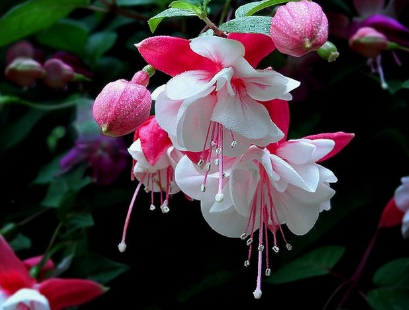
Fuchsia, also known as pendulous begonia, lantern begonia, and pendulous plum, is an evergreen subshrub of the genus Fuchsia in the family Onagraceae. Potted plants are 25-45 cm tall. Leaves are simple, opposite, or in whorls of three. Flowers are solitary at the stem tip and leaf axils, with long, drooping pedicels. There are extremely many horticultural varieties, and the plant height, calyx, petals, and other types vary greatly. Flower colors include white, pink, red, and others. Petal colors are abundant, including white, pink, pinkish red, rose red, purple, blue, and others, and there are single-petaled and double-petaled types. Common ones include Fuchsia corymbiflora, Fuchsia fulgens, and white-calyx fuchsia. When in bloom, the flowers hang one after another, like suspended colorful lanterns, graceful and lovely, making it a small flower much welcomed by the public.
Fuchsia is native to Peru, Chile, and other places. It likes cool, humid, and semi-shaded conditions. In summer, it avoids high temperature and intense heat, and fears scorching sun exposure. The most suitable temperature for growth is 10-25°C. When the temperature exceeds 30°C, it is extremely unfavorable for growth and enters a semi-dormant state. In winter, it can withstand low temperatures of 5°C. It is suitable for fertile sandy loam rich in humus with good drainage.
Fuchsia is mainly propagated by cuttings. Spring cuttings have strong vitality and are not prone to death during summer. Keep the cutting temperature at 15-20°C, with cuttings about 10 cm long. After inserting, place them in a shaded place, and they can root in about half a month.
The key points for four-season care of fuchsia are:
1. Spring: Plant surviving cuttings in small flower pots about 10-12 cm in diameter. For the pot and soil, it is suitable to mix 5 parts leaf mold, 3 parts garden soil, and 2 parts river sand evenly, and add a small amount of decomposed cake fertilizer powder as base fertilizer. After potting, water thoroughly and place in a more shaded spot for seedling recovery. After about one week, gradually expose to light. In early spring, let it receive sufficient light; around midday in late spring, provide shade. Watering should be alternately dry and wet. 5-10 days after potting, apply dilute liquid fertilizer 2 times. When the young seedlings grow to 10 cm high, pinch them. After the branches grow 3-4 nodes, pinch again. Keep 5-7 branches per plant. In this way, the plant shape is full and it blooms more.