Fuchsia Cuttage Methods and Common Varieties Introduction
Fuchsias have peculiar shapes, like little lanterns, but not every variety has the same shape. There are long-tubed ones, short-tubed ones, and the colors are not all the same either. So fuchsias also have many different varieties. Let's uncover the mysterious veil of the fuchsia together.
How to take fuchsia cuttings
1. Cutting time for fuchsias
Apart from the summer dormant period, fuchsias can be propagated by cuttings at any other time as long as the temperature is suitable, but mid-November to mid-April is the most suitable period each year. Because this period is the plant's peak growing season, you can select robust growing branches for cuttings, and since the temperature is cooler, the cuttings are less likely to rot, and the survival rate is very high.
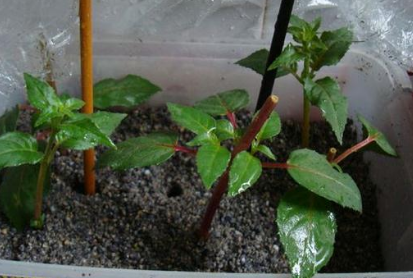
2. Selection of fuchsia cuttings
The cuttings should be selected from current-year growth, and must be ones that have not yet become woody, preferably with a tender tip. The cutting length should be 6-10 cm, and the lower leaves should be removed.
It should be noted that when taking cuttings, it is best to use sterilized scissors, and try to ensure the cut surface of the cutting is smooth; do not pinch them off directly with your hands.
3. Preparation of fuchsia cutting medium and cutting bed
The cutting medium is best made of sifted fine river sand, but it must be scalded and disinfected with boiling water. The cutting bed can be a shallow pot or a wooden box, and it should also be sprayed beforehand with a 0.1% potassium permanganate solution for disinfection. If gardening enthusiasts find this troublesome, they can directly purchase soil.
4. Fuchsia cutting method
Before cutting, first soak the cuttings in vitamin B12 for 20 minutes; the soaked branches will grow very well later.
Use a thin bamboo stick to poke a small hole in the sand, then insert the cutting into the hole, with a depth of 3 to 4 cm being appropriate, and keep a distance of about 8 cm between cuttings to facilitate potting after rooting.
After cutting, water thoroughly and cover with plastic film to retain moisture. Do not expose to strong sunlight; ordinary temperature is fine.
5. Post-cutting management of fuchsias
After cutting, the cutting bed should be placed indoors in a place with diffused light, not directly exposed to sunlight, with room temperature kept at around 20°C; only after a week can it receive some light.
Frequently spray water into the pot. If cutting in winter, spray once a day; in spring, spray once in the morning and once in the evening each day. Keep soil humidity above 80%. In winter, rooting generally takes 25 days; in spring, 20 days.
6. Potting up fuchsia seedlings
After the cuttings survive, they should be potted up promptly and planted separately in pots. Choose fertilizer-free sandy loam for the potting soil; both the pot and the cultivation soil should be disinfected, and use broken pot pieces at the bottom of the pot to make a drainage layer. Use a small bamboo shovel to gently lift the seedlings and place them in the prepared flowerpot. After positioning them upright, bury the roots well and press the soil firm with your hands. After planting the seedlings, water immediately once to let the soil naturally settle, then place them in a cool place for care. If after 3 days the leaves show no wilting, they can receive light. After one month, apply a light fertilizer once, and then normal management is fine.
What are the common varieties of fuchsias?
1. Large-flowered fuchsia
The tube is deep red, and the petals are purple, red, or white; there are many horticultural varieties.
2. Short-tubed fuchsia
The calyx tube is bright red, and the petals are purple.
3. White-calyx fuchsia
It is a cultivated hybrid. The calyx tube is white, relatively long, with recurved lobes, and the petals are red.
4. Long-tubed fuchsia
The plant height is 1-2 m, sparsely covered with soft hairs, and with tuberous stems at the lower part. The branches are somewhat succulent and reddish, and the leaves are relatively long, 10-20 cm long and 5-12 cm wide. The calyx tube is long-tubular, slender at the base, bright vermilion, 5-7.5 cm long. The petals are short, 1 cm long, and deep crimson.
5. Creeping fuchsia
The branches are slender and creeping, and the calyx tube is apricot yellow.
6. Coral red fuchsia
A clump-forming dwarf variety, with dark leaf color and large flowers; the calyx is crimson, and the corolla is violet.
7. Spherical short-tubed fuchsia
The branches are hairless and drooping, the leaf veins are red, and the pedicels are long with crimson sepals; the petals are bright blue-violet, about 1/2 the length of the calyx lobes.
8. Variegated short-tubed fuchsia
A clump-forming dwarf variety, with branches dark purplish-red. The leaves are small, in whorls of 3, ovate-lanceolate. The flowers are small and numerous; the calyx is red, with a slender short tube; the petals are blunt-tipped and shorter than the calyx lobes.
9. Reitz's short-tubed fuchsia
The branches are slender and drooping. The leaves are extremely small. The flowers are long and drooping; the calyx tube is bright red, and the petals are violet.
10. Three-leaved fuchsia
A low clump-forming shrub, 20-50 cm tall, with leaves usually in whorls of 3, the upper leaf surface green and the underside bright red-brown, with dense down on the veins. The flowers are vermilion, 4 cm long, with a long calyx tube that widens above, and the petals are very short.
Key points for home care of fuchsias: how to grow fuchsias
Fuchsia, also known as lady's eardrops, is an evergreen shrub in the genus Fuchsia of the family Onagraceae. The flowers are solitary in the leaf axils and grow drooping. The flowers are divided into single and double forms; the sepals are red, and the corolla can be purple, blue, white, rose red, pink, and other colors. Under suitable temperatures it can bloom all year round, especially most abundantly in spring and autumn. There are many varieties. Currently common ones on the market include white-calyx fuchsia, double-flowered fuchsia, narcissus fuchsia, long-tubed fuchsia, and creeping fuchsia.
Fuchsias prefer a cool, humid environment. In winter they require ample sunlight, while in summer they require a cool, ventilated, semi-shaded environment. They fear heat but are also not very cold-tolerant. Fuchsias grow vigorously in spring and autumn, and the soil should be kept moist. Along with loosening the soil, apply a fully decomposed dilute liquid fertilizer or compound fertilizer once every 7 to 10 days to provide sufficient nutrients and encourage the plant to bloom more.
In summer the plant grows slowly or stops growing, entering a dormant or semi-dormant state. It can be placed under a shaded shed with good ventilation and no direct sunlight for care. Do not water too much, and stop fertilizing. When the potting soil is dry, water with a small amount of clear water, and do not let it get rained on, so as to avoid muggy, humid conditions that cause leaves to yellow, wither, and roots to rot, or even cause plant death. After the weather cools in autumn, resume normal water and fertilizer management. After September, the soil should be kept moist, and light fertilizer should be applied frequently.
In winter, place the flowerpot indoors in a sunny place; it can overwinter safely if the temperature does not drop below 5°C. If the air is relatively dry, spray water on the plant frequently to increase air humidity, but the soil should not become waterlogged. Every year in early to mid-June and July, prune away some leaves to let the plant gradually enter dormancy. In early autumn after dormancy, cut off or shorten branches that are too long, too dense, or otherwise affecting the plant's shape, to encourage new branches.
Because fuchsia flower buds mostly form in the leaf axils of new shoots, attention should be paid to pinching during cultivation to promote the sprouting of new shoots and the formation of more flower buds, thereby achieving more blooms. Pinching can also be used to regulate the flowering period; generally, new shoots can bloom 15 to 25 days after pinching. In addition, pinching can also make the plant shape fuller and more symmetrical. Repot once every autumn; when repotting, remove 1/3 to 1/2 of the old soil and add new soil for planting. The potting soil should be fertile, loose, rich in humus, and have good drainage, such as sandy soil.
Fuchsias can be propagated by cuttings or sowing, among which cuttings are most commonly used and can be done all year round, with March to May and September to October being the most suitable. Cut current-year tender branches 7 to 10 cm long and insert them into river sand or vermiculite to half the length of the cutting; they root about half a month after insertion. You can also dip the base of the cutting in rooting powder and then grow it in water; it will root in about ten days.
Fuchsia pictures: fuchsia
Fuchsia photo albumCommon name: fuchsia
Scientific name: FuchsiahybridaVoss.
Aliases: lady's eardrops, hanging bell flower, lantern begonia
Scientific classification: Angiosperms, Dicotyledons, Myrtales, Onagraceae, Fuchsia
Introduction:
Mainly propagated by cuttings, generally cuttings are taken in January, February, and October, with a suitable cutting temperature of 15-20°C, rooting in about 20 days. Species that easily set seed can be propagated by sowing, sown in pots in a greenhouse in spring and autumn; they germinate in about 15 days and bloom the next year. During the growing period, apply liquid fertilizer once every 7-14 days. It has strong phototropism, so the pot should be turned frequently. In hot, rainy areas, attention should be paid to ventilation and cooling in summer, placing it under a shaded shed and keeping the potting soil slightly dry. Dormant plants do not need watering or fertilizing. Because fuchsias have brilliant flower colors, peculiar flower shapes, and a long flowering period, they are often grown as potted flowers for ornamental display; in cool summer areas they can be planted in the ground to arrange flower beds. There are about 100 species in the same genus, and commonly cultivated species include: white-calyx fuchsia (F. xalbacocinea); long-tubed fuchsia (F. fulgens); short-tubed fuchsia (F. magellanica); three-leaved fuchsia (F. triphylla), etc.
Origin and distribution
Native to Peru, Chile, Argentina, Bolivia, Mexico, and other Central and South American countries, and now widely cultivated.
Common varieties
There are extremely many horticultural varieties, including single and double forms, with flower colors such as white, pink, orange-yellow, rose purple, and eggplant purple. Some plants are low with spreading branches and are suitable for pot cultivation; some have thick branches with an unspreading branch cluster; there are also a few foliage varieties.
Common varieties include: 1. Large-flowered lady's eardrops; 2. Red-flowered lady's eardrops; 3. Large-leaved lady's eardrops; 4. White-calyx lady's eardrops; 5. Three-leaved lady's eardrops, etc. The plant height is 30-150 cm. The branches are slender, pink or purplish-red, and the old branches become woody. The leaves are opposite or whorled, ovate to ovate-lanceolate, with sparse teeth along the leaf margin. The flowers are borne in the leaf axils on the upper part of the branches, with long pedicels and drooping. There are extremely many horticultural varieties, including single and double forms, with flower colors such as white, pink, orange-yellow, rose purple, and eggplant purple. Some plants are low with spreading branches and are suitable for pot cultivation; some have thick branches with an unspreading branch cluster; there are also a few foliage varieties.
Morphological characteristics
A subshrub or small shrub, 30-150 cm tall, with stems nearly smooth, branches slender and slightly drooping, often pink or purplish-red, and old branches distinctly woody. Leaves are opposite or in whorls of three, ovate to ovate-lanceolate, with sparse teeth along the margin. Flowers are solitary in the leaf axils on the upper part of the branches, with long pedicels and drooping. The calyx tube is oblong, with 4 calyx lobes that are rolled back. There are 4 petals extending from the calyx tube, often connivent or slightly spreading, and some are semi-double. The calyx is tubular, especially well developed, 4-lobed, and thick in texture; there are 8 stamens extending beyond the petals. The petals can be red, white, purple, etc., and the calyx can also be red or white. The flowering period is April to July. Berry.
Ecological habits
It prefers a cool and humid environment and fears high temperatures and strong light. It is best in fertile, loose, slightly acidic loam. In winter it requires warmth and humidity, ample sunlight, and air circulation; in summer it requires dry, cool, and semi-shaded conditions. It avoids severe heat, muggy conditions, rain, and sun exposure. The suitable growth temperature is 15-25°C. In winter the temperature should not be lower than 5°C. When the summer temperature reaches 30°C, growth becomes extremely slow, and at 35°C large numbers wither and die. It is suitable for fertile sandy loam rich in humus and with good drainage.
When the temperature reaches 30°C, growth is noticeably poorer and the plant enters a semi-dormant state; above 35°C, branches and leaves wither and may even die. In winter the minimum greenhouse temperature should be kept at 10°C; at a low temperature of 5°C it is prone to cold damage. The suitable growth room temperature is 10-25°C, and it requires relatively high air humidity.
Medicinal value
In addition to its ornamental value, fuchsia is also a traditional Chinese medicinal material, with the functions of promoting blood circulation and removing blood stasis, cooling the blood, and dispelling wind. It is pungent and sour in taste and slightly cold in nature, entering the liver and pericardium meridians. Its functions are to invigorate the blood and dissipate stasis, cool the blood, and dispel wind. It mainly treats irregular menstruation, amenorrhea and abdominal masses, postpartum breast swelling, skin itching, acne, and other conditions.
Sources:
Supplement to the Materia Medica Derivations: Fuchsia is an important medicine for treating pain in the blood, and it is extremely quick at tonifying yin. It has the quality of guarding while acting alone; why is it often used in women's formulas?
Compendium of Materia Medica: Fuchsia and its root are sweet and sour and cold; the stems and leaves are somewhat bitter. It acts in the blood aspect and can remove hidden fire in the blood, so it mainly treats postpartum lactation disorders, uterine bleeding, and other diseases, as well as syndromes of blood heat generating wind.
Commentary on the Classic of Materia Medica: Zi Zang is a drastic medicine that enters the liver and moves blood, so it mainly treats women's postpartum lingering illness, as well as flooding and spotting, headache, blood blockage with heat, emaciation, and various syndromes; as for nourishing the fetus, that is definitely not suitable to its nature, and users should be cautious.
Explanation of the Materia Medica: The qi of Zi Shu is cold, and its flavor is salty first and dominant, then bitter and reducing. It is undoubtedly known to enter the blood and dissipate heat nodules. Danxi said it tonifies yin very quickly, while Binhu also said it enters the blood aspect and removes hidden fire, so it is certainly not solely for free flow. If Miao Xiyong regarded it as a drastic blood-moving medicine, perhaps he also said this based on what the Materia Medica calls treating headache and opening blood blockage? Rihua Zi says it treats heat-toxin wind, which means transforming heat-toxin wind, that is, the heat pent up in the blood transforming into toxic wind. Although its nature mainly moves, it must be able to tonify yin before it can eliminate heat-toxin wind; this is movement that is also supplementation. If one doubts that it can only move blood, then consider why this flavor is also feared by brine salt? Because eating too much salt can damage the blood; that which fears blood damage certainly is not drastic at moving blood. Danxi said it has the quality of guarding and can act alone; how could that be a baseless claim?
Venerating the Origins of the Materia Medica: Zi Zang is used in recent times as a medicine to open menstruation and induce abortion. Zhang Zhongjing's Biejia Jian Wan also uses Zi Zang to dissolve headache marks; it certainly is not a fetal-calming item. The two words "nourish the fetus" in the Classic of Materia Medica should be an error for "abort the fetus."
Encountering the Origins of the Materia Medica: Fuchsia is often used for headache, blood blockage, blood qi stabbing pain, severe wind, and malignant sores, all taking advantage of its function of dissipating bad blood.
Seeking the Truth in the Materia Medica: Whenever fire lurks in the blood in ordinary people, and there appear yang binding and blood blockage, wind itching, flooding and leukorrhea, and bearing-down pain, all caused by blood mania and blood heat, this (Chinese trumpet creeper flower) should be used for treatment, because it specifically governs purging heat, and when heat is gone the blood naturally becomes active. Therefore, in medicines for lung abscess, it is often used as the chief ingredient. If used during pregnancy and the pregnancy remains secure, that is because there is manic accumulation within, and when the mania is gone the fetus becomes secure. The statement that pregnant women should avoid taking it is out of fear that if the manic blood is already absent, reckless use may cause other problems. This is a medicine that must be used in gynecology, but it should be used according to the syndrome.
Righteousness of the Materia Medica: Fuchsia - Wu Pu says Shennong, Leigong, and Qibo all treat it as chief; Bianque says it is bitter and salty and clears the heat of the blood aspect of the eyes, so it can invigorate blood and move stagnation, and can also treat leukorrhea and flooding. The Classic of Materia Medica specifically governs women's postpartum lingering diseases, precisely because at the time of first giving birth and nursing a child, yin blood is already deficient and solitary yang is relatively abundant. This sour, salty, slightly cold medicine is most suitable, entering directly into the blood aspect to protect the already depleted original yin and to restrain the floating residual flame. It can be seen that the ancients' treatment of postpartum conditions mainly focused on assisting yin and suppressing yang, which is exactly the opposite of the recent vulgar view of recklessly using warm tonics after childbirth and consuming yin fluids. As for treating flooding, it refers specifically to flooding caused by hyperactive yang acting recklessly and unable to restrain itself, not to say it can generally treat uterine collapse from blood deficiency and failure to hold. Headache and blood blockage are also spoken of in terms of blood heat being too excessive and burning into mania, and it is clear this is not bearing-down pain and blockage caused by yin cold congelation.
Cultivation techniques
Efficient seedling raising
Fuchsia is a potted flower deeply loved by people. It almost never produces seeds and often relies on cuttings for propagation. Practice has proved that the "water soaking, sand cutting, and plain soil root cultivation method" can basically achieve a 100% survival rate under natural conditions.
Water soaking of cuttings for freshness preservation
After fuchsia tender branches are cut from the mother plant, they quickly lose water and wilt, and inserting them directly into the medium easily causes death, especially in high-temperature weather, where the survival rate is not high. If inserted into water first, it not only ensures water supply after separation from the mother plant, but also promotes callus formation. Cuttings 5-8 cm long with tender tips are better. For cut long branches, trim the base flat with a blade. For small branches, break them off with roots, remove 2 lower leaves, and retain as many leaves as possible. First soak all cuttings in a 0.1% potassium permanganate solution for 30 seconds, then stand them upright with the leaves exposed, and soak the bases in the solution for another 30 minutes. Then soak the bases of the cuttings in clean water for 24-48 hours before inserting.
Sand cutting to promote rooting
Moist coarse river sand is a relatively ideal medium. Before insertion, wash the sand clean and put it into a clean pot. Leave more than 5 cm of rim at the mouth of the pot so that the tops of the cuttings remain below the pot rim in a humid micro-environment. When inserting, use a bamboo stick to make holes. The density should be such that the leaves do not cover each other. The depth should be 1/2-1/3 of the length of the cuttings. Spray water 2-3 times a day in summer and autumn, and they will root in 10-15 days.
Plain soil temporary planting to preserve survival
After the cuttings root, they should be transplanted as early as possible. Generally, the root length should not exceed 2 cm. First plant the cuttings in plain soil (made of 50% garden soil plus 50% river sand) in small pots to promote root growth. Plain soil is less irritating to new tender roots, which helps survival. After planting, water thoroughly twice, arrange them tightly in a shallow basin, and place them in a semi-shaded place for care.
Propagation methods
Mainly by cuttings. Except in the hot summer, it can be done throughout the year, and spring cuttings root fastest.
Cut growing, well-developed shoot tips 5-8 cm long as cuttings. At 20°C, tender branch cuttings root two weeks after insertion. After rooting, pot them up promptly, otherwise the roots easily rot. It is often propagated by cuttings, possible all year round, with faster rooting in spring and autumn. The best cuttings are tender tips, 7-8 cm long, inserted into a sand bed and kept moist; they root about 10 days after insertion and can be potted in September. Potted soil should be loose, fertile, and well-drained; waterlogging easily causes root rot and death. In spring and autumn growth is rapid, so fertilize once every ten days. In summer high temperatures, stop fertilizing. Place it in a ventilated, cool place, and avoid direct strong light in midsummer. Water frequently to increase air humidity. Fuchsia branches are slender, weak, and drooping, so pinching and shaping are needed to encourage branching; move them less during the flowering period to prevent bud and flower drop.
Key points for propagating lady's eardrops
It is often propagated by cuttings, possible all year round, with faster rooting in spring and autumn. The best cuttings are tender tips, 7-8 cm long, inserted into a sand bed and kept moist; they root about 10 days after insertion and can be potted in September.
Cultivation and propagation
Light and temperature: Lady's eardrops (also known as fuchsia) prefer a semi-shaded environment, but light requirements differ by season. In winter, early spring, and late autumn they need full sun; in early summer and early autumn they need half-day sun; in the severe heat of midsummer they should be shaded. The suitable growth temperature for lady's eardrops is 15°C to 25°C, with the best temperature being 18°C to 22°C; above 30°C they enter dormancy, and below 5°C they stop growing. According to this habit, in non-suitable temperature seasons, effective measures can be taken to adjust the temperature accordingly to meet growth needs. Watering and fertilizing: In spring and autumn, watering should follow the principle of watering when dry and stopping when wet, to keep the potting soil moist. In midsummer the potting soil should be on the dry side, and spraying water should raise relative air humidity to above 60%. In winter it must be slightly moist to promote new shoot growth. In spring and autumn, apply a dilute liquid fertilizer once every 10 to 15 days, and once a week during the bud stage. New plants cultivated in the previous year and in the current spring should still be fertilized normally in summer to continue blooming; perennial old plants stop fertilization because they are in the dormant period. In winter, because they are kept indoors, it is suitable to apply compound fertilizer or cake residue. Getting through summer and overwintering: The task of summer care is to enable the plant to safely pass through midsummer.
Fuchsia cutting method
Fuchsia, also known as lady's eardrops and lantern flower, is an evergreen small shrub in the family Onagraceae. It is native to high-altitude mountain areas of Central and South America and the mountains of New Zealand, and is also cultivated in various places in China. Its flower colors are brilliant and its flowering period is long, making it a potted flower deeply loved by people. Fuchsias generally do not set seed and are mostly propagated by cuttings, but the key points must be mastered; survival can generally reach above 95%.
1. Cutting time: Apart from the summer dormant period, fuchsias can be propagated by cuttings at other times as long as the temperature is suitable, but mid-November to mid-April of the following year is better. Because this period is precisely the plant's peak growing season, you can choose cuttings with stronger vitality, and since the temperature is cooler, the cuttings are less likely to rot, resulting in a higher survival rate.
2. Selection of cuttings: Cuttings should be selected from current-year branches that have not yet become woody, preferably with tender tips. The length of the cuttings is generally 6 to 10 cm, and the lower leaves should be removed. It should be noted that when taking cuttings, sterilized scissors must be used so that the cut surface of the cutting is neat and smooth; never pinch cuttings directly from the plant with your hands.
3. Preparation of cutting medium and cutting bed: The cutting medium is best made of sifted fine river sand, but it must be scalded and disinfected with boiling water. The cutting bed can be a shallow pot or a wooden box, and it should also be sprayed beforehand with a 0.1% potassium permanganate solution for disinfection.
4. Cutting method: Before cutting, first soak the cuttings in vitamin B12 for 20 minutes, use a thin bamboo stick to poke a small hole in the sand, then insert the cutting into the hole, with a depth of 3 to 4 cm being appropriate. The spacing between cuttings should be kept at about 8 cm to facilitate potting after rooting. After cutting, water thoroughly once and cover with plastic film to maintain the humidity of the cutting bed.
5. Post-cutting management: After cutting, the cutting bed should be placed indoors in a place with diffused light, not directly exposed to sunlight, with room temperature kept at around 20°C; only after a week can it receive some light. After cutting, water should be sprayed into the cutting bed frequently: once a day in winter, and once in the morning and once in the evening each day in spring, keeping the humidity in the cutting bed above 80%. In winter rooting generally takes about 25 days, and in spring about 20 days.
6. Potting up seedlings: After the cuttings root, they should be potted up promptly. The potting soil should be fertilizer-free sandy loam; both the pot and the cultivation soil should be disinfected, and use broken pot pieces at the bottom of the pot to make a drainage layer. When transplanting, use a small bamboo shovel to gently lift the seedlings and place them into small holes made in advance in the pot. After positioning them upright, bury the roots with soil, and do not press the soil with your hands, so as to avoid damaging the roots and seedlings from excessive force. After the seedlings are planted, water thoroughly once immediately so that the soil naturally settles, then place the pot in a shaded place for care. If after three days the leaves show no wilting, they can receive light. After one month, apply a little dilute liquid fertilizer and enter normal management.
Cultivation management
Propagation: by cuttings, possible throughout the year except in summer. Cuttings root fastest when taken in April-May or September-October. Use either the shoot tips or the middle and lower parts, cut into 8 cm-10 cm sections and insert them into a pot filled with sandy soil, place in a shaded place, cover with glass, and they will root after more than 10 days; after another 7 days of cultivation, they can be repotted and planted separately.
Management: After rooting and propagation, pay attention to fertilizer and water management, and pinch several times once a certain height is reached so that the plant has more branches and more flowers. After flowering, prune to leave only 15 cm-20 cm of the stem, control watering, place in a cool place to pass the summer, and when the weather turns cool, apply fertilizer and water frequently to promote growth. In winter, move into a greenhouse; the potting soil should be mixed with 4 parts clay, 4 parts leaf mold, and 2 parts river sand. Repot once every spring, and during vigorous growth apply oil cake water liquid fertilizer once every 10 to 15 days. The white-flowered species is not heat-tolerant, so it is best to take a batch of new cuttings after flowering, because seedlings are more heat-tolerant than large plants.
Potted soil should be loose, fertile, and well-drained; waterlogging easily causes root rot and death. In spring and autumn growth is rapid, so fertilize once every ten days. In summer high temperatures, stop fertilizing. Place in a ventilated, cool place, and avoid direct strong light in midsummer. Water frequently to increase air humidity. Fuchsia branches are slender, weak, and drooping, so pinching and shaping are needed to encourage branching; move them less during the flowering period to prevent bud and flower drop.