Pruning Methods for Fuchsia and Summer Care Precautions
Fuchsia prefers a cool, humid environment, fears high temperatures and strong light, and can hardly endure the intense heat of summer or wind and rain. Therefore, fuchsia needs special care in summer, so fellow gardeners take note.
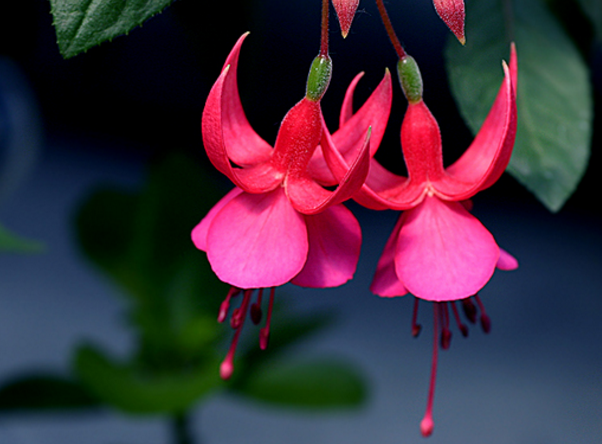
What Are the Pruning Methods for Fuchsia
When you buy a pot of fuchsia from the market, most plants are thick and well-shaped, but after you take it home and let it grow for a period of time, its branches will gradually grow longer and the plant shape will become trailing, losing its original beauty. At this point, you need to learn how to prune your fuchsia!
Shaping and pruning fuchsia at the seedling stage:
The so-called seedling-stage pruning means shaping the fuchsia before it has taken form. The main goal is to cultivate a graceful plant shape during care, and different training methods should be determined according to the growth characteristics of different varieties.
1. Cross-shaped training method
This method is suitable for varieties with a small branching angle (branches growing upward), such as 'Zijin Chui'. When the seedling is taller than 20 cm, pinch off the growing tip to promote the sprouting of new branches. Because the side branches generally grow symmetrically, when pruning you should keep the two symmetrical branches above and completely remove the branches and leaves below. When the side branches grow to about 10 cm, they need to be pinched, and after new branches grow out, just let them grow freely. Be careful to cut off side branches growing inward and downward at any time.
After pruning to the same length, keep 8 to 10 flowering branches for potted plants with a diameter of 15 cm to 18 cm.
2. Tower-shaped training method
This method is suitable for varieties with a large side-branch spreading angle (branches extending horizontally) and strong growth vigor, such as 'White Calyx' and 'Maiden's Skirt'. When the plant is relatively small, do not pinch the growing tip. When it grows to 20 cm, cut off all branches and leaves below 10 cm. After the side branches grow, to avoid overlapping branches, a layered training method can be used. Keep one symmetrical branch on each layer, remove one pair of symmetrical branches, then keep another layer of symmetrical branches, and repeat this process.
3. Natural-form training method
It is suitable for varieties with trailing branches and weak growth, as well as large-flowered and double-flowered varieties. Prune them into a natural form according to their shape. When the seedling grows to 30-40 cm, pinch off the top of the main stem, remove adjacent overlapping branches, and shorten long branches to promote branching. Cut off side branches growing inward at any time to promote a graceful plant shape.
Shaping and pruning fuchsia during the flowering period:
In the natural environment of the north, the full bloom period of fuchsia is from April to July. Therefore, pruning should stop in late March of spring to ensure flowering in mid-April. Because fuchsia flowers best at the top, the flowering branches will keep elongating. When the flowering branches grow to a certain length, they should be pinched, and the new branches that grow out can continue to bloom.
During flowering, cut off the small branches and leaves in the center of the plant at any time to avoid consuming nutrients and to facilitate ventilation and light penetration.
Shaping and pruning after flowering:
In July, when the temperature rises and reaches 30°C, the plant will enter a semi-dormant state. The leaves will gradually become weak, and at this time heavy pruning is needed to reduce nutrient consumption, which is beneficial for safely passing the summer. Cut off all the longer branches, leaving only the main framework branches, remove all old leaves, and place it in a cool place. If flower buds sprout at this time, remove them promptly as well. In September, new branches will grow, and the plant shape at this time will be relatively compact.
What Should Be Noted in Summer Care for Fuchsia
Key points for summer care of fuchsia:
First, lower the temperature and increase humidity
It can be placed under a shaded shed, and water should be sprinkled on the ground continuously to lower the temperature, while ventilation should be strengthened.
Second, control fertilizer and water
Strictly control watering and stop fertilizing. The potting soil should preferably be slightly dry. If the potting soil is often in an overly wet state or is stuffy and unventilated, it will cause the plant's leaves to turn yellow and scorch, and may even cause root rot and death.
Third, prevent rain from hitting the plant
After being exposed to rain, it is prone to root rot and leaf drop.
Fourth, cultivate new seedlings
Old plants are sensitive to temperature and have poor resistance to high temperatures, while young plants have strong resistance to high temperatures.
Getting fuchsia through the summer should also start in spring. In spring, new seedlings should be cultivated by cuttings.
Attention should also be paid after summer. After the weather turns cool, fuchsia will gradually enter a period of vigorous growth. The amount of fertilizer and water should be gradually increased, light should be strengthened, and appropriate pruning should be done to promote flowering.
Pruning Methods for Fuchsia
Shaping and pruning fuchsia at the seedling stage
The so-called seedling-stage pruning means shaping the fuchsia before it has taken form. The main goal is to cultivate a graceful plant shape during care, and different training methods should be determined according to the growth characteristics of different varieties.
Cross-shaped training method
This method is suitable for varieties with a small branching angle (branches growing upward), such as 'Zijin Chui'. When the seedling is taller than 20 cm, pinch off the growing tip to promote the sprouting of new branches. Because the side branches generally grow symmetrically, when pruning you should keep the two symmetrical branches above and completely remove the branches and leaves below. When the side branches grow to about 10 cm, they need to be pinched, and after new branches grow out, just let them grow freely. Be careful to cut off side branches growing inward and downward at any time.
After pruning to the same length, keep 8 to 10 flowering branches for potted plants with a diameter of 15 cm to 18 cm.
Tower-shaped training method
This method is suitable for varieties with a large side-branch spreading angle (branches extending horizontally) and strong growth vigor, such as 'White Calyx' and 'Maiden's Skirt'. When the plant is relatively small, do not pinch the growing tip. When it grows to 20 cm, cut off all branches and leaves below 10 cm. After the side branches grow, to avoid overlapping branches, a layered training method can be used. Keep one symmetrical branch on each layer, remove one pair of symmetrical branches, then keep another layer of symmetrical branches, and repeat this process.
Natural-form training method
It is suitable for varieties with trailing branches and weak growth, as well as large-flowered and double-flowered varieties. Prune them into a natural form according to their shape. When the seedling grows to 30-40 cm, pinch off the top of the main stem, remove adjacent overlapping branches, and shorten long branches to promote branching. Cut off side branches growing inward at any time to promote a graceful plant shape.
Shaping and pruning fuchsia during the flowering period
In the natural environment of the north, the full bloom period of fuchsia is from April to July. Therefore, pruning should stop in late March of spring to ensure flowering in mid-April. Because fuchsia flowers best at the top, the flowering branches will keep elongating. When the flowering branches grow to a certain length, they should be pinched, and the new branches that grow out can continue to bloom.
During flowering, cut off the small branches and leaves in the center of the plant at any time to avoid consuming nutrients and to facilitate ventilation and light penetration.
Shaping and pruning after flowering
In July, when the temperature rises and reaches 30°C, the plant will enter a semi-dormant state. The leaves will gradually become weak, and at this time heavy pruning is needed to reduce nutrient consumption, which is beneficial for safely passing the summer. Cut off all the longer branches, leaving only the main framework branches, remove all old leaves, and place it in a cool place. If flower buds sprout at this time, remove them promptly as well. In September, new branches will grow, and the plant shape at this time will be relatively compact.
Propagation Methods for Fuchsia and Care Methods for Fuchsia
Fuchsia is native to Mexico and is widely cultivated in China, especially in the north or in greenhouses on the northwestern and southwestern plateaus. Potted plants are suitable for decoration in guest rooms, on flower stands, and on desks. Placed in a bottle of clean water, they are not only ornamental but can also root and propagate. Now let's take a look at how to grow fuchsia!
Growth Characteristics of Fuchsia
Fuchsia is a perennial shrub, with lanceolate-ovate leaves, toothed leaf margins, pointed tips, and opposite arrangement. Flowers are solitary, the calyx tube is bell-shaped, the petals vary greatly, the flower stalk is long, and the fruit is a berry. There are many varieties.
Fuchsia is native to Mexico. It likes cool and humid conditions and fears heat and high temperatures. Its growth temperature is 15-25°C. Above 30°C, the growth of branches and leaves is affected. At high temperatures above 35°C, branches and leaves will wither and die. When the temperature is below 10°C in autumn and winter, it should be moved indoors immediately. If the temperature drops to 5°C, it should immediately be regulated to above 5°C, otherwise it will suffer cold damage.
Propagation Methods for Fuchsia
Fuchsia propagation is mainly by cuttings, which can be done throughout the year, but spring and autumn are more suitable. In spring, March to May is preferable, and in autumn, August to October, when the temperature is more suitable.
Cut 5-8 cm long, fully grown shoot tips as cuttings. At a temperature of 20°C, softwood cuttings root in two weeks after planting. After rooting, pot them promptly, otherwise the roots are prone to rot. Cuttings are often used for propagation throughout the year, and rooting is faster in spring and autumn.
The best cuttings are tender shoot tips, 7-8 cm long, inserted into a sand bed and kept moist. They will root in about 10 days after insertion, and can be potted in September.
How to Grow Fuchsia
Fuchsia is averse to intense summer heat, stuffiness, rain, and direct sun. The suitable growth temperature is 15-25°C. In winter, the temperature should not be lower than 5°C. When the summer temperature reaches 30°C, growth becomes extremely slow, and at 35°C large numbers wither and die. In winter, the minimum greenhouse temperature should be kept at 10°C. At a low temperature of 5°C, it is prone to cold damage. The suitable growth temperature is 10-25°C, and relatively high air humidity is required. Fuchsia is suitable for fertile sandy loam rich in humus and well drained. To make fuchsia lush in leaves and abundant in flowers, attention should be paid in daily care and management to:
1. Repotting and soil changing: Seedlings that have survived cuttings or have been sown all need to go through several repottings from small pots to medium pots to large pots. The plants need to have their soil changed once before sprouting in spring or autumn each year. The substrate should preferably be fertile, loose, well-drained potting soil. Generally, leaf mold plus sandy loam plus decomposed organic fertilizer and phosphate fertilizer can be evenly mixed, and no base fertilizer needs to be applied, so as to avoid root rot.
2. Fertilizing: Because fuchsia grows quickly and blooms many times, during the growth period you should apply thin fertilizer frequently, about once every 10 days with thin cake fertilizer or compound fertilizer. During the flowering period, a liquid fertilizer mainly of phosphorus and potassium should also be applied once a month, but fertilizing should stop in high-temperature seasons. Before fertilizing, the potting soil should be on the dry side; after fertilizing, spray water once with a fine nozzle to prevent the leaves from being stained with fertilizer water and rotting.
3. Temperature: The growth temperature of fuchsia is 10-28°C. In summer, the temperature cannot exceed 30°C, so cooling work should be done well in summer; in winter, sufficient sunlight is required, and the cultivation temperature cannot be lower than 5°C, otherwise it will cause cold damage, and insulation measures must be taken. In addition, whether in winter or summer, attention should be paid to ventilation.
4. Watering: Water whenever the soil looks dry, and water thoroughly, but never allow waterlogging. In summer, the potting soil is better kept on the dry side, but pay attention to spraying water on the leaves and the ground.
5. Placement: In order to keep the fuchsia plant full and shapely, its position should be changed frequently during the growth period so that the plant receives even light and does not lean to one side and ruin the plant shape. However, during the flowering period, it should be moved as little as possible, otherwise it will cause bud drop and flower drop.
Care Methods for Fuchsia
1. Temperature and humidity regulation: Place the plant in a shaded, ventilated, cool, and rain-sheltered place, spray water on the leaves multiple times a day, and sprinkle water on the ground to lower the temperature and increase air humidity.
2. Fertilizer and water management: For perennial old plants, withhold water and stop fertilizing so they can pass through the dormant period smoothly. The plant should be moved indoors before Frost's Descent and moved outdoors after Qingming, and the room temperature should be kept above 5°C. In cold snaps and snowy, windy weather, when freezing occurs outdoors, it is best to move it back indoors.
3. Pinching and shaping: For perennial plants, it is best to pinch in winter, cutting off the tender tips 5 cm to 6 cm from the top to encourage more branching. During the summer dormant period, shorten the thin, weak, bending, leggy branches so that flowering is abundant in autumn. For newly cultivated young plants, when they grow to 20 cm to 30 cm, remove the top to set the main stem and promote side branches, forming a plant shape with many and even branches. Around the Beginning of Autumn, perform a second pinching to welcome a second full bloom period. Before bringing them indoors, carry out a whole-plant pruning and shaping, cutting off dead branches, weak branches, inward-growing branches, and overly dense branches, and shortening leggy branches, so as to concentrate nutrients, promote winter buds, and lay the foundation for the next year.