Reasons Why Kumquat Bonsai Does Not Bear Fruit and Home Care Methods
Kumquat belongs to the family Rutaceae (fennel family), an evergreen shrub, 3 m tall, generally without thorns. Leaves lanceolate to oblong, flowers small, white, fragrant, with 5 petals, fruit obovate or elliptical, 2.5-3.5 cm long, golden yellow.
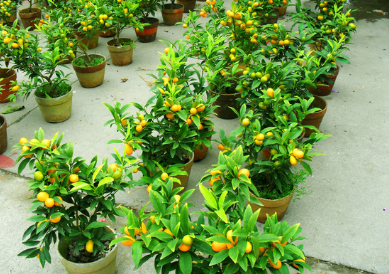
Home Care Methods for Kumquat Bonsai
Potted kumquats are generally bought by people as New Year flowers, and many people do not know how to care for them after buying them.
1. Soil Requirements for Growing Kumquat
Potted kumquat likes loose and fertile soil. If the soil of the potted kumquat is found to be compacted, it should be repotted immediately, as soil that is not breathable or permeable easily leads to root rot. When repotting, the soil can be a mix of 4 parts leaf mold, 5 parts sandy soil, and 1 part cake fertilizer.
2. Watering Methods for Growing Kumquat
Kumquat likes moisture but dislikes waterlogging; too much watering easily leads to root rot. For home care, the timing of watering should depend on the home care environment. In dry spring, spray water on the leaves once a day to increase air humidity. In summer, spray water 2-3 times a day and also spray the ground. When watering, avoid water droplets falling on the flowers, which can cause the flowers to rot and affect fruiting.
3. Light Requirements for Growing Kumquat
Kumquat likes a sunny environment, so it should be placed in a sunny spot during care. If light is insufficient, the plant tends to grow leggy and bears fewer flowers and fruits. In summer, when the temperature is high and light is strong, the kumquat should be placed in a shaded area. In winter, the indoor temperature should be kept above freezing. If the room temperature is too high, the plant cannot get sufficient dormancy, and its growth will be weak the next year, making it prone to flower and fruit drop.
4. Temperature Requirements for Growing Kumquat
Kumquat likes a warm and refreshing environment. When the autumn temperature drops below 10 degrees, the kumquat should be moved indoors, and in winter it is best to maintain a growing temperature of 6-12 degrees. If the temperature is too low, it is prone to cold damage; if too high, it affects the plant's dormancy, which is unfavorable for flowering and fruiting the next year.
5. Fertilization Methods for Growing Kumquat
Potted kumquat requires proper water and fertilizer management. When the branches have grown fully, apply a quick-acting phosphorus fertilizer, such as superphosphate, to prevent leggy growth of branches and leaves and to promote flower bud differentiation and flowering and fruiting.
6. Pruning Requirements for Growing Kumquat
Pruning is an important technical measure to make kumquat bloom abundantly and bear many fruits. To make the tree shape beautiful and bear more fruit, before spring buds sprout, cut off some of the previous year's branches, leaving 2-3 buds on vigorous ones, and keep 3 pruned one-year-old branches per plant, which helps spring shoots sprout. When the new shoots grow to 15-20 cm, pinch off the tips to make the branches full.
7. Pest Control for Growing Kumquat
Kumquat branches and leaves are often harmed by scale insects, red spiders, and swallowtail butterfly larvae, among which scale insects are relatively common, occurring from April to May. You can spray acephate 1000 times dilution; you can also brush off the pests with a small brush.
Potted kumquat has luxuriant branches and leaves and stays evergreen all year round. When it blooms, it is filled with a fresh fragrance, and the white flowers are very delicate. When the fruit ripens, it turns yellow-red. Whether for foliage, flowers, or fruit, it has certain ornamental value and is also very common in homes. That is all for the kumquat growing methods introduced to everyone, and I hope it is helpful.
Reasons Why Kumquat Bonsai Does Not Bear Fruit and What to Do
1. Kumquat not bearing fruit is due to too much water and fertilizer
The reason kumquat does not bear fruit may be too much water and fertilizer, because with too much water and fertilizer, the plant grows vigorously, but this vigor refers to branches and leaves; the vigorous growth of branches and leaves instead affects the fruiting of kumquat.
During the plant's growing period, do not apply too much or too concentrated fertilizer to kumquat. Generally, apply fertilizer once every 10 days. During the flowering period, some phosphorus fertilizer can be applied, which helps fruit set. Watering should also be appropriate. Before kumquat blooms, you can appropriately withhold water to control the amount of watering. Watering is generally done when the plant's leaves appear wilted, which can promote flower bud differentiation. During the flowering and fruit-setting periods of kumquat, watering should not be too much.
2. Kumquat not bearing fruit because of too little light
Light is an important factor affecting plant growth and reproduction, because light is a necessary condition for photosynthesis. With too little light, the plant's photosynthesis is poor, which affects flowering and fruiting.
When growing kumquat, it is necessary to provide appropriately sufficient light. Do not leave it in too shady a place for a long time. If light is lacking during care, find ways to meet its light needs.
3. Kumquat not bearing fruit because of no pruning
Reasonable pruning is an important measure for the growth and reproduction of kumquat. Without pruning, kumquat will bear few or no fruits.
Generally, in order for kumquat to bear fruit better, it needs to be pruned. Pruning during the growing period is mainly to retain branches, adjust the growth status and plant shape of the kumquat, and reduce nutrient consumption. At this time, pruning is mainly carried out according to the needs of shaping and branch retention. During the flowering period, the flower buds of kumquat also need to be pruned, keeping 2-8 flower buds on one branch, and generally keeping 1——2 fruits.
With proper pruning, kumquat will grow well.
Kumquat Bonsai Care Methods
Kumquat Bonsai Care Methods
Today we will introduce kumquat bonsai care methods to everyone. Netizens who like growing kumquat bonsai can pay attention.
Kumquat fruit is golden yellow and has a fresh fragrance, and the fruiting time is relatively long, making it an excellent ornamental fruit plant. It is suitable both as a potted ornamental plant and as a bonsai, and its taste is sweet and sour and it has various nutritional values. Potted kumquat is evergreen all year round, with luxuriant branches and leaves and a beautiful tree shape. It blooms in summer, the flowers are jade white, and the fragrance spreads far. In autumn and winter, the fruit ripens and is either yellow or red, dotted among the green leaves. It can be described as green leaves and golden pellets, lush and flourishing, with extremely high ornamental value.
I. Material Selection and Propagation Measures
Artificial propagation: can use cuttings, grafting, and other methods. Cuttings are best done from late May to late June. Select cuttings from branches that developed fully the previous year, or use current-year semi-lignified young branches with shorter internodes.
The cuttings are about 10 cm long. Remove the branches and leaves at the lower end, keep two leaves at the upper end, and cut each in half.
Insert into the soil to a depth of about 23, press the surrounding soil firmly, water thoroughly, and then just keep the soil moist. After insertion, build a shade frame in time and spray frequently. Roots can develop after about 30 days. After that, careful care and management are still needed, and after the weather warms the next spring, transplant to cultivate larger seedlings.
The grafting method can be carried out from early April to early May, mostly using cut grafting or cleft grafting.
If bud grafting is used, it can be carried out from June to September. The rootstock is mostly citrus (Poncirus trifoliata) seedlings, and finger citron, lemon, and trifoliate orange can also be used.
Cultivation method for potted kumquat that is grafted in the same year and bears fruit in the same year: use finger citron or lemon cuttings, keep them vigorous, and from May to August, when the branches are semi-lignified, graft by cleft grafting. The scion should use current-year semi-lignified sturdy branches. After grafting, cover with a bag for care, and remove the bag after about 1 week. After survival, keep 1 vigorous branch, cut off the remaining grafted branches, and remove rootstock buds at any time.
After 20 days, remove the tying rope and strengthen fertilizer and water management. Fertilization is mainly phosphorus and potassium fertilizer, applied once every 10 days.
Pay attention to withholding water and increasing light.
With proper care, it can bloom and bear fruit in the same year.
II. Potting Process
Pot selection: Kumquat is suitable for medium-deep purple clay pottery pots, and glazed pottery pots can also be used. Shallow pots are not suitable. The pot shape can be square, rectangular, or round. The pot color is best chosen as begonia red or deep sunflower yellow, to set off the green leaves and golden fruit and increase the ornamental effect.
Soil: Kumquat grows best in acidic sandy loam with good permeability. For potting, weathered pond mud or garden soil mixed with sandy soil is mostly used.
Planting: It is best carried out in April in spring. When planting, organize the root system so that the fibrous roots spread out in the pot soil, appropriately cut off old roots, and place crushed bone, rapeseed cake, bone meal, etc. at the bottom of the pot as base fertilizer.
III. Shaping Techniques
Processing: Kumquat mostly uses pruning for processing, and generally very little wiring is done. It is only necessary to appropriately wire the trunk and large branches, and the rest can be pruned. Processing and pruning are best done in April in spring during rainy weather.
Tree shape: Kumquat styling should win by simplicity and should not be too complicated. The main tree shapes include straight trunk style, slanting trunk style, etc.
Generally, it is pruned into a natural large tree shape or a semicircular spherical shape.
IV. Care and Management
Placement location: Kumquat likes light and should be placed in a sunny, warm, and ventilated place. In summer, it should be appropriately shaded and avoid exposure to the sun. The placement location should be fixed and not moved around too much. During the full flowering period, pay attention to avoiding rain. In winter, it should be moved indoors to overwinter to prevent freezing.
Watering: Usually keep the pot soil moist. During the spring growing period, water frequently. During the high-temperature period in summer, the "water withholding" method can be used to inhibit summer shoot growth and promote flower bud differentiation.
Fertilization: Kumquat likes fertilizer, and it is best to apply thin fertilizer frequently. The fertilizer is mainly phosphorus and potassium fertilizer, such as chicken or duck manure or fishy water, applied once every 7-10 days. During the plum rain season, some cake fertilizer crumbs can be spread on the pot surface. During the flowering period, apply little or no fertilizer. After the fruit is set steadily, apply light fertilizer 2 times.
Pruning: Generally carried out in early spring from February to March. Mainly cut off dead and weak branches, overlapping branches, crossing branches, and diseased and insect-damaged branches. According to the tree shape, adopt the principle of strong branches lightly pruned and weak branches heavily pruned, and shorten the main branches. Generally leave 4-5 buds on thick and strong branches and 2-3 buds on thin and weak branches, and cut off the rest. After new shoots sprout, remove overly dense branches and tender branches that disturb the tree shape as early as possible.
Repotting: Kumquat can be repotted once every 2-3 years, preferably from March to April in spring. When repotting, remove 12 old soil, replace with loose and fertile cultivation soil, and at the same time cut off some rotten roots and old roots.
Pest and disease control: The main disease of kumquat is black mold, and Bordeaux mixture can be sprayed or the mold stains can be wiped clean with 5% alcohol; the main pest is scale insects, and 40% omethoate 1000 times dilution can be sprayed or the insect bodies can be removed with a small brush or small knife.
Grafting and Care Methods for Kumquat Tree Bonsai
Introduction to grafting and care methods for kumquat tree bonsai: generally through branch grafting, using cut grafting in March-April; bud grafting is carried out from June to September; approach grafting is carried out in June, and this method is often used for potted plants. After the graft survives, it can be transplanted before sprouting the next year, and more original soil should be kept. For potted kumquat, when the weather turns cold, as long as it is moved indoors, it can generally overwinter safely. The room temperature should not be too high, as too high a temperature instead causes growth decline. Every 1-2 years, change the soil when it is moved outdoors in spring. After changing the soil, keep it in a shady place for half a month, then place it in the sun for cultivation.Kumquat should be pruned reasonably, carried out in February-March, cutting off dense branches, thin and weak branches, crossing and overlapping branches, drooping branches, and diseased and dead branches. Strong branches do not need to be cut, leggy branches should be pinched, and aging branches should be shortened to promote renewal. After pruning, the branches should neither be messy nor lose considerable density, forming a good round-headed crown. In July, when autumn shoots newly emerge, tender branches that are too dense or affect the tree shape should be removed in time. Water and fertilizer management should be appropriate. If the leaves turn yellow, it may be too wet, so "withhold water" immediately; if the leaves dry and curl, replenish water immediately. In order to achieve the goal of ornamental fruit, appropriately increase phosphorus fertilizer. During care, also pay attention to phototropism. If the flower pot faces south, after moving it should still face south, and the light should not be disrupted, otherwise the tree vigor will not be strong.
Kumquat has an elegant tree posture, fragrance spreading far, and exquisite golden fruits. Planted under courtyard windows or planted in groups around lawns and tree clusters, it adds color to the bleak winter. It has strong resistance to carbon dioxide and can also be used as a tree species for factory greening. Kumquat fruit and flowers are used as medicine and can regulate qi, relieve depression, resolve blood stasis, and sober one up. The root is used as medicine and has the functions of promoting qi, resolving phlegm, and dispersing nodules.
Care Methods for Kumquat Tree Bonsai
1. Water control to promote flowering. When spring new shoots have grown for about one month and the branches have not yet lignified, carry out water control, that is, drought treatment, on potted kumquat, preferably when the leaves curl inward but have not yet curled to the point of meeting at the midrib. If they curl severely, leaf drop will occur. After that, from 11:00 to 17:00 every day, spray water on the leaves 3-4 times, so that the leaves become moist and open and then lose water and curl again. After one week, observe the axillary buds on the branches. If the axillary buds swell and become light green round-headed protrusions, it indicates that they have become flower buds, and the water control treatment to promote flowering can be ended. After that, normal fertilizer and water management can be carried out. After a few days, the leaves develop normally, and the axillary buds quickly produce buds and become flowers.
2. Pruning techniques. In early March, carry out one heavy pruning on potted kumquat, and cut off all fruits, retaining only 4-5 main branches. When 10 leaves have sprouted, pinch the tips once to promote the sprouting of new branches. Branches that grow in summer can all become fruiting branches, while branches that grow in autumn should be cut off. After fruiting, newly sprouted branches should also be removed to avoid competing with the fruit for nutrients. Generally, keep 2-3 fruits per branch, and appropriately thin flowers and fruits to promote uniform fruit size.
3. Ringing to promote flowering. The ringing time depends on the growth vigor of the kumquat. It is carried out when summer sprouted branches have grown for about 25 days. Generally, cut one ring. After cutting, control water to the extent that the leaves do not curl. After half a month, the leaves turn yellow, and after 20 days, flower buds will form. Ringing is only suitable for vigorous trees and vigorous branches, not for weak trees and weak branches.
4. Plant growth regulators for fruit retention. After flower thinning of kumquat, spraying gibberellin 20 mg/L or 2.4-D 10 mg/L + 0.3% urea is beneficial for fruit set. Spraying 0.3% monopotassium phosphate + fruit-preserving agent 40 mg/L during the young fruit stage is beneficial for young fruit development. During the fruit-swelling stage, spray 0.3% urea + 2.4 mg/L-D 20 mg/L.
5. Fertilizer and water management. In spring and autumn, water thoroughly once every 2-3 days. In summer, on clear days, water once a day. Before sprouting, apply a compound fertilizer mainly based on nitrogen fertilizer. After fruit set, apply nitrogen fertilizer and potassium fertilizer, but do not apply too much nitrogen fertilizer. After fruiting, follow the principle of not watering when the pot soil is not dry, and watering thoroughly when watering, and apply alum fertilizer water containing phosphorus and calcium or composted cake fertilizer. During the summer shoot growth period, if the pot soil moisture is too high, it will cause flower and fruit drop. The pot soil should also not be too dry. During the fruiting period, too much water will also cause fruit drop.
The main pests and diseases of kumquat include canker disease, scab disease, yellow swallowtail butterfly, citrus swallowtail butterfly, red spider, leaf miner, rust mite, citrus aphid, star longhorn beetle, etc., and they should be controlled in time.