The Correct Methods for Hydroponic Growing and Pruning of Buddhist Pine
Buddhist pine (Podocarpus macrophyllus), an evergreen tree genus, is known by people as Luohan Shan, Jiangnan Bai, and other names. Its tree form is beautiful, and its crown is large and spreading; it is mainly grown in the Jiangsu-Zhejiang region, while household growing is mainly of dwarf plants, mostly as potted specimens.
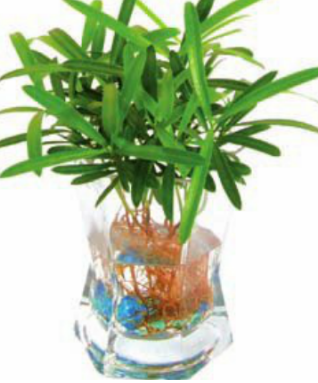
How to correctly grow Buddhist pine hydroponically
1. Key points for hydroponic growing of Buddhist pine
1. Sow the seeds in river sand to raise seedlings; usually one-year-old seedling plants are chosen to begin hydroponic growing.
2. Choose upright plants; use various containers, glass bottles or small water cups as containers, with maifan stone as the fixing material for hydroponic growing.
3. Frequently spray water on the small leaves; a dilute nutrient solution may be added to the container at irregular intervals, making the leaf color even more beautiful.
4. Try to keep the indoor ventilation good. If placed in an environment with poor air circulation, its growth is easily affected. Give it an appropriate amount of sunlight, but it must not be exposed to blazing sun.
2. Ecological habits of Buddhist pine
Seedlings are shade-tolerant; it likes a warm and humid climate and has strong cold resistance.
3. Ornamental characteristics and applications of Buddhist pine
Buddhist pine grows relatively slowly and is a good miniature potted plant for indoors. Its trunk is upright and broadly ovate in shape. The leaves are linear-lanceolate, spirally alternate; the leaf surface is dark green and the underside is yellow-green. After hydroponic growing, it is suitable for decorating a study or a child's room.
4. Flower language
Health and longevity, good fortune and wealth.
How to correctly prune Buddhist pine
1. Key elements of pruning Buddhist pine: follow the shaping purpose
The purpose of artistic shaping of Buddhist pine is to “shape according to the tree” and “apply skill according to the material”, using superb artistic expression techniques to draw out the highest artistic realm from an ordinary tree form and to maximize its ornamental value.
2. How to prune potted Buddhist pine
Shaping techniques for pruning Buddhist pine:
Commonly used techniques include clipping, tying, pressing, binding and hanging. Pruning and shaping are relatively simple, while shaping techniques such as tying, pressing, binding and hanging are more difficult, requiring higher levels of artistic imagination and operating skill from the shaper as well as attention to the tree's trunk and branch conditions.
In the shaping process, artistic processing must be carried out according to the natural beauty of the seedling itself, that is, measures must suit the tree, adding beauty to beauty, so that the shape is strong and powerful with distinct layers.
3. Specific operations for pruning Buddhist pine
Clipping: Taking advantage of Buddhist pine's tolerance of pruning and small leaf shape, various shapes can be made, such as spherical, conical, multi-layered spherical, and so on; simply prune according to the pattern designed in advance.
For example, when pruning a three-layer spherical shape, first choose a seedling with an obvious trunk and a relatively good upright form. It is best if the upper, middle and lower spheres gradually increase in size, so as to seek coordinated proportions and better ornamental value. Generally, pruning is best done when new shoots have grown 20-30 cm, and multiple prunings are needed to make each layer of spheres round, full and compact.
Tying: For tying-style shaping, sturdy bamboo sticks and strong tough hemp rope can be chosen. Use the hemp rope to tie the bamboo sticks and branches tightly and firmly, then fix one end of the bamboo stick to the trunk, so that by adjusting the direction of the bamboo stick, the branches grow in a specific direction according to the shaper's wishes, achieving the purpose of shaping.
Pressing: Pressing-style shaping mainly uses the method of bending and tilting the trunk, so that the tree body on a slant presents an artistic beauty completely different from that of an upright plane.
Because the branches of Buddhist pine resemble human arms, while the leaves clustered into hemispherical shapes at the tops of the branches look like human palms, and combined with the bent tree body, it is just like a greeter bending at the waist and arms to welcome arriving guests, very vivid and lifelike.
Can Buddhist pine be grown hydroponically? Hydroponic cultivation methods for Buddhist pine
Buddhist pine hydroponic growing - hearing this may make everyone feel it is strange, but there are still many curious friends who like to try new things. So can Buddhist pine be grown hydroponically? Below, we introduce the hydroponic cultivation methods for Buddhist pine.
Can Buddhist pine be grown hydroponically?
As for the question of whether Buddhist pine can be grown hydroponically, in theory it should be possible, but a hydroponically grown Buddhist pine may not live very long, because Buddhist pine still needs sunlight and rain and dew. Although hydroponic growing can also meet the nutritional needs of Buddhist pine's growth, it always feels a bit inappropriate for Buddhist pine to be grown hydroponically.
Hydroponic cultivation methods for Buddhist pine
1. Temperature
The suitable growing temperature for hydroponic plants is above 5 degrees and below 30 degrees. That is to say, as long as the temperature feels relatively comfortable to people, the plants will also feel relatively comfortable, and they can grow normally. Even in winter, they can still have luxuriant branches and leaves, adding vigorous vitality for us.
2. Light:
Mainly scattered light. What is scattered light? It is natural light coming in through windows and other places and naturally scattering indoors. Generally, plants only need appropriate brightness to grow; they do not necessarily have to be exposed to the sun, and in summer, direct sunlight should be avoided as much as possible.
3. Nutrient solution:
The special fertilizer used for hydroponic flowers is completely mineral inorganic nutrition, and is formulated from multiple nutrient elements (including nitrogen, phosphorus, potassium, calcium, magnesium, sulfur, iron, manganese, zinc, copper, boron, molybdenum, fluorine, etc.). The medium for hydroponic flowers is pure water or tap water free of pollution and impurities, so hydroponic flowers are basically sterile and rarely suffer from pests and diseases. But precisely because the medium of hydroponic flowers is water, as everyone knows, various nutrient elements in water are almost blank, and the nutrition in the water is far from enough to meet the normal needs of flowers. Therefore, reasonable and timely fertilization for hydroponic flowers is undoubtedly a very important management measure. Hydroponic nutrient solutions are all concentrated, so please dilute them according to the product instructions before use.
4. Changing water:
Changing water means replacing the water in the bottle to which nutrient solution has been added. Generally, in spring and autumn, change the water once every 7-10 days; in summer, change it once about every 5-7 days; in winter, change it once every 15-20 days (use tap water after letting it sit for half a day).
Changing the water is to ensure the oxygen supply in the water. Fresh water contains more oxygen, and plants will grow more healthily. If the water is not changed for a long time, the plants can still hold on for a period. For example, sometimes when everyone goes on a business trip or vacation and is away from home for ten days to half a month or even a month, soil-grown plants would have long been unable to bear it and died, while hydroponic plants, as long as you add more water, can still persist. But if the time is too long and the water in the bottle is very stale or has deteriorated, it will affect the growth of hydroponic plants and, in severe cases, cause their death.
Note: When changing the water, for plants with a planting basket, the water level should not soak the very bottom of the planting basket; it should be more than 3 cm away from the planting basket. The part of the roots left in the air can provide the plant with some extra oxygen. For those without a planting basket (such as those fixed with ceramic pellets or perlite), please expose one third of the plant's roots or keep the water level at one third below the root crown, otherwise if the water completely submerges the roots, they will rot due to lack of oxygen.
5. Cleaning the plant and trimming the roots:
Each time you change the water, rinse the plant's roots and container with clean water, and prune dead branches, withered leaves and rotten roots. Under normal growth conditions, plant roots, like any life, have a cycle of growth, aging and death, so hydroponic plants will also age according to the cycle, die off part of their roots, and then grow a new part of roots. When a small number of rotten roots are found, use sterilized scissors (sterilized with alcohol cotton) to prune away the rotten roots. Sometimes if the roots are too long, they will become tangled at the bottom of the bottle, affecting the ornamental appearance. At this time, some old roots and overly long roots can also be pruned away, leaving just a portion of root length, but be careful to disinfect the scissors.
6. Growing flowers and fish together:
At present, the most popular form of hydroponic plants is growing flowers and fish together. The plants above are full of green, while the lively small fish below swim freely among the roots. The plants are still and the fish are moving; one still and one moving complement each other, and the ornamental effect is very good.
For the fish in the flowers-and-fish combination, try to choose tropical fish, not goldfish, because goldfish are too delicate and cannot survive under oxygen-deficient conditions, while tropical fish are relatively tolerant of oxygen deficiency and do not need to be fed often. Usually they will eat a little of the plant's rotten roots and metabolites to sustain life; then feeding once the day before each water change is enough (be sure to feed only a little), so that the food the fish cannot finish and the fish's excrement can be cleaned up in time and will not affect the plant's growth.
7. Moisture retention:
In winter, there is very little moisture in the air, especially in the north, where indoors is very dry, which is unfavorable for plant growth. Therefore, in daily care, please spray the leaf surface with clean water to maintain humidity; you can spray clean water twice a day.
Japanese Buddhist pine: What are the cultivation methods for Buddhist pine? How to grow Japanese Buddhist pine?
For beginners growing Buddhist pine, if they do not first understand and learn the cultivation methods of Buddhist pine and how to grow Japanese Buddhist pine, they will not only get twice the result with half the effort, but may also cause damage to and waste of Buddhist pine seedlings. Therefore, understanding the cultivation methods of Buddhist pine is imperative.
[Great Recommendations]Indoor plants, scented geranium, fragrant wood, hydroponic plants, small potted plants, flowering plants, feng shui radiation-proof plants,
What are the cultivation methods for Buddhist pine? How to grow Japanese Buddhist pine?
[Plant Profile]
Chinese name:Buddhist pine
Scientific name:Podocarpus macrophyllus
Aliases:Luohan Shan, Evergreen Luohan Shan, Tushan, Golden Larch, Xianbai, Luohan Bai, Jiangnan Bai
Family:Podocarpaceae
Genus:Podocarpus
Origin and distribution:Buddhist pine is commonly found in southern China, including the Hong Kong, China area.
Morphological characteristics:Evergreen tree, can reach up to 18 m tall, usually pruned to keep it low; leaves alternate, arranged in a spiral; blooms in early summer, also divided into male and female; male flowers cylindrical, 3-5 clustered in leaf axils; female flowers solitary in leaf axils; the seed receptacle is larger than the seed and turns red when mature; together with the green seed, it looks like a bald monk wearing a red monk's robe, hence the name Buddhist pine.
[Cultivation methods for Buddhist pine]
◆ Try to use fertile soil, such as sandy loam, leaf mold and other fertile, well-draining soils.
After the plant grows larger, replace the flowerpot in time. Buddhist pine has high requirements for flowerpots, and they must also have a certain ornamental value, and their value is not cheap either, but this should not be a reason not to replace the flowerpot for a Buddhist pine still in its growth period and affect its later growth and development.
◆ Maintain sufficient moisture, but not excessively. Buddhist pine is a moisture-loving plant. In summer, ensure the soil is moist, but there must be no water accumulation; in winter, do not water too much.
◆ Try to keep indoor ventilation good. If placed in an environment with poor air circulation, its growth is easily affected. Give it an appropriate amount of sunlight, but it must not be exposed to blazing sun.
◆ Buddhist pine is susceptible to damage from giant bagworms, scale insects and white wax insects. In addition, leaf spot disease and branch blight disease are also extremely harmful. When pests and diseases are found, they must be dealt with in time; do not delay.
[How to grow Japanese Buddhist pine]
Japanese Buddhist pine is a Buddhist pine abundantly produced in Japan, and is therefore named Japanese Buddhist pine. As for how to grow Japanese Buddhist pine, the general methods are largely the same as the basic methods for other types of Buddhist pine; you only need to pay special attention to the few methods that are not suitable for growing Japanese Buddhist pine.
Conclusion:Only the Buddhist pine that you have carefully cultivated and tended is the most precious and most beautiful to you. No matter how beautiful and magnificent other Buddhist pines are, in your heart they cannot compare with the Buddhist pine you planted with your own hands.
【More plant encyclopedia】
Cultivation methods for Peperomia argyreia, cultivation methods for sago palm, effects of cactus, characteristics of peony flowers, how to grow wintersweet, how to grow Aglaia odorata
Cultivation methods and precautions for pothos, does cactus absorb radiation, cultivation methods for Guzmania, causes of yellowing leaves in cyclamen, price of blue rose
Lucky bamboo, sago palm pictures, cultivation methods for sago palm, is rubber tree toxic, sunflower flower language, Ping'an tree, cyclamen, Sansevieria trifasciata 'Laurentii'
Spider plant yellowing leaf tips, how to grow lilies, Cymbidium nine-nine large-flowered, Anthurium, is flamingo flower toxic, cultivation methods for money tree, Buddhist pine bonsai pictures