The correct hydroponic method for the ponytail palm, its flowering time and flower meaning
The ponytail palm, also called the elephant-foot tree, belongs to the family Ruscaceae. It is an evergreen small tree and a foliage plant. It is native to the hot, dry regions of Mexico. The ponytail palm is a tree-like succulent. Its shape resembles a large wine bottle, which makes it a very unusual ornamental plant.
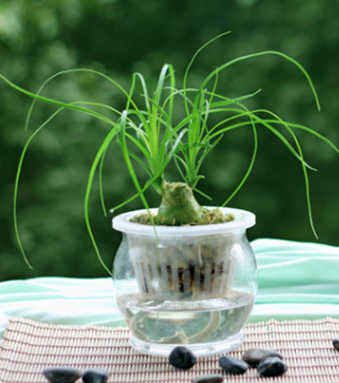
How to correctly grow the ponytail palm hydroponically
1. Taking seedlings for hydroponic ponytail palm
Choose a robust, disease-free, well-formed single-headed ponytail palm that has grown for many years, or a mini plant with relatively many apical buds, then dig it out of the pot or the ground, remove the soil from its upper part, taking care to protect the roots, then wash it clean with water, cut off the rotten or weak roots, and soak it in diluted plant nutrient solution for one day.
2. Choosing containers for hydroponic ponytail palm
Take two double-layer containers. The upper container needs a plastic sieve with a bottom hole, while the base container needs to be a plastic or glass bottle without a bottom hole.
3. Hydroponic method for the ponytail palm
Dig four or five small holes of about 1 cm in the bottom of the upper container, plant the ponytail palm soaked in diluted plant nutrient solution in the upper container, with the roots passing through the bottom holes of the upper container, and add ceramsite. Then steady the ponytail palm, place it on the base container, add clean water and plant nutrient solution, the water should reach the bottom of the upper container, then place it in a cool, shaded spot.
4. Hydroponic management of the ponytail palm
Spray the branches and leaves with diluted plant nutrient solution every three days, change the water once every half month, and also add plant nutrient solution at the same time. Roots will form half a month after potting. In fact, hydroponics is a bit more hygienic than soil cultivation. If the water runs low, you can add water every 5-6 days, and hydroponic plants have fewer pests and diseases.
When does the ponytail palm bloom
1. Will the ponytail palm bloom
Will the ponytail palm bloom? This can be answered with certainty: the ponytail palm does bloom, but it takes quite a long time for the ponytail palm to bloom, so it is said to be extremely rare.
Generally, when cultivated, it will bloom only after environmental conditions such as temperature and light and the plant's nutrient accumulation are sufficient. Some say this process takes a very long time, generally requiring 60 years of planting before it is possible. Actually, that is not the case. Although the ponytail palm blooming is relatively rare, generally plants over 10 years old have the possibility of blooming, and with proper care, you can also see the ponytail palm's unique flowers earlier.
The ponytail palm blooms much like most plants in the Agavaceae family, very unusual. When it blooms, the ponytail palm's small creamy-white flowers grow densely on the flower branches, and the loose panicle inflorescence is very spectacular. These flowers also give off a peculiar fragrance that can attract butterflies and bees.
2. The flower meaning of the ponytail palm
It is natural and poised.
How to grow hydroponic cyclamen
Cyclamen's flower meaning carries the meaning of welcoming distinguished guests and hospitality, so it is a flower very suitable for placing in the living room, giving visiting guests a feeling of being at home. And hydroponic cyclamen gives people an even fresher, clearer, pure and elegant feeling, and its cultivation method is also easier than that of soil-grown cyclamen.
How to grow hydroponic cyclamen
——————————————————————————————————————————————
[Plant profile]
——————————————————————————————————————————————
Chinese name:Cyclamen
Scientific name:Cyclamen persicum
Alternative names:Radish begonia, rabbit ear flower, rabbit flower, yipinguan, bonfire flower, fan-petal lotus
Family:Myrsinaceae
Genus:Cyclamen
Place of origin and distribution:The cyclamen is native to Greece, Syria and other Mediterranean regions, northern Africa and Asia Minor. It was introduced to Paris, Europe only in 1620, while cultivation in England began in 1731, and the cyclamen was introduced to China in 1840.
Morphological characteristics:The cyclamen is a perennial herbaceous plant, with a flattened round fleshy corm 4-12 cm in diameter, sprouting at the end of winter and blooming in autumn. Flowers are solitary, with long stalks, in purple-red, red, pink and white, and the base of the perianth often has purple-red spots; the leaves are heart-shaped, grayish-green, with silver-gray patterns on them.
How to grow cyclamen: choosing the plant and container
——————————————————————————————————————————————
For the cyclamen, it is advisable to choose a healthy, robust, 1-3 year old cyclamen plant with buds about to open. It is best to choose one that has previously been grown in a soilless cultivation substrate (perlite, vermiculite, sawdust and other substrates), so that after a change of environment the cyclamen will not suffer root damage, will not need to recover from transplanting, and will adapt faster.
Choose the container simply and conveniently; any container that can hold water, such as a fish tank, teacup, beverage box, wine bottle or vase, will do, and you can fully exercise your ability to reuse waste. A transparent container feels best in appearance, allowing you to fully appreciate the cyclamen's roots, stems, leaves, flowers and fruit. The basic principle for choosing a container is that its size, height and color should be in harmony with the cyclamen plant, highlighting the exquisite, crystal-clear and elegant charm of the hydroponic cyclamen.
How to grow cyclamen: water cultivation time and method
——————————————————————————————————————————————
Since the cyclamen's flowering period is generally from October to June of the following year, the best time for hydroponic cyclamen is from September to April of the following year, slightly 1-2 months earlier than the flowering period.
Take the selected cyclamen plant out of its pot, and without damaging the roots, wash off the substrate sticking to the roots with warm water at about 20°C, then place it directly into the container. The water depth in the container should be level with the root zone, and at the deepest must not exceed 1/3 of the corm, otherwise the corm will rot. Place the prepared hydroponic cyclamen in a suitable spot indoors, and add water and nutrient solution regularly. After the cyclamen flowers fade, take it out and put it into cultivation substrate to spend the summer.
How to grow cyclamen: requirements for water quality and water temperature
——————————————————————————————————————————————
For hydroponic cyclamen, it is best to use mountain spring water or magnetized water. This water is clean and contains various trace elements essential to plants, ensuring that no water change is needed throughout the hydroponic period. Tap water, however, contains chlorine, which is unfavorable to flower growth, and tends to become cloudy and form sediment, so the water needs to be changed every few days.
The water temperature should just be kept close to the indoor air temperature at the time, generally 10-20°C.
How to grow cyclamen: requirements for light and indoor temperature
——————————————————————————————————————————————
The cyclamen likes a sunny environment, so place it on a tabletop or windowsill indoors with plenty of sunlight, but people in the north should be careful not to place the cyclamen directly on a radiator to be baked.
The most suitable indoor temperature is 15-20°C, at most not above 25°C, and at minimum not below 10°C.
How to grow cyclamen: adding nutrient solution
——————————————————————————————————————————————
During the flowering period, hydroponic cyclamen needs regular nutrient supplementation. Generally calculated per cyclamen plant, add 50 ml of 1:100 flowering plant nutrient solution per plant every 10 days. If you prepare the nutrient solution yourself, also use mountain spring water rather than tap water.
If you notice the cyclamen's leaves turning yellow, leaves being small, flowers being small and so on, after ruling out root rot, you may add a little more nutrient solution as appropriate.
" Conclusion:That is all there is to the hydroponic cyclamen growing method, still very simple and easy to do, right! However, the rhizome part of the cyclamen is somewhat toxic; eating it will cause vomiting and diarrhea, and skin contact will cause redness and swelling, so take extra care when cultivating it.
【Related recommendations】
·How to grow agave·bedroom? "Is calla lily toxic·Plant growing tips·How to grow canna·How to grow the money tree
·Cultivating Dendrobium officinale·How to grow sunflowers·How to grow snake plant·How to grow Sempervivum in winter·How to plant iris
·How to grow peace lily·How to grow snake plant·Effects and functions of Kunlun snow chrysanthemum·How to grow Christmas cactus·Lithops