How to correctly prune and care for geraniums in summer
Geraniums grow quickly and send out shoots rapidly; if you are not careful, stray branches grow everywhere, so they basically need pruning every year. Master the correct pruning method to keep your geranium's shape beautiful!
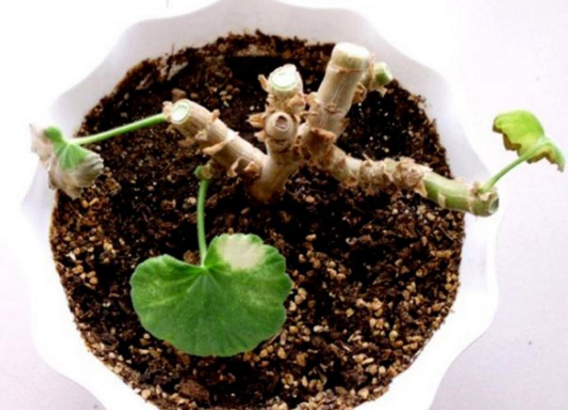
How to prune and shape geraniums
1. Geranium pruning tools
If you want a beautiful plant shape and many flowers, you have to be ruthless. Scissors, saws, knives, daggers, no matter what the weapon is, the faster and sharper the better.
Scalpels, men's single-edge razors, blades, and sharp scissors can all be used to trim cuttings, and they are excellent.
The cut should be as neat as possible so it heals quickly, especially for large thick stems like those of the Apple Blossom type.
Branches should also be cut as neatly as possible; leaving them looking gnawed by a dog makes them prone to rot.
The tools should be disinfected with alcohol, and after cutting one plant you should disinfect them before cutting others.
2. What to know before pruning geraniums
Pruning also depends on the variety. Hybrid geraniums naturally branch very poorly, so after pinching the effect will not be as obvious as with other varieties. Still, you should pinch, but do not expect too much branching; this is the characteristic trait of hybrid geraniums. So if you want to shape a perfect plant form, be careful when choosing hybrid varieties.
3. Geranium pruning methods
According to the plant's growth, after autumn choose and keep 3~5 main branches near the base that are vigorous and evenly distributed. For other overly dense, weak, and leggy branches, you can cut them off directly from the base.
Then shorten the main branches and side branches, keeping only the vigorous side buds on each side branch. In this way the whole branch structure is evenly distributed and compact, and the plant shape is full and stocky.
How to care for geraniums in summer
1. Summer care methods for geraniums
First: in the hot summer do not let the geranium pot hold standing water. The soil medium is best mixed so it can dry out as quickly as possible, such as peat soil + perlite + a small amount of plant ash, and try not to use soil media with too good water retention like Cuiyun pretty soil.
Second: one saying has been repeated many times: what geraniums need most in the hot summer is, first, ventilation, second, ventilation, and third, still ventilation.
2. Different environments require different methods
First, for flower lovers with a yard, it is easy to achieve ventilation. Just make sure the geranium gets partial shade and do not let its roots sit in standing water, and basically it will be safe and worry-free. In the dog days of summer in 2006, right when Beijing was at its hottest, I saw several pots of flowering trailing geraniums in Haiming's yard, making one sigh that being connected to the earth really makes a difference. Apart from getting through summer, geraniums are actually very easy plants to grow, so flower lovers who grow geraniums outdoors can stop reading here.
Next are flower lovers who live in buildings but whose rooms have north-south cross ventilation. Because ventilation conditions are good, put all the geraniums on the north balcony (unclosed is best) to avoid sun exposure, control water and fertilizer, and basically you can also be worry-free.
Finally, the hardest situation for geraniums is living on a poorly ventilated enclosed south-facing balcony, where the stems easily turn black and die, and the plant completely collapses. So be sure to pay attention to ventilation!
3. Summer care guide for geraniums
1. Wooden pots (cannot guarantee 100% summer survival for geraniums, but 90% is no problem)
2. Drill more holes in plastic pots for air permeability so the soil dries quickly
3. Use small wicker baskets, but be careful that water flows everywhere
4. Several other methods, for example one borrows the clematis root-flushing tube method, and another borrows the African violet cotton-wick water-drawing method; in practice, summarize after autumn.
What are the cultivation methods and precautions for geraniums?
Summary: Geraniums are relatively common in the West and are common plants for window decoration, with very strong home-decorating effect. This article mainly introduces geranium cultivation methods and related precautions.
[Geranium cultivation methods]
Geraniums are mostly planted in southern Africa. Because they are light-loving and do not like too much water, they are mainly soil-cultivated, and hydroponics is relatively rare. The detailed steps for soil cultivation of geraniums are as follows:
① Pot selection: Geraniums are flowering plants, so the choice of flowerpot needs a certain simplicity, and the material should be chosen according to cultivation needs; choose a neutral plastic flowerpot, or you may also choose an attractive ceramic pot.
② Soil preparation: Geraniums are mostly planted in spring and have strong adaptability, so the soil can be chosen freely. The most suitable soil is sandy loam with strong humus content. You may also directly choose fertile garden soil, mix it evenly, and then put it into the pot.
③ Transplanting: Plant the geranium seedling in the middle of the flowerpot, burying about two thirds of the roots, and water it in at the same time.
④ Light: Because geraniums are light-loving plants, they can be placed on a balcony to enjoy sufficient light, and if grown indoors they also need to be placed in a sunny spot.
⑤ Temperature: For geranium cultivation, the most suitable temperature is 15-20°C, but in hot summer it can tolerate temperatures below 28°C, and in winter it can tolerate temperatures of around 8. If the temperature is hard to control, it cannot bloom normally.
⑥ Fertilizing: About half a month after the geranium seedlings grow, the first fertilizing can be done, when about 3 tender leaves have grown. But geraniums do not like heavy fertilizer, so you can directly dilute fertilizer in water and irrigate it like watering. Choose decomposed soybean cake water, and fertilize once every half month. However, before and after the flowering period, choose monopotassium phosphate solution to ensure normal blooming.
⑦ Pinching: In the cultivation of flowering plants, appropriate pinching is often done at the seedling stage. When pinching, the geranium has grown to about 10 cm; remove the growing tip, and then directly prune excess branches and diseased branches.
⑧ Pruning: The pruning of geraniums should be done at the mature seedling stage, after the first flowering period. To ensure the plant shape of the geranium, pruning must be done once every half month; at this time you can also prune dead branches. The main purpose is beautification, and it can also prevent diseased branches from consuming too many nutrients.
[Geranium cultivation precautions]
Temperature control
In geranium cultivation, temperature can determine the plant's flowering time and flowering quality, and also directly affect the plant's growth rate. If the temperature is too high, leaves may turn yellow and wither, roots may rot, and sunscald may occur. If the temperature is too low, it will suppress the growth rate, causing frost damage and a lifeless appearance.
The best suitable temperature for geraniums is 10-20°C, mostly suitable for planting in spring and autumn. Therefore in summer the temperature must be controlled, avoiding direct sun in summer; it can be placed in a shaded spot, but you need to ensure about five hours or more of diffused light exposure, and in winter the temperature should not be lower than 0°C.
Water control
Geraniums are light-loving plants, and overwatering is taboo. If root rot occurs, it is mostly caused by overwatering. Even in hot summer, pay attention to the watering method, and the watering frequency can be controlled to once every 2-3 days.
Weather influence
Geranium roots are fragile, so in windy and rainy weather avoid outdoor care and move them indoors in time.
Fertilizer control
Too much fertilizer will cause geraniums to lack nutrients and become malnourished, or even show dehydration, and at the same time it will cause the plant to grow wildly yet fail to bloom for a long time, affecting the normal growth rate. For this phenomenon, water more frequently to improve it.
Conclusion: The geranium cultivation methods and precautions are introduced above. It is recommended that after buying seedlings, ask professional care staff and master the most correct cultivation methods and daily care precautions. The flower language of the geranium is "accidental encounter," and giving it directly as a gift is also the best choice.
[More related information] How to grow Cymbidium Flower languages of various flowers Hyacinth flower language Lily flower language Cherry tree pruning Apple tree pruning techniques
Geraniums must be protected against freezing in winter, as it affects flowering the following year
Geraniums like warmth and fear cold, so special attention should be paid to cold and freeze protection in winter. When cultivating geraniums in northern regions, the potted plants should be moved indoors when frost descends, placed by a sunny window so they receive sufficient light. If light is insufficient, the plant easily becomes leggy, affecting flower bud formation, and even already formed flower buds may wither due to insufficient light. If in the south, after the start of winter the potted plants should also be moved to a wind-sheltered, warm, sunny place, making it convenient both for the potted flowers to get more sun and to avoid wind and cold. Indoor temperature should maintain a daytime temperature of 15°C to 20°C, and at night not lower than 10°C. In an environment with too low a temperature, the plant grows weakly, which is not conducive to flower bud differentiation, resulting in fewer flowers or even no flowers, but an environment with a temperature above 25°C is also unfavorable for its growth and flowering.
Geraniums like dry conditions and fear dampness, so daily watering should be moderate. In winter, do not water every day; even in dry weather, generally water once every five to seven days, keeping the potting soil slightly dry with just a little moisture. Too much watering will cause leaves to turn yellow and fall off, thereby affecting flowering, and even causing root rot and death. However, frequently spraying the leaf surface with clean water and keeping the leaves clean is beneficial to photosynthesis. If you want geraniums to bloom continuously, you need to provide sufficient nutrients. Generally, apply a dilute liquid fertilizer once about every 10 days. It can be made by mixing soybean cake, hoof pieces, and fishy water, then adding water after fermentation. You can also use compound fertilizer sold in flower shops, using only 3 to 5 pieces each time. Geraniums branch a lot; to promote more flowering, the plant should be pinched several times to encourage more branching and more buds. After the flowers fade, promptly cut off the spent flowers and prune overly dense or weak branches to avoid consuming nutrients. However, in deep winter, heavy pruning is not suitable.
When growing geraniums, pruning should be carried out continuously. After each flowering, the flower stalks should be trimmed off promptly. Otherwise it not only affects the beauty of the plant shape but also consumes nutrients. In addition, the longer the branches grow, the taller they become and the more easily they age, affecting new growth and flowering, so they must also be promptly trimmed off or shortened to encourage new branches or side branches, so they produce more buds and more flowers. Especially in early spring after winter dormancy, heavy pruning should be carried out from about 10 cm above the roots, so that the newly grown branches are stronger and more vigorous, and the flowers produced are more brilliant.
The main factors restricting and affecting geranium flowering are:
1. Too much watering or being exposed to rain, with long-term standing water in the pot, causing root rot, yellowing leaves, or leggy plants, all of which affect flowering.
2. Excessive fertilizing, especially too much nitrogen fertilizer, easily causes leggy branches and leaves, no flowering or sparse flowering, and poor flower quality. However, insufficient fertilizing or no fertilizing will also affect normal plant growth and flowering. Therefore, in early spring or early autumn, appropriately apply more phosphorus and potassium fertilizer.
3. Temperature too high or too low. If the indoor temperature in winter is above 20°C, plus poor ventilation, branches and leaves easily become leggy, affecting flowering the next year. But if the overwintering temperature is below 0°C, it is also unfavorable for dormancy, and the plant is even prone to freezing damage, with leaf edges turning yellow and soft. Geraniums are also relatively sensitive to temperature differences; if there is a sharp change, it will cause flowers to drop. In hot summer and direct strong light, leaf edges are prone to sunscald, growth is poor, or flowers and leaves drop.
4. Pinching and pruning too heavily, with very few leaves for a long time, will also delay the growth period and reduce the number of buds and flowers. In addition, when caring for them indoors in winter and spring, if light is insufficient for a long time, the plant easily becomes leggy and does not bloom, and even already formed flower buds may shrink and dry up due to insufficient light. Therefore, in winter, attention should be paid to providing sufficient light. Comply with its own habits and requirements for the ecological environment, satisfy them as much as possible, and cultivate it carefully, and it will surely bloom continuously.
The above is the explanation provided by Duorou Huapu on the reasons why geraniums do not bloom and the correct winter care! I hope everyone can gain something after reading this article!