How to grow Chamaedorea elegans (parlor palm) in water culture so it blooms?
Chamaedorea elegans is a palm of the family Arecaceae, native to Mexico and Guatemala. It is very suitable as a small to medium indoor potted plant, decorating indoor environments such as living rooms, studies, meeting rooms, and hotel reception desks. It can add a tropical atmosphere and charm to the interior, add a lively touch of greenery to indoor spaces, and give the interior a charming tropical look.
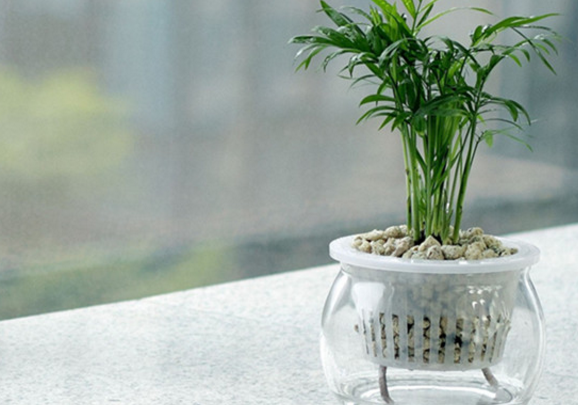
How to grow Chamaedorea elegans in water culture
Water culture method for Chamaedorea elegans:
1. Choose a potted plant with strong, healthy growth, wash the roots clean, and then grow it in water.
2. Its roots are fine and slender, and new roots sprout slowly, while old roots are brown. Use granular substrates such as expanded clay pebbles or maifan stone to anchor the plant and conceal the unattractive roots. Once new roots have sprouted, the old roots can be cut off and the plant switched to plain water culture.
3. If the Chamaedorea elegans has lush foliage, do not place too many stems in one container for water culture; instead, use a mini container for a single plant, or plant three to five plants together in one container.
Care method for Chamaedorea elegans in water culture:
The roots of Chamaedorea elegans are fine and slender, rather underdeveloped, and new roots sprout slowly in a water culture environment. However, the old roots are firm and not prone to rotting, so generally no pruning of the roots is done. Once the roots fill the container, remove 1/3 of the roots, remove the withered and yellow leaves, rinse the substrate, and repot into a container one size larger.
1. Watering
In summer, water Chamaedorea elegans 2 to 3 times a day; in winter, control the amount of watering. Wash the anchoring substrate every 6-8 weeks, especially in summer, to prevent harmful substances from damaging the plant. The pH of the nutrient solution for Chamaedorea elegans needs to be checked frequently; if it becomes too alkaline, the leaves will turn yellow. Chamaedorea elegans has a strong water-absorbing capacity, so when the water level drops, promptly top up the water to the specified level.
2. Light
Chamaedorea elegans prefers shaded environments, so water-cultured plants should not be placed near a south-facing window; instead, place them on north, east, or west windowsills, or in equivalent locations. In darker spots, the leaves grow a deeper green, while under direct light the leaf color gradually turns yellow-green. Excessive strong light can cause scorched leaves and black spots; use a 60% shade net for shading, which keeps the leaves of Chamaedorea elegans emerald green and growing well.
3. Temperature
The optimal growing temperature for Chamaedorea elegans is between 20-30°C; it enters dormancy at 13°C, and in winter it must not go below 10°C. In winter, provide good insulation for Chamaedorea elegans so it can overwinter safely.
4. Fertilizing
During the growing season, apply a water-culture nutrient solution once every 2-3 weeks. For example, 901 soilless cultivation nutrient solution or Huabao, which need to be diluted 1000-1500 times.
Does Chamaedorea elegans bloom?
1. The flowering period of Chamaedorea elegans
Chamaedorea elegans does bloom, generally in spring, though blooming is quite difficult and whether it flowers or not depends on the influence of climate and environment.
Conditions for Chamaedorea elegans to bloom: Under ordinary potted conditions, it basically will not bloom, but if you are a plant lover who cares for it attentively and provides plenty of nutrients, letting the Chamaedorea elegans store up a certain amount of nutrition, it will grow flower buds and bloom, though the blooming process is very slow. The flower buds of Chamaedorea elegans grow into little yellow balls, and these are its flowers.
2. Care during the flowering period of Chamaedorea elegans
Chamaedorea elegans is a plant that does not bloom easily; to make it bloom, you must ensure adequate nutrients
First, grow Chamaedorea elegans in a warm, humid environment with good drainage and fertile soil, and control watering according to air humidity. In dry seasons, water frequently to keep the soil moist; in rainy seasons, reduce watering. As long as the potting soil is moist, do not water.
Second, note that in summer and autumn, during the relatively dry seasons, you should frequently spray water on the leaves to keep them humid, which also keeps the leaves clean and attractive.
Finally, prevent and control diseases of Chamaedorea elegans. Under high-temperature conditions, Chamaedorea elegans can develop brown spot disease, the leaves turn yellow, affecting the growth of the stems and branches, and thereby affecting the development of flower buds. Therefore, spray with chemicals, or improve ventilation and lower the temperature.
If you want your Chamaedorea elegans to bloom, the most important thing is to ensure the nutrients it needs, sufficient light, fertile soil, excellent drainage, and appropriate watering. Your Chamaedorea elegans will accumulate nutrients on its own and then bloom.
3. The flower meaning of Chamaedorea elegans
The flower meaning of Chamaedorea elegans symbolizes vitality, because although the Chamaedorea elegans is small, its vitality is very vigorous, so it represents the spirit of strong and powerful life.
Chamaedorea elegans Chamaedorea elegans illustrated guide: how to grow Chamaedorea elegans / how to propagate Chamaedorea elegans
Chamaedorea elegans profileChamaedorea elegans Chamaedorea elegans
How to grow and care for Chamaedorea elegans and points to note; introduction to Chamaedorea elegans
Chamaedorea elegans is an evergreen small shrub, with potted height generally not exceeding 1 m. Its stem is upright, unbranched, dark green, and marked with irregular patterns. The leaves generally grow at the top of the stem, pinnately parted, with lanceolate leaflets, alternate, dark green, and glossy. They are 14-22 cm long and 2-3 cm wide; the bases of the top two pinnae are often fused into a fishtail shape. Young leaves are green, old leaves are dark green, and the surface is glossy, like a wax product. The spadix is axillary, the flowers are yellow and ball-shaped, and the plant is dioecious; the male inflorescence is slightly upright, while the female inflorescence droops slightly when nutritional conditions are good. The berries are orange-yellow. The flowering period is in spring. The leaves are flat and spreading, and mature plants look umbrella-shaped.
Chamaedorea elegans (scientific name Chamaedorea elegans), also known as dwarf coconut, parlor palm, and dwarf palm. It belongs to the genus Chamaedorea in the family Arecaceae, also known as dwarf coconut and other names, and is native to Mexico and Guatemala. Because it is also shade-tolerant, it is very suitable as a small to medium indoor potted plant, decorating indoor environments such as living rooms, studies, meeting rooms, and hotel reception desks, and can add a tropical atmosphere and charm to the interior. Placed in a corner of a room or on a coffee table, it can add a lively touch of greenery to the interior and give the room a charming tropical look.
Morphological characteristics of Chamaedorea elegans
When potted, Chamaedorea elegans does not exceed 1 m in height. Its stem is slender and upright, unbranched, dark green, with irregular ring markings. The leaves emerge from the top of the stem, are pinnately compound, fully parted, with broad lanceolate leaflets; there are 20-40 pinnate leaflets, sickle-shaped, dark green, and glossy. The plant blooms in spring, with axillary spicate inflorescences and separate male and female plants; the male flowers are slightly upright, while the female inflorescence droops slightly when nutritional conditions are good. The flowers are yellow and bead-like; the small berries produced are mostly orange-red or yellow.
Plant height 4-5 m, stem slender. Leaves terminal, pinnately compound and arching, with a sharp tail and a 2-cleft apex. The spadix droops, paniculate, flowers unisexual, monoecious.
The optimal growing temperature for Chamaedorea elegans is 20-30°C; it enters dormancy at 13°C, and the overwintering temperature is 10°C.
Chamaedorea elegans is a perennial evergreen small shrub of the family Arecaceae and the genus Chamaedorea, with an upright, solitary, dark green stem bearing irregular markings. The leaves are pinnately parted, with lanceolate leaflets, dark green and glossy. There are about 120 species in the same genus, mainly distributed in the tropical regions of Central America. It likes high temperature, high humidity, and semi-shaded environments. In plant taxonomy, it is an evergreen dwarf shrub or small tree of the palm family, and the plant is small in stature. Its English species name means graceful. Because its plant shape closely resembles a tropical coconut palm and its form is small, exquisite, and attractive, it is named Chamaedorea elegans (parlor palm).
Ecological habits of Chamaedorea elegans
It likes warm, humid, and semi-shaded environments. The suitable growing temperature is 20-30°C; it enters dormancy at 13°C, and the minimum overwintering temperature in winter is 3°C. The cultivation substrate for Chamaedorea elegans is best as well-drained, moist, fertile loam. When potting, a mixture of leaf mold and peat soil plus 1/4 river sand and a small amount of base fertilizer can generally be used as the substrate. It does not have high fertilizer requirements; generally, apply liquid fertilizer 1-2 times a month during the growing season, and apply little or no fertilizer in late autumn and winter. Repot once every 2-3 years in spring. When watering Chamaedorea elegans, follow the principle of preferring moist over dry, and just keep the potting soil consistently moist. In summer and autumn when the air is dry, frequently spray water on the plant to increase the ambient air humidity; this benefits its growth and also keeps the leaf surface dark green and glossy. In winter, appropriately reduce watering to help it overwinter. Chamaedorea elegans likes semi-shaded conditions and avoids direct sunlight in hot seasons. Under strong sunlight, its leaf color becomes lighter or yellow, and scorched leaves and black spots appear, losing ornamental value. In addition, under high temperature and high humidity, Chamaedorea elegans is prone to brown spot disease. If brown spot disease is found, promptly use 800-1000 times diluted thiophanate or baijunlingqing for control. When the air is dry and ventilation is poor, scale insects are also likely to occur. If scale insects are found, they can be removed manually, or sprayed with 800-1000 times diluted omethoate for control.
Cultivation techniques for Chamaedorea elegans
The cultivation substrate for Chamaedorea elegans is best as well-drained, moist, fertile loam. When potting, a mixture of leaf mold and peat soil plus 1/4 river sand and a small amount of base fertilizer can generally be used as the substrate. It does not have high fertilizer requirements; generally, apply liquid fertilizer 1-2 times a month during the growing season, and apply little or no fertilizer in late autumn and winter. Repot once every 2-3 years in spring. Follow the principle of preferring dry over wet when watering, and just keep the potting soil consistently moist. In summer and autumn when the air is dry, frequently spray water on the plant to increase the ambient air humidity; this benefits its growth and also keeps the leaf surface dark green and glossy. In winter, appropriately reduce watering to help it overwinter. Chamaedorea elegans likes semi-shaded conditions and fears direct sunlight. Under strong sunlight, its leaf color becomes lighter or yellow, and scorched leaves and black spots appear, losing ornamental value. In addition, under high temperature and high humidity, Chamaedorea elegans is prone to brown spot disease. If brown spot disease is found, promptly use 800-1000 times diluted thiophanate or baijunlingqing for control. When the air is dry and ventilation is poor, scale insects are also likely to occur. If scale insects are found, they can be removed manually, or sprayed with 800-1000 times diluted omethoate for control. When seedlings grown from seed reach 10 cm in height, they can be transplanted into nutrient pots. The cultivation substrate is peat, perlite, expanded clay pebbles, and so on. After planting, the first application of nutrient solution should be thorough, until seepage is seen in the saucer at the bottom of the pot. For regular replenishment of solution, replenish once every 10-15 days; replenish water in time according to the moisture condition of the substrate, but do not replenish water on days when solution is replenished. Before each water replenishment, first pour out the seepage from the saucer; if no disease occurs, it can be reused, otherwise it should be discarded. When there is no seepage in the saucer, water promptly. Each time you replenish solution or water, it is best to use a small sprinkling can for irrigation; for large-scale cultivation, sprinkler irrigation facilities can be set up to spray nutrient mist directly. This not only rinses the substrate but also increases the air humidity around the plant, benefiting normal plant growth.
From October to February of the following year in winter, this is the relatively dormant period for Chamaedorea elegans (night temperature 12-14°C), and watering should be controlled to prevent root rot, yellow leaves, necrosis, and other symptoms caused by excessively low temperatures. During the winter heating period in northern regions, room temperature can generally be maintained at 15-20°C or 25°C. At this time, indoor air is dry, so attention should be paid to replenishing water; it is best to spray water on the leaf surface 1-2 times a day, and the flowerpot should not be placed close to a stove, radiator, or air conditioner, to prevent acute water loss from the leaves, causing dry tips, yellow leaves, or even death. In addition, in winter, place the flowerpot in a sunny spot indoors to facilitate photosynthesis.
Soilless cultivation
Soilless cultivation technology for growing Chamaedorea elegans uses an inorganic chemical fertilizer solution, that is, the nutrient solution cultivation method. Chamaedorea elegans prefers shaded environments and should not be placed near a south-facing window; instead, place it on north, east, or west windowsills, or in equivalent locations. In darker spots, the leaves grow a deeper green, while under direct light the leaf color gradually turns yellow-green. Excessive strong light can cause scorched leaves and black spots. The optimal growing temperature is between 20-30°C; it enters dormancy at 13°C, and in winter it must not go below 10°C.
For watering, follow the principle of preferring moist over dry, keeping the potting soil moist year-round. In winter, appropriately reduce the amount of water, and it is best to water with cooled boiled water. In summer, clean rainwater may be used. Frequently spray water on the leaves and the surrounding ground to maintain relatively high air humidity.
Management table
Growing temperature: between 20-30°C; enters dormancy at 13°C; in winter must not be below 10°C.
Sunlight: prefers shaded environments, 60% shade net.
Cultivation substrate: river sand or 1/2 vermiculite + 1/2 perlite
Fertilizing: during the growing season, apply a water-culture nutrient solution once every 2-3 weeks. For example, 901 soilless cultivation nutrient solution or Huabao, diluted 1000-1500 times.
Watering: in summer, water 2-3 times a day; in winter, control the amount of watering. Wash the anchoring substrate every 6-8 weeks, especially in summer. This prevents harmful substances from damaging the plant. Frequently check the pH of the nutrient solution; if it becomes too alkaline, the leaves will turn yellow. Chamaedorea elegans has a strong water-absorbing capacity, so when the water level drops, promptly top up the water to the specified level.
It is very important to master the management methods for soilless cultivation of Chamaedorea elegans. Try to avoid direct sunlight and prevent the nutrient solution from evaporating too quickly; it can be placed in a bright spot. Once the roots fill the container, remove 1/3 of the roots, remove the withered and yellow leaves, rinse the substrate, and repot into a container one size larger.
Nutrient solution
1. Easily soluble salts should be used to prepare the nutrient solution.
2. Mineral nutrient elements should be controlled within 4‰. Control the amount of trace elements used.
3. Measure the pH of the nutrient solution in time to maintain the acidity and alkalinity required by the plant.
4. The types of various elements in the nutrient solution vary with different plants and different growing conditions.
Chamaedorea elegans is called the desk coconut. If paired with a plain and elegant container, it looks even more beautiful and distinctive. Choose a ceramic or glass container with no hole at the bottom or an opening on the side, and it should suit the size of the plant. First spread clean large or medium expanded clay pebbles as an anchoring substrate, about 2-3 cm thick, then place the plant into the flowerpot. Try to spread the roots out in all directions, then fill with clean expanded clay pebbles, leaving 3-5 cm from the rim of the pot. Note that during the growing season the roots must be washed clean. Remove the old roots, spread the roots out, and place them in the center of the flowerpot. After transplanting, pour in the prepared diluted nutrient solution until it reaches 1/5 of the container height.
Pre-harvest management
The placement density is 6-18 pots per square meter, depending on the size of the plant. Chamaedorea elegans likes a slightly moist, somewhat dry soil environment. In addition to applying a small amount of leaf mold as base fertilizer at the base of the flowerpot when planting, during the vigorous growth stage a thin liquid fertilizer should also be applied once every half month. Chamaedorea elegans likes a loosely shaded environment and avoids direct sunlight; especially plants that have long been kept in a shaded environment, if suddenly placed in strong direct sunlight, will have their leaves scorched. Just maintain appropriate ventilation in the environment. Chamaedorea elegans likes warm environments, and its optimal growing temperature is 16-28°C; the overwintering temperature should not be lower than 5°C.
Management and care
After being moved outdoors in spring, it should be placed in a shaded spot, avoiding direct sunlight; relatively bright light is enough. When the plant is larger, repot it in time. It has relatively high requirements for environmental humidity, and watering should follow the principle of preferring moist over dry to keep the potting soil moist. When the air is dry, frequently spray water on the plant to increase the ambient air humidity. This flower and plant does not have high fertilizer requirements; from May to October, apply cake fertilizer water twice a month.
Seeds should be sown as soon as they are collected; at a temperature of about 25°C, germination takes about 3 months. During the seedling stage, Chamaedorea elegans tillers quite a lot, so divide the plants in time. Plant height should preferably be controlled between 40-60 cm, so fertilizing should not be excessive; generally, during the seedling stage and in spring and autumn, applying thin liquid fertilizer 3-4 times is enough. Repot once every 2-3 years in spring to promote growth.
Key care points
To grow Chamaedorea elegans well, the issues to note include:
Light: Chamaedorea elegans likes semi-shade; under strong sunlight the leaves turn scorched yellow; if kept in a place with insufficient light for a long time, the plant becomes spindly. So indoors it is best placed in a bright spot by a window.
Temperature: Chamaedorea elegans likes warmth; the optimal growing temperature is 18-24°C, and it enters dormancy at 13°C. In winter it is best not to go below 10°C.
Watering: Chamaedorea elegans likes water; during the growing period keep the soil moist, and during the dormant period wait until two-thirds of the potting soil is dry before watering. In addition, Chamaedorea elegans likes high air humidity; if it is too dry, the leaf tips turn brown. So during dry periods such as autumn, take measures such as frequently spraying water on the leaf surface to increase the air humidity around the plant.
Fertilizing: during the growing season, apply a compound fertilizer to the plant once a month.
Potting soil: it is best to grow it in well-drained, loose, fertile loam.
Propagation: Chamaedorea elegans is generally propagated by seed.
Water culture care
1. Avoid direct sunlight, otherwise the leaves will turn scorched yellow, but in too shady a place the leaf color will also fade.
2. Chamaedorea elegans is at its most beautiful at a plant shape of 30-50 cm; when the plant is too tall, the lower part becomes bare, reducing its ornamental value, so when growing it, small plants can be planted below. 3. Obtaining water culture material: use the potted root-washing method. After washing in water, new roots can grow within a few days.
With current nutrient solution formulations, most plants can be grown in water culture, but they need careful care, otherwise the flowers are likely to die from nutrient problems! See Potted Plants Converted to Water Culture [1]
Points to note
To grow Chamaedorea elegans well, the following technical issues should be noted:
① Beware of scorched edges caused by too much light. Because Chamaedorea elegans likes relatively shaded environments, indoors it should be placed near a north window, an east window, or another spot with bright scattered light; Chamaedorea elegans fears strong direct light most, and even a short period of exposure can cause leaf scorch and yellowing. Conversely, if kept in too dry and dark a place for a long time, the leaf color will also fade and lose its gloss.
② Suitable growing temperature. The optimal growing temperature is generally 20-30°C; in winter the indoor temperature should be between 12-14°C, and the minimum temperature must not be lower than 10°C.
③ Maintain the surrounding air humidity. It is necessary to frequently spray water on the leaf surface to increase air humidity.
④ Do not use acidic soil for the potting soil, and a small amount of clay should also be added.
⑤ Repot once every 3 years.
⑥ During the seedling stage, applying thin liquid fertilizer 3-4 times in spring and autumn is enough.
Chamaedorea elegans is also known as dwarf coconut. Its plant shape resembles a tropical coconut palm, evergreen all year round, petite and lovely. Placing one pot indoors can recreate a tropical scene with plenty of charm. Because the roots of Chamaedorea elegans are relatively fine and slender, loose, fertile potting soil should be chosen when potting; using heavy clay soil easily causes root rot. Because it likes relatively shaded environments, indoors it should be placed near a north window, an east window, or another spot with bright scattered light. Chamaedorea elegans fears strong direct light most. Even a short period of exposure can cause leaf scorch and yellowing. Conversely, if kept in too dark a place for a long time, the leaf color will also fade and its gloss will weaken. The optimal growing temperature is 20-30°C; in winter the room temperature should be between 12-14°C, and the minimum must not be lower than 10°C. Chamaedorea elegans has a strong water-absorbing capacity, so during the growing period the potting soil needs to be kept moist frequently, and during the dormant period watering should be controlled. In summer, watering should be ample, and water should also be sprayed on the leaf surface frequently to increase air humidity. To meet indoor ornamental needs, plant height is best controlled between 40 cm and 60 cm, so fertilizing should not be excessive. Generally, during the seedling stage and in spring and autumn, applying thin liquid fertilizer 3-4 times is enough. The ratio of nitrogen to phosphorus in the fertilizer is best at 1.5:1.2. This ratio can both promote sturdy stems and improve leaf gloss. Repot once every 2-3 years in spring to promote growth. Because Chamaedorea elegans is difficult to root from cuttings, seed sowing is mainly used for propagation.
Propagation method of Chamaedorea elegans: seed propagation
Selection: Before sowing, the seeds must first be selected; whether the seeds are well chosen directly affects whether sowing succeeds.
1. It is best to use seeds harvested in the current year. The longer the seeds are stored, the lower their germination rate.
2. Choose seeds that are plump and free of defects or deformities.
3. Choose seeds free of pests and diseases. Disinfection: Disinfection includes two concepts, one refers to disinfecting the seeds, and the other refers to disinfecting the sowing substrate. For household seed disinfection, a common method is to soak the seeds in hot water at about 60°C for a quarter of an hour, then use warm water to promote germination for 12-24 hours. For disinfecting the sowing substrate, the best method is to put it in a pot and heat it while stirring; any pests and diseases will be killed by the heat.
Germination promotion: Soak the seeds in warm water for 12-24 hours, until the seeds absorb water and swell. For very common seeds that germinate easily, this step can be skipped.
Sowing: For tiny seeds that are difficult to pick up with your hands or other tools, you can moisten one end of a toothpick with water and stick the seeds one by one onto the surface of the substrate, then cover with substrate 1 cm thick, then place the sowing flowerpot into water, with the water depth at 1/2-2/3 of the flowerpot height, letting the water slowly soak up from below (this method is called the "pot immersion method"); for larger seeds that can be picked up with your hands or other tools, directly place the seeds into the substrate and sow them in spots at a spacing of 3 x 5 cm. After sowing, cover with substrate to a thickness 2-3 times that of the seeds. After sowing, use a sprayer or a fine-hole watering can to moisten the sowing substrate, and later when the potting soil is slightly dry, water again; still be careful not to water too forcefully, so as not to wash the seeds out;
Management after sowing: After sowing in late autumn, early spring, or winter, if a cold wave and low temperatures occur, you can wrap the flowerpot in plastic film to help keep it warm and moist; after the seedlings emerge, promptly uncover the film, and let the seedlings receive sunlight before 9:30 every morning or after 3:30 in the afternoon, otherwise the seedlings will grow very weak; after most of the seeds have emerged, appropriate thinning is needed: pull out the diseased and unhealthy seedlings so that the remaining seedlings have a certain amount of space from one another; when most of the seedlings have grown 3 or more leaves, they can be transplanted.
Strong, healthy plants can bloom in 3-4 years; when blooming, they can set seed after artificial pollination, and the fruit takes 6-7 months to mature. Sowing should preferably be done as soon as the seeds are collected, and spring sowing is preferable. Choose plump, large, fresh seeds, wash the berries, rub the seeds, and sow them directly in a river sand seedling bed, using plastic film to keep warm and raise seedlings. The soil should be kept moist, and the temperature should be controlled at 24-26°C. Generally it takes 3-6 months to germinate and emerge. When the seedlings have 3-4 leaves, they can be given a light application of decomposed human waste water or 0.3% urea solution, mixed evenly with a small amount of potassium sulfate and poured on, to promote strong growth. The following spring, thinning can be done, and the seedlings can be potted for cultivation and care.
Division propagation
Choose a mixed substrate of peat and perlite, use a plastic flowerpot with a diameter of 15 cm to 20 cm, and add expanded clay granules at the bottom of the pot as a drainage layer. Take a soilless potted Chamaedorea elegans that is more than one year old and divide it in spring along with repotting, planting it in the flowerpot with the above mixed substrate, with 3 to 4 plants per pot.
From October to February of the following year is the relatively dormant period for Chamaedorea elegans. In northern regions, place it in a sunny spot indoors in winter, with the temperature kept at 15-25°C. If the air is dry, spray water on the leaf surface daily to keep it moist. When indoor temperatures are low, water less, and water again only when the surface layer looks dry, because with low temperatures and too much water, root rot easily occurs. In summer in the north, indoor scattered light is suitable for the growth of Chamaedorea elegans, but attention should be paid to frequently spraying water on the leaf surface to keep it moist.
After planting, the first application of comprehensive nutrient solution should be thorough, until seepage is seen in the saucer. Normally, replenish solution and water according to routine, but do not replenish water when replenishing solution, and keep the substrate moist.
Chamaedorea elegans likes warm, humid environments and prefers fertile, loose soil with good aggregate structure for growth. The optimal growing temperature is 20-30°C; it enters dormancy at 13°C, and the overwintering temperature is 10°C. For potting, use leaf mold, peat soil, or dried pond mud or vegetable garden soil, add 1/4 coarse river sand or coal cinder granules, and add a small amount of decomposed organic fertilizer and a small amount of superphosphate, mix evenly as base fertilizer for the potting soil. For small pots of seedlings, 3 plants are suitable; for medium pots, 5 plants are suitable. After potting, water with rooting water, and place in a semi-shaded shed for cultivation. After new leaves emerge, switch to normal management. During the growing period from April to October, apply liquid fertilizer or compound fertilizer 1-2 times a month; the fertilizer is mainly decomposed peanut bran water, or a compound fertilizer containing nitrogen, phosphorus, and potassium diluted with water and poured on. Apply compound fertilizer every 15-20 days to promote rapid growth and lush greenness; apply 5-8 g for small pots and 10-12 g for medium pots. Keep the potting soil moist, and water once only after the potting soil looks dry. Spray a solution of 0.2% urea + 0.2% monopotassium phosphate every 10-15 days to promote strong plant growth and dark green leaves. In late autumn and winter, apply little or no fertilizer. Repotting every 2-3 years in mid-to-late March of spring is preferable. During the growing period, water according to the principle of preferring dry over wet, and keep it ventilated and cool, which benefits plant growth and can improve disease resistance. Just keep the potting soil moist. If there is a lot of rainfall or excessive watering, and the potting soil is too wet, it easily causes rot and disease in the lower leaves of the plant, leading to the occurrence and spread of black spot disease, causing leaves to turn yellow or even die.
Humidity: Keep the relative air humidity at 75-85%. The basic requirement for cuttings to root is that before the cuttings root, it must be ensured that the cuttings remain fresh and tender enough to carry out photosynthesis to produce rooting substances. However, cuttings that have not rooted cannot absorb enough water to maintain their internal water balance. Therefore, misting must be used to reduce water evaporation from the cuttings: under shaded conditions, mist the cuttings 3-5 times a day; the higher the temperature on sunny days, the more frequent the misting, while on cloudy and rainy days with lower temperatures, mist less or not at all. But excessive misting makes the cuttings susceptible to infection by pathogens and rot, because many kinds of pathogens exist in water.
Light: Sunlight is indispensable, because the cuttings still need to continue photosynthesis to produce nutrients and rooting substances to supply their rooting needs. However, the stronger the light, the higher the temperature inside the cuttings, the more vigorous the transpiration of the cuttings, and the more water they consume, which is not conducive to the survival of the cuttings. Therefore, after cutting, 50-80% of the sunlight must be shaded out, and after the root system grows out, gradually remove the shade net: on sunny days, remove the shade net at 4:00 every afternoon, and cover the shade net again before 9:00 the next morning.
Chamaedorea elegans grows relatively fast in high-temperature, high-humidity, semi-shaded environments. It fears direct sunlight; under strong sunlight its leaf color becomes lighter or yellow, and scorched leaves and black spots appear, losing ornamental value. It is relatively shade-tolerant. During the seedling cultivation period or growing period, especially in summer and autumn, the shading degree is generally 60%, but in winter and spring it is preferable to give relatively bright scattered light. Placing it indoors for 1-2 months will not have much effect on plant growth and ornamental value, but during the display period attention should be paid to spraying water on the leaf surface to clean the leaves, making the leaf color dark green, glossy, and bright. Regularly expose it to scattered light, and pay attention to fertilizer and water management, to improve the ornamental effect.
High temperature, high humidity, and poor ventilation easily cause black spot disease, especially during the vigorous growing period from April to November, so attention must be paid to disease prevention. Once leaf tip scorch is found, promptly spray 50% thiophanate or 50% chlorothalonil 800-1000 times diluted solution for control, and at the same time ensure the indoor environment is ventilated and cool, with good air permeability, and appropriately apply more phosphorus and potassium fertilizers, such as plant ash, to promote strong plant growth. The soil should be well drained, not too dry, and not too wet. During the growing period, the potting soil should remain moist to benefit plant growth and improve disease resistance. Dry air and poor ventilation easily cause scale insect damage; you can spray 40% omethoate 1000 times diluted solution or 25% buprofezin wettable powder 1500-2000 times diluted solution, or 20% fenvalerate 1500 times diluted solution for control, and depending on the pest situation, spray again after 10-15 days.
Renewal propagation
Girdle in advance to promote callusing. After late May, keep the stem-top cutting at a height of 15 cm to 20 cm, then strip off the old leaves below this height completely, exposing the stem. Next, use a sharp knife to make a girdle 0.6 cm to 1 cm wide below a certain stem node and peel off the stem skin. After that, air-dry for a week to let the wound heal naturally on the mother plant. During this period, mist the leaf surface in the morning and evening to appropriately increase air humidity, and place it in 50% to 70% shade to ensure effective accumulation through photosynthesis.
Air layering in time. One week after the girdling and callusing treatment, use plastic film to wrap the girdled area, tie the lower part of the girdled area tightly with string, fill it with moss mixed with soil at appropriate moisture, then tie the upper opening tightly as well. Generally, replenish water about once every 10 days, about 2 to 4 times in total, and in about one month roots can be seen. After rooting, choose a sunny day to cut off the cutting, remove the film, and let the roots retain as much moss-mixed soil as possible. After planting, cultivate it in a cool place for a period of time, and then it can be managed normally like the original mother plant; the new plant will bring new vitality.
Uses and functions of Chamaedorea elegans: household functions
It can simultaneously purify benzene, trichloroethylene, and formaldehyde from the air, making it a "high-efficiency air purifier" among plants. It is very suitable for placing indoors or in newly renovated rooms.
Application value
The Chamaedorea elegans plant is small and exquisite, with a graceful plant shape and elegant bearing. Its leaves are dark green and glossy, and it has strong shade tolerance, making it an excellent small to medium indoor potted foliage plant. The leaves are flat and spreading, and mature plants look umbrella-shaped, dignified and solemn, simple yet elegant; the leaves are unrestrained and lustrous as jade, giving a sense of sincerity, simplicity, and abundant vitality. Small plants are suitable for planting in small pots and placing on a desk or tabletop as a treasured item on the stand, and are also suitable for hanging indoors to decorate the space. Larger plants can be displayed in halls, meeting rooms, airport lounges, and other places, making it an important foliage plant for beautifying interiors, and it has already become popular all over the world.
Disease and pest control for Chamaedorea elegans
Common diseases and pests of Chamaedorea elegans include brown leaf scale and anthracnose.
1. Brown leaf scale. Pest symptoms: leaf color becomes lighter with pale spots; in severe cases the plant weakens, affecting growth and losing ornamental value. Control methods: (1) use the red-spotted ladybird beetle for biological control; (2) when larvae appear in large numbers, spray with 40% omethoate 1000 times diluted solution once a week.
2. Anthracnose. Disease symptoms: at the beginning of the disease the leaf tips are dark brown, the lesions slowly expand, and in the later stage the leaf lesions merge into one patch. Control methods: (1) strengthen care, do not bruise the leaves, spray more water to keep the leaves clean; (2) in summer, spray 1% Bordeaux mixture of equal amounts once every 10 days.
In addition, in hot seasons Chamaedorea elegans can also develop leaf spot disease and root rot, so attention should be paid to ventilation in its growing environment and air permeability of the soil. When necessary, spray thiophanate and chlorothalonil for control.
Variety classification of Chamaedorea elegans and distinctions between similar species
These two plants are relatively similar in appearance; the specific distinctions are as follows:
① Areca palm: The stem is smooth, without hairs or thorns, cylindrical, slightly swollen at the base, and can reach 3-8 m in height. The leaves are smooth and slender, pinnately parted to the base, with 40-60 leaflets per leaf, arranged in 2 rows, fairly stiff, not drooping, lanceolate, 40-60 cm long, with a long tail-like acuminate tip that is unequally short 2-cleft, bright green. The slender petiole and stem are golden yellow, and the leaf sheath is yellow-green, initially covered with white powder on the upper part, later falling off. The spadix grows below the leaf sheath cluster, much branched, arranged as a panicle. It is dioecious, with small golden-yellow flowers. The fruit is top-shaped, purple-black, without an endocarp.
② Parlor palm: It reaches at most 1-3 m in height; potted plants are mostly about 20-50 cm. The stem is upright and unbranched, and the leaves emerge from the top, pinnately parted to the base, with broad lanceolate leaflets, dark green and glossy. It blooms in spring. The spadix is axillary, and the species is dioecious. The male inflorescence is upright, while the female inflorescence droops slightly when nutritional conditions are good. The flowers are yellow and small, bead-like. The fruit is orange-red.
Identifying the parlor palm
The parlor palm also has many other names, such as dwarf coconut palm, miniature palm, miniature areca, and happy palm. It belongs to the genus Chamaedorea in the palm family and is a perennial evergreen small tree. The plant height is about 1 m, and under warm open-field cultivation it can reach more than 2 m. The root system is well developed. The stem is slender and upright, usually solitary, dark green, and bears ring marks left by the base of the leaf sheaths after the leaves fall; the spacing between the ring marks varies. The leaves are alternate and clustered at the tip of the stem, odd-pinnate and parted to the base, 30-40 cm long, with lanceolate leaflets, 20-40 in number, dark green, and leathery. The spadix is much branched and powdery, in the form of a panicle. It is monoecious, with both sexes in the same inflorescence, and the flowers are yellow. The fruit is nearly round and blue-black when ripe. Cultivated plants rarely set fruit.
Parlor palm pictures
Parlor palm: how to grow the parlor palm, and appreciation of parlor palm pictures
Native to Mexico and Guatemala, the parlor palm is an ornamental indoor potted plant. It is named for being small, exquisite, and beautifully distinctive. As a small to medium-sized indoor potted plant, it can add a tropical atmosphere and charm to a room. Today, here the editor will tell everyone about how to grow the parlor palm, and include parlor palm pictures for everyone to enjoy.
[Editor's picks] Indoor plants, Cuban oregano, fragrant wood, hydroponic plants, small potted plants, flowering plants, feng shui plants, radiation-proof plants, love-in-a-mist
[Parlor palm] How to grow the parlor palm, parlor palm pictures
——————————————————————————————————————————————
[Plant profile]
——————————————————————————————————————————————
Chinese name: Parlor palm
Scientific name: Chamaedorea elegans
Aliases: Dwarf coconut palm, miniature palm, dwarf palm
Family: Arecaceae
Genus: Chamaedorea
Origin and distribution: Native to Mexico and Guatemala.
Morphological characteristics: A potted parlor palm does not exceed 1 m in height. Its stem is slender and upright, unbranched, dark green, with irregular ring patterns. The leaves emerge from the top of the stem, are compound and pinnate, parted to the base, with broad lanceolate leaflets; there are 20-40 pinnate leaflets, sickle-shaped, dark green, and glossy. The plant blooms in spring. The spadix is axillary, and the species is dioecious. The male flowers are slightly upright, while the female inflorescence droops slightly when nutritional conditions are good. The flowers are yellow and small-bead-like. The small berries are mostly orange-red or yellow.
How do you grow the parlor palm?
——————————————————————————————————————————————
◆ Growth habits: It prefers a warm, humid, and semi-shaded environment. The suitable growing temperature is 20-30°C. At 13°C it enters dormancy, and the minimum winter overwintering temperature is 3°C.
◆ Potting soil: For potted parlor palm, a substrate made from leaf mold and peat soil plus 1/4 river sand and a small amount of base fertilizer can generally be used. Loam soil that drains well and is loose and fertile is best for planting.
◆ Watering: Follow the principle of preferring moist over dry when watering; just keep the potting soil often moist. In summer and autumn, when the air is dry, spray the plant frequently to raise the ambient air humidity. This favors its growth and at the same time can keep the leaf surface dark green and glossy. In winter, reduce the amount of watering appropriately to help it overwinter.
◆ Fertilizing: The parlor palm does not demand much fertilizer. Generally, apply liquid fertilizer 1-2 times per month during the growing season, and apply little or no fertilizer in late autumn and winter. Repot once every 2-3 years in spring.
◆ Propagation: The parlor palm is generally propagated by seed.
◆ Temperature settings: The suitable growing temperature is 15-30°C, of which May-September is 19-30°C, and October to April of the following year is 13-16°C. In summer it can tolerate high temperatures of 35°C. When the temperature exceeds 35°C, appropriate shading or measures such as spraying water and ventilation should be taken. In winter, the ambient temperature should be kept no lower than 5°C; otherwise, when temperatures below 5°C persist for a long time, it is prone to cold damage and leaf drop.
◆ Placement: The parlor palm is very tolerant of light, but the best location is a semi-shaded spot with 50-60% sunlight.
◆ Disease and pest control: In addition, under high temperature and high humidity, the parlor palm is prone to brown spot disease. If brown spot disease is found, promptly use 800-1000 times diluted thiophanate or carbendazim for control. When the air is dry and ventilation is poor, scale insects are also likely to occur. If scale insects are found, they can be removed manually, or sprayed with 800-1000 times diluted omethoate for control.
How to grow the parlor palm
——————————————————————————————————————————————
① Sowing
Selection: Before sowing, the seeds must first be selected. Whether the seeds are well chosen directly affects whether sowing succeeds.
◆ Choose seeds free of pests and diseases.
◆ Choose seeds that are plump and free of damage or deformities.
◆ It is best to use seeds harvested in the same year. The longer the seeds are stored, the lower their germination rate.
Disinfection: Disinfection includes two concepts: one refers to disinfecting the seeds, and the other refers to disinfecting the sowing substrate.
Stratification: Soak the seeds in warm hot water for 12-24 hours until the seeds absorb water and swell. For very common seeds that germinate easily, this step can be skipped.
Method: For tiny seeds that are difficult to pick up by hand or with other tools, moisten one end of a toothpick with water, stick the seeds one by one onto the surface of the substrate, cover with substrate 1 cm thick, then place the sowing pot into water with a depth of 1/2-2/3 the height of the pot so the water slowly seeps up. For larger seeds that can be picked up by hand or with other tools, place the seeds directly into the substrate and sow them in spots at a spacing of 3 x 5 cm.
Management: After sowing in late autumn, early spring, or winter, if cold waves and low temperatures occur, the flowerpot can be wrapped in plastic film to help preserve heat and moisture. After the seedlings emerge, promptly uncover the film. After most of the seeds have sprouted, appropriate thinning is needed: pull out diseased and unhealthy seedlings so that the remaining seedlings have a certain amount of space from one another. When most of the seedlings have grown 3 or more leaves, they can be transplanted.
② Division
Method: Use a mixed substrate of peat and perlite, and use plastic flowerpots with a diameter of 15 cm to 20 cm, with ceramsite added to the bottom of the pot as a drainage layer. For soilless potted parlor palms more than one year old, divide them in spring together with repotting, and plant them in flowerpots with the above mixed substrate, with 3 to 4 plants per pot.
Humidity: Keep the relative air humidity at 75-85%. The basic requirement for spike rooting is that before the cuttings root, the cuttings must remain fresh and tender enough to carry out photosynthesis to produce rooting substances. However, cuttings that have not rooted cannot absorb enough water to maintain their internal water balance.
Light: Sunlight is indispensable. After cutting, 50-80% of the sunlight must be blocked. After the root system grows, gradually remove the shade net: on sunny days, remove the shade net at 4:00 p.m. each day, and cover it again before 9:00 a.m. the next day.
To grow the parlor palm well, attention should be paid to the following technical issues:
——————————————————————————————————————————————
◆ During the seedling stage, apply thin liquid fertilizer 3-4 times in the two spring seasons.
◆ Beware of scorched leaf edges caused by too much light. Because the parlor palm prefers a more shaded environment, indoors it should be placed near a north window, east window, or another spot with bright scattered light. The parlor palm fears direct strong light most; even brief exposure to the sun can cause leaf scorch and yellowing of the leaves. Conversely, if it is kept in an overly dry and dark place for a long time, the leaf color will also fade and lose its gloss.
◆ Suitable temperature. The optimum growing temperature is generally 20-30°C. In winter, the indoor temperature should be between 12-14°C, and the minimum temperature must not be lower than 10°C. At the same time, the surrounding air humidity should also be maintained. Spray water on the leaf surface frequently to increase air humidity.
◆ Repot once every 3 years. The potting soil must not use acidic soil, and a small amount of clay should also be added.
The benefits of the parlor palm
——————————————————————————————————————————————
The parlor palm not only has high ornamental value, but can also purify benzene, trichloroethylene, and formaldehyde from the air, making it a "high-efficiency air purifier" among plants. It is very suitable for placement indoors or in newly renovated rooms.
"Conclusion: The parlor palm is a relatively popular indoor potted plant in the north, and in recent years it has become popular all over the world. Many consumers are always attracted by its verdant color. It is believed that as long as you understand how to grow the parlor palm and give it careful attention, the parlor palm will show a perfect appearance with a graceful plant shape, elegant posture, and dark green, glossy leaves.
[More plant encyclopedia]
How to grow creeping fig, how to grow sago palm, the benefits of cactus, the characteristics of peony, how to grow wintersweet, how to grow Aglaia odorata
How to grow pothos and precautions, does the golden barrel cactus protect against radiation, how to grow bromeliads, Cyclamen leaves turning yellow, blue enchantress price
Lucky bamboo, sago palm pictures, how to grow sago palm, is the rubber tree poisonous, sunflower flower language, Ping'an tree, cyclamen, water lily, Sansevieria with golden edges
Spider plant leaf tips turning yellow, how to grow lilies, nine-child Cymbidium, Anthurium, is the flamingo flower poisonous, how to grow the money tree, Buddhist pine bonsai pictures