Azalea Growing Methods and Precautions, and the Difference from Ying Shan Hong (Mountain Azalea)
When it comes to azaleas, many people love to grow them. Azaleas are truly gorgeous. Let's take a look at the growing methods and precautions for azaleas. What is the difference between azaleas and Ying Shan Hong:
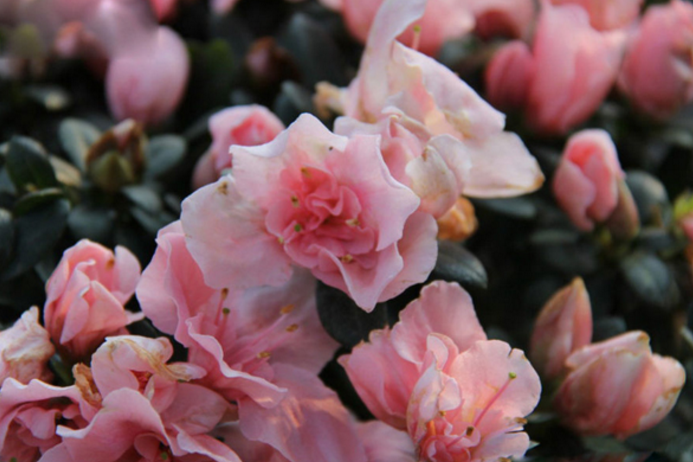
Azalea growing methods and precautions:
1. Care environment requirements
When planting azaleas, it is best to have both indoor and outdoor environments. Azaleas overwinter indoors; a sunny, well-ventilated spot is sufficient. In other seasons, place them outdoors, preferably on soil ground, with as spacious a site as possible and appropriate shade.
2. Potting soil requirements
Azaleas prefer loose, well-aerated soil with good drainage, with a pH between 5 and 6. Try not to use clay or alkaline soil. In particular, some varieties such as summer azaleas and Western azaleas can only use mountain soil.
3. Flower pot selection
Azaleas usually use two kinds of flower pots: clay pots and purple clay (zisha) pots.
Clay pots have relatively good air permeability and water permeability, and most azaleas cared for outdoors use this kind of pot.
For well-formed azaleas, especially those already shaped, an attractive and elegant purple clay pot is usually chosen. Purple clay pots have a fine texture, rich colors and beautiful shapes, which can multiply their ornamental value.
4. Watering requirements
It is best to use rainwater for azaleas, followed by river water and pond water. But now most households use tap water, which can be left to sit for 1-2 days to let the chlorine evaporate before use. When watering, a small amount of ferrous sulfate can be added; during the growing season, water once every 7-10 days. Regular use can keep the soil acidic.
5. Fertilizer and water management
Azaleas like a shady and humid environment and should not be too dry. In winter, azaleas enter dormancy and do not need much fertilizer or water. Generally, water once every 4-5 days, which can be done around noon on clear, warm days. During the flowering period, supplement nutrients appropriately.
6. Repot and change soil in time
Azaleas grow relatively slowly and do not need repotting every year; once every 2-3 years is sufficient. When repotting, do not damage the roots, and replace half with new soil. The time for changing soil is after the flowers fade or in autumn. After changing the soil, spray a thiophanate solution to prevent pests and diseases.
7. Shading and pruning
When the weather turns warm, flower lovers will move azaleas outdoors (or to a balcony) for care. From leaving the indoor space to blooming, they should get plenty of sunlight. During the flowering period, short-term shading is needed, with 40% light blockage.
Azaleas grow slowly and are generally allowed to grow naturally; just shape them after flowering by cutting off diseased branches, damaged branches and leggy branches. If you need to create a bonsai, you can shape them appropriately. #p#Subtitle#e#
What is the difference between Ying Shan Hong and azaleas:
1. Azalea
The public also calls it Ying Shan Hong, generally referring to various red azaleas, describing how their brilliant fiery red color reddens the mountains. In fact, azaleas are not only red; in modern plant taxonomy, "Ying Shan Hong" is only one species (including many cultivated varieties). Yunnan Province alone has nearly 300 species. China is the native home of azaleas, and Yunnan is their distribution center.
2. Ying Shan Hong
It is a common type of azalea, named because when it blooms it reddens the whole mountain. It is distributed in mountainous areas at an altitude of more than 500 m in Xijiang, Fenghuang Mountain, Zhuangkou, Lanshan and other places in Huichang County, Ganzhou City, Jiangxi Province. Ying Shan Hong has long enjoyed the reputation of "king of woody flowers." Writers and scholars in China and abroad, ancient and modern, have written many beautiful essays and poems praising Ying Shan Hong, such as a poem by Yang Wanli of the Song Dynasty: "Why need famous gardens to see the spring breeze? The mountain flowers along the way do not fail you. Day after day the Jin River shows brocade patterns; the clear stream reflects Ying Shan Hong upside down." It praises the plain and tenacious vitality of Ying Shan Hong. Climbing the lush Yantou Mountain, you will see fiery red Ying Shan Hong among the green mountains and trees, rising like clouds and mist, in clusters and clumps, blooming so passionately and brilliantly. Each flower is like red agate, standing gracefully in the wind, delicate and charming. The petals are densely packed, stamens leaning against stamens, petals close to petals, nestling and reflecting one another, attracting countless bees and butterflies. Every flower is ethereal and subtle, like a poem and a painting, so beautiful that one cannot take it all in and lingers without wanting to leave. Azaleas are mostly shrubs and small trees 1-2 m tall, but there are also creeping azaleas and purple-backed azaleas only a few cm tall lying on rocky ground, as well as large tree azaleas and giant azaleas several zhang tall with tens of thousands of flowers. The azalea's terminal umbel-like inflorescence is composed of several bell-shaped or funnel-shaped flowers, just like a full hydrangea ball. The leaves are mostly leathery, as large as loquat leaves and as small as fingernails; there is even a pointed azalea whose leaves reach more than 70 cm long and more than 20 cm wide. The fruit is a capsule, and the seeds are as fine as dust; sowing requires careful management before seedlings can emerge.
In Yunnan, azaleas grow at altitudes from 800 m to 4,500 m in high mountains, mid-mountains, low hills and fields, with the richest variety in the high mountains of western Yunnan, especially in cold, humid high mountain zones. Many evergreen azaleas such as yellow-cup azalea, snow-white azalea, clustered-flower azalea and broad-bell azalea, in various colors, often form dense azalea thickets and pure forests; there is even the spectacle of "seas of flowers" of azaleas stretching continuously for 10-20 km. The flowering period of azaleas varies with climate and species: in warm, hot low mountain zones they mostly bloom in February-March, in cool mid-mountain zones mostly in April-June, and in cold, cool high mountain zones mostly in July-August. Because of their great variety, wide distribution and complex, diverse ecological environments, azaleas also have diverse postures and styles: some have sparse branches and leaves, some have a hundred bare branches; some are lush, handsome and upright, some are crooked like curly dragons, vigorous and antique. Their flower colors are even more dazzling and varied: deep red like fire, golden and brilliant, crystal blue like treasure, or with spots and dots, or with stripes and patches; pink, magenta, orange-yellow, light purple, yellow with red, red with white, white with green, truly ever-changing and full of wonders. Some are heavily made up in gorgeous dress, some are plainly clad in white, some have red lips and white teeth, some are fragrant and refreshing; truly each has its own style and countless charms. Precisely because of the important value of azaleas in landscaping, our country's rich azalea resources were long coveted by Western countries. As early as the early 19th century, they sent people to Yunnan many times at great expense to collect specimens and seeds. Many of the several hundred species of azaleas that the Royal Botanic Gardens in Britain boasts about today were mostly collected and cultivated from Yunnan, and have long since grown into forests. When the flower buds are in full bloom, British men and women come and go in crowds, lingering without wanting to leave.
That is the end of the introduction to azalea growing methods, and the difference between azaleas and Ying Shan Hong has also been covered.
A detailed explanation of azalea growing methods and precautions
Azalea, also known as Ying Shan Hong and mountain pomegranate, is an evergreen or semi-evergreen shrub plant. In ancient times, legend told of a cuckoo bird that cried day and night until it coughed blood, dyeing the flowers all over the mountains red, and so it was called azalea. Azaleas generally bloom in spring, with 2-6 flowers per cluster. The corolla is funnel-shaped, and the colors include red, light red, apricot red, snow blue, white and so on. The flowers are very lush and gorgeous. They generally grow in mountain sparse thickets or under pine forests at an altitude of 500-1,200 m, and are a typical acid-indicating plant in central-south and southwest China. The plant has good medicinal value; it can promote the flow of qi and invigorate blood, and tonify deficiency. It has especially good effects on internal injury cough, kidney deficiency deafness, irregular menstruation, rheumatism and other diseases. Because of such good effects, many people very much want to grow azaleas. Below, the editor will introduce the azalea growing methods and precautions.
[Azalea growing environment]
Azaleas are recognized as the best ornamental flowering trees. Their flowering period is from April to July, relatively long. When in full bloom, the flowers cluster like brocade, colorful and splendid. For different flower varieties, their flowering periods are also different. They grow suitably in an environment of 15-20°C. They have certain light requirements and are not tolerant of scorching sun; in summer and autumn, measures should be taken to block the strong sun, and water should be sprayed on the ground to reduce humidity.
[Azalea growing methods]
1. Soil
In azalea growing methods, choose loose, highly permeable, well-drained acidic soil rich in humus, with a pH of 5.0-6.0 being best; adding some peat soil is also quite suitable. Azalea is a shade-loving plant and avoids direct sunlight; when growing it, it is best to place it in a shaded spot under tree shadows.
2. Growing conditions
Azaleas are suitable for living in both indoor and outdoor environments. Indoors is the winter growing environment, and outdoors is the summer and autumn growing environment. Soil ground is best, but concrete ground should be avoided. The site should be spacious, ventilated and cool, with a light transmittance of 30% being most suitable.
3. Flower pot selection
In the process of growing azaleas, choose either clay pots or purple sand pots. Clay pots require good permeability; this kind of flower pot is used in units. After azaleas have taken shape and are placed indoors for display, an antique purple clay pot is best. Purple clay pots are relatively fine and beautiful in shape, thereby improving ornamental value.
4. Improving water quality
For watering in azalea growing methods, rainwater is best, and river water and pond water can also be used. If using tap water, it needs to be left to sit for 1-2 days to let the chlorine in the water evaporate, then add 0.2% ferrous sulfate. During the growing season, water about once every ten days. If used regularly, it can maintain the acidity of the soil. During flowering, more water is needed; in winter, reduce watering and water once every 4-5 days, preferably around warm noon.
5. Light
Before the flowering period, more photosynthesis is needed, but during the flowering period, certain shading treatment should be carried out at noon, with a light transmittance of 60%.
6. Pruning
The growth cycle of azaleas is relatively slow. Pruning is best done after flowering, cutting off diseased and weak branches, deformed branches, damaged branches, leggy branches and so on.
7. Pest and disease control
A common pest in the azalea growing process is the lace bug; you can spray 40% dimethoate 1,500x solution once a week, for three consecutive times. There is also the top bud leaf roller; its control method mainly relies on manual capture and killing, and the larvae or pupae can also be killed by spraying 40% dimethoate emulsifiable concentrate 2,000x solution or dichlorvos 1,500x solution.
[Detailed explanation of azalea precautions]
1. After the flowering period, pruning must be carried out to remove spent flowers to avoid nutrient consumption. When new branches sprout, thin them appropriately, pruning according to the plant's length.
2. Azaleas are suitable for growing in muddy pot soil. Choose clay pots with water-absorbing and breathable soil, which is beneficial to root development.
3. Potted azaleas are generally placed on a southeast-facing balcony, and in a ventilated position; do not move them frequently. If not ventilated, it will cause black spot disease and leaf drop.
4. In summer, avoid direct sunlight.
Summary: The above is the detailed explanation of azalea growing methods and precautions introduced by the editor. I hope the editor's introduction is of some help to everyone in the process of growing azaleas. Thank you for reading.
More related information: sunflower flower language do cacti have leaves peach tree pruning techniques Gesang flower language how to grow cymbidium
Azalea growing methods and precautions: An introduction to azalea growing
Azalea, also called Ying Shan Hong and mountain pomegranate, is an evergreen or semi-evergreen shrub. In China's ranking of the four famous flowers, it is sixth. It has high ornamental value and can be used as a bonsai and grown at home. In addition, azalea can be used as medicine, with effects such as promoting the flow of qi and invigorating blood, tonifying deficiency, and treating internal injury cough. So what precautions are there when we usually grow azaleas at home? Today, the editor will talk about azalea growing methods and precautions, as well as an introduction to azalea growing.
Azalea growing methods:
1. Environmental conditions:When cultivating azaleas, it is best to have both indoor and outdoor environments. The indoor environment is used in winter. The outdoor site is used in summer and autumn; soil ground is best, and concrete ground should be avoided. The site should be spacious, ventilated and shaded. A shade shed should be built above, covered with reed curtains or using the shelter of natural tree shade. A light transmittance of about 30% is suitable, and afternoon sun must be strictly avoided.
2. Potting soil requirements:Azaleas like loose, highly permeable, well-drained acidic soil rich in humus, with a pH of 5.0-6.0. If clay or alkaline soil is used, hardly one in a hundred survives. In particular, summer azaleas and Western azaleas cannot do without mountain soil. Mountain soil also needs to be improved. At present, 3 kinds of prepared culture soil are usually used.
3. Flower pot selection:For flower pots for cultivating azaleas, generally two kinds are chosen: clay pots and purple clay pots. Clay pots have good air and water permeability, and production units all use this kind of pot for cultivation. For well-formed azaleas, especially those already shaped, for indoor and outdoor display, they are generally planted in attractive and antique purple clay pots. Purple clay pots have a fine texture, rich colors and beautiful shapes, which can multiply their ornamental value.
4. Improving water quality:It is best to use rainwater for watering azaleas, followed by river water and pond water. If using tap water, it is advisable to store the water for 1-2 days to let the chlorine evaporate before use. When using it, add 0.2% ferrous sulfate; during the growing season, water once every 7-10 days. Regular use ensures the soil is acidic.
5. Fertilizer and water management:Azaleas like shade and humidity and should not be too dry. During the flowering period, even more water is needed. In winter, azaleas have entered dormancy and do not need much water; generally water once every 4-5 days, preferably around noon on clear, warm days;
6. Outdoor shading:From before leaving the room to before blooming, they should get more sunlight; during the flowering period, short-term shading is needed at noon, with a light transmittance of 60%;
7. Shaping and pruning:Azaleas grow relatively slowly and are generally allowed to grow naturally; only after flowering should they be shaped, cutting off leggy branches, diseased and weak branches, deformed branches and damaged branches.
8. Disease and pest control:Lace bug (also known as crown net bug): during the damage period, spray 40% dimethoate 1,500x solution once every 7 days, for 3 consecutive times. Top bud roller