When to sow Lobelia and how to grow it so it blooms
Lobelia grows about 12-20 cm tall, with fine, dense stems and branches. The upper stem leaves are smaller and lance-shaped, while the leaves near the base are slightly larger and broadly spoon-shaped; the leaves are alternate. The flowers are terminal or axillary, with the corolla tip divided into five lobes, the lower 3 lobes larger and shaped like a butterfly with spread wings. Flower colors include red, peach red, purple, violet-blue, white and more. It can be used as a medicinal herb.
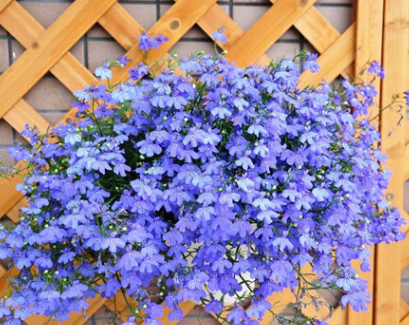
When to sow Lobelia
1. Autumn sowing
The best sowing time is September, and no later than November, as too low a temperature affects the seed germination rate. When sown in August, the seedlings take shape very early and bloom roughly between February and March of the following year. However, because of the growing environment, sunlight, temperature and other factors are hard to guarantee, so the flowering effect is not very good.
2. Spring sowing
Spring sowing is generally done between January and March, when the temperature gradually warms, plants grow faster, and the climate is pleasant, making it more suitable for plant growth. However, spring sowing also has drawbacks: as the temperature gradually rises, plants grow faster, leaving less time for pinching to control growth, so timely pinching is needed to achieve a good shape. But it is precisely because it is a suitable growing season that the flowering period lasts longer.
3. Sowing precautions
Whether sowing in spring or autumn, one thing to pay attention to when sowing is that the seeds and the soil medium must be pressed firm, otherwise the seeds will have no moisture and cannot germinate. In addition, firming the soil ensures close contact with the plant roots, so that when we transplant, the root ball is not easy to fall apart.
How to grow Lobelia so it blooms
1. Conditions for Lobelia to bloom
When growing Lobelia, you need to maintain a long-day and low-temperature environment for it to bloom well. Once the growing environment conditions for Lobelia are met, it will gradually mature, the leaves will begin to become pointed and strap-like, flower buds will begin to appear, and at this point it is getting ready to bloom.
When Lobelia's flower buds begin to differentiate, if its overall shape is still not satisfactory, you can continue to adjust it. At this point you can remove some of the buds and fertilize to promote growth, then gradually bring Lobelia to the ideal plant shape, so that flowering will also be more ornamental.
If Lobelia shows uneven flower bud differentiation, shaping methods can also be used to make it bloom more and better.
2. Care during Lobelia's flowering period
In the early stages of Lobelia's flowering, you can apply a flower fertilizer once to improve flowering, but be careful not to use too high a concentration. You also need to prevent pests and diseases by spraying some fungicides and insecticides to prevent their occurrence. This way, you can prevent pests and diseases from appearing during flowering and causing unnecessary trouble.
When Lobelia is flowering, be careful to avoid rain, as rain will have a bad effect on the overall shape of the flowers and is also bad for the plant's growth.
When does Lobelia bloom (which month) Lobelia sowing time
As for the question of what Lobelia is, the editor actually finds it hard to answer; one can only say that Lobelia is a plant with very beautiful flowers. The plant's name itself is something people gave it, so as long as you match the plant's form with its name, you can make a good connection.
When does Lobelia bloom
Lobelia is a very important ornamental flowering plant. It generally blooms in February and March in spring, and the flowers are mainly terminal or axillary, looking somewhat like butterflies.
Lobelia's flower colors are also relatively rich, including red, peach red, purple, white and other colors. The distinctive blue Lobelia is a common flowerbed plant in spring.
Lobelia sowing time
1. Autumn sowing
The best sowing time is September, and no later than November, as too low a temperature affects the seed germination rate. When sown in August, the seedlings take shape very early and bloom roughly between February and March of the following year. However, because of the growing environment, sunlight, temperature and other factors are hard to guarantee, so the flowering effect is not very good.
2. Spring sowing
Spring sowing is generally done between January and March, when the temperature gradually warms, plants grow faster, and the climate is pleasant, making it more suitable for plant growth. However, spring sowing also has drawbacks: as the temperature gradually rises, plants grow faster, leaving less time for pinching to control growth, so timely pinching is needed to achieve a good shape. But it is precisely because it is a suitable growing season that the flowering period lasts longer.
Conditions for Lobelia to bloom
When growing Lobelia, you need to maintain a long-day and low-temperature environment for it to bloom well. Once the growing environment conditions for Lobelia are met, it will gradually mature, the leaves will begin to become pointed and strap-like, flower buds will begin to appear, and at this point it is getting ready to bloom.
When Lobelia's flower buds begin to differentiate, if its overall shape is still not satisfactory, you can continue to adjust it. At this point you can remove some of the buds and fertilize to promote growth, then gradually bring Lobelia to the ideal plant shape, so that flowering will also be more ornamental.
If Lobelia shows uneven flower bud differentiation, shaping methods can also be used to make it bloom more and better.
How to care for Lobelia at home
1. Light
Lobelia is not shade-tolerant and must be grown in full light to grow normally. When caring for it at home, it must be placed somewhere that direct sunlight can reach. If light is insufficient, try to take Lobelia to a sunny spot for three to four hours of exposure every day. It can only bloom normally in a long-day, low-temperature environment.
2. Temperature
Lobelia is a cool-season flower, but its cold tolerance is not strong, so it cannot overwinter outdoors in the north. It dislikes intense heat and enters a dormant state when summer temperatures are high.
3. Soil
It prefers loose, fertile soil rich in humus.
4. Water
Watering should be based on the care environment, pot soil size and growth condition; in general, just keep the pot soil moist. When you water, water thoroughly.
5. Fertilizer
Fertilize selectively as needed; fertilize more during the growing season, and stop fertilizing in winter when temperatures are low.
Lobelia's flowers are very beautiful, so people have relatively high expectations for it to bloom when growing it. Therefore, mastering the flowering period and the conditions for Lobelia to bloom are very important parts of caring for Lobelia. In short, everything is aimed at flowering.
When to sow Lobelia
Many flower lovers do not know when to sow Lobelia. For Lobelia's sowing time, the best sowing period in the Yangtze River basin is September 10-September 20; no later than November, and no earlier than September 1.When sown in August, the seedlings take shape very early and can bloom roughly from the end of February to early March, but due to climatic conditions, the sunlight and temperature for flowering are hard to guarantee, so the flowering effect is not ideal and relatively sparse. As the temperature rises, the internodes of the branches become longer, and the resulting effect will be loose and cannot achieve a very full look. Of course, if you like a very flowing, trailing effect, then it is very ideal. Sowing early this way also has a certain advantage: a long viewing period.
Sowing in September is the most suitable, especially the climate conditions in mid-month; see the picture.
When sown in October, the temperature drops relatively quickly, the seedling stage is long, and growth is slow throughout the winter, so it tests the patience of flower lovers. As spring temperatures rise, the seedlings gradually grow, leaving less time for pinching to control growth, so achieving a very good effect will be difficult. Seedlings sown in October can also be raised to maturity and can bloom, but because the temperature is already relatively high during the suitable growing season, the internodes will be relatively long, and the density of flowering will also be greatly reduced.
Because this flower is relatively intolerant of heat, the viewing period is limited in many places. You also do not want something you worked hard to raise for more than half a year to suddenly be gone.
Precautions before sowing Lobelia
Regarding root development, what I want to say is that the medium should be pressed appropriately firm. For the seedlings I grow, whether sown or cuttings, when moving them from the container to the next stage, the root ball basically does not fall apart, so later root damage is especially small, and after planting the transplant recovery process can be ignored.