How to Convert a Pothos from Soil to Water Culture: A Watertight Container Is Essential
Speaking of pothos, this is a plant that so many people absolutely adore, and that is exactly how lovable it is. So what is the method for converting a pothos from soil culture to water culture:
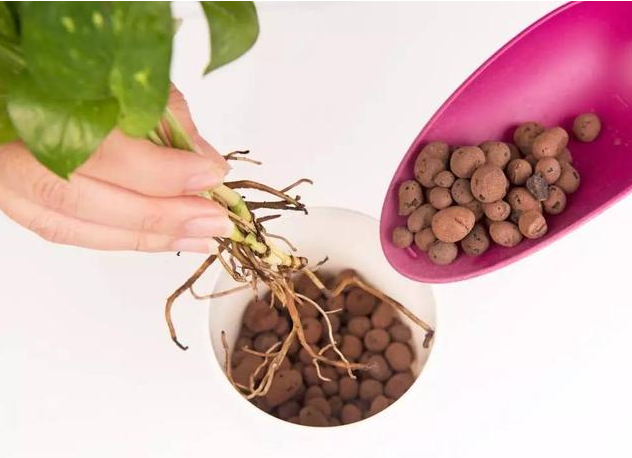
1. Choosing the materials needed for water culture:
Prepare a potted pothos grown in soil;
A large bag of expanded clay pebbles, in whatever size you prefer;
A watertight container (for water culture).
2. Specific steps for water culture:
1. Separate the plant from its temporary pot
First, take the plant out of the temporary pot it came in when purchased. To separate the plant from the temporary pot, it is a good idea to first tap gently around the rim of the pot.
This loosens the soil around the roots from the temporary pot, making it easier to take the plant out; if the plant is stuck quite tightly, you can also soak the roots together with the pot in water first, and usually it will then pull out more easily!
2. Carefully remove the soil from the roots
(Next, wash the soil off the roots until clean)
It is a good idea to soak the roots together with the soil (usually potting mix) in water for a few minutes; once the soil has absorbed water and softened, it will be easier to wash off;
Key point:
Do not underestimate this step! Since it is nearly impossible for us to know whether the potting mix originally used for the purchased soil-grown plant is clean and free of insect eggs, carefully removing the soil is the key to reducing the chance of pest and disease problems in the future!
3. Transplant the plant into a new container
Fill the gaps in the container with washed expanded clay pebbles and secure the plant
Plant the washed-root plant into the container, filling the gaps with washed expanded clay pebbles until the plant can stand on its own;
Since the clay pebbles have just been washed and are still wet, this means there is already enough moisture in the container, so there is no need to water at this point!
The whole water-culture acclimation process is now complete. Next, for most foliage plants, you simply wait 2-4 weeks and they will grow many new aerial roots, and after about another 2-4 weeks these will completely replace the plant's original root system.
4. Points to note during the water-culture acclimation and rooting period
During water-culture acclimation, the plant must be placed indoors in a ventilated spot away from direct sunlight, so that rooting proceeds smoothly.
During water-culture acclimation, misting the leaves is more important than watering; generally, mist a little every day, and be sure to remember this! Just a little mist every day.
During water-culture acclimation, watering should be done only enough to keep the expanded clay pebbles moist. It is best to water only when the surface layer of expanded clay pebbles feels dry to the touch, and each time water evenly over the surface layer of clay pebbles.
Do not fertilize during the aerial root growth process. If you want to fertilize, it is best to wait at least one month after transplanting before starting, so as to avoid root disease caused by the roots being unable to absorb nutrients, which can lead to root rot and plant death.
For water-cultured plants, it is recommended to change the water once a week to avoid foul odors and fungus gnats caused by changes in water quality.
That is all for the method of converting pothos from soil culture to water culture. Give this method a try soon; it is really quite good.
Water-Cultured Bowl Lotus: How to Grow Bowl Lotus
BowlLotus is different from water lily. Bowl lotus is a plant of the genus Nelumbo, while water lily is a plant of the genus Nymphaea. The way to tell them apart is that water lily floats on the water surface, while bowl lotus emerges from the mud unstained. Also, water lily leaves have a notch, while bowl lotus leaves do not. Let us look at how to grow water-cultured bowl lotus.
Water-Cultured Bowl Lotus: How to Grow Bowl Lotus
——————————————————————————————————————————————
[Plant Profile]
——————————————————————————————————————————————
Chinese name:Lotus (bowl lotus)
Scientific name:Nelumbo nucifera
Alternative names:Lotus, sacred lotus, called furong, handan, and fuqu in ancient times
Family:Nelumbonaceae
Genus:Nelumbo
Place of origin and distribution:Native to China
Morphological characteristics:A perennial emergent aquatic plant, with underground stems buried deep in the mud at the bottom of the water; it blooms in summer, with flowers borne singly. The seeds have a hard, watertight seed coat and can remain uncorrupted for over a thousand years.
How to Grow Bowl Lotus
——————————————————————————————————————————————
▲ Propagation method: Bowl lotus can be propagated by division and by seed. With the division method, around Qingming, select healthy lotus rhizomes and cut them into sections of 2-3 nodes each; each section must have a terminal bud and a tail node, and is then planted in its own pot. With the seed method, break the seed coat of the bowl lotus seeds, soak them in clean water, and change the water every day until 2-3 leaves have grown, after which they can be planted. In the early stage, keep the water surface at a depth of 2 cm; after standing leaves grow, keep it at 10 cm.
▲ Container selection: Bowl lotus is mostly grown in water culture in refined bowls or pots, such as small decorated vats, which look very attractive. Even if using a bowl, it must be a large bowl about 25 cm in diameter and more than 20 cm deep, because if the container is too small, the growth of the bowl lotus is restricted and it is very difficult for it to bloom well.
▲ Soil and fertilizer: In the bowl lotus container, apply a base fertilizer at about 1% of the amount of potting soil, then add pond mud until it reaches 2/3 of the depth of the container. Bowl lotus has little soil and insufficient nutrients, so it needs frequent fertilizing, but fertilizer must be applied lightly and often.
▲ Planting and management: Place the seed rhizomes end to end, with the terminal buds facing the center of the container, and plant them into the pot. After planting, add water to 2-3 cm, let it dry out, then add water again, repeating two or three times, so that the seed rhizomes and mud bind tightly together and do not float easily. In summer, water must be added to the bowl lotus every day.
▲ Pest and disease control: Bowl lotus is generally prone to aphids, which can be sprayed with a 3000-fold dilution of julehe oil.
" Conclusion:The bowl lotus blooming season is right in midsummer, during the off-season for flowers, so it fills the flower gap very well. Keeping a pot of bowl lotus on a desk or a shelf has a special charm. In recent years, bowl lotus has sold very well on the market, so fashion lovers should not miss it.
【More Plant Encyclopedia】
Poppy Night-blooming jasmine Rose Azalea Lavender Pothos Asparagus fern Peperomia Hyacinth Anthurium Cherry blossom Calla lily
African jasmine Rose Spring Festival flowers Succulents Tropical plants Tumi flower Agave Canna Red spider lily Forget-me-not Dandelion
Dendrobium officinale Yew Kapok Osmanthus Begonia Water-cultured plants Home feng shui plants Bedroom feng shui plants Plum blossom Aloe
Jasmine Radiation-absorbing plants Moneywort Potted plants Bonsai making Narcotic plants Mistletoe Indoor flowers Money tree Lucky bamboo Fortune bamboo
Potted plant making Anthurium Mint Living stones Geranium Garden Christmas cactus Peace lily Snake plant Kunlun snow chrysanthemum Water lily Blue enchantress rose
Half-dead flowers thrown into water actually grew like crazy!
1 Moneywort
Flower meaning: rolling in wealth
Placement: balcony, windowsill, bookshelf
Moneywort has a very high water requirement. Soil-grown moneywort, as in the picture above, easily wilts from lack of water, and it is painful to look at. When this happens, quickly move it to water culture.
First, cut off all the wilted moneywort. Do not be reluctant to do so; after water culture, the moneywort will quickly grow new leaves.
Take the moneywort out of the pot, then find a watertight container, plant the moneywort into the new container, and fill it with water so that the water level covers the moneywort's growth points.
Whenever you see there is no water left in the container, add more; moneywort can grow very well in water.
2 Peace lily
Flower meaning: smooth sailing
Placement: balcony, windowsill, bookshelf
Peace lily likes a humid air environment. When the air is dry, the leaf tips easily dry out, and improper watering can also cause root rot. Water-cultured plants can provide it with ample humidity, and you no longer need to worry about improper watering.
First, carefully take the peace lily out of the pot and remove the soil from the roots.
Use scissors to cut off the peace lily's dried leaf edges and overly long roots.
Next, rinse the peace lily's roots clean with clean water.
Finally, place the peace lily into a water-culture container, secure it with pebbles, and add water. The water level does not need to completely cover the roots; leaving some exposed to the air will let it grow better.
3 Money tree
Flower meaning: bringing in wealth and treasure
Placement: balcony, windowsill, bookshelf
Soil-grown money trees easily suffer root rot. This is because the money tree's root system is very underdeveloped, so flower lovers who do not know how to care for them can also try growing them in water culture.
First, take the money tree out of the pot, remove the soil, rinse it clean with clean water, cut off all the old roots with scissors, and then place it into a water-culture bottle.
Note that when water-culturing a money tree, the swollen trunk must be above the water level, with the water level covering one-third to two-thirds of the roots, and place it in a spot with indirect light.
If you have water-culture nutrient solution, you can add it once a month; do not use it in hot seasons. If you do not have any, you can grind up vitamin C and dissolve it in the water, which can also help the money tree grow better.
4 Asparagus fern
Flower meaning: purity, eternity
Placement: balcony, windowsill, bookshelf
Asparagus fern leaves are very tender and weak, and when the air is dry they easily turn dry and yellow, so water culture is also a very good choice.
Choose a healthy asparagus fern, carefully take the plant out of the pot, remove the soil from outside the roots, rinse clean with clean water, and then use scissors to trim off overly long or rotten roots.
After that, use a planting basket to secure the asparagus fern in the water-culture container; if you do not have a planting basket, you can also secure it with pebbles or expanded clay pebbles.
In the early stage of water-culturing asparagus fern, change the water every two or three days. If you find root rot, trim it promptly. When the new aquatic roots have grown to two or three centimeters, you can add nutrient solution to help the asparagus fern grow better.
To avoid root rot in asparagus fern, you can also add a little activated charcoal to the water-culture solution; its good adsorption capacity can keep the water clean.
5 Pothos
Flower meaning: warm and cheerful
Placement: balcony, windowsill, bookshelf
Pothos is one of the most common indoor green plants and can be grown in soil or in water. Many people have asked Huahua before whether pothos is better in water culture or soil culture. Huahua suggests here that if you kill every flower you grow, then you should just grow it in water culture.
For water-culturing pothos, you can simply use a stem cutting. When visiting a friend's home, pinch off a stem, choosing one with aerial roots, bring it home and stick it in a bottle, add water, and since summer temperatures are high, it will root within a few days.
6 Cactus
Flower meaning: steadfast and unshakable
Placement: balcony, windowsill, bookshelf
The cactus is widely recognized as an easy plant to grow, but quite a few flower lovers still manage to kill it, so Huahua wants to say, why not try water-culturing your cactus?
A key point to note when water-culturing a cactus: the cactus body must never get wet; if it gets wet, it will definitely rot. In addition, it is enough for less than one-third of the roots to be in the water. If you notice the bottle wall is dirty, clean it promptly to avoid bacterial infection.
7 Spider plant
Flower meaning: wealth and good fortune
Placement: balcony, windowsill, bookshelf
The small spider plantlets on the spider plant's runners can be cut off and planted directly as cuttings, but you need to prepare soil and a pot, and after planting you still have to care for them, keeping them moist and watered, which many flower lovers have surely grown tired of. The simplest method is of course water culture.
When water-culturing spider plants, it is also best to choose small plantlets with aerial roots, so that they root quickly in water. To speed up rooting, you can also dilute rooting powder and add it to the water-culture solution, which can also promote rapid rooting in spider plants.
8 Christmas cactus
Flower meaning: good fortune at its peak
Placement: balcony, windowsill, bookshelf
Not many people have tried water-culturing Christmas cactus, right? It is somewhat similar to water-culturing cactus: just put a small amount of the roots in the water and leave part of the roots in the air to breathe.
Before water culture, rinse the roots clean, cut off most of the roots, then disinfect with potassium permanganate, afterward take them out, rinse, and let them dry in a ventilated place, and then they can be planted into the water-culture solution.
Remember not to change the water too frequently; as long as the water is not dirty, you usually only need to top it up.
Water-cultured Christmas cactus is clean and hygienic, but it needs frequent additions of water-culture nutrient solution, otherwise it very likely will not bloom.
9 Radermachera
Flower meaning: happiness and completeness
Placement: balcony, windowsill, bookshelf
Radermachera symbolizes happiness and completeness and family harmony, and many families grow it. Common radermachera comes in two sizes, large and small. If growing it in water culture, Huahua suggests choosing a small radermachera, as it is easier to keep alive and simpler to care for than soil culture.
Take the radermachera out of the pot, remove the soil from the roots, wash it several times to make sure it is clean, then soak it for a while in a diluted carbendazim solution to prevent root rot.
Then place the radermachera into a water-culture container and secure it with a planting basket, expanded clay pebbles, pebbles, or maifan stone. Change the water every two days until new roots grow, after which you can lengthen the interval between water changes.
Flower lovers, have you learned how to do it?
What other plants have you grown hydroponically,
Hurry up and recommend them to everyone~