How to grow potted cherry blossoms, do they need frequent watering?
Cherry blossoms, many people love to grow them, these cherry blossoms are truly beautiful, and they can be grown in pots. What is the method for growing potted cherry blossoms? Do potted cherry blossoms need frequent watering:
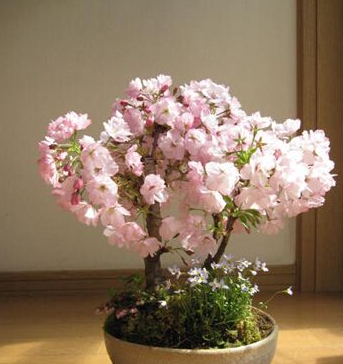
Methods for growing potted cherry blossoms:
1. Soil:
For potted cherry blossoms, you first need to prepare the soil. Generally, homemade leaf mold can be used. The specific method is to collect leaves and acidic soil, chicken manure, charcoal powder and microorganisms and compost them together. Homemade leaf mold has good drainage and aeration, and is suitable for the growth of potted cherry blossoms.
2. Pruning:
Pruning potted cherry blossoms requires special attention. Before and after flowering, appropriately thin out overly dense branches, cutting away inner branches, dead branches, weak slender branches, and diseased or pest-infested branches. Throughout the growing season, promptly remove suckers and water sprouts to avoid consuming nutrients. After pruning, an antiseptic must be applied to prevent the wounds from rotting, because cherry blossom wounds heal relatively slowly. Newly potted cherry blossom branches should be cut back to encourage more new branches and the differentiation of more flower buds.
3. Watering:
Cherry blossoms dislike waterlogging. Water reasonably according to the different seasons and the size of the cherry blossom seedling, following the principle of watering when dry and letting it dry out between waterings. The soil must not be too wet or waterlogged, otherwise it will cause root rot, ranging from leaf drop that affects flowering to the death of the whole plant in severe cases.
4. Fertilizing:
Potted cherry blossoms need sufficient fertilizer to ensure the nutrients required for their growth and development, making the plants lush with branches and leaves and the flowers brightly colored. Generally, apply decomposed liquid fertilizer once a week. In the early stage, mainly use nitrogen fertilizer to promote vegetative growth. In the later stage, pay attention to applying phosphorus fertilizer in combination to prevent excessive vegetative growth from affecting flower bud differentiation. In May-June, spray 0.1%-0.2% potassium dihydrogen phosphate on the leaves. Apply base fertilizer once before flowering and once after flowering to lay the foundation for flowering the following year.
5. Pest control:
Cherry blossoms suffer from gummosis and root rot. For both conditions, timely treatment is needed to improve the soil, strengthen water and fertilizer management, and prune reasonably. During the annual growth process, cherry blossoms can be harmed by aphids, red spider mites, and scale insects. Generally, spray pesticide 3-4 times: the first time before flowering, the second time after flowering, and the third time in July-August. Careful observation and timely control are necessary to achieve good results.
Do potted cherry blossoms need frequent watering:
Cherry blossoms dislike waterlogging. Water reasonably according to the different seasons and seedling size, master the principle of watering when dry and letting it dry out between waterings. The soil must not be too wet or waterlogged, otherwise it will cause root rot, ranging from leaf drop that affects flowering. Generally, watering once every 2-3 months is enough.
That is all for the methods of growing potted cherry blossoms. Potted cherry blossoms should not be watered frequently.
How to grow potted cherry blossoms: Methods for growing potted cherry blossoms
Cherry blossom is the collective name for several plants in the genus Cerasus of the rose family. It is an important flowering tree species for early spring, often used for garden ornamentation, and is very suitable for planting in the ground, but it can also be grown in pots. The varieties suitable for potted cherry blossoms mainly include Asahi, bean cherry, turmeric, and Gyoiko, etc. Now let us take a look at how to grow potted cherry blossoms!
Pot soil preparation
For potted cherry blossoms, you first need to prepare the soil. Generally, homemade leaf mold can be used. The specific method is to collect leaves and acidic soil, chicken manure, charcoal powder and microorganisms and compost them together. Homemade leaf mold has good drainage and aeration, and is suitable for the growth of potted cherry blossoms.
Reasonable pruning
Pruning potted cherry blossoms requires special attention. Before and after flowering, appropriately thin out overly dense branches, cutting away inner branches, dead branches, weak slender branches, and diseased or pest-infested branches. Throughout the growing season, promptly remove suckers and water sprouts to avoid consuming nutrients. After pruning, an antiseptic must be applied to prevent the wounds from rotting, because cherry blossom wounds heal relatively slowly. Newly potted cherry blossom branches should be cut back to encourage more new branches and the differentiation of more flower buds.
Reasonable watering
Cherry blossoms dislike waterlogging. Water reasonably according to the different seasons and the size of the cherry blossom seedling, following the principle of watering when dry and letting it dry out between waterings. The soil must not be too wet or waterlogged, otherwise it will cause root rot, ranging from leaf drop that affects flowering to the death of the whole plant in severe cases.
Timely fertilizing
Potted cherry blossoms need sufficient fertilizer to ensure the nutrients required for their growth and development, making the plants lush with branches and leaves and the flowers brightly colored. Generally, apply decomposed liquid fertilizer once a week. In the early stage, mainly use nitrogen fertilizer to promote vegetative growth. In the later stage, pay attention to applying phosphorus fertilizer in combination to prevent excessive vegetative growth from affecting flower bud differentiation. In May-June, spray 0.1%-0.2% potassium dihydrogen phosphate on the leaves. Apply base fertilizer once before flowering and once after flowering to lay the foundation for flowering the following year.
Pest and disease control
Cherry blossoms mainly suffer from gummosis and root rot. Both conditions require timely treatment to improve the soil, strengthen water and fertilizer management, and prune reasonably. During the annual growth process, cherry blossoms can be harmed by aphids, red spider mites, and scale insects. Generally, spray pesticide 3-4 times: the first time before flowering, the second time after flowering, and the third time in July-August. Careful observation and timely control are necessary to achieve good results.
How to sow potted cherry blossom seeds? Methods for growing potted cherry blossoms
Cherry blossom is a common ornamental flower in landscaping. Its blooms are brilliant and it is very suitable for ground planting. However, many cherry blossom varieties are also very suitable for potted cultivation, such as Asahi, bean cherry, turmeric, and Gyoiko, etc. In the process of growing potted cherry blossoms, sowing propagation is often used. So how do you sow potted cherry blossom seeds? The sowing propagation methods and growing methods for potted cherry blossoms are introduced below.
Image: Potted cherry blossom
I. Sowing propagation methods for potted cherry blossoms
Prepare cherry blossom seeds. In fact, there is no need to buy them specially. If you see them planted in a nearby flowerbed or at a friend's home, just pick some seeds. They are relatively fresh and very convenient. Before sowing, it is best to keep them out of light and soak them in warm water for 24 hours. The sowing time is generally spring or autumn, and the best germination temperature is around 20 degrees. Its growing temperature is 16 degrees. Prepare a flower pot and soil. For the soil, it is best to use peat soil mixed with coarse sand, leaf mold, etc. After sowing the seeds, do not cover them with too much soil.
II. Methods for growing potted cherry blossoms
1. Applying fertilizer:Cherry blossoms are fertilized twice a year, and acidic fertilizer is preferable. One is winter fertilizer, applying organic fertilizers such as bean cake, chicken manure and decomposed fertilizer in winter or early spring; the other is after the flowers fall, applying quick-acting fertilizers such as ammonium sulfate, ferrous sulfate, and superphosphate.
2. Watering key points:After planting, cherry blossom seedlings are prone to drought damage. In addition to sufficient watering at planting, water once every 8-10 days afterward, keeping the soil moist but not waterlogged. Loosen the soil promptly after watering, and it is best to cover the ground thinly with grass to reduce water evaporation. Within 2-3 years after planting, to prevent the trunk from drying out, it can be wrapped with straw. But after 2 to 3 years, when the sapling grows new roots and its adaptability to the environment gradually increases, there is no need to wrap it with straw anymore.
Image: Potted cherry blossom
3. Pruning essentials:Pruning cherry blossoms mainly involves cutting off withered branches, water sprouts, overlapping branches, and diseased or pest-infested branches. In addition, when many branches grow from the trunk of a large cherry blossom tree, several robust-growing branches should be retained and the rest all cut off from the base to facilitate ventilation and light penetration. After pruning, promptly disinfect the wounds with medication to prevent pathogens from invading after rain and causing rot. After long periods of exposure to the sun, the bark of cherry blossoms is prone to aging and damage, causing rot, and it should be removed promptly and disinfected. After that, wrap the rotted area with leaf mold and charcoal powder to help it restore normal physiological function.
4. Repotting:Cherry blossoms should stop being watered 3-4 days before repotting, so that the pot soil is slightly dry. When repotting, hold the flower pot upside down with the left hand, then pat the flower pot with the right palm, or push against the drainage hole of the flower pot with a wooden stick, and the cherry blossom can be removed from the pot together with the soil. The root system of the cherry blossom removed from the pot has dense white roots distributed along the edge of the pot soil. Use a bamboo stick to loosen the fibrous roots, remove most of the old soil, retain one third, and transplant it with soil into a new pot.
5. Pest and disease control:Cherry blossoms mainly suffer from gummosis and root rot. Both conditions require timely treatment to improve the soil, strengthen water and fertilizer management, and prune reasonably. During the annual growth process, cherry blossoms can be harmed by aphids, red spider mites, and scale insects. Generally, spray pesticide 3-4 times: the first time before flowering, the second time after flowering, and the third time in July-August. Careful observation and timely control are necessary to achieve good results.
[Editor's concluding remarks]Although cherry blossoms are mainly grown in the ground, they also have a unique ornamental value when potted. The above has introduced the sowing propagation methods and growing methods for potted cherry blossoms, hoping to help everyone!