Why cineraria plants die, and can they really only be kept for one year?
Cineraria (Pericallis x hybrida) is something many people absolutely love to grow, and it has a rather lovely name too. Everyone says cineraria is easy to grow, yet you ended up killing yours. What are the reasons cineraria dies? Can cineraria only be kept for one year?
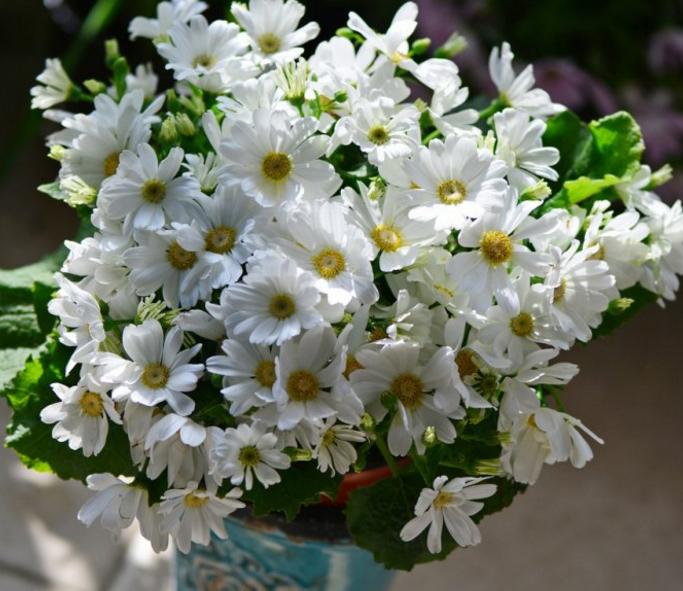
Reasons cineraria dies:
Mistake 1: Not opening the bag in time for ventilation.
Flowers sold at the flower market are always wrapped in a plastic bag on the outside, mainly to prevent the flower stems from being knocked off during transport, and of course it also serves a decorative purpose. This batch of cineraria was bought after New Year's Day, and after buying the flowers I put them in the car and did not deal with them, since I would be going home in a couple of days anyway. On the third day I got home, and when I took the cineraria out, I found things were not looking good, because cooped up in the bag, most of the lower leaves had gone moldy and rotten. Those days the outdoor temperature was also quite low, and several pots of cineraria already looked listless.
A photo of the cineraria just after buying it: the flowers look decent, but the leaves near the bottom are either rotting or turning yellow.
Mistake 2: The temperature was too low!
Looking at the cineraria that had been stewing and rotting, the first thing I did was immediately put them in a ventilated spot outside on the balcony.
However, I ignored the temperature, and it was too cold outside. The result was that when I got home the second evening, I found that the flower stems of several pots of cineraria had gone soft and drooped.
Mistake 3: Sudden cold and sudden heat!
Seeing the cineraria with soft, drooping flower heads, I judged it was because they had been chilled, so that same evening I set them out at home. The living room temperature at night is generally 18-20 degrees too.
Two pots were already OVER and could not recover at all.
Mistake 4: Overwatering.
Many times you just keep making mistake after mistake. While looking up the reasons cineraria goes soft, I saw that a few pots had already dried out, so I watered them, keeping them moist...
Continuing to keep them moist...
As a result, several more plants went OVER. Too much moisture caused root rot.
Can cineraria only be kept for one year?
That is not necessarily so. As soon as cineraria blooms, it is bound to die, and generally it can only be kept alive for 1 to 2 years.
That wraps up the reasons cineraria dies; this cineraria really does have a rather short lifespan.
Can cineraria only be kept for one year? What colors does cineraria come in? All colors except yellow
Cineraria, a flower much loved by gardeners recently, has many varieties and rich flower colors, and looks highly ornamental grown indoors. During the growing process, many people say cineraria can only live for one year, so can cineraria only be kept for one year? If not, how many years can cineraria be kept? What colors does cineraria come in? Let the editor clear this up for you.
1. Can cineraria only be kept for one year? It can be kept for 1-2 years
In daily life, many gardeners' cineraria dies right after blooming, so everyone assumes it can only be kept for one year. So can cineraria only be kept for one year? Here the editor can tell you the truth is not so, because cineraria is a perennial herbaceous plant, so it can be kept for many years. It is just that people often grow cineraria as a 1-2 year crop.
As a common ornamental flower, cineraria is not difficult to grow, and its propagation is not difficult either. So in order for cineraria to bloom at home every year, you should master the propagation methods of cineraria, especially seed sowing, and by controlling the timing well, you can also control the blooming period of cineraria, as follows:
① Sow cineraria in late August of the previous year, and after careful care, it will bloom at New Year's Day;
② Sow cineraria in late September of the previous year, and after careful care, it will bloom in spring;
③ Plant cineraria in December of the previous year, and after careful care, it will bloom at Labor Day;
④ Sow around May, and after careful care, cineraria will bloom at Mid-Autumn.
2. What colors does cineraria come in
Gardeners fairly familiar with cineraria should know that it hybridizes easily, so it has many varieties and extremely rich flower colors. As for what colors cineraria comes in, according to the editor's research, all colors are available except yellow. Not only that, cineraria flower colors also include red-and-white bicolor! Below let us admire cineraria in its various flower colors.
Which flowering plants are the easiest to grow?
Although spider plant and pothos are easy to grow, they only offer foliage, so their ornamental value always falls a bit short. Today Huahua recommends some flowering plants commonly grown at home, easy to care for and beautiful in bloom; with just one pot, they will immediately make your home shine.Which flowering plants are the easiest to grow?
1.Chinese rose
Bloom period: natural bloom period from August to April of the following year
Growing Chinese roses is very simple; it is best placed on a balcony or terrace in a sunny, ventilated spot. Blooming Chinese roses can also be cut for use as cut flowers, so you will not even need to buy flowers for your girlfriend on Valentine's Day!
Care points:
1. Ensure 6 hours of light each day, otherwise Chinese roses easily grow only leaves and do not bloom.
2. Watering Chinese roses has its particularities: do not water if not dry, and when you water, water thoroughly. Chinese roses fear waterlogging, so there must be no standing water in the pot; too much water easily causes root rot. During the winter dormant period, be sure to water less and just keep it half-dry.
3. Chinese roses like fertilizer, so they need frequent fertilizing. During the growing season, apply a dilute liquid fertilizer about every ten days, but do not overdo it, otherwise the seedlings will burn. No fertilizing during the winter dormant period.
Which flowering plants are the easiest to grow?
2.Gardenia
Bloom period: March-July
"Gardenia flowers bloom, oh bloom, gardenia flowers bloom, oh bloom, like sparkling waves blooming in the sea of my heart." The pure white gardenia, fresh and elegant, is like a youth's first love; its rich fragrance is like a memory you cannot forget.
Care points:
1. For watering, rainwater or rice-washing water is best. Apply ferrous sulfate once every two weeks, which can change alkaline soil; gardenia does not grow well under alkaline conditions.
2. After blooming, from August onward, just water with plain water. In October it can be moved indoors, and in winter strictly control water. From May to July each year, you can pinch and top it to encourage side branches to sprout.
3. Gardenia can be propagated by cuttings, best in spring and autumn. Cut a branch that has grown for two or three years into a piece about ten centimeters long, remove the lower leaves, insert it into vermiculite or sandy soil, keep it moist, and it will root in about a month.
Which flowering plants are the easiest to grow?
3.Cineraria
Bloom period: January-April
The flower language of cineraria is joy and happiness, and family joy. Keeping a pot indoors will make your mood superb, and you can also give it to relatives and friends, with all your blessings in the flowers.
Care points:
1. Cineraria is generally grown as an annual, and needs to be placed in a cool, ventilated spot. It fears scorching sun, and in summer you also need to mist water to cool it down.
2. During the growing period, apply a nitrogen-phosphorus-potassium compound fertilizer or thin cake fertilizer once every 2 weeks, which can promote flower growth. Be careful not to apply too much nitrogen fertilizer. Before blooming, control the amount of watering, otherwise the leaves will grow too large and affect the ornamental value.
Which flowering plants are the easiest to grow?
4.Tree peony
Bloom period: May
The tree peony, of national beauty and heavenly fragrance, has always been called the king of flowers, with gorgeous colors, magnificent and splendid, and extremely high ornamental value.
Care points:
1. If you want the tree peony to bloom, it must go through low-temperature treatment for two or three months. Many gardeners' tree peonies do not bloom, mostly because they have been kept indoors without low-temperature treatment. But if placed outdoors, in cold northern regions it is best to take appropriate cold-protection measures.
2. Prune dead branches, diseased branches and weak branches in time to concentrate nutrients, which can make tree peony flowers large and brightly colored.
3. Each autumn you can apply decomposed organic fertilizer as a top dressing, and in spring and summer you can use chemical fertilizer, combined with watering, to keep the plant growing healthily.
Which flowering plants are the easiest to grow?
5.Blue plumbago
Bloom period: July-September
Blue plumbago blooms in summer, and its pale blue flowers bring a touch of coolness to the hot summer. Placed in the living room or on the balcony, with branches hanging down, it is unspeakably beautiful.
Care points:
1. During the growing season, top-dress blue plumbago with a complete-element compound fertilizer at least once a week.
2. Usually keep the surface of the medium dry, and when watering, also water thoroughly.
3. Maintaining a relatively high temperature and sufficient light can encourage blue plumbago to branch more.
Which flowering plants are the easiest to grow?
6.Christmas cactus
Bloom period: October to February of the following year
Christmas cactus blooms in winter and is also called the Christmas cactus. Its plant shape trails downward, and it looks very beautiful placed on a windowsill or in the living room.
Care points:
1. Christmas cactus does not demand much water, and the potting soil must not become waterlogged, which easily causes root rot. During the growing season, just keep the soil moist.
2. Repot once every other year, preferably in March or April each year, and a loose, fertile, slightly acidic soil is best.
3. For fertilizing Christmas cactus, it is best to choose organic fertilizer you have composted yourself, and chemical fertilizer is not suitable; excessive fertilizer and water easily cause the plant to die.